


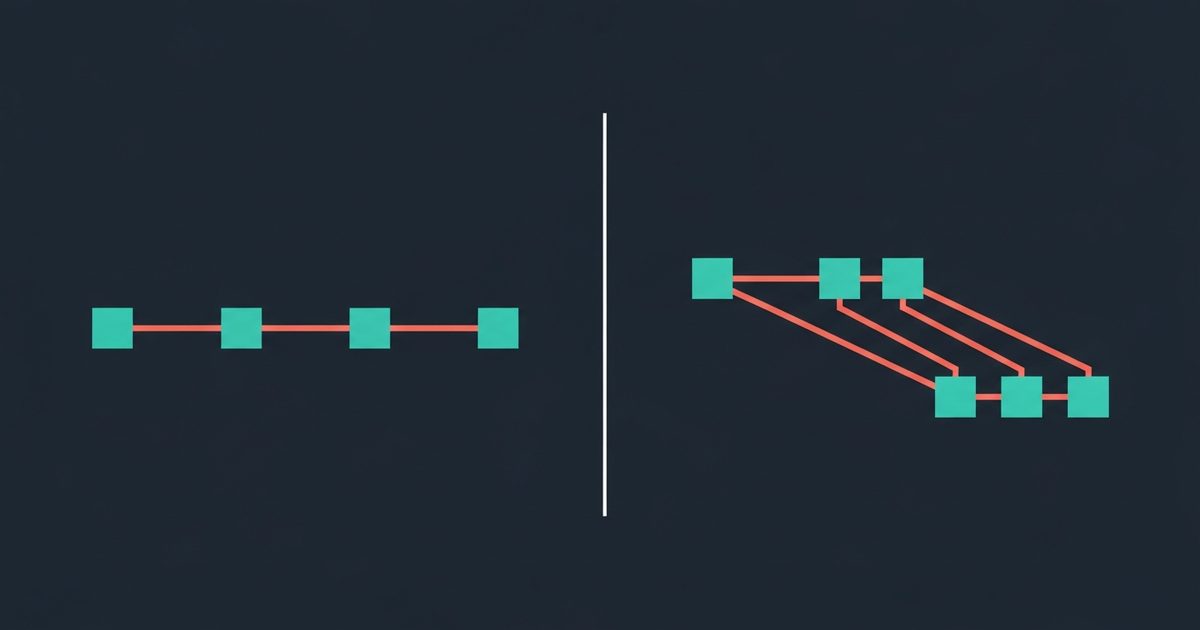
An AI SEO tool runs a sequence somebody wrote in advance and hands you the output. An agent is given an outcome, picks its own sequence from what the data says, and keeps going until it has an answer. Tools are cheaper and reproducible. Agents handle problems nobody scripted.
Most teams do not need to choose. They need to know which jobs belong on which side of that line, because putting an open-ended investigation through a fixed-sequence tool wastes the analyst's afternoon, and putting a recurring report through an agent produces a different-shaped report every month at a variable price.
Below: the dimensions that actually differ, three worked examples of the same job done both ways, and a test for whether a vendor is selling you an agent or a workflow with agentic branding.
The difference between an AI SEO agent and an AI SEO tool
The formal version of this distinction comes from Anthropic's Building Effective AI Agents, which separates workflows, where "LLMs and tools are orchestrated through predefined code paths", from agents, where the model "dynamically directs its own processes and tool usage, maintaining control over how it accomplishes tasks". Almost everything marketed as an SEO agent is the first thing.
| Dimension | AI SEO tool | AI SEO agent |
|---|---|---|
| What you give it | A prompt, keyword or URL | An outcome to reach |
| Who picks the steps | The product, in advance | The model, at runtime |
| Data sources per run | Usually one | Several, reconciled together |
| Same input twice | Identical output | May take a different route |
| Novel situations | Returns an error or nothing | Reroutes and continues |
| Pricing | Flat seat or credit pack | Variable: tokens plus tool calls |
| Cost predictability | High | Low without a step cap |
| Where it fails | Output is generic | Output is confidently wrong |
| Debugging | Read the settings | Read the run transcript |
| Human time per run | Setup and interpretation | Review and validation |
Two rows deserve more than a cell. Reproducibility is the reason client-facing recurring work should stay on tools: a report that changes shape month to month is a report the client cannot compare. And the failure mode row is the real decision criterion. A weak tool output costs you a minute of judgement. A wrong agent conclusion that nobody checked can steer a quarter of work.
Worked example 1: keyword research
With a tool. You enter a seed keyword. You get volume, difficulty and a related list. You export it, open a spreadsheet, filter difficulty below your threshold, cross-check which terms you already rank for, cluster the survivors by intent by hand, and decide what to build. Elapsed time is 40 to 90 minutes and almost all of it is yours. The tool did one step of a nine-step job.
With an agent. You say: find keyword opportunities for this domain that we can realistically rank for in two quarters. The agent pulls your currently ranked keywords, discovers competitors, pulls their ranked sets, subtracts yours to get the gap, gets volume and difficulty in bulk on the remainder, filters against your existing authority, clusters what is left, and returns a sized shortlist with reasoning. Elapsed time is a few minutes, and the human work is checking whether the shortlist is sane.
Verdict. The agent wins clearly, because the tool was only ever automating step one. Note what it actually replaced: not the keyword database, which the agent is calling underneath, but the spreadsheet work in the middle.
Worked example 2: the Monday client report
With a tool. A scheduled report pulls the same metrics into the same template every week. It arrives on time, in a format the client recognises, at a fixed cost. If a metric is missing the row is blank and somebody notices.
With an agent. The agent pulls the data, writes commentary that is genuinely better than a template, and may also decide this week that a particular section deserves three paragraphs it did not get last week. Cost varies by run. Two months in, the client asks why the report looks different every time.
Verdict. The tool wins on the report. The useful hybrid is deterministic assembly with an agent writing only the commentary section, which is the part where variation is a feature rather than a defect.
Worked example 3: organic traffic dropped 30% and nobody knows why
With a tool. There is no tool for this, which is the point. You open Search Console, compare two windows, export, open GA4, compare, open the rank tracker, check whether a core update landed, check the deploy log. Every tool answers one question and you are the integration layer. Two to four hours, and the sequence you follow depends on what you find, which is exactly why it cannot be pre-scripted.
With an agent. It pulls both windows, separates impression loss from click loss from position loss, isolates the URLs and queries carrying the decline, checks whether the affected pages share a template or a section, cross-references timing against known events, and returns a ranked set of hypotheses with the evidence behind each. Then you verify.
Verdict. The agent wins decisively, and this is the archetypal agent task: the correct second step genuinely depends on what the first step returned. Flat position with collapsed clicks points at SERP features or a title change. Collapsed impressions with flat position points at indexation or demand. No fixed sequence covers both.
Which is cheaper
Tools are cheaper per run and the price is knowable in advance. Agents cost tokens plus tool calls, and the tool calls dominate because they wrap paid APIs. In our own catalogue a page audit is 50 credits, a Search Console or GA4 query 50, a keyword gap analysis 30, a live SERP lookup 5 per keyword, a brand visibility check 100 per engine, with model tokens billed at 300 credits per million on top. One broad instruction can fan out across a dozen of those calls.
The comparison that matters is not price per run, though. It is price per resolved question including the analyst time. The keyword research example costs more in agent credits than in tool subscription and less in total, because 70 minutes of spreadsheet work disappeared. The Monday report goes the other way.
Anthropic's guidance is worth repeating here because vendors will not: agentic systems "trade latency and cost for better task performance", and the recommendation is to use the simplest thing that works rather than the most sophisticated.
How much control you lose with an agent
More than the marketing implies, and the loss is manageable if you insist on four things. A hard step cap, so a misread goal cannot run up an unbounded bill - ours stops at 15 and synthesizes what it has rather than failing silently. A pre-flight cost estimate with an approval gate above a threshold. Read, generate and write permissions tagged per tool, so nothing publishes unattended. And a readable transcript of every call, argument, cost and result.
That last one is the real control mechanism. You are not supervising the agent's decisions in real time; you are auditing them afterwards. A vendor who cannot show you a full transcript is asking you to trust an output you cannot check.
There is also a security dimension tools do not have. An agent that fetches a competitor page has pulled somebody else's text into the same context window as your instructions. If that page carries injected commands, a naive agent can act on them. Our runtime fences fetched content, marks the turn tainted, and refuses write tools for the remainder of it unless a human approves.
Do you need both
Yes, and the split is stable. Keep tools for anything recurring, client-facing or where identical output matters: rank tracking, scheduled reports, site crawls, uptime and Core Web Vitals monitoring. Use agents for anything investigative, cross-source or open-ended: diagnosis, gap analysis, opportunity mining, brief construction.
For agencies managing multiple clients the split sharpens rather than blurs. Deliverables that go to a client on a schedule should be deterministic, because consistency is part of the product. Agent runs belong in the analyst's own workflow, where the output is an input to human judgement rather than the deliverable itself. The efficiency gain is real and it is upstream of the client, not in front of them.
How to tell if a vendor is really selling an agent
Four questions, and the answers are hard to fake:
- "Can you show me a run transcript with every tool call and its cost?" A real agent has one. A workflow has a settings page.
- "Will the same instruction always take the same path?" If yes, it is a workflow. That is fine, but the price should reflect it.
- "What is the step cap and what happens when it is hit?" No answer means no bound, which means no cost control.
- "What does one realistic multi-tool run cost?" Not the seat price. The run price.
This scepticism is warranted by the market. Gartner estimated in June 2025 that only around 130 of the thousands of vendors marketing agentic AI were genuinely agentic, describing the rest as "agent washing" - existing assistants, chatbots and robotic process automation with new labels. The same analysis forecasts over 40% of agentic AI projects being cancelled by the end of 2027.
One thing neither category can do, incidentally, is make content rank because a machine produced it. Google's generative AI optimization guide states plainly that there are "no additional requirements to appear in AI Overviews or AI Mode, nor other special optimizations necessary". Choose between agents and tools on operational grounds. Neither one is a ranking input.
If you want the architecture behind the agent side, start with what an AI SEO agent is, or see the operating model in agentic SEO explained. Our pricing page lists the per-tool costs quoted above.
Frequently Asked Questions
What is the difference between an AI SEO agent and an AI SEO tool?▾
Which is cheaper, an AI SEO tool or an agent?▾
When should you use a tool instead of an agent?▾
How much control do you lose with an agent?▾
Do you need both an SEO tool and an SEO agent?▾
Which one is better for agencies managing multiple clients?▾
How do you tell if a vendor is really selling an agent?▾
Get a Free AI Ranking Consultation
Want to improve your brand's visibility in AI search engines like ChatGPT, Gemini, and Perplexity? Fill out the form and our experts will create a personalized strategy for you.

Written by
Devanshu
Chief Marketing Officer & AI Search Optimization Architect
Digital Marketing Strategist & Pioneer in SEO, Answer Engine Optimization (AEO), and Generative Engine Optimization (GEO).


