


The AI Search Revolution Has Reached Australia
The shift from traditional keyword-based search to AI-generated answers is accelerating globally, and Australian businesses are squarely in the path of the disruption. ChatGPT now processes over 1 billion queries per week worldwide, with Australian usage growing in line with global trends. Gartner forecasts a 25% decline in traditional search traffic by 2026. And with 60% of searches now ending without a click - users getting their answers directly in the search interface - the traditional page-one Google ranking is delivering less value than it did three years ago.
For Australian marketers, this creates a new strategic imperative: optimizing not just for Google, but for the AI engines that are increasingly mediating how Australian consumers discover products, services, and brands. The five trends in this article represent the most significant shifts every Australian digital marketer needs to understand and act on in 2026.
Trend 1: AEO Is Replacing Click-Based SEO as the Primary Visibility Metric
The traditional SEO success metric - traffic from Google clicks - is structurally declining. AI Overviews in Google Search alone reduce click-through rates by 58% for queries where they appear. Perplexity and ChatGPT answer questions without routing users to external sites at all. Zero-click search was already at 60% before AI engines became mainstream - the proportion is now considerably higher for many query types.
Australian businesses that measure their digital marketing success purely by Google Analytics organic traffic are missing the shift. The emerging success metric for the AI search era is citation rate: how often is your brand mentioned in AI-generated answers to the questions your target customers ask?
Answer Engine Optimization (AEO) is the discipline of improving this citation rate. It involves structuring content so AI engines can parse it as authoritative, specific, and trustworthy. FAQ sections with schema markup. Direct-answer paragraphs that address the exact question being asked. Entity clarity that helps AI engines understand who you are and what you do. Topical depth that signals genuine expertise.
For Australian businesses, the measurement tool that makes AEO trackable is AI Rank Lab. The platform tracks your brand's citation rate across ChatGPT, Claude, Gemini, Perplexity, Google AI Overviews, and Google AI Mode using a custom library of industry-specific prompts. You can see your current citation rate today, track whether optimization efforts improve it, and benchmark against Australian competitors. The business impact is direct: brands cited by AI see 35% more organic clicks and 91% more paid clicks. And LLM-referred visitors convert at 2x the rate of organic search visitors.
Action for Australian businesses: Audit your current citation rate in the major AI engines using the 100 free credits you get at signup (no credit card) at airanklab.com. If you do not appear in the top results for the five most important questions your customers ask about your category, you have an AEO gap that is costing you visibility and revenue.
Trend 2: AI Content Saturation Is Making Quality the Primary Differentiator
The democratization of AI writing tools has produced a flood of AI-generated content across every industry. Australian websites, like their global counterparts, are publishing unprecedented volumes of AI-assisted articles, product descriptions, and landing pages. The result is content saturation in most categories: more pages exist, but fewer are genuinely useful.
This saturation has a specific consequence for AEO: AI engines are becoming better at distinguishing high-quality, expert-authored content from generic AI output. They preferentially cite content that demonstrates genuine expertise through specific data, authentic experience, unique insights, and clear brand authority. Generic templates and keyword-stuffed AI slop are systematically filtered out.
For Australian businesses, this creates a paradox. The tools that seem to offer a shortcut to content production actually make it harder to win AI citations. The businesses winning in AI search are producing less content but better content - content with genuine Australian market insight, locally-relevant data points, and expert perspectives that cannot be replicated by generic AI tools.
The global AI marketing market is valued at $47.32 billion in 2026, and 60% of marketers use AI daily. The differentiation is not whether you use AI - it is how thoughtfully you use it. Human-led, AI-assisted workflows that apply expert editorial judgment produce content that outperforms pure AI output in citation rates.
Action for Australian businesses: Audit your existing content for genuine expertise signals. Does your content cite Australian market data? Does it reflect actual experience serving Australian customers? Does it address questions that only an Australian-market expert would know to answer? If not, the content may be producing traffic but failing at AEO.
Trend 3: Personalized and Local Search Is Evolving with AI
AI engines are increasingly delivering locally-contextualized answers. When an Australian user asks ChatGPT for restaurant recommendations, software comparisons, or professional service providers, the AI engine increasingly factors in geographic context in its recommendations. This creates new opportunities for Australian brands to win local AI citations.
Local AI search is particularly relevant for Australian service businesses: accountants, law firms, trades, health providers, financial advisers. These businesses often serve a specific geographic market and their customers increasingly use AI engines for local research. An accounting firm that appears frequently in AI-generated answers about "best accountants in Melbourne" or "how to choose a tax accountant in Australia" has a significant competitive advantage over one that does not.
The optimization principles for local AI visibility overlap significantly with general AEO: structured data, entity clarity, FAQ coverage, topical authority. The additions for local context are: consistent NAP (Name, Address, Phone) data across all digital properties, locally-specific content that references Australian suburbs, cities, and market conditions, and testimonials and case studies from Australian clients.
Google My Business optimization remains relevant but is increasingly insufficient. The brands winning local AI citation in 2026 are the ones with comprehensive local content strategies, not just a well-maintained Google profile.
Action for Australian businesses: Review whether your content explicitly addresses Australian-specific questions. Add FAQ content that addresses questions specific to your local market. Ensure your brand entity information is consistent and accurate across all digital properties.
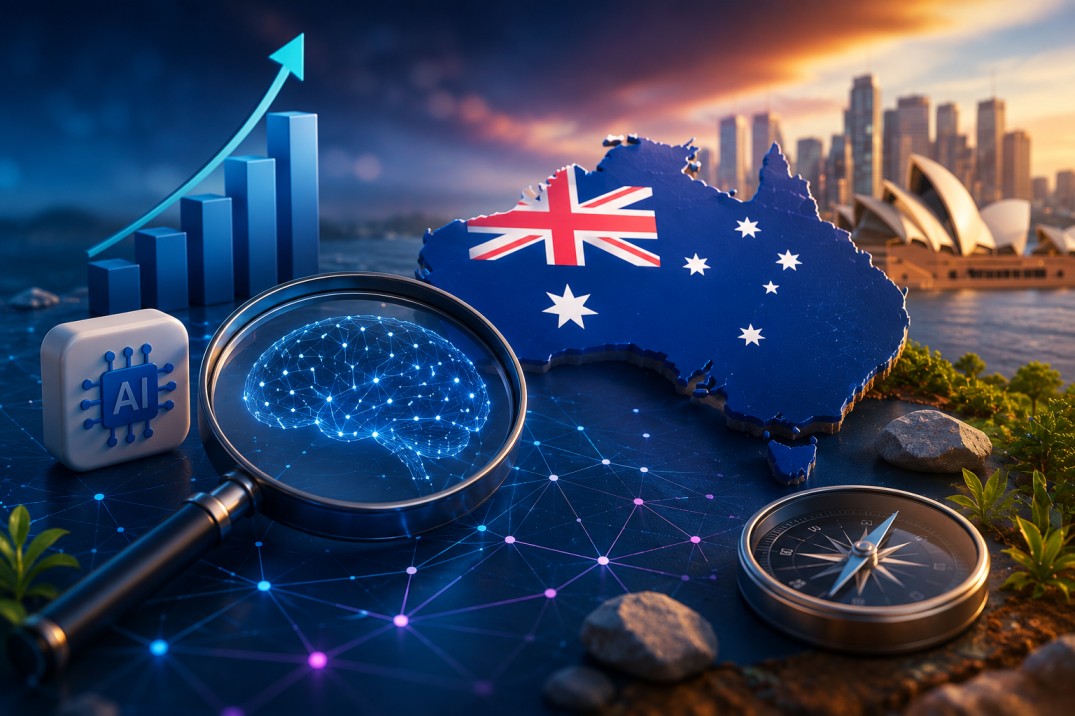
Five AI SEO trends reshaping Australian digital marketing in 2026
Trend 4: Entity-Based Search Authority Is Becoming Central to AI Visibility
Traditional SEO was largely about keywords: which terms does a page include, how many times, and with what surrounding context. AI-powered search is fundamentally different - it operates on entities. An entity is a recognized concept with defined attributes: a brand, a person, a place, a product. AI engines maintain knowledge graphs that map relationships between entities and use these graphs to decide which brands to cite as authoritative answers.
For Australian brands, entity establishment is one of the highest-leverage AEO activities. A brand that AI engines can clearly identify - with consistent information about what it does, where it operates, who it serves, and what makes it credible - is dramatically more likely to be cited than a brand that exists only as a domain name and some content pages.
Entity establishment for Australian businesses involves several elements. Structured data markup (Schema.org Organization type) on the primary brand page. A clear "About" page that describes the brand's expertise, market focus, and credentials. Wikipedia presence for brands with sufficient significance. Consistent brand mentions across credible third-party sources: industry publications, Australian business directories, professional associations. Social media profiles with complete and accurate brand information.
The content dimension of entity authority is topical: brands that publish deep, authoritative content on their core area of expertise are recognized by AI engines as entities with specific knowledge claims. An Australian financial planning firm that publishes comprehensive content about Australian superannuation, tax strategy, and retirement planning becomes the recognized entity for financial planning in AI engines' knowledge models - and gets cited accordingly.
Action for Australian businesses: Run an entity audit. Search for your brand name in ChatGPT, Gemini, and Perplexity and review what information they have about you. Gaps in entity knowledge - missing location, incorrect description, no mention of your specialization - should be fixed through structured data, About page content, and third-party coverage building.
Trend 5: Intelligent Automation with Strategic Oversight Is the New Efficiency Model
The fifth trend is not about a specific tactic but about how Australian businesses are integrating AI into their marketing operations. The early wave of AI adoption was characterized by maximum automation: AI writes the content, AI optimizes it, AI publishes it. The results were often poor - and the AEO citation rates reflected that.
The businesses winning in 2026 have evolved to an intelligent automation model: AI handles the volume, humans provide the strategy and quality control. This applies to content creation, technical optimization, and reporting. AI generates the first draft, the brief, the initial keyword research. Humans review, refine, add expertise, and make judgment calls. The output is higher quality than human-only production at a fraction of the time cost.
For AEO specifically, intelligent automation applies to monitoring: platforms like AI Rank Lab automate the citation checks, competitor comparison, and performance reporting that would take a team days to produce manually, each time you run your prompts. This automation frees human attention for the high-value activities that AI cannot replace: strategic prioritization, expert content development, client communication, and competitive positioning decisions.
Australian agencies are increasingly packaging this intelligent automation approach as a service offering: AI-powered monitoring and auditing, human-guided optimization strategy, AI-assisted content production with expert editorial review. This combination delivers AEO results at a service price point that traditional manual-only approaches cannot match.
Action for Australian businesses: Map your current marketing workflow and identify where AI automation can replace manual process without sacrificing quality. Start with monitoring: track your AI citations in AI Rank Lab, where prompts you opt into the Action Plan citation tracker are re-checked weekly, so you have reliable weekly data without checking each engine by hand. Then apply intelligent automation to content production, with human editorial oversight at the quality gate.
What Australian Businesses Should Do Now
These five trends point toward a consistent set of practical actions for Australian businesses wanting to maintain and improve digital visibility in the AI search era:
Measure first: You cannot optimize what you do not measure. Start with a baseline AEO audit using AI Rank Lab's 100 free signup credits. Understand your current citation rate before building a strategy. Businesses that start measuring now will have six months of trend data before competitors begin tracking.
Quality over quantity: Audit your existing content library for genuine expertise signals. Identify the 20% of pages most likely to generate AI citations and invest in improving them before publishing new content. One outstanding, expert-authored piece outperforms ten generic AI-written articles for AEO.
Establish entity signals: Ensure your brand entity is clearly established across the key platforms AI engines use: structured data on your website, accurate and complete information on Australian business directories, professional association listings, and third-party coverage in relevant industry publications.
Build the AEO workflow: Implement a monthly review cycle that tracks citation rates, identifies new content gaps, executes optimization tasks, and measures results. The four-phase workflow (prompts, baseline, execute, report) is practical for any Australian business with a small marketing team.
Conclusion
The five trends reshaping Australian AI SEO in 2026 - AEO replacing click-based SEO, content quality differentiation, local search evolution, entity-based authority, and intelligent automation - are all pointing in the same direction: more sophisticated, measurement-driven AI visibility strategy.
Australian businesses that build this capability in 2026 will compound their advantage over the next two to three years. The tools and frameworks are available today. AI Rank Lab provides the measurement platform to track every dimension of your AI search visibility and the optimization guidance to improve it systematically. Start your free AEO audit today and get your Australian brand's baseline AI citation score. Plans and pricing at airanklab.com/pricing.
अक्सर पूछे जाने वाले प्रश्न
How is AI search affecting Australian businesses in 2026?▾
What is AEO and why does it matter for Australian companies?▾
Are there Australian-specific AI SEO tools?▾
How should Australian businesses approach content quality for AI search?▾
What is entity-based search and why does it matter for Australian brands?▾
Get a Free AI Ranking Consultation
Want to improve your brand's visibility in AI search engines like ChatGPT, Gemini, and Perplexity? Fill out the form and our experts will create a personalized strategy for you.

द्वारा लिखित
Devanshu
Chief Marketing Officer & AI Search Optimization Architect
Digital Marketing Strategist & Pioneer in SEO, Answer Engine Optimization (AEO), and Generative Engine Optimization (GEO).


