


If you are searching for a Semrush alternative for AI search visibility, you are likely facing the same realisation many marketing teams reach in 2026: Semrush is a world-class platform for Google SEO, and it does not measure whether your brand appears in ChatGPT, Gemini, Perplexity, or Claude responses.
That is not a criticism of Semrush. It is a product scope decision - Semrush is built to optimise for and measure Google, Bing, and traditional search engines. AI engine citations operate on entirely different infrastructure, require different measurement approaches, and are simply outside Semrush's current product scope.
The question for businesses in 2026 is not which is better - it is which tool fills which gap in your measurement stack, and which AI visibility tool specifically is the right complement to the Google-focused tooling you already have.
What Semrush Measures (and Does Not Measure)
Semrush covers traditional search comprehensively:
Google keyword rankings (position tracking by keyword, location, device)
Organic traffic estimates and trend analysis
Backlink analysis and link building opportunities
Technical SEO site audits
Competitor keyword gap analysis
Google Search Console integration
Google Ads keyword and PPC analysis
Local SEO and Google Business Profile integration
Content optimisation for Google-targeted queries
What Semrush does not measure:
Whether your brand is cited in ChatGPT responses
Your citation rate on Gemini, Perplexity, or Claude
How often competitors are recommended by AI engines in your category
Which of your pages are being used as AI citation sources
How your AI citation rate changes week-over-week
AI Overview appearances on Google (partially available, but not full AI citation tracking)
This gap is increasingly significant. AI engines now influence purchase decisions at the top and mid-funnel stages - before users reach the Google searches where Semrush data is relevant. A business optimised entirely on Semrush data can have strong Google rankings while being completely absent from the AI recommendation layer where its competitors are being mentioned.
Why AI Citation Tracking Requires a Different Tool
Measuring AI citations is fundamentally different from measuring Google rankings, which is why no traditional SEO platform has added this capability effectively.
Google rankings are deterministic and consistent: for a given keyword and location, Googlebot returns the same results page, and rank trackers can query that page repeatedly to measure position changes. AI engine responses are generative and variable: the same query asked twice may produce different responses citing different sources, because AI systems generate outputs rather than retrieving a fixed results page.
Measuring citation rates accurately requires:
Querying each AI engine multiple times per keyword to establish statistical citation rates rather than single-point observations
Tracking across four different AI engines simultaneously (ChatGPT, Gemini, Perplexity, Claude) - each with different citation patterns
Distinguishing between direct brand citations, source citations, and recommendation mentions
Maintaining access as AI engines update their systems and response formats change
This is why dedicated AI visibility tools exist rather than Semrush simply adding a new module - the measurement infrastructure is entirely different.
The Main Alternatives for AI Search Visibility Tracking
AI Rank Lab
AI Rank Lab is built specifically for AI citation visibility tracking and AEO optimisation. It monitors citation rates across ChatGPT, Gemini, Perplexity, and Claude simultaneously, with automated weekly tracking and competitive benchmarking. Key capabilities:
Automated citation rate monitoring across all four major AI engines
Competitive AI visibility benchmarking (track competitor citation rates alongside your own)
Page-level citation attribution (which specific pages are generating citations)
Schema markup analysis and recommendations
AEO content optimisation guidance
Agency multi-client management with white-label reporting
Historical citation rate trend data
AI Rank Lab's free tier provides citation rate tracking across all four engines for a limited keyword set, making it practical to verify your current AI visibility before committing to a paid plan.
Brandwatch and Mention (for brand monitoring)
Brand monitoring platforms like Brandwatch and Mention track brand mentions across the web, social media, and some AI-adjacent content. They are not built for AI citation rate tracking - they do not query AI engines directly or measure how often your brand appears in AI-generated recommendations. Useful for broader brand listening; not a direct alternative for AI citation tracking.
Manual tracking with spreadsheets
Some teams manually query ChatGPT and Perplexity with tracked keywords and record citation appearances in spreadsheets. This works for 1-2 clients with small keyword sets. It does not scale, does not provide statistical citation rates, misses Gemini and Claude, and produces data that is difficult to trend over time. The cost in team time typically exceeds the cost of a dedicated tool within the first month.
Ahrefs and Moz
Ahrefs and Moz are direct Semrush competitors in the traditional SEO platform category. Neither tracks AI engine citations. If your primary gap is AI visibility measurement, switching from Semrush to Ahrefs does not address it - you would still need a dedicated AI visibility tool alongside whichever traditional SEO platform you use.
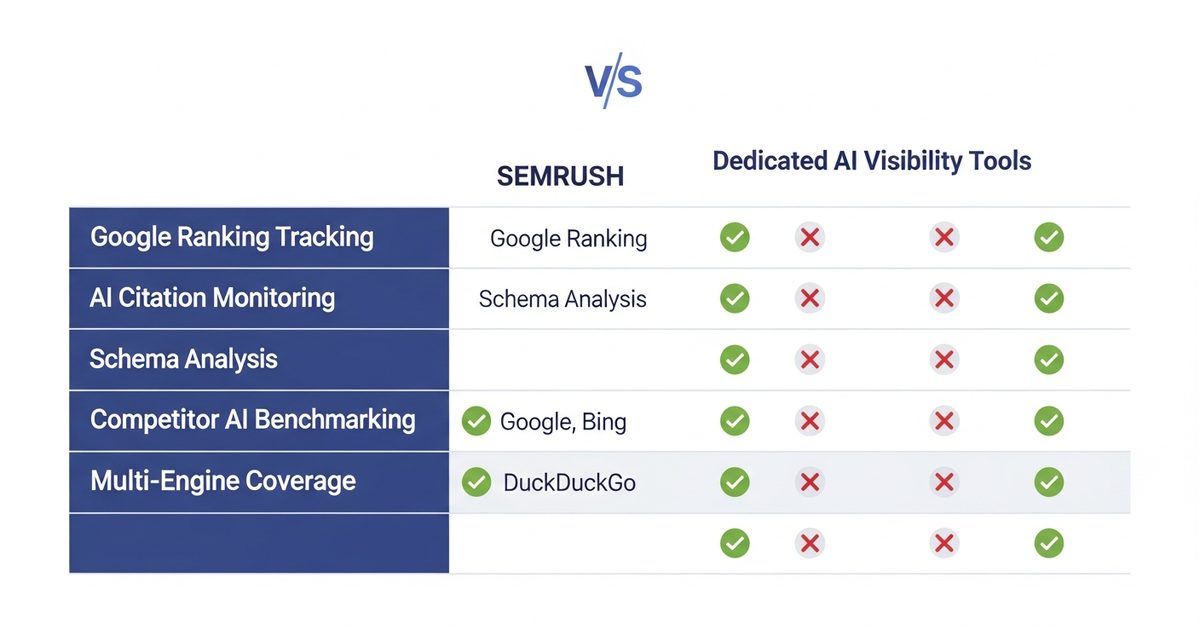
Semrush vs. Dedicated AI Visibility Tools: Feature Comparison
Capability | Semrush | AI Rank Lab |
|---|---|---|
Google keyword rank tracking | Yes - comprehensive | No (use Semrush or GSC for this) |
Backlink analysis | Yes - industry-leading | No |
Technical SEO audit | Yes - comprehensive | Schema and AEO-specific |
ChatGPT citation tracking | No | Yes - automated weekly |
Gemini citation tracking | No | Yes - automated weekly |
Perplexity citation tracking | No | Yes - automated weekly |
Claude citation tracking | No | Yes - automated weekly |
AI competitor benchmarking | No | Yes |
AEO content recommendations | No | Yes |
Multi-client agency view | Yes | Yes |
Free tier available | Limited trial | Yes |
The comparison makes the stack clear: Semrush handles Google, AI Rank Lab handles AI engines. They are not competing for the same measurement job.
The Right Stack for 2026
For most businesses, the right approach is not choosing between Semrush and an AI visibility tool - it is running both and connecting the data.
Semrush (or Ahrefs) for Google:
Keyword rank tracking and traffic estimates
Backlink monitoring and competitive link analysis
Technical SEO audit and crawl data
Content gap analysis for Google-targeted content
AI Rank Lab for AI engines:
Citation rate tracking across ChatGPT, Gemini, Perplexity, Claude
Competitive AI visibility benchmarking
AEO optimisation recommendations
Schema markup analysis
Google Search Console (free):
Actual click and impression data from Google
Google AI Overview appearances
Index coverage and crawl data
The combined monthly cost of this stack (Semrush Pro + AI Rank Lab + free Search Console) is comparable to a single Semrush Business plan, while providing coverage across both traditional and AI search channels.
If You Are Currently Paying for Semrush and Need AI Visibility Coverage
The most common scenario is a business already paying for Semrush that needs to add AI visibility tracking without significantly increasing tooling costs.
Practical steps:
Start with AI Rank Lab's free tier to establish baseline citation rates across your most important category queries. This gives you data on how visible you currently are in AI engines before spending anything.
If the baseline shows significant gaps (low citation rates while competitors are being recommended), the case for upgrading to a paid AI visibility plan becomes straightforward to make internally.
Review your Semrush plan tier. Many businesses are on Semrush Business when Semrush Pro covers their actual usage. If a plan downgrade frees budget for AI visibility tooling without sacrificing needed functionality, that reallocation makes sense.
Run both tools in parallel for 60-90 days to demonstrate the value of each. The combination of Google Search Console data (from Semrush or directly), Google traffic trends (from Semrush), and AI citation rate trends (from AI Rank Lab) gives you the complete picture of how your search visibility is evolving across channels.
The Measurement Gap Is a Competitive Gap
Businesses that measure only Google performance are making strategic decisions based on incomplete data. If ChatGPT recommends competitors in your category for every relevant research query while your Google rankings hold steady, your traffic may look fine while your pipeline is being eroded at the top of the funnel.
The Semrush alternative you need for AI visibility is not a replacement for Semrush - it is an addition to it. Start measuring your AI citation rates before your competitors do, not after. AI Rank Lab's free tier runs a baseline citation check across ChatGPT, Gemini, Perplexity, and Claude in minutes.
Frequently Asked Questions
Does Semrush track AI search visibility?▾
What is the best Semrush alternative for AI visibility?▾
Should I replace Semrush with an AI visibility tool?▾
How much does it cost to add AI visibility tracking to a Semrush subscription?▾
Can I track my competitors' ChatGPT citations?▾
Get a Free AI Ranking Consultation
Want to improve your brand's visibility in AI search engines like ChatGPT, Gemini, and Perplexity? Fill out the form and our experts will create a personalized strategy for you.

Written by
Devanshu
Chief Marketing Officer & AI Search Optimization Architect
Digital Marketing Strategist & Pioneer in SEO, Answer Engine Optimization (AEO), and Generative Engine Optimization (GEO).


