


A GEO tracker asks AI assistants a fixed set of questions on a schedule and records whether your brand shows up in the answers. That is the entire mechanism. Everything a tracker reports - visibility percentage, share of voice, citation count, sentiment - is a statistic computed over a sample of generated answers.
Which means the number you see is an estimate, and estimates have error bars. Most guides to generative engine optimization tracking skip straight to a tool comparison. This one covers the part that decides whether your dashboard is telling you anything: what a GEO tracker actually measures, why the number moves on its own, how many prompts and repeats you need before the score is stable, and which claims the data can and cannot support.
What a GEO tracker actually measures
A GEO tracker measures presence in generated answers, not position on a page. The unit of observation is a single model response to a single prompt. For each response the tracker records some combination of: whether your brand name appeared, whether your domain was linked as a citation, where in the answer it appeared, which competitors appeared alongside you, and what tone the mention carried.
Those response-level records get aggregated into the headline metric. If you run 50 prompts across 4 engines and your brand appears in 60 of the 200 resulting answers, your visibility is 30%. There is no ranking algorithm being reverse-engineered here and no index being queried. The tracker is running a survey, and the respondents are language models.
The term comes from GEO: Generative Engine Optimization, presented at KDD 2024 by Aggarwal and colleagues. That paper was the first to show in a controlled experiment that content changes could lift visibility inside generated answers, reporting boosts of up to 40% on their GEO-bench benchmark. It also established the framing that trackers inherit: visibility is a property of the generated response, measured across many queries, not a property of a document.
GEO tracker vs traditional SEO rank tracker: different objects, different math
A traditional rank tracker and a GEO tracker look similar on a dashboard and are doing fundamentally different things.
| SEO rank tracker | GEO tracker | |
|---|---|---|
| What it queries | A search index | A generative model |
| Unit measured | Position of a URL | Presence of a brand in a response |
| Result for one query | An ordered list | A passage of prose |
| Repeatability | High. Same query, near-identical results | Low. Same prompt, different wording each run |
| Competitor set | Fixed by the SERP | Varies answer to answer |
| Sample needed for a stable reading | One check | Many, across several dimensions |
The last row is the one that catches teams out. A rank tracker can check a keyword once a day because the index is stable between checks. A GEO tracker cannot, because the thing it is measuring is generated fresh every time, from a probability distribution.
Why your GEO tracker visibility score changes when your website has not changed
Because the model is sampling, not retrieving. Ask the same question twice and you get two different answers, and sometimes only one of them mentions you.
This is not a bug in your tracker. A 2026 study by Dmitrij Żatuchin, Where Does the Noise Come From? A Variance-Components Decomposition of Non-Determinism in LLM Brand Answers, took the question apart properly. Across 12,933 responses covering 20 brands, 8 languages and 3 models, it partitioned the variance in brand-mention outcomes into its sources:
- Within-prompt resampling: 34.8% of total variance. Simply re-asking the identical prompt.
- Brand-in-context interaction: 29.6%. Which brand, in which specific prompt context.
- Query language: 26.5%. The language the question was asked in.
- Brand by language: 8.6%.
- Brand identity alone: 1.5%.
Read that list again with a dashboard in mind. Only 1.5% of the movement in a brand-mention measurement is attributable to the brand itself. The single largest component, over a third, is pure resampling noise - the model answering the same question differently on the second try.
The practical consequence: a week-over-week change in your GEO tracker score is not evidence of anything until you know how large the noise band is. A visibility score that moved from 28% to 33% has almost certainly not moved at all.
How many prompts and repeats does a GEO tracker need for a reliable score
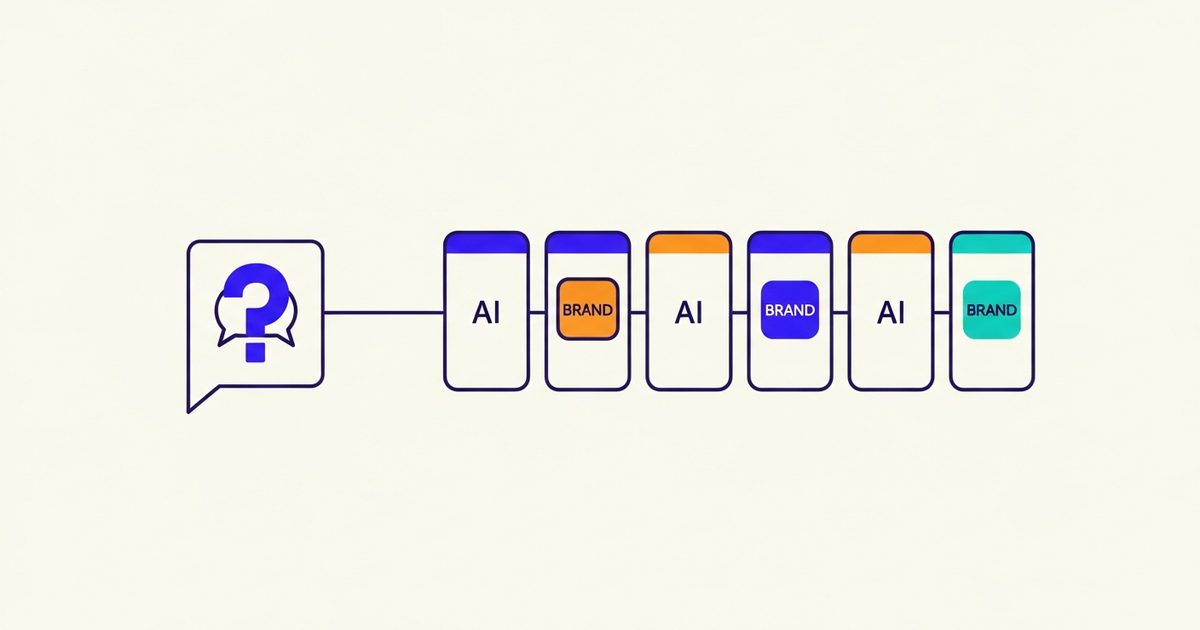
Fewer repeats than you would guess, and more breadth than you would guess. The same variance study found sharply diminishing returns on re-asking: past the fifth repeat of a prompt, an additional repeat reduced measurement error by only 0.0003. Meanwhile reliability across the full design reached roughly 0.36, against 0.01 for a single answer. The author's conclusion is blunt: reliability "is bought by spreading across languages and models, not by repeating one prompt."
That gives a concrete design rule for anyone configuring generative engine optimization tracking:
- Repeat each prompt about 5 times. Enough to average out sampling noise. Past that you are burning API credits for nothing.
- Spend the budget on prompt breadth instead. Thirty distinct prompts sampled 5 times each beats five prompts sampled 30 times each, at identical cost.
- Cover multiple models. Model identity is a real, separable source of variance. One engine is one opinion.
- Cover multiple languages if you sell in multiple languages. Language accounted for more than a quarter of variance. An English-only tracker is not measuring your German market.
- Report a band, not a point. Publish "28% plus or minus 6" rather than "28%". If your tool will not give you dispersion, compute it yourself from the response-level data.
Reliability near 0.36 is worth sitting with. Even a well-constructed design leaves substantial unexplained variance. GEO measurement is directionally useful over months. It is not precise week to week, and no vendor dashboard can make it so.
Which AI engines should a GEO tracker cover
Cover the engines your buyers actually use, and cover more than one, because model identity is its own variance component. In practice that means the four systems that answer commercial questions with live retrieval: OpenAI's ChatGPT, Google's Gemini and AI experiences, Anthropic's Claude, and Perplexity.
Coverage detail matters more than the logo count. A tracker that queries a base model without web access is measuring training-data memory, not search behaviour, and those are different things. In AI Rank Lab our brand checks run against web-enabled configurations specifically: the OpenAI Responses API on GPT-4o, Claude Haiku 4.5, Gemini 3 Flash, and Perplexity's Sonar models, which are web-enabled by default. When you evaluate any GEO tracker, ask which model version and which retrieval mode sits behind each engine icon. Vendors rarely publish it, and it changes what the number means.
Does ranking in the top 10 organic results guarantee AI citations?
No, and the relationship has been loosening. Ahrefs analysed 1.9 million citations across 1 million AI Overviews and found that 76.10% of AI Overview-cited pages ranked in the top 10 for the same query as of July 2025, with 14.40% of citations coming from pages ranking below position 100. BrightEdge, tracking 9 industries from May 2024 to September 2025, reported that 54.5% of AI Overview citations now rank organically, up from 32.3%, while only 16.7% came from top 10 results.
The two studies measure slightly different things, which is exactly why you should not treat either as a law. What both support is the practical claim: organic ranking is a strong input to AI citation but not a guarantee of it, and a meaningful share of citations come from pages that rank poorly or not at all. That is the gap a GEO tracker exists to observe. Your rank tracker cannot see it.
It is also why Google's own position is worth quoting directly. Its guide to optimizing for generative AI features, updated July 2026, states that "the best practices for SEO continue to be relevant because our generative AI features on Google Search are rooted in our core Search ranking and quality systems," and that to be eligible "a page must be indexed and eligible to be shown in Google Search with a snippet." There is no separate AI ranking system to game. There is a retrieval layer with a query fan-out on top, which Google defines as "a set of concurrent, related queries generated by the model."
Can a GEO tracker prove that AI search sent traffic to your website?
No. A GEO tracker measures appearance in answers. It cannot prove attribution, and you should be careful about letting anyone read it that way.
Two independent datasets explain why the gap is so wide. Cloudflare's crawl-to-refer ratio, published July 2025, divides HTML requests from a platform's crawlers by HTML requests carrying that platform's referrer. For the week of 19-26 June 2025 the ratios ran from Anthropic at roughly 70,900:1 down to Mistral at 0.1:1. Cloudflare notes an important caveat: traffic referred by Claude's native app carries no referrer header, so the ratios "may overstate" the imbalance by an unknown amount. Even discounted heavily, the direction is unambiguous. Being read is common. Being clicked through from is rare.
Semrush's traffic channel mix study, published April 2026 across 50,000+ websites in 17 industries, puts numbers on the other side: AI traffic accounted for 0.14% of total traffic in 2025 against organic search at 16.04%, though AI traffic grew 66.02% year over year, from 462 million to 767 million monthly visits.
Hold both facts at once. AI referral volume is currently small and growing fast, and citation volume is far larger than click volume. A GEO tracker measures the citation side. If you promise a stakeholder that a rising visibility score will produce proportional sessions, the analytics will embarrass you.
How the Google Search Console generative AI report compares with a third party GEO tracker
They are complementary and neither replaces the other. Google shipped Generative AI performance reports in Search Console in June 2026. It is first-party data from the platform itself, which no third party tracker can match for accuracy. But it is deliberately narrow:
| Search Console generative AI report | Third party GEO tracker | |
|---|---|---|
| Source | First-party, from Google | Sampled model responses |
| Metrics | Impressions only. No clicks, CTR or position | Visibility, citations, share of voice, sentiment |
| Dimensions | Page, country, device, date | Prompt, engine, competitor |
| Prompts shown | No | Yes, you define them |
| Engine coverage | Google AI Overviews and AI Mode only | Multiple vendors |
| Competitor view | None | Yes |
Use Search Console as ground truth for Google surfaces and to sanity-check whether your tracker's Google numbers are drifting from reality. Use the tracker for everything Search Console structurally cannot show you: other vendors' assistants, the prompts themselves, and competitors.
How AI bot server logs complement GEO tracker data
Server logs give you the one part of the pipeline that is fully observable and not sampled. Before a model can cite you, a crawler generally has to fetch you, and that fetch lands in your logs with a user agent attached.
This is a useful diagnostic layer because it separates two failure modes that a visibility score alone conflates. If your GEO tracker shows you absent from answers, log data tells you which problem you have:
- Crawlers are not fetching the pages at all. A technical or access problem. Check robots.txt, blocking rules and rendering.
- Crawlers fetch the pages regularly but you are still not cited. A content and authority problem. The retrieval layer sees the page and does not select it.
Those need completely different fixes, and the visibility number cannot distinguish them. Our own bot tracking watches for GPTBot, ClaudeBot, PerplexityBot, Google-Extended, CCBot and BingBot, and pairing that server-side record against prompt-level visibility is the fastest way we have found to work out which of the two problems a domain actually has.
What a GEO tracker cannot tell you
Being explicit about the limits is what separates a defensible reporting practice from a vanity dashboard.
- It cannot tell you what real users asked. Your prompt list is a hypothesis about demand, written by you. No vendor has access to AI assistant query logs. Search Console does not expose prompts either.
- It cannot tell you why competitors appear. You can see that a competitor was mentioned. The reason is not in the data, only in your inference.
- It cannot prove causation from a content change. With resampling alone driving over a third of variance, attributing a score move to last month's page edits requires a controlled comparison, not a before-and-after screenshot.
- It cannot see personalised or logged-in answers. Trackers query APIs. Real users have memory, history and location applied.
- It cannot measure Google's AI surfaces authoritatively. Only Google has that. Third party AI Overview scraping is an approximation.
Which GEO tracking metrics to report to stakeholders
Report the small number of things the sample can support, with their uncertainty attached, and drop the rest.
Worth reporting:
- Visibility rate with a dispersion band, over a rolling 30 days rather than week to week.
- Share of voice against a fixed competitor set, using a prompt list that does not change between periods. Changing the prompts changes the metric.
- Cited-domain counts from server logs, which are counts rather than estimates and carry no sampling error.
- Search Console AI impressions for Google surfaces, as first-party corroboration.
Worth dropping:
- Week-over-week percentage deltas. Almost always noise. Reporting them trains stakeholders to react to randomness.
- A single blended "AI visibility score" across engines. It hides the engine-level differences that are actually actionable.
- Sentiment scored on tiny samples. Sentiment on 20 mentions is not a trend.
- Any projection from visibility to revenue. The attribution chain does not exist yet.
A 30-day rollout that produces a defensible baseline
The sequence matters. Most teams start tracking before they have decided what they are measuring, then spend months interpreting noise.
- Days 1-3. Build the prompt set. Aim for 30 to 50 prompts covering your category, your competitors' categories, problem-first phrasings and comparison phrasings. Write them the way a buyer would type them. Freeze this list.
- Days 4-5. Fix the design. Five samples per prompt per engine. Record which model version answered. If you sell in more than one language, split the prompt set by market now, not later.
- Days 6-12. Collect a baseline. Run the full design daily for a week without changing anything on your site. This week's spread is your noise band. You will need it to interpret every subsequent number.
- Day 13. Turn on server-side bot logging and confirm your key pages are actually being fetched by the crawlers listed above.
- Days 14-30. Change one thing and watch. Pick the single largest gap the baseline exposed, fix it, and keep the prompt set and sampling design frozen so the comparison means something.
At day 30 you have what most teams never get: a visibility number, a known error band around it, and independent server-side evidence of whether crawlers can even see the pages. That combination is what makes a GEO tracker worth having. The dashboard on its own is just a number that moves.
Frequently Asked Questions
What is a GEO tracker and what does it actually measure?▾
How is a GEO tracker different from a traditional SEO rank tracker?▾
Why does my GEO tracker visibility score change when my website has not changed?▾
How many prompts and repeats does a GEO tracker need for a reliable score?▾
Which AI engines should a GEO tracker cover?▾
Does ranking in the top 10 organic results guarantee AI citations?▾
Can a GEO tracker prove that AI search sent traffic to my website?▾
How does the Google Search Console generative AI report compare with a third party GEO tracker?▾
How do AI bot server logs complement GEO tracker data?▾
What can a GEO tracker not tell me about competitors?▾
Which GEO tracking metrics should I report to stakeholders?▾
Get a Free AI Ranking Consultation
Want to improve your brand's visibility in AI search engines like ChatGPT, Gemini, and Perplexity? Fill out the form and our experts will create a personalized strategy for you.

Written by
Devanshu
Chief Marketing Officer & AI Search Optimization Architect
Digital Marketing Strategist & Pioneer in SEO, Answer Engine Optimization (AEO), and Generative Engine Optimization (GEO).


