


Schema Markup Is the Language AI Engines Speak
When a user asks Perplexity "what are the best practices for robots.txt in 2026," Perplexity does not just find relevant pages and summarize them. It actively looks for pages that communicate their content in structured, extractable formats. Pages that answer questions directly in marked-up Q&A pairs are significantly more likely to be cited than pages with the same information in unstructured prose.
This is the core insight behind schema markup for AEO (Answer Engine Optimization): structured data is not just about Google rich results anymore. It is the primary technical signal AI engines use to identify citation-ready content. Getting schema right for AEO requires understanding which types drive LLM citations, how to implement them correctly, and how to sequence the work for maximum impact.
This guide covers the complete AEO schema stack - which types matter, implementation code for each, and the prioritization framework we recommend to clients using AI Rank Lab's schema generator.
How LLMs Use Schema Markup (What Actually Happens)
Understanding how AI engines use schema changes how you implement it. Here is the actual process:
Crawling: AI crawlers (GPTBot, ClaudeBot, PerplexityBot) crawl your page like any web crawler
Structured data extraction: The crawler extracts JSON-LD from the page's head section and inline scripts
Entity mapping: The structured data is used to map your content to schema.org entity types - Question, Answer, HowToStep, Product, Person, etc.
Knowledge graph integration: Extracted entities are added to the AI system's training data or real-time knowledge base
Citation weighting: When generating a response, the AI system weights structured data sources more heavily than unstructured prose for specific facts and Q&A content
The practical implication: schema does not guarantee citation, but it dramatically increases the probability that your content is extracted accurately and cited correctly. AI engines are probabilistic - schema removes ambiguity about what your content means and what question it answers.
The AEO Schema Priority Stack
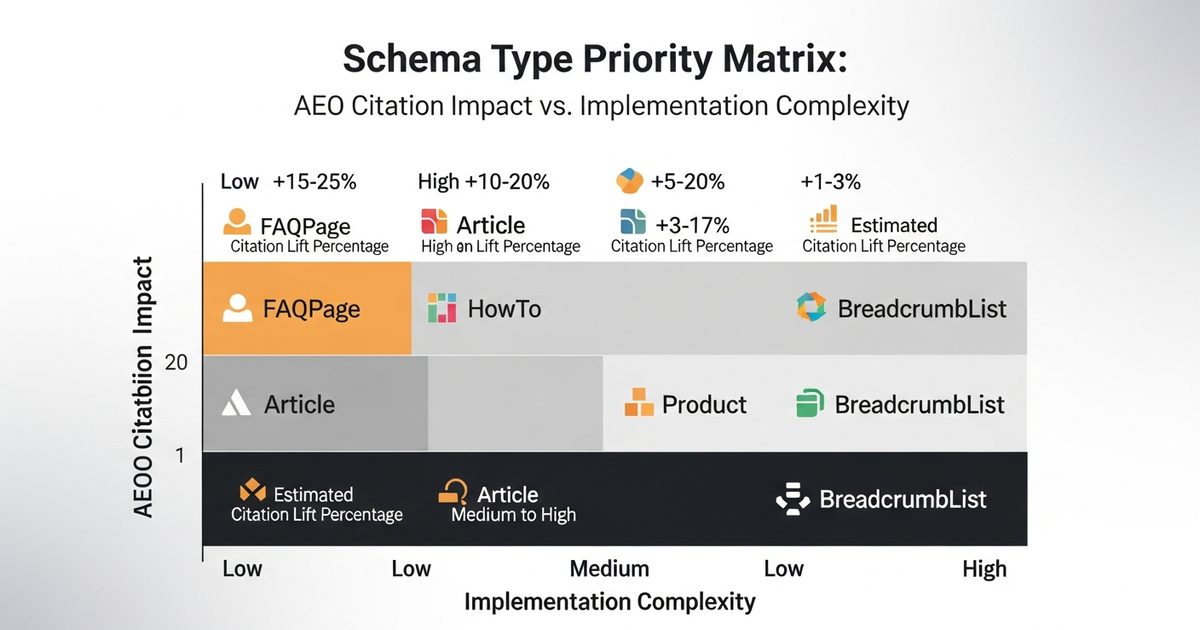
Not all schema types contribute equally to AI citation rates. Based on analysis of citation patterns across AI engines, here is the priority order:
Priority 1: FAQPage Schema (Highest AEO Impact)
FAQPage schema directly mirrors the conversational format of AI search. Each Question / acceptedAnswer pair is a pre-packaged citation unit - a question AI engines can match to user queries, with an answer they can extract and attribute. The match between FAQPage schema structure and LLM response generation architecture is the tightest of any schema type.
Implementation note: write FAQ answers in a direct, authoritative tone ("The three most effective approaches are X, Y, and Z") rather than hedged language ("Some people think it might be a good idea to consider..."). AI engines prefer extractable declarative statements over hedged prose.
{
  "@context": "https://schema.org",
  "@type": "FAQPage",
  "mainEntity": [
    {
      "@type": "Question",
      "name": "What is the difference between AEO and SEO?",
      "acceptedAnswer": {
        "@type": "Answer",
        "text": "SEO (Search Engine Optimization) optimizes content for Google's ranking algorithm. AEO (Answer Engine Optimization) optimizes content to be cited by AI answer engines like ChatGPT, Perplexity, and Gemini. AEO requires different signals: structured Q&A content, FAQPage schema, AI bot access, and citation-ready writing style."
      }
    },
    {
      "@type": "Question",
      "name": "How many FAQ items should I include in FAQPage schema?",
      "acceptedAnswer": {
        "@type": "Answer",
        "text": "Include 3-10 FAQ items per page. Google displays up to 10 in rich results. For AEO, quality matters more than quantity - each FAQ should answer a distinct, real question users ask. Avoid padding with low-value questions."
      }
    }
  ]
}
Priority 2: HowTo Schema
HowTo schema is the procedural counterpart to FAQPage. When users ask AI engines process questions ("how do I audit my robots.txt for AI crawlers"), HowTo schema gives the AI engine a structured, stepwise answer it can extract. The HowToStep type maps naturally to the numbered step format AI engines use in instructional responses.
Key implementation note: each step should be genuinely discrete and actionable. Steps like "Think about your goals" are not useful. Steps like "Check your robots.txt file at yourdomain.com/robots.txt and look for User-agent: GPTBot lines" are citation-ready.
{
  "@context": "https://schema.org",
  "@type": "HowTo",
  "name": "How to audit your robots.txt for AI crawler access",
  "description": "Step-by-step guide to checking and correcting robots.txt for GPTBot, ClaudeBot, and PerplexityBot access.",
  "totalTime": "PT10M",
  "step": [
    {
      "@type": "HowToStep",
      "name": "Check your current robots.txt",
      "text": "Navigate to yourdomain.com/robots.txt in your browser. This shows the live file as crawlers see it.",
      "position": 1
    },
    {
      "@type": "HowToStep",
      "name": "Identify AI crawler rules",
      "text": "Search the file for User-agent entries that match GPTBot, ClaudeBot, anthropic-ai, and PerplexityBot. If none exist, the wildcard User-agent:* rule applies.",
      "position": 2
    },
    {
      "@type": "HowToStep",
      "name": "Add explicit allow rules",
      "text": "Add User-agent: GPTBot / Allow: / entries for each AI crawler you want to permit. This overrides any restrictive wildcard rules.",
      "position": 3
    }
  ]
}
Priority 3: Article Schema with Full E-E-A-T Signals
Article schema does not help AI engines find specific answers the way FAQPage does. Its value is in building the trust signals (E-E-A-T) that AI engines use to decide which sources are worth citing at all. A domain with no Article schema, no author attribution, and no publication dates is less citable than a domain where every article clearly signals who wrote it, when, and what makes the author credible on this topic.
For maximum AEO value, Article schema should include author data that links to a real Person entity - with the author's name, a link to their bio or professional profile (LinkedIn, personal site), and ideally their title or credentials.
{
  "@context": "https://schema.org",
  "@type": "Article",
  "headline": "Schema Markup for AEO: Which Types Drive LLM Citations",
  "description": "Complete guide to schema markup for answer engine optimization...",
  "datePublished": "2026-07-23",
  "dateModified": "2026-07-23",
  "author": {
    "@type": "Person",
    "name": "Devanshu",
    "url": "https://airanklab.com/about",
    "jobTitle": "AI Search Optimization Specialist"
  },
  "publisher": {
    "@type": "Organization",
    "name": "AI Rank Lab",
    "logo": {
      "@type": "ImageObject",
      "url": "https://www.airanklab.com/logo.png"
    }
  },
  "image": "https://www.airanklab.com/blog/schema-aeo-hero.jpg",
  "mainEntityOfPage": {
    "@type": "WebPage",
    "@id": "https://www.airanklab.com/blog/schema-markup-for-aeo-llm-citations"
  }
}
Priority 4: BreadcrumbList Schema
BreadcrumbList communicates topical hierarchy to AI engines - this page is part of this category, which is part of this broader topic domain. AI engines use site structure as an authority proxy: a site with a clear topical hierarchy (Home > Blog > AEO Education > Schema Markup) is more trustworthy as a citable source on AEO topics than a site where every page appears to exist in isolation.
{
  "@context": "https://schema.org",
  "@type": "BreadcrumbList",
  "itemListElement": [
    {
      "@type": "ListItem",
      "position": 1,
      "name": "Home",
      "item": "https://www.airanklab.com"
    },
    {
      "@type": "ListItem",
      "position": 2,
      "name": "Blog",
      "item": "https://www.airanklab.com/blog"
    },
    {
      "@type": "ListItem",
      "position": 3,
      "name": "AEO Education",
      "item": "https://www.airanklab.com/blog/category/aeo"
    },
    {
      "@type": "ListItem",
      "position": 4,
      "name": "Schema Markup for AEO"
    }
  ]
}
Priority 5: Organization Schema (Site-Wide)
Organization schema on your homepage is a foundational entity declaration. It tells AI engines: this website is operated by this organization, which does this thing, in this field, with these contact details. Without Organization schema, AI engines have to infer what your brand is from page content - and that inference may be incomplete or incorrect.
Organization schema is also the anchor for brand narrative in GEO (Generative Engine Optimization). When LLMs describe your company in responses, they pull from entity data including Organization schema. Getting the description, name, industry, and URL right in your Organization schema is a GEO signal as much as an SEO one.
Combining Schema Types on a Single Page
A single page can - and should - have multiple schema types. The most AEO-effective pages in our analysis typically combine:
Article + FAQPage: The Article schema provides E-E-A-T context and attribution; the FAQPage schema provides direct Q&A extraction. This combination covers both "who to trust" and "what the answer is."
Article + BreadcrumbList: Every article should have both, providing topical hierarchy context alongside authorship signals.
HowTo + FAQPage: For tutorial content that also answers common questions about the process. The HowTo covers the process itself; the FAQPage covers surrounding questions.
To combine schema types, use a JSON-LD array or separate script blocks. Both are valid:
<script type="application/ld+json">
{ Article schema here }
</script>

<script type="application/ld+json">
{ FAQPage schema here }
</script>


<script type="application/ld+json">
[
  { Article schema here },
  { FAQPage schema here }
]
</script>
AEO Schema: What Does NOT Work
Schema that contradicts visible content
The most common and most damaging mistake. If your FAQPage schema includes answers that are not visible on the page, AI engines flag the schema as potentially misleading and reduce citation weight. Every field in your schema must correspond to visible, crawlable content on the page.
Boilerplate answers
FAQPage answers that redirect users to call you, give vague non-answers, or hedge everything reduce citation likelihood because they are not extractable as useful answers. "Contact us for pricing" is not a citation-ready answer. "Our pricing starts at $49/month for the Starter plan, which covers up to 3 domains" is.
Overloading pages with irrelevant schema
Adding Product schema to a blog post or FAQPage schema to a contact page creates signal noise. AI engines can detect schema that does not match page context and may reduce overall trust in your structured data. Apply schema that accurately describes the page type.
Ignoring the AI search optimization guide
Schema is one piece of the AEO puzzle. For the complete picture of what makes content citation-ready, see the AI search optimization guide which covers content strategy, entity clarity, and the full technical setup alongside schema implementation.
How to Audit Your Current Schema Coverage
Before adding new schema, audit what you already have. Most sites have incomplete or incorrectly implemented schema that should be fixed before new schema is added.
The fastest audit approach:
Run your key pages through Google's Rich Results Test - it shows all detected schema and validation errors
Use AI Rank Lab's full audit tool to check schema coverage across your entire site - it identifies which page types have schema, which are missing it, and which have implementation errors
Use the schema generator to create corrected versions of pages with errors
The combination of the audit (to find gaps) and the generator (to fill them) is the most efficient schema implementation workflow for sites with more than a handful of pages.
Conclusion
Schema markup for AEO is not about checking a technical SEO checkbox. It is about speaking the language AI engines use to identify, extract, and cite content. FAQPage schema is the highest-priority investment because it maps directly to AI response generation. HowTo schema extends that to procedural content. Article schema builds the trust layer. Together, they create a page that AI engines can cite with confidence - knowing what the content says, who said it, when, and what question it answers.
Use AI Rank Lab's free schema generator to implement any of the schema types covered here, and run the full audit to see your current schema coverage gaps. For teams that want to build comprehensive AEO capability, schema implementation is the fastest-ROI technical action in the stack.
Часто задаваемые вопросы
Which schema type is most important for AEO and LLM citations?▾
Does schema markup directly get you cited by ChatGPT or Perplexity?▾
Can I have multiple schema types on one page?▾
What makes FAQ schema answers good for AI citation?▾
How do I check if my schema is correctly implemented for AEO?▾
Get a Free AI Ranking Consultation
Want to improve your brand's visibility in AI search engines like ChatGPT, Gemini, and Perplexity? Fill out the form and our experts will create a personalized strategy for you.

Автор
Devanshu
Chief Marketing Officer & AI Search Optimization Architect
Digital Marketing Strategist & Pioneer in SEO, Answer Engine Optimization (AEO), and Generative Engine Optimization (GEO).


