


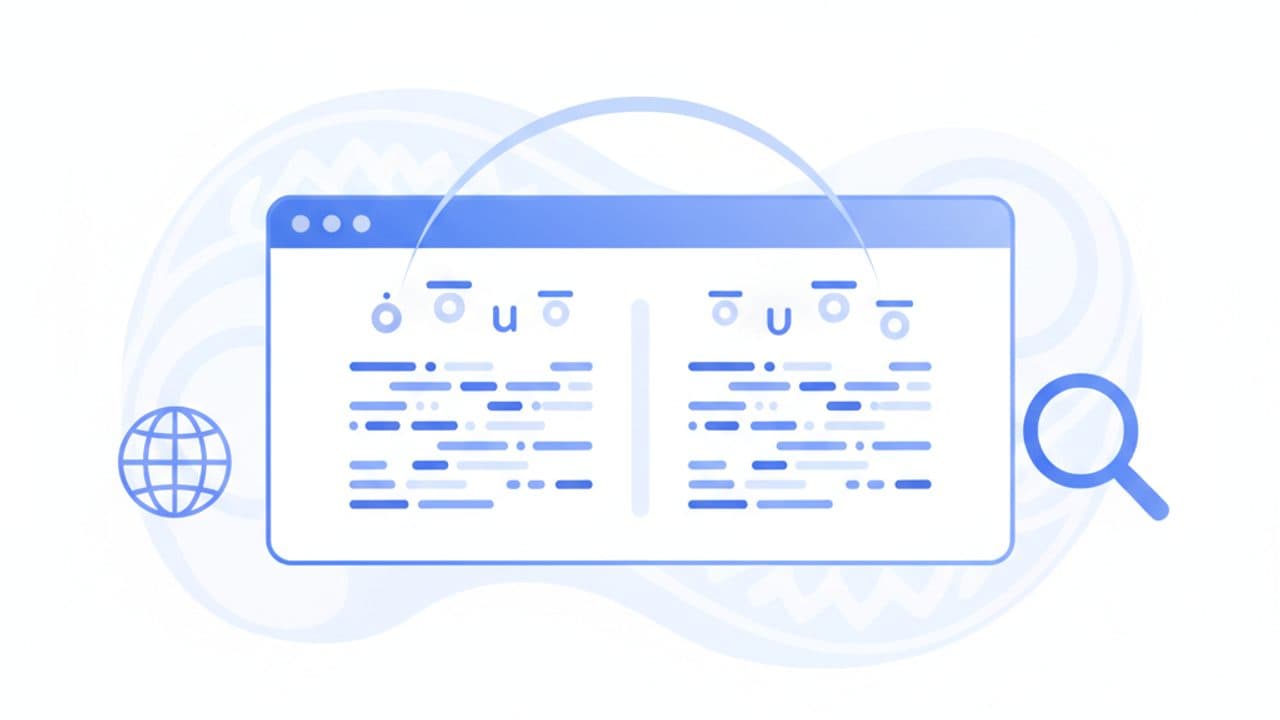
To use te reo Māori on a website well, keep macrons as real Unicode characters in your copy, titles and alt text, mark Māori passages with lang="mi", and give fully translated pages their own URLs linked with hreflang="mi" and hreflang="en-NZ". Search engines read macronised text as normal text. The real risks sit in your own systems (slug generators that turn "Māori" into "m-ori", site search that treats "maori" and "māori" as different words) and in AI tools, which handle te reo Māori far less reliably than English. Every line of te reo Māori should be written or checked by a qualified translator, not a machine.
This guide covers macrons in URLs, titles and alt text, language codes and hreflang, three bilingual page layouts, dual place names, how AI models cope with te reo Māori, and what Māori data sovereignty means for your content. It includes small tests we ran on 2 November 2026 and finishes with a checklist.
Key takeaways
- The language code for te reo Māori is
mi(ISO 639-1, in the IANA registry since 2005). Usemifor Māori pages anden-NZfor New Zealand English. - Google detects a page's language from its visible text, not from
langor hreflang. hreflang only helps Google choose between separate URLs, so it does nothing for a single side-by-side bilingual page. - Never let your CMS delete macronised letters. In our test, a basic ASCII slug rule turned "Te Wiki o te Reo Māori" into
te-wiki-o-te-reo-m-ori. Keep the macron in the URL or swap it for a plain vowel, and do the same thing everywhere. - Store text as precomposed (NFC) Unicode. "Māori" typed two different ways looks identical on screen but gives two different URLs.
- In our tokeniser test, the same message cost about 1.5 times as many GPT-4o-family tokens in te reo Māori as in English, and each macronised vowel was usually split into its own token. That's one sign of how thin te reo Māori is in AI training data.
- Te Taura Whiri i te Reo Māori licenses translators and keeps a public register. Te Hiku Media's Kaitiakitanga License shows that Māori language data comes with obligations, not just permissions.
How we tested this (and what we did not test)
Most pages on this topic are style guides or forum threads. None of them shows what software actually does with te reo Māori. So on 2 November 2026 we ran four small, reproducible checks:
- Slug generation. We passed three titles containing te reo Māori words through three common approaches: a basic ASCII regular expression, the
slugifynpm package (v1.6.6), and a Unicode-preserving slug. We also read WordPress core'ssanitize_title()source code. - Unicode normalisation. We compared how precomposed (NFC) and decomposed (NFD) forms of "Māori" are percent-encoded in a URL.
- Tokenisation. We counted tokens for a parallel te reo Māori and English passage, taken word for word from Te Taura Whiri i te Reo Māori's bilingual Google Maps page. We used OpenAI's open-source
o200k_base(GPT-4o generation) andcl100k_base(GPT-4 generation) encodings through thegpt-tokenizerpackage. - Documentation checks. We read Google Search Central, the IANA language subtag registry, Google's supported-language lists for Cloud Translation and Gemini Apps, and the live markup of two bilingual New Zealand sites.
What we did not test: live Google rankings for macronised versus plain-vowel queries. Results vary by user, device and date, and a handful of manual searches would prove little. Further down we show how to check this on your own site using Search Console data instead.
Do macrons matter for SEO?
Yes, but mainly for meaning, trust and your own site's plumbing, not because Google penalises one spelling. A macron (tohutō) marks a long vowel, and it can change a word completely. Consumer NZ's guide to typing macrons on your devices gives wētā (the insect) versus weta (filth). A New Zealand user on the Ghost forum gave kākā (the native parrot) versus kaka (slang for excrement) as a reason to support macrons in URLs. A page that drops its macrons tells fluent readers that nobody who knows the language checked it.
The standard is clear. Te Taura Whiri i te Reo Māori's Guidelines for Māori Language Orthography say the macron "is the established means of indicating a long vowel in words and names in all but a small number of cases". They also say that "in text produced on a computer, Unicode macrons should be used". There is one respected exception. Some iwi write long vowels as double vowels (Maaori rather than Māori), and some official names use them. Auckland Transport's web style guide uses Takaanini as its example. Follow the convention of the iwi or the official name, then stick to it.
How does search handle "Māori" versus "Maori"?
Google indexes macronised letters as ordinary Unicode text. Its multilingual guidance says "Google uses the visible content of your page to determine its language". The bigger risk is the search engine on your own site. In May 2025, a New Zealand community manager reported on Discourse's support forum that searching "maori" missed posts spelt "māori". The fix was an "ignore accents" setting that was off by default and only took effect after the index was rebuilt. Check your site search, shop search and help-centre search for the same problem.
To see which spelling your audience actually types, open the Search Console Performance report and filter queries by "maori", then by "māori". The split varies by site and topic, so measure it rather than guessing. If people search both ways, you don't need two pages. Write the macronised form in your copy, then check in Search Console that the page appears for both spellings.
Should you put macrons in URLs?
Either keep the macron or replace it with the plain vowel. Never let the letter disappear. Google's URL structure guidance says it is fine to use words in your audience's language in a URL, and that non-ASCII characters should be percent-encoded as UTF-8 when you link to them. So /te-wiki-o-te-reo-māori is a valid URL. Browsers show the macron; the underlying link is m%C4%81ori. Here is what our slug test produced:
| Title | Basic ASCII regex [^a-z0-9]+ → - | Transliterated (slugify 1.6.6; WordPress does the same on save) | Unicode-preserving |
|---|---|---|---|
| Te Wiki o te Reo Māori | te-wiki-o-te-reo-m-ori | te-wiki-o-te-reo-maori | te-wiki-o-te-reo-māori |
| Kākā or kaka? Why macrons matter | k-k-or-kaka-why-macrons-matter | kaka-or-kaka-why-macrons-matter | kākā-or-kaka-why-macrons-matter |
| Whānau-friendly cafés in Ōtautahi | wh-nau-friendly-caf-s-in-tautahi | whanau-friendly-cafes-in-otautahi | whānau-friendly-cafés-in-ōtautahi |
The first column is the failure to avoid, and it happens on real sites. A Newshub article titled "Te Wiki o Te Reo Māori: What are macrons and why are they so important?" now redirects to a Stuff URL containing te-wiki-o-te-reo-m-ori. In 2016 a Squiz Matrix user reported "Māori" becoming "mori" because a character-map setting was off by default. WordPress transliterates instead. Its sanitize_title() runs remove_accents(), which maps ā to a and ō to o (from the core source, read 2 November 2026).
Which should you choose? Transliterated slugs are the safest to share in email, print and analytics tools. Look at the second row, though: they can merge two different words into the same slug. Unicode slugs keep the meaning but depend on every tool in your stack handling UTF-8. Pick one, write it into your style guide, and 301-redirect any old m-ori URLs to the corrected version.
Domain names are a separate case. DNS only handles ASCII, so a macron domain is stored as Punycode. Softsource vBridge's example turns Māori.svbgroup.co.nz into xn--mori-qsa.svbgroup.co.nz, and notes that one registrar rejected the "--" sequence Punycode needs. Check your registrar and DNS host before you commit to a macron domain.
Why do two identical-looking macrons give two different URLs?
Unicode can store "ā" in two ways. The precomposed form is one character, U+0101. The decomposed form is "a" plus a combining macron, U+0304. They look the same on screen, but in our test "Māori" percent-encoded to M%C4%81ori in NFC form and to Ma%CC%84ori in NFD form. Those are two different URLs, two different strings for site search, and in our tokeniser test the NFD version of a passage cost up to 30% more tokens than the NFC version. Decomposed text does turn up in practice. Some of the PDF links on Te Taura Whiri's own language planning resources page use the decomposed form (o%CC%84). That's normal for files saved on some systems, but it shows why your CMS should normalise text to NFC when it saves (in JavaScript, text.normalize('NFC')).
Macrons in titles, meta descriptions and alt text
Use them everywhere you would write the word for a person: title tags, meta descriptions, headings, image alt text, Open Graph tags, file names you control and structured data. Make sure every template outputs UTF-8 (). If you see garbled characters (an "Ä" followed by a stray symbol where the ā should be), or old umlaut substitutes like "Mäori", something in the pipeline isn't using UTF-8. In alt text, describe the image in the page's main language and write te reo Māori words with their macrons. If the alt text is entirely in te reo Māori, put lang="mi" on the image or on the element that contains it.
Which language code should you use for te reo Māori?
Use mi. It's the ISO 639-1 code for Māori, and the IANA language subtag registry has listed it since 16 October 2005 (registry file dated 17 September 2026). Don't use the three-letter codes mri or mao in HTML or hreflang. Google's localised versions documentation (updated 21 September 2026) says "only language codes listed in ISO 639-1 and region codes listed in ISO 3166-1 Alpha 2 are supported" for hreflang. Use en-NZ for New Zealand English.
A region suffix on Māori (mi-NZ) is valid but not needed. Te reo Māori is not published in competing regional versions the way English is. Plain mi is cleaner, and it's what Google Cloud Translation uses (its supported languages list shows "Maori - mi").
Does the lang attribute help Google?
Not directly. Google states that it "doesn't use hreflang or the HTML lang attribute to detect the language of a page". You should still set it. The W3C's guidance on declaring language in HTML is to "always use a language attribute on the html tag" and to add one to any element whose content is in another language. Screen readers, browser translation prompts, hyphenation and spell-checkers rely on it. A screen reader reading te reo Māori with English pronunciation rules is a poor experience. Two patterns:
  ...
  Nau mai, haere mai - welcome to our clinic.
Hosted platforms often hard-code this attribute. When we checked on 2 November 2026, Te Taura Whiri i te Reo Māori publishes its te reo Māori site at www.tetaurawhiri.govt.nz and its English site at en.tetaurawhiri.govt.nz. Both versions' templates declared lang="en" and carried no hreflang tags. Google still reads the visible te reo Māori text, so the content is understood. But it shows that the markup your CMS template outputs is worth checking, whoever you are.
How do you set up hreflang for an English and te reo Māori site?
Only use hreflang when each language has its own URL. Every version lists every version, including itself, and adds an x-default. Google warns: "If two pages don't both point to each other, the tags will be ignored." A two-language set looks like this:
Use absolute URLs, keep the set identical on each page, and give each page a canonical that points to itself, not to the other language. If you also sell into Australia with an en-AU version, the cluster gets more complicated. Our trans-Tasman SEO guide covers same-language regional variants. For how AI engines treat multilingual sites more broadly, see our multilingual AI search evidence review.
Which bilingual page layout should you use?
It depends on who the page is for. Google's advice and Māori users' preferences pull in different directions, and the right answer often uses both. Google recommends "using a single language for content and navigation on each page" and different URLs for each language "rather than using cookies or browser settings". Research by Indigenous Design and Innovation Aotearoa (IDIA) for Te Papa, Archives New Zealand and the National Library, published as Use of te reo Māori online (July 2023), found something different. Speakers at every level saw "immediate value" in a simultaneous dual-language layout, because it "caters to reo Māori speakers of varying levels of familiarity, confidence and understanding".
| Pattern | How it works | Strengths | Search and AI trade-offs | Best for |
|---|---|---|---|---|
| Side-by-side (reo e rua) on one URL | Te reo Māori and English shown together, e.g. bilingual headings, navigation and key passages | Preferred by learners in the IDIA research; normalises te reo; one page to maintain | Google sees one mixed page and usually ranks it for the dominant language; no hreflang applies; mark te reo Māori blocks with lang="mi" | Navigation, headings, landing pages, kaupapa Māori content for mixed audiences |
| Toggle on the same URL | A switch swaps the page text with JavaScript or a cookie | Clean reading in one language at a time | Weakest for search: Google advises against cookie or browser-setting language switching, so the te reo Māori version may never be indexed separately | Avoid, unless the toggle loads a separate URL |
| Separate pages (e.g. /mi/ and /en/) | Each language has its own URL, linked with hreflang and a visible language switcher | Full immersion (rumaki) option; each version indexable and citable on its own | Best fit for Google's guidance; doubles maintenance; translations must be kept in sync | Fully translated services, policies, campaign pages, kaupapa Māori organisations |
For most New Zealand organisations, the workable model is a hybrid. Use bilingual navigation and headings everywhere (the University of Auckland added te reo Māori to its main menu in 2021, led by its Office of the Pro Vice-Chancellor Māori with a Māori advisory group). Then publish full te reo Māori versions on their own URLs for the pages where you have the content and the translation budget. If you use a switcher, make it a link to the other URL, not a script that rewrites the page.
Should page titles and headings be in te reo Māori?
Use te reo Māori in titles where it's genuinely part of how you speak to your audience, and pair it with English where most people will search in English. Auckland Transport's rule is a practical model. Its top three page levels carry a te reo Māori title alongside the English one, and other pages use English titles that can include te reo Māori words. The same guide gives several usage rules that apply to any site:
- Never add an English "s" to make a Māori word plural; use "ngā" and restructure the sentence.
- Write "te reo Māori", not "the te reo Māori", and don't use "te reo" alone to mean the Māori language in formal copy.
- Translate sparingly with approved words, rather than scattering kupu through English copy as decoration.
- Keep product names in their original form.
From a search point of view, bilingual labels are fine: Google reads both languages. Te Taura Whiri's own navigation pairs labels such as "Rauemi" with "Resources". The thing to avoid is tokenism, such as a greeting in te reo Māori bolted onto an otherwise unchanged page. The IDIA research participants said they wanted high-quality, grammatically correct translation and an "āhua Māori" across the experience, not decoration.
How should dual place names be written for local SEO?
Use the official name recorded by the New Zealand Geographic Board, Ngā Pou Taunaha o Aotearoa, and keep it the same across your site, your Google Business Profile and your directory listings. The Board gives places official names and maintains the New Zealand Gazetteer of official and recorded names. You can download a CSV of Māori place names with macrons from it. LINZ notes that "not all Māori place names have been reviewed for correct spelling", so for an important name, check the Gazetteer entry and its status rather than copying an old sign.
Official dual names are written with a spaced slash, as in Aoraki / Mount Cook. Auckland Transport's style is Māori name first, then a spaced slash, then the English name, using only the Māori name on later mentions. In local content, use the name your community uses, and include both parts of an official dual name at least once on location pages. That helps people who search either form and makes the page clearer to AI answers that pull text from it. Our guide to local SEO in New Zealand covers Google Business Profile, NZBN and Kiwi directories.
Google is also changing how it says these names out loud. Te Taura Whiri i te Reo Māori worked with Google on a New Zealand text-to-speech voice for Google Maps, designed to pronounce te reo Māori place names correctly. The pronunciation approach was guided by Te Taura Whiri and supported by public NZ Geographic Board data. According to the Commission's FAQ, the voice is English with Māori place names (not a te reo Māori version of Maps), handles no dialect variation, and is only available in Google Maps. There's a form on that page to report names it mispronounces.
How well do AI models handle te reo Māori?
Unevenly, and noticeably worse than English. Machine translation exists: Google Cloud Translation lists Māori (mi) as a supported language (list updated 27 October 2026). But Google's Gemini Apps help page lists more than 70 supported languages, and Māori was not among them when we checked on 2 November 2026. A model may still try to answer in te reo Māori, but nobody has made an official commitment about quality.
Our tokeniser test helps explain why. Tokens are the units a language model reads, and a language that splits into many small fragments usually means the model saw less of it in training:
| Text (Te Taura Whiri's parallel Google Maps paragraph) | Words | o200k_base tokens (GPT-4o generation) | cl100k_base tokens (GPT-4 generation) |
|---|---|---|---|
| English version | 56 | 65 | 70 |
| Te reo Māori version, NFC macrons | 68 | 96 | 127 |
| Te reo Māori, macrons stripped | 68 | 90 | 111 |
| Te reo Māori, NFD (decomposed) macrons | 68 | 125 | 141 |
The same message cost about 1.5 times as many tokens in te reo Māori as in English on the newer encoding, and about 1.8 times on the older one. At word level, "Māori" splits into three tokens (M | ā | ori) where "Maori" takes two, and "kākā" splits into three where "kaka" takes two. Stripping macrons lowers the count, but that is not a reason to strip them. It means the model has learned less about macronised te reo Māori, so its output in te reo Māori deserves more scepticism, not less. This test measures how the text is split, not translation quality, and it covers OpenAI's public encodings only.
Speech recognition shows the same pattern. In January 2023, Te Hiku Media's Papa Reo team tested OpenAI's Whisper on their te reo Māori test set. Whisper Large scored a 73% word error rate, against 53% for their own existing model. After fine-tuning it on about 125 hours of their own labelled speech, it reached 38%. Their threshold for a useful system is under 15%. Those figures are from 2023 and models have moved on, but the lesson stands: general-purpose AI is weakest in exactly the languages with the least well-governed data.
Can you use Google Translate or ChatGPT to translate your site?
Not for anything you publish. Auckland Transport's guide says it directly: "Do not use Google translate to translate content, as it is not always accurate". It requires a professional translator for translated resources and testing with fluent speakers. AI tools are fine for helping you understand a draft, but a machine-translated te reo Māori page is the kind of low-effort content that damages trust with the very people it is meant for, and it can carry meaning errors that you can't spot yourself.
What is the Kaitiakitanga License and why does Māori data sovereignty matter here?
The Kaitiakitanga License is Te Hiku Media's own licence for its code and data. It puts kaitiakitanga (guardianship) in place of open-source "take it and use it". Its terms require anyone to contact Te Hiku Media and seek permission to access, use or modify the material. It bars commercial use without explicit permission, and it binds derived works to the same licence. The preamble says: "By simply open sourcing our data and knowledge, we further allow ourselves to be colonised digitally in the modern world." The repository also notes: "It is unlikely that the Kaitiakitanga License can be applied within a non-Indigenous context." It is not a licence you can simply adopt for your own site. Te Hiku Media explains the background in Data Sovereignty and the Kaitiakitanga License and links to Te Mana Raraunga's Māori Data Sovereignty Principles.
The Google Maps voice uses a similar model. Te Taura Whiri says it is "the kaitiaki of the Māori language data used in this model" and that Google holds a licence to use it. Over time, the Commission intends to set up a group of interested parties as long-term kaitiaki.
What this means for a website owner:
- Ask before you publish te reo Māori content that belongs to others. Pūrākau, karakia, waiata, whakapapa or recordings shared by iwi, hapū or kaumātua may come with conditions. Agree with them how the content is used, including whether it should be open to AI training.
- Know your crawler controls. You can opt pages out of AI training without leaving search. Google says the Google-Extended token controls use of content for Gemini training and grounding, and "does not impact a site's inclusion in Google Search". Our AI crawler user-agent list covers the other bots. Blocking a crawler only affects future crawling; it can't remove content a model has already been trained on.
- Weigh visibility against control. Keeping te reo Māori content open makes it findable and citable. Restricting it respects any conditions attached to it. That is a decision for the people the content comes from, not one for the SEO team to make alone.
Where to get te reo Māori right: Te Taura Whiri i te Reo Māori resources
Start with the Māori Language Commission. Te Taura Whiri i te Reo Māori does not translate for the public. Under the Māori Language Act 2016 (Te Ture mō Te Reo Māori 2016) it licenses translators and interpreters, and its National Translators and Interpreters Register lets you filter by region and specialism. Its best practice guidelines make points worth repeating to any project manager:
- "Not all reo Māori speakers are translators". Translation is a specialist skill.
- Plan ahead and contact a translator early. Timeframes and cost depend on the content and are agreed with the translator.
- Quality translations are essential for public services, and the Commission recommends using a certified translator.
- The orthography guidelines cover macrons, word division and the hyphenation of long proper names. For example, names of seven or more syllables are hyphenated, while "Te" at the start of a name is always written as a separate word.
Budget for a cultural advisor as well as a translator when the content touches tikanga, iwi history or taonga. Their job is different. A translator gets the words right; an advisor helps you decide what should be said, and by whom.
Checklist: te reo Māori on your website
| Check | Why it matters | How to verify |
|---|---|---|
| Every page serves UTF-8 and stores text as NFC | Prevents mojibake, duplicate URLs and broken search matching | View source for |
| Macrons used in copy, titles, meta descriptions and alt text | Meaning, credibility, Te Taura Whiri orthography | Have a fluent reviewer scan templates and SEO fields, not just body copy |
| Slugs never delete macronised letters | Avoids m-ori URLs and merged meanings | Create a test post titled "Kākā or kaka" and check the slug; redirect old broken URLs |
lang set on | Screen readers, browser tools, W3C guidance | Inspect the template; check that lang="mi" appears around te reo Māori blocks |
hreflang (mi, en-NZ, x-default) only on separate-URL versions, with return links | Google ignores one-way or malformed sets | Fetch both pages and compare the alternate link sets |
| Language switcher links to a URL, not a cookie or script toggle | Lets Google index each version | Switch language and confirm the address bar changes |
| Place names match the NZ Gazetteer, with dual names in full | Consistency across the site, Google Business Profile and directories | Look up each location name in the Gazetteer and note its official status |
| Site search treats "maori" and "māori" as the same word | Users type both | Search both spellings on your own site and compare results |
| All te reo Māori copy written or checked by a licensed translator | Machine translation is not reliable for te reo Māori | Keep the translator's name and date in your content log |
| Content shared by iwi, hapū or whānau has agreed conditions, including AI crawler access | Data sovereignty and trust | Record the agreement; set robots.txt rules to match |
For the wider New Zealand picture, from domains to Google Business Profile, see our guide to SEO in New Zealand.
Limitations of this guide
We are an SEO software company, not Māori language experts. This guide covers technical handling and points to te reo Māori authorities for the language itself. Our tests were small and dated (2 November 2026). The slug and normalisation results are deterministic and you can repeat them. The tokeniser counts cover two OpenAI encodings and one parallel passage, so treat them as an illustration, not a benchmark. We did not measure rankings for macronised and plain-vowel queries. The Whisper figures are Te Hiku Media's from January 2023. Gemini's language list and Google's documentation change, so recheck them before you rely on them.
Check your markup: AI Rank Lab's SEO, AEO and GEO audit flags a missing lang declaration, malformed hreflang codes and hreflang sets without a self-reference. It can't judge the quality of your te reo Māori - that is the translator's job.
Get a free AI ranking consultation
Want your brand to show up when ChatGPT, Gemini and Perplexity answer questions in your market? Tell us about your site and our team will send a personalized strategy.


