


What Is llms.txt and Why Does It Matter for AI Visibility?
The llms.txt file is a plain-text guidance document placed at the root of your website (at yoursite.com/llms.txt) that tells large language models what your site is about, which pages are most important, and how AI systems should use your content. Think of it as a README file for AI systems - the briefing document you would write if you could sit down with ChatGPT, Claude, or Perplexity and explain your site before they indexed it.
The specification was proposed in 2024 and has gained adoption among AI-forward websites and major AI companies. While not every LLM supports it yet, adoption is growing because it solves a real problem: AI systems often misrepresent, incompletely understand, or incorrectly prioritize website content because they have no structured guidance about what matters most. llms.txt provides that guidance.
This guide explains the llms.txt specification, why it matters for GEO (Generative Engine Optimization), how to create an effective file for your site, and how to use AI Rank Lab's free llms.txt generator to build a correctly formatted file in minutes.
The llms.txt Specification Explained
The llms.txt specification is intentionally simple. The file uses Markdown formatting with defined sections. Here is the structure:
# Site Name

> One or two sentence description of what the site is and who it serves.

## Optional context sections

Additional context about the organization, what to expect from the content,
not-for-training notices, or other guidance for AI systems.

## Section: Key Pages

- [Page Title](URL): Brief description of what this page covers
- [Page Title](URL): Brief description

## Section: Documentation / Guides

- [Guide Title](URL): What this guide covers

## Optional: Blocked Content

Content that should not be used for training or citation.
The key elements are:
H1 heading: Your site or organization name
Blockquote summary: A 1-2 sentence description of what your site does and for whom
Optional sections: Context about your content, key page listings, documentation, and any usage restrictions
Page listings: Markdown links with brief descriptions - these tell AI systems which pages are most important and what they cover
Why llms.txt Improves AI Visibility
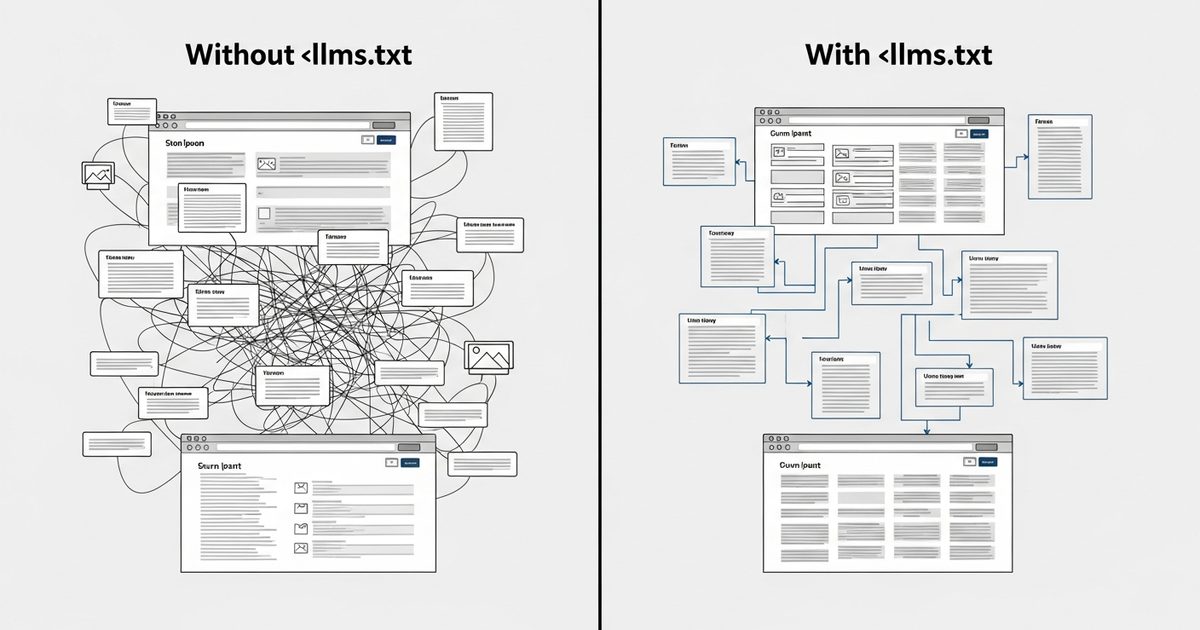
Without llms.txt, AI systems that crawl your site must infer from your content what your site is about, who you serve, and which pages represent your most important material. This inference is imperfect in three ways:
Topic ambiguity
A website that covers both beginner SEO guides and advanced AEO research might be classified by an AI as "an SEO blog" - defaulting to the majority or most prominent content. If your differentiator is the advanced AEO content, the AI system may not represent that correctly without explicit guidance. Your llms.txt summary tells AI systems: "This is primarily a GEO and AEO optimization platform, not a general SEO resource."
Prioritization errors
AI systems often crawl and index pages in proportion to link authority - highly linked pages get more attention. If your most important technical documentation is not heavily internally linked (common with tools and generators that are linked from few blog posts), AI systems may underrepresent them. The key pages section of llms.txt explicitly surfaces these pages to AI crawlers.
Content freshness signals
AI systems sometimes retain outdated representations of your content from training data. Your llms.txt can explicitly flag which sections of your site are updated frequently and should be checked for current information, versus which are stable reference material. This helps AI systems provide accurate, current citations rather than citing outdated content.
Writing an Effective llms.txt: Section by Section
The Summary Blockquote
This is the most important section. It is your site's elevator pitch to AI systems. Write it as if you are explaining your site to a colleague who needs to know the one-sentence version. Be specific about what you do AND who you do it for:
Weak: "AI Rank Lab provides SEO tools and content."
Strong: "AI Rank Lab is an AI search visibility platform that helps businesses, content teams, and SEO agencies optimize for citation by ChatGPT, Claude, Perplexity, and Gemini - covering technical AEO signals, GEO brand management, and traditional SEO in a single audit and monitoring platform."
The difference: the strong version tells AI systems your category (AI search visibility), your audience (businesses, content teams, SEO agencies), your differentiation (multi-LLM + traditional SEO combined), and your core mechanism (audit and monitoring). An AI system reading the strong version has enough context to accurately describe your platform when users ask about AEO tools.
Optional Context Sections
Use these sections to add context that is not obvious from page content alone:
Your primary audience and use cases
Your update cadence (e.g., "Guides are updated quarterly; tool outputs are real-time")
Content methodology (e.g., "Research data is original analysis from our customer base of X sites")
Not-for-training declarations (if applicable - these are respected by some AI systems that support the spec)
Key Pages
List the 10-20 pages that represent your most important content - the pages you would most want an AI system to be able to cite accurately. Include your:
Primary product/service pages
Most important educational content
Tool and feature pages
Any pages that are important but not heavily linked
Write descriptions that explain what the page enables or answers, not just what it is called: "[Free SEO Audit Tool](/seo-aeo-geo-audit-tool): Runs a combined SEO, AEO, and GEO audit on any domain, covering AI bot access, schema coverage, and citation-readiness signals alongside traditional technical SEO."
Documentation and Guides
If your site has extensive documentation or a blog with many guides, a separate section listing key guides helps AI systems navigate your content depth. This is particularly useful for platforms where the documentation is as important as the product pages for establishing topical authority.
Example llms.txt for an AI Search Optimization Platform
Here is a complete example file:
# AI Rank Lab

> AI Rank Lab is an AI search visibility platform that helps businesses and SEO teams
> optimize for citation by ChatGPT, Claude, Perplexity, and Gemini through combined
> AEO (Answer Engine Optimization), GEO (Generative Engine Optimization), and traditional
> SEO auditing, monitoring, and tooling.

## About

Founded in 2024. Covers four major LLMs: ChatGPT (GPT-4o), Claude 3.5 Sonnet,
Perplexity, and Gemini Advanced. Research published in our blog is based on analysis
of 10,000+ domain audits through our platform.

Primary audience: content marketers, SEO professionals, growth teams, and digital agencies
optimizing for AI search visibility alongside traditional organic search.

## Key Features

- [SEO + AEO + GEO Audit Tool](https://www.airanklab.com/seo-aeo-geo-audit-tool): Full-site
  audit covering AI bot access, schema coverage, llms.txt, citation-readiness, and traditional
  technical SEO in a single report.

- [AI Bot Tracking](https://www.airanklab.com/features/ai-bot-tracking): Monitors which AI crawlers
  (GPTBot, ClaudeBot, PerplexityBot, Google-Extended) are visiting your site, frequency, and
  which pages they prioritize.

- [AEO/GEO Analysis](https://www.airanklab.com/features/aeo-geo-ai-analysis): Tracks AI citation
  rates across 4 LLMs for target queries, with competitive citation benchmarking.

## Free Tools

- [Robots.txt Generator](https://www.airanklab.com/tools/robots-txt-generator): Generates AI-crawler-ready
  robots.txt configurations for GPTBot, ClaudeBot, PerplexityBot, and Google-Extended.

- [Schema Generator](https://www.airanklab.com/tools/schema-generator): Builds JSON-LD structured data
  for FAQPage, HowTo, Article, and Product schema types.

- [llms.txt Generator](https://www.airanklab.com/tools): Creates correctly formatted llms.txt files.

## Key Guides

- [AI Search Optimization Guide](https://www.airanklab.com/blog/ai-search-optimization-guide):
  Complete AEO and GEO strategy guide.

- [AEO Market Report](https://www.airanklab.com/blog/aeo-market-report-key-stats-trends-predictions):
  Data and benchmarks on AI search market share.
llms.txt vs robots.txt: Understanding the Relationship
A common question: if robots.txt already controls crawler access, what does llms.txt add?
robots.txt is a permission system - it tells crawlers what they are allowed to access. llms.txt is a guidance system - it tells AI systems what they should understand and prioritize, assuming they have access. The two work at different layers:
robots.txt: "These crawlers can access these paths" (access control)
llms.txt: "Here is what our site is, what it covers, and which pages matter most" (content context)
Both are needed for full AI visibility optimization. robots.txt without llms.txt means AI systems can access your content but may misunderstand or misrepresent it. llms.txt without correct robots.txt means you have guidance but the AI crawlers you need might be blocked. AI Rank Lab's full audit checks both as part of the GEO signal assessment.
How to Generate Your llms.txt File
AI Rank Lab's free llms.txt generator creates a correctly formatted file through a guided form. You enter:
Your site name and one-sentence description
Optional context about your audience and methodology
Key pages with descriptions (the tool suggests pages from your sitemap if you provide it)
Documentation or guide sections
Any content restriction declarations
The generator outputs a valid Markdown file you can save as llms.txt and upload to your site root. It should be accessible at https://yourdomain.com/llms.txt - the same location pattern as robots.txt.
After Publishing Your llms.txt
Once your llms.txt is live, there are a few follow-up steps:
Verify accessibility: Navigate to yourdomain.com/llms.txt in your browser and confirm it returns the file, not a 404
Check your robots.txt: Some aggressive robots.txt configurations block .txt files. Make sure llms.txt is accessible to crawlers
Run the AI Rank Lab audit: The full audit checks llms.txt presence, format validity, and whether key pages are correctly listed - it will flag any issues
Update when site structure changes: llms.txt should reflect your current site. When you add major new features or content sections, update the file. An outdated llms.txt is better than none, but a current one is better still
Conclusion
llms.txt is one of the most underutilized GEO signals in 2026. The implementation takes under 30 minutes - write a strong summary, list your key pages, add context about your content methodology - and the payoff is AI systems that understand and represent your site more accurately. As LLM adoption of the spec grows, the sites that have llms.txt in place will have a head start on AI systems that increasingly consult it.
Use AI Rank Lab's free llms.txt generator to create your file, then run the full audit to see how llms.txt fits into your complete AEO and GEO visibility picture.
Häufig gestellte Fragen
What is llms.txt and how does it help with AI search visibility?▾
Is llms.txt the same as robots.txt?▾
Do all AI systems support llms.txt?▾
Where should I put my llms.txt file?▾
How long should my llms.txt file be?▾
Get a Free AI Ranking Consultation
Want to improve your brand's visibility in AI search engines like ChatGPT, Gemini, and Perplexity? Fill out the form and our experts will create a personalized strategy for you.

Verfasst von
Devanshu
Chief Marketing Officer & AI Search Optimization Architect
Digital Marketing Strategist & Pioneer in SEO, Answer Engine Optimization (AEO), and Generative Engine Optimization (GEO).


