


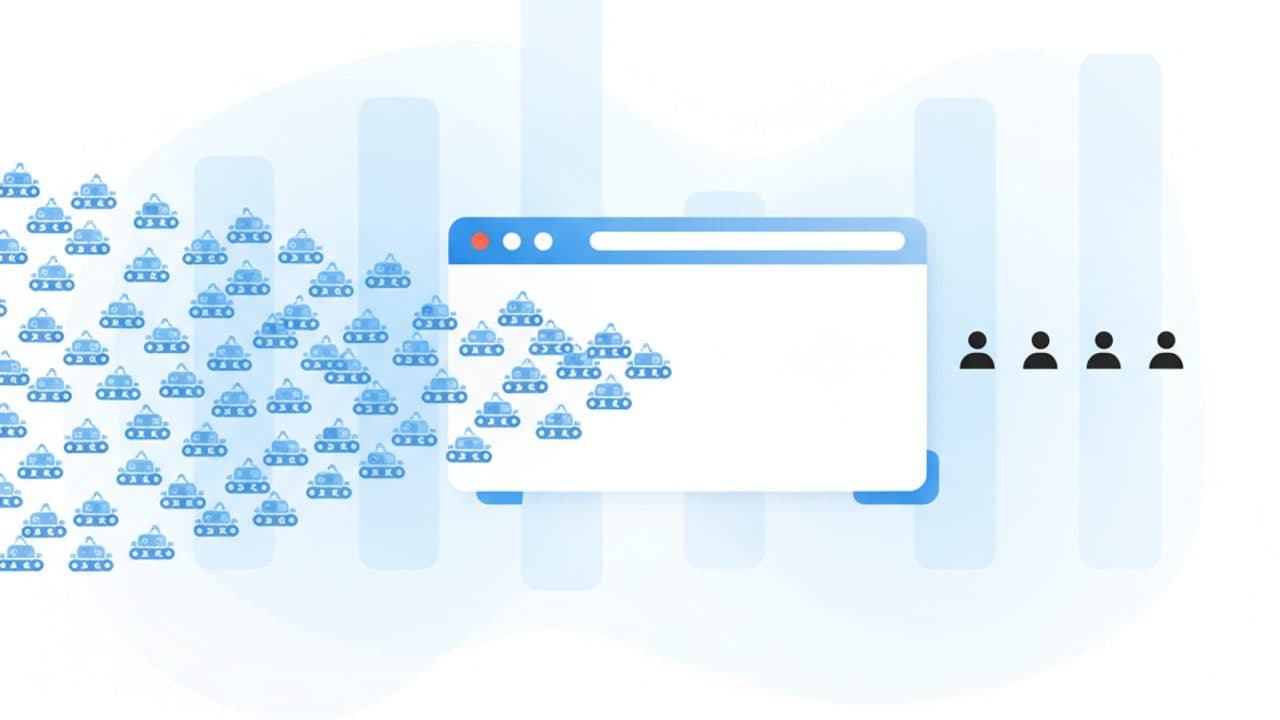
AI crawlers are a small slice of web traffic that takes far more pages than it sends back visitors. Across Cloudflare's network, AI bots averaged 4.2% of HTML requests in 2025, close to Googlebot's 4.5% on its own (Cloudflare Radar 2025 Year in Review, 1 January to 2 December 2025). Training was 79% of that AI crawling in July 2025, and Anthropic's bots requested about 38,000 pages for every visitor Claude referred, against roughly 5 for Google (Cloudflare, The crawl-to-click gap, July 2025).
This report collects the AI crawler statistics that come from network logs, web-wide crawls and the crawler operators' own documentation. Every number has its source and the period it covers beside it. We opened each source on 11 November 2026, so this is data to November 2026: nothing here is a 2027 measurement, and where the newest figure is from 2025 we say so. Two sections are unusual for a statistics page. One shows where Cloudflare's own numbers disagree with each other. The other lists popular figures we could not trace and left out.
Key statistics
- 4.2% of HTML requests on Cloudflare's network came from AI bots in 2025, ranging from 2.4% in early April to 6.4% in late June. Googlebot alone was 4.5%. (Cloudflare Radar 2025 Year in Review)
- 28.1% of AI-only crawling came from GPTBot in July 2025, up from 11.9% in July 2024. ClaudeBot was second at 23.3%. (Cloudflare)
- 79% of AI crawling was for model training in July 2025, 17% for search and 3.2% for user actions. (Cloudflare)
- 38,065.7 to 1: Anthropic's crawl-to-refer ratio in July 2025. OpenAI was 1,091.4, Perplexity 194.8 and Google 5.4. (Cloudflare)
- 52% of crawler requests were for AI training as of June 2026, by Cloudflare's newer classification, with mixed-use crawlers at over 36%. (Cloudflare, July 2026)
- 20.9% of the top 1,000 websites name GPTBot in robots.txt, against about 4.5% of all sites. (HTTP Archive Web Almanac 2025, July 2025 crawl)
- 48% of the most-used news websites in ten countries blocked OpenAI's crawlers at the end of 2023. (Reuters Institute)
- 2.13% of desktop sites had a valid llms.txt file in the July 2025 crawl. (Web Almanac 2025)
How much web traffic is bots, and how much of it is AI crawlers?
About a third of all requests on Cloudflare's network are automated, and AI bots are a single-digit share of page requests. The answer changes with the denominator, so here are the three measures Cloudflare has published, each with its base.
| Measure | Figure | Denominator | Period | Source |
|---|---|---|---|---|
| Automated traffic | 32% | All traffic across Cloudflare's network | Not stated; post dated 2 April 2026 | Cloudflare, Why we're rethinking cache for the AI era |
| AI bots | 4.2% average (2.4% to 6.4%) | HTML requests | 1 Jan to 2 Dec 2025 | Radar 2025 Year in Review |
| Googlebot | 4.5% average, peaking at 11% in late April | HTML requests | 1 Jan to 2 Dec 2025 | Radar 2025 Year in Review |
| Humans vs non-AI bots | 47% vs 44% | HTML requests | As of 2 Dec 2025 | Radar 2025 Year in Review |
| AI crawlers | 20% | Verified Bot traffic (search crawlers: 40%) | 2025 | Radar 2025 Year in Review |
| AI bot requests | Over 10 billion a week | Count, Cloudflare network | Not stated; post dated 2 April 2026 | Cloudflare |
Read the table by row, not by column. "32% automated" counts every request, including images, scripts and API calls. The 4.2% counts only requests for HTML pages, which is the number that matters if you publish articles or product pages. "20% of Verified Bot traffic" is a share of bots that have passed Cloudflare's verification, so it excludes anything pretending to be a browser.
Googlebot needs a caveat of its own. Cloudflare notes that Googlebot crawls for both search indexing and AI training, so the 4.5% is not purely "search". It was also the busiest verified bot of 2025 at over 28% of Verified Bot traffic, with GPTBot next at about 7.5% (Radar 2025 Year in Review).
Have bots overtaken humans?
On Cloudflare's HTML measure, humans were still slightly ahead in December 2025: 47% of HTML requests against 44% for non-AI bots. In July 2026 the company wrote that "more than 50% of traffic on the Internet is now non-human" (Cloudflare, Content Independence Day, one year on, 1 July 2026). That post does not define "non-human" or give the base, and it sits beside the 32% all-traffic figure from three months earlier. Our reading: the claim is about page requests, where bots and humans were already near parity. We would quote the 32% for "share of all web traffic" and the 47% vs 44% split for "share of page requests", and treat "more than 50%" as a company statement until Cloudflare publishes the series behind it.
Which AI crawlers crawl the most?
GPTBot was the largest AI-only crawler in the last month Cloudflare published a full table for, July 2025, with 28.1% of AI-only crawling. ClaudeBot followed at 23.3% and Meta-ExternalAgent at 17.7%. A year earlier the leader was ByteDance's Bytespider at 37.3%, which then fell to 5.8% (Cloudflare, The crawl-to-click gap).
| Crawler | Operator | Share of AI-only crawling, July 2024 | July 2025 | Change (points) |
|---|---|---|---|---|
| GPTBot | OpenAI | 11.9% | 28.1% | +16.1 |
| ClaudeBot | Anthropic | 15% | 23.3% | +8.3 |
| Meta-ExternalAgent | Meta | 2.4% | 17.7% | +15.3 |
| Amazonbot | Amazon | 26.4% | 14.1% | -12.3 |
| Bytespider | ByteDance | 37.3% | 5.8% | -31.5 |
| Applebot | Apple | 4.9% | 3.7% | -1.2 |
| ChatGPT-User | OpenAI | 0.2% | 2.4% | +2.2 |
| OAI-SearchBot | OpenAI | 0% | 2.2% | +2.2 |
| PerplexityBot | Perplexity | 0% | 0.4% | +0.4 |
Source: Cloudflare, fixed set of customers, July 2024 and July 2025. Shares are of AI-only crawler traffic, so Googlebot and Bingbot are excluded.
GPTBot statistics
GPTBot's raw requests rose 305% between May 2024 and May 2025, while total AI and search crawler traffic grew 18% on a fixed set of Cloudflare customers (Cloudflare, From Googlebot to GPTBot). Put Googlebot back in the picture and GPTBot shrinks: in July 2025 Googlebot was 39% of all AI and search crawler traffic and GPTBot 11.7% (Cloudflare). On one hosting network, Vercel counted 569 million GPTBot fetches in a month against 4.5 billion for Googlebot (Vercel, The rise of the AI crawler, published 17 December 2024).
OpenAI runs GPTBot for training only. Its documentation says disallowing GPTBot "indicates a site's content should not be used in training generative AI foundation models", and that ChatGPT search inclusion is controlled by a different bot, OAI-SearchBot (OpenAI crawler documentation, checked 11 November 2026). So a GPTBot count tells you about training appetite, not about how often ChatGPT might cite you.
ClaudeBot statistics
ClaudeBot's share has swung more than any other major crawler. It fell from 11.7% to 5.4% of AI and search crawler traffic between May 2024 and May 2025, with raw requests down 46% (Cloudflare), yet two months later it held 23.3% of AI-only crawling (Cloudflare). Across 2025 its crawling "effectively doubled through the first half of the year" and ended about 10% above where it started (Radar 2025 Year in Review). Single-month ClaudeBot figures are unreliable for this reason. Quote the month.
User-triggered fetchers are the fastest-growing group
Bots that fetch a page because a person asked an assistant about it grew fastest in 2025, from a tiny base. ChatGPT-User requests rose 2,825% from May 2024 to May 2025 (Cloudflare), and it made up nearly three quarters of user-action crawling in July 2025 (Cloudflare, A deeper look at AI crawlers). The Year in Review says user-action crawling grew "over 15x" in its headline and "over 21x from January through early December" in the body (Radar 2025 Year in Review). Both statements are on the same page; we quote the lower one.
Is AI crawling mostly for training or for search?
Training. Every Cloudflare measurement puts training well ahead of search crawling, but the published shares conflict depending on when and how the bots were classified.
| Period | Training | Search | User action | Other category | Source |
|---|---|---|---|---|---|
| July 2024 | 72% | 26% | 2% | - | Cloudflare, Aug 2025 |
| July 2025 | 79% | 17% | 3.2% | - | Cloudflare, Aug 2025 |
| 12 months to July 2025 | 80% | 18% | 2% | - | Cloudflare, Aug 2025 |
| "Spring 2025", as restated in 2026 | 22% | Not given | Not given | Not given | Cloudflare, Jul 2026 |
| June 2026 | 52% | "Small and declining" | Not given | Mixed-use: over 36% | Cloudflare, Jul 2026 |
The 2025 posts and the July 2026 post cannot be describing one series. Cloudflare said training was about 79% in mid-2025, then a year later said training was 52% "up from 22% in Spring 2025". The newer post introduces a "mixed-use" category for crawlers that gather content for search, agents and training at once, which the 2025 breakdown did not have. Cloudflare does not explain the restatement in the post. Third-party trackers that pull Radar data each month report that the purpose series was reclassified during 2026, which fits, but we could not confirm it on a Cloudflare page.
What we would do with this: quote each figure with its date and never draw a line from 79% to 52%. The stable finding across both versions is that pure search crawling is the minority, and that a growing share of bots will not say which job a given fetch is for. One more caution from Cloudflare's own methodology: purpose labels come from "operator disclosures and industry sources". They record what the operator says the bot is for.
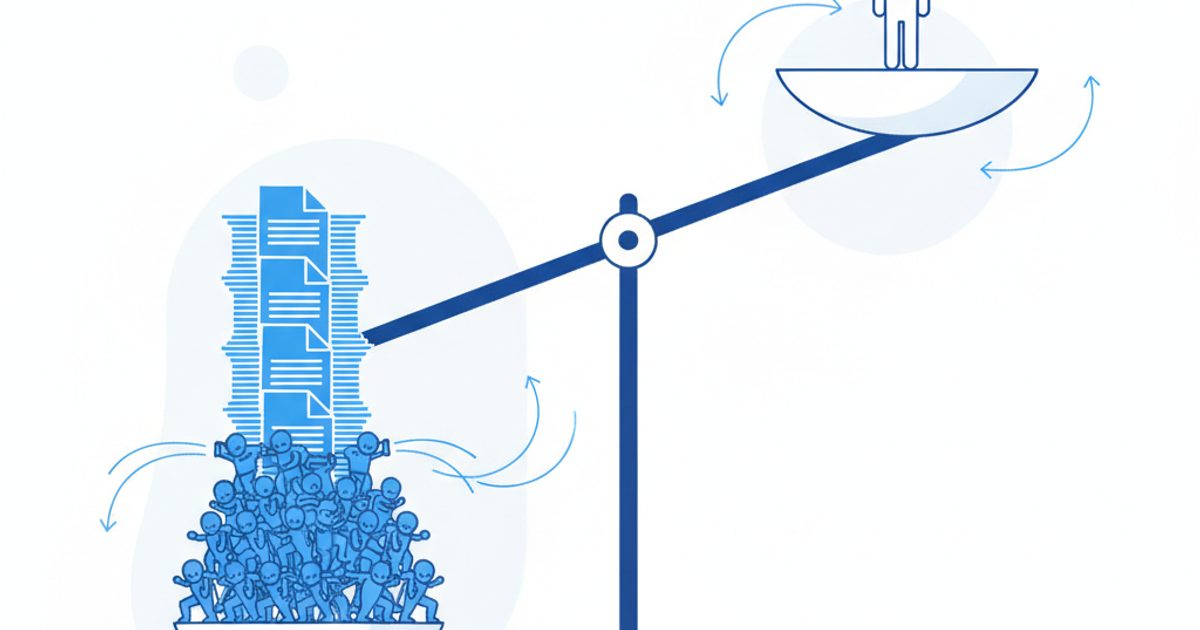
What is a crawl-to-refer ratio, and how many pages do AI bots take per visitor?
A crawl-to-refer ratio is the number of HTML pages a platform's bots request for each visitor the platform refers back. Cloudflare calculates it by dividing HTML requests from a platform's crawler user agents by HTML requests whose Referer header names that platform (Cloudflare, The crawl before the fall of referrals, 1 July 2025). A ratio of 100 means one hundred pages crawled per referred visit.
| Platform | January 2025 | July 2025 | Jan-Jul average | Change Jan to Jul |
|---|---|---|---|---|
| Anthropic | 286,930.1 | 38,065.7 | 147,754.7 | -86.7% |
| OpenAI | 1,217.4 | 1,091.4 | 1,437.8 | -10.4% |
| Perplexity | 54.6 | 194.8 | 172.4 | +256.7% |
| Microsoft | 38.5 | 40.7 | 42.3 | +5.7% |
| 3.8 | 5.4 | 11.8 | +43% | |
| DuckDuckGo | 0.1 | 0.3 | 0.2 | +116.3% |
Source: Cloudflare, The crawl-to-click gap, monthly values, January to July 2025. Each figure is pages crawled per one referral.
The gap between AI platforms and search engines runs from two to four orders of magnitude, and that is the finding to keep. Google's ratio moved between 3.8 and 22.5 during those seven months. Anthropic's never dropped below 38,000.
Why the same platform has five different ratios
The window changes the answer. Anthropic's ratio was 70,900 to 1 for 19 to 26 June 2025 (Cloudflare), 38,065.7 for the month of July 2025 (Cloudflare), "nearly 50,000:1" for 1 to 7 August 2025 (Cloudflare), and peaked at "as much as 500,000:1" during 2025 (Radar 2025 Year in Review). All four are correct for their window.
Industry changes it too. In the first week of August 2025, the ratios for News and Publications sites were 2,500 to 1 for Anthropic, 152 for OpenAI and 32.7 for Perplexity, far below the all-industry values of nearly 50,000, 887 and 118 (Cloudflare). News sites get more AI referrals per crawl than the average site, probably because people ask assistants about current events.
Three limits on these ratios
- App referrals are invisible. Cloudflare states that traffic referred by Claude's native app carries no Referer header, believes the same holds for other native apps, and says the calculations "may overstate the respective ratios, but it is unclear by how much" (Cloudflare).
- A ratio mixes two jobs. The numerator includes training crawls that were never meant to produce a visit. A company that trains heavily and has a small consumer product will always look worst.
- It is one network. Cloudflare says more than 20% of the web sits behind it (Cloudflare, July 2026). That is a large sample and still a sample.
Newer values exist. Radar's AI Insights dashboard updates the ratios continuously, and the Year in Review notes Perplexity stayed below 200 to 1 from September 2025. We could not open the dashboard with our tools on 11 November 2026, and the third-party pages that read it for 2026 disagree with each other for the same months, so we publish no 2026 ratio here. The direction those readers report is consistent: Anthropic's ratio has fallen by orders of magnitude since 2025. Check the dashboard for the current month before quoting one.
How many websites block AI crawlers in robots.txt?
Few sites overall, and a large minority of big ones. The European Commission gave robots.txt formal weight for AI in 2025: under Measure 1.3 of the General-Purpose AI Code of Practice copyright chapter, published 10 July 2025, signatories commit "to employ web-crawlers that read and follow instructions expressed in accordance with the Robot Exclusion Protocol (robots.txt)" as specified in RFC 9309 (European Commission, General-Purpose AI Code of Practice). Amazon, Anthropic, Google, Microsoft, Mistral AI and OpenAI are among the signatories listed on that page, which was last updated 7 October 2026.
How many sites use that lever depends on where you look:
| Sample | Finding | Period | Source |
|---|---|---|---|
| About 12.9 million sites | 94.1% have a robots.txt file; GPTBot is named in about 4.5% (2.6% in 2024) | July 2025 crawl | Web Almanac 2025, Generative AI |
| Top 1,000 sites | GPTBot named by 20.9% | July 2025 crawl | Web Almanac 2025, Generative AI |
| Top 10,000 / 100,000 / 1 million sites | GPTBot named by 12.1% / 6.1% / 3.6% | July 2025 crawl | Web Almanac 2025, Generative AI |
| 3,816 robots.txt files found on the top 10,000 domains | 546 (about 14%) had directives for AI bots; GPTBot disallowed on 312 and allowed on 61 | Snapshot, 6 June 2025 | Cloudflare |
| About 150 leading news sites, ten countries | 48% blocked OpenAI's crawlers; 24% blocked Google's AI crawler | End of 2023 | Reuters Institute |
"Named in robots.txt" is not identical to "blocked", though the Almanac authors found that on popular sites nearly all AI-bot directives are disallows. Cloudflare's top-10,000 snapshot agrees: five GPTBot disallow rules for every allow rule.
Which AI bots are named most often?
GPTBot leads, with ClaudeBot gaining fastest. The Web Almanac's SEO chapter lists the share of robots.txt files naming each bot (desktop crawl, 2025): gptbot 4.5%, claudebot 3.6%, ccbot 3.5%, google-extended 3.4%, amazonbot 3.3%, perplexitybot 2.8% and chatgpt-user 2.8% (Web Almanac 2025, SEO chapter). ClaudeBot was at 1.9% a year earlier. The two Almanac chapters give slightly different 2024 baselines for GPTBot, 2.6% in the Generative AI chapter and 2.9% in the SEO chapter's desktop figure. We use the SEO chapter for year-on-year comparisons because it states desktop and mobile separately.
How many news sites block AI crawlers?
Close to half of leading news sites, on the best academic count, which is now dated. The Reuters Institute checked archived robots.txt files for the 15 most-used online news sources in each of ten countries and found 48% blocking OpenAI's crawlers by the end of 2023. The spread was wide: 79% in the United States, 20% in Mexico and Poland. Legacy print publishers blocked most (57%) and digital-born outlets least (31%). No site that blocked a crawler during 2023 unblocked it (Reuters Institute, How many news websites block AI crawlers?, 22 February 2024). We found no primary study repeating this method for 2025 or 2026, so treat 48% as a floor from two years ago, not a current rate.
Do AI crawlers obey robots.txt?
The declared training and search crawlers say they do; user-triggered fetchers often do not, by design. Compliance is voluntary: RFC 9309 states that robots.txt rules "are not a form of access authorization" (IETF RFC 9309, September 2022). Here is what each operator's documentation said on 11 November 2026:
- OpenAI: GPTBot and OAI-SearchBot are controlled through robots.txt, with about 24 hours for a change to take effect. For ChatGPT-User, "robots.txt rules may not apply" because a user started the action (OpenAI).
- Anthropic: ClaudeBot, Claude-User and Claude-SearchBot honor robots.txt, and Anthropic supports the non-standard Crawl-delay directive (Anthropic help center).
- Google: Google-Extended is a robots.txt token with no separate user agent. It controls use for Gemini training and grounding and "does not impact a site's inclusion in Google Search" (Google crawler documentation).
- Perplexity: PerplexityBot follows robots.txt, with up to 24 hours for changes. Perplexity-User "generally ignores robots.txt rules" (Perplexity documentation).
Stated policy and observed behavior can differ. In August 2025 Cloudflare reported that Perplexity's declared crawlers made 20 to 25 million requests a day while an undeclared crawler presenting itself as Chrome made 3 to 6 million more, including to test domains whose robots.txt disallowed all bots. In the same test, ChatGPT-User fetched robots.txt and stopped (Cloudflare, 4 August 2025). That is one vendor's test of two companies, not a compliance rate for the industry. Nobody has published one. For the full list of tokens and what blocking each one costs, see our AI crawler user agent reference.
How many sites have an llms.txt file, and does Google use it?
About 2% of sites, and no. The Web Almanac found a valid llms.txt on 2.13% of desktop sites and 2.1% of mobile sites in its July 2025 crawl (Web Almanac 2025, Generative AI). The SEO chapter counted 324,184 valid files across mobile sites and traced 39.6% of them to the All in One SEO plugin and 3.6% to Yoast SEO (Web Almanac 2025, SEO chapter). A large part of "adoption" is a plugin default, not a decision someone made.
Google's guidance is direct. You do not need "new machine readable files, AI text files, markup, or Markdown to appear in Google Search", and creating llms.txt "will neither harm nor help your site's visibility or rankings in Google Search" (Google Search Central, generative AI optimization guide). We have no primary data on how often other assistants request the file. If you already publish one, our llms.txt checker validates the format, and our post on whether llms.txt improves AI citations covers the evidence in more depth.
What do AI crawlers do once they reach a page?
They fetch raw HTML, skip JavaScript and hit a lot of dead URLs. The only primary study we found is from Vercel and MERJ, covering one month on Vercel's network in late 2024 (Vercel, The rise of the AI crawler, 17 December 2024), so treat it as dated and as one host's traffic:
- Volume: GPTBot made 569 million fetches, Claude 370 million, and Googlebot 4.5 billion.
- JavaScript: none of the major AI crawlers tested (OpenAI, Anthropic, Meta, ByteDance, Perplexity) rendered JavaScript. Googlebot does.
- Dead ends: 34.82% of ChatGPT's fetches and 34.16% of Claude's returned a 404, against 8.22% for Googlebot.
The practical point survives the age of the data: if your main content appears only after client-side JavaScript runs, most AI crawlers never see it. Cloudflare adds a cost angle. AI crawlers raise cache miss rates, and crawlers made up 80% of self-identified AI bot traffic on its network (Cloudflare, April 2026).
Numbers in circulation that we left out
These figures appear on other AI crawler statistics pages. We could not confirm them on a primary page on 11 November 2026, so none is in the key statistics.
| Claim you will see | Usual attribution | Why it is not in this report |
|---|---|---|
| Bots are 57.5% of HTML requests (June 2026) | A social media post by Cloudflare's CEO, repeated by roundups | We found no Cloudflare page carrying the figure. The July 2026 blog post says only "more than 50%". |
| Monthly 2026 crawl-to-refer ratios and bot shares | Vendor blogs reading the Radar API | Radar is the origin, but we could not open it, and the vendor readings conflict for the same month. One tracker notes Cloudflare revised the series after publication. |
| "Automated traffic is 51% (or 53%) of all internet traffic" | Imperva Bad Bot Report | The 2026 report's landing page says bots are "the majority of global web traffic" in text but shows the percentage only in a graphic we could not read. |
| "About 10% of sites have llms.txt" | Unnamed | No source or sample given where we saw it. The crawl-based figure is 2.13%. |
| Crawler counts from JavaScript analytics tags | Various tools | Most AI crawlers do not run JavaScript, so a client-side tag undercounts them badly. That includes our own tag, which is why this report uses none of our data. |
How to measure AI crawler traffic on your own site
Use server-side logs. Network averages tell you what is normal; your logs tell you what is happening to you.
- Pull 30 days of server or CDN logs. Analytics tags will not do, for the JavaScript reason above.
- Filter by user agent for GPTBot, OAI-SearchBot, ChatGPT-User, ClaudeBot, Claude-SearchBot, Claude-User, PerplexityBot, Perplexity-User, Meta-ExternalAgent, Amazonbot, Bytespider and Googlebot.
- Verify the claims. User agents are easy to fake. Check requests against the IP ranges each operator publishes or use reverse DNS. Our guide to monitoring GPTBot, ClaudeBot and PerplexityBot has the steps.
- Group by purpose: training, search index, user-triggered. This is the split that drives the allow or block decision.
- Count referrals separately. In GA4 or your logs, count sessions referred from chatgpt.com, claude.ai, perplexity.ai, gemini.google.com and copilot.microsoft.com for the same 30 days.
- Divide. HTML requests by an operator's bots over referred sessions from its product gives your own crawl-to-refer ratio, with the same app-referral blind spot Cloudflare describes.
- Decide per bot, then write the rules. Blocking a training bot does not remove you from that company's search product, as long as you leave its search bot alone.
Two of our free tools help with the last step: the robots.txt generator writes per-bot rules, and the walkthrough in robots.txt templates for AI crawlers explains the trade-offs. For step 5, AI Rank Lab's AI bot tracking records visits referred by AI assistants per page. It runs in the browser, so it does not count GPTBot or ClaudeBot hits; your logs do that.
Our position on blocking, since the numbers invite one: we would allow the search and user-triggered bots, because they are the only path to being cited, and decide on training bots by whether your content is your product. A 38,000 to 1 ratio is a fair reason for a publisher to block ClaudeBot. It is a weak reason for a SaaS company whose goal is to be described accurately by Claude.
Methodology
What we included. Numbers from three kinds of source: network measurements published by the company that operates the network (Cloudflare, Vercel), web-wide crawls with a stated sample (HTTP Archive Web Almanac, Reuters Institute), and official documents (operator crawler documentation, IETF RFC 9309, the European Commission's code of practice, Google Search Central). We opened every source on 11 November 2026 and confirmed each figure on the page.
Data cutoff. 11 November 2026. The newest network data here is from Cloudflare posts dated April and July 2026; the detailed bot-by-bot and ratio tables are from July 2025; the web crawls are from July 2025; the news-site study is from the end of 2023. Cloudflare's 2026 Year in Review usually publishes in December and will replace several figures. We will update this page when it does.
What we left out and why. Any figure whose origin we could not open, vendor readings of the Radar API, security-vendor reports whose numbers sit behind a form, and all data from JavaScript-based analytics, including our own product's. The section above lists the main exclusions.
Known limits. Most traffic figures come from one company, Cloudflare, which also sells bot-blocking and pay-per-crawl products. Its data covers sites behind its network. Purpose labels rely on what operators declare. Crawl-to-refer ratios miss referrals from native apps. Shares for single months move a lot, and Cloudflare restated its purpose series in 2026.
How this was made. Research and drafting were AI-assisted. Every number was checked against the linked source before publication. Disclosure: AI Rank Lab is our product; it appears only in the measurement section.
Sources
- Cloudflare Radar 2025 Year in Review. Cloudflare. 15 December 2025.
- The crawl-to-click gap: Cloudflare data on AI bots, training, and referrals. Cloudflare. 29 August 2025.
- A deeper look at AI crawlers: breaking down traffic by purpose and industry. Cloudflare. 28 August 2025.
- From Googlebot to GPTBot: who's crawling your site in 2025. Cloudflare. 1 July 2025.
- The crawl before the fall of referrals: understanding AI's impact on content providers. Cloudflare. 1 July 2025.
- Content Independence Day, one year on: building the business model for the agentic Internet. Cloudflare. 1 July 2026.
- Why we're rethinking cache for the AI era. Cloudflare. 2 April 2026.
- Perplexity is using stealth, undeclared crawlers to evade website no-crawl directives. Cloudflare. 4 August 2025.
- Cloudflare Radar AI Insights (live dashboard; not readable with our tools on 11 November 2026, no figure taken from it). Cloudflare. continuous.
- The rise of the AI crawler. Vercel and MERJ. 17 December 2024.
- Web Almanac 2025, Generative AI chapter. HTTP Archive. 15 January 2026 (July 2025 crawl).
- Web Almanac 2025, SEO chapter. HTTP Archive. 15 January 2026, updated 9 June 2026.
- How many news websites block AI crawlers?. Reuters Institute for the Study of Journalism, University of Oxford. 22 February 2024.
- The General-Purpose AI Code of Practice (copyright chapter, Measure 1.3). European Commission. 10 July 2025; page updated 7 October 2026.
- RFC 9309: Robots Exclusion Protocol. Internet Engineering Task Force. September 2022.
- Overview of OpenAI crawlers. OpenAI. checked 11 November 2026.
- Does Anthropic crawl data from the web, and how can site owners block the crawler?. Anthropic. checked 11 November 2026.
- Google's common crawlers. Google Search Central. checked 11 November 2026.
- Perplexity crawlers. Perplexity. checked 11 November 2026.
- Guide to optimizing for generative AI features on Google Search. Google Search Central. 15 May 2026.
If you want the referral side of this picture for your own site, AI Rank Lab's AI bot tracking shows which pages AI assistants send visitors to. Sign-up includes 100 free credits and needs no card.
Get a free AI ranking consultation
Want your brand to show up when ChatGPT, Gemini and Perplexity answer questions in your market? Tell us about your site and our team will send a personalized strategy.


