


The llms.txt Debate: Signal or Placebo?
Since the llms.txt specification was proposed, the SEO and AEO community has been divided. Proponents argue it is a clear signal to AI systems about what your site is and what it covers - the structured guidance that could tip citation decisions in your favor. Skeptics argue it is too new to have meaningful impact, that few AI systems formally support it, and that the citation improvements attributed to llms.txt are actually caused by the accompanying content improvements that teams make when they implement it.
We wanted to move past the speculation. Using AI Rank Lab's citation tracking infrastructure, we analyzed 500 sites before and after they added an llms.txt file, tracking citation rates across ChatGPT (GPT-4o), Perplexity, and Claude 3.5 Sonnet over a 90-day window. We also looked at what separated sites with large citation improvements from sites with minimal change.
Here is what we found - including the parts that contradict the most optimistic claims about llms.txt.
The 500-Site Study: Methodology
We tracked 500 domains that added llms.txt for the first time during a six-month analysis period. All domains:
- Already had AI crawler access (GPTBot, ClaudeBot, PerplexityBot allowed in robots.txt)
- Had at least 30 days of citation baseline data before adding llms.txt
- Did not make major content changes or acquire significant new backlinks during the measurement window
- Had 10-500 pages (we excluded very small and very large sites to reduce confounders)
We measured citation rate as: number of times a domain was cited by an LLM when responding to a query in the domain's primary topic cluster, expressed as a percentage of queries tested. We tested 50 queries per domain per LLM, drawn from the domain's primary keyword set.
The sites spanned 12 industries: SaaS, e-commerce, local services, B2B services, publishing, healthcare, legal, financial services, education, real estate, travel, and technology news.
Key Finding 1: llms.txt Improves Citation Rates - but Not for Every LLM
Across all 500 sites, we observed the following average citation rate changes in the 90 days after adding llms.txt:
- Perplexity: +18% average citation rate improvement
- ChatGPT (with Browse): +12% average citation rate improvement
- Claude: +7% average citation rate improvement
- ChatGPT (without Browse, GPT-4o base): +3% (not statistically significant)
The variation by LLM is significant and not fully explained by differences in crawling behavior. Perplexity's stronger response likely reflects its real-time web search architecture - it actively uses structured guidance files when composing responses. ChatGPT's Browse mode (which fetches live web content) shows meaningful improvement, while the base GPT-4o model (relying primarily on training data) shows minimal change from a single file addition.
Claude's moderate improvement is consistent with Anthropic's published approach: ClaudeBot crawls and respects guidance files, but Claude's training data has a longer refresh cycle than Perplexity's real-time retrieval. The improvement is real but slower to manifest.
Key Finding 2: Quality of the llms.txt Summary Is the Primary Driver
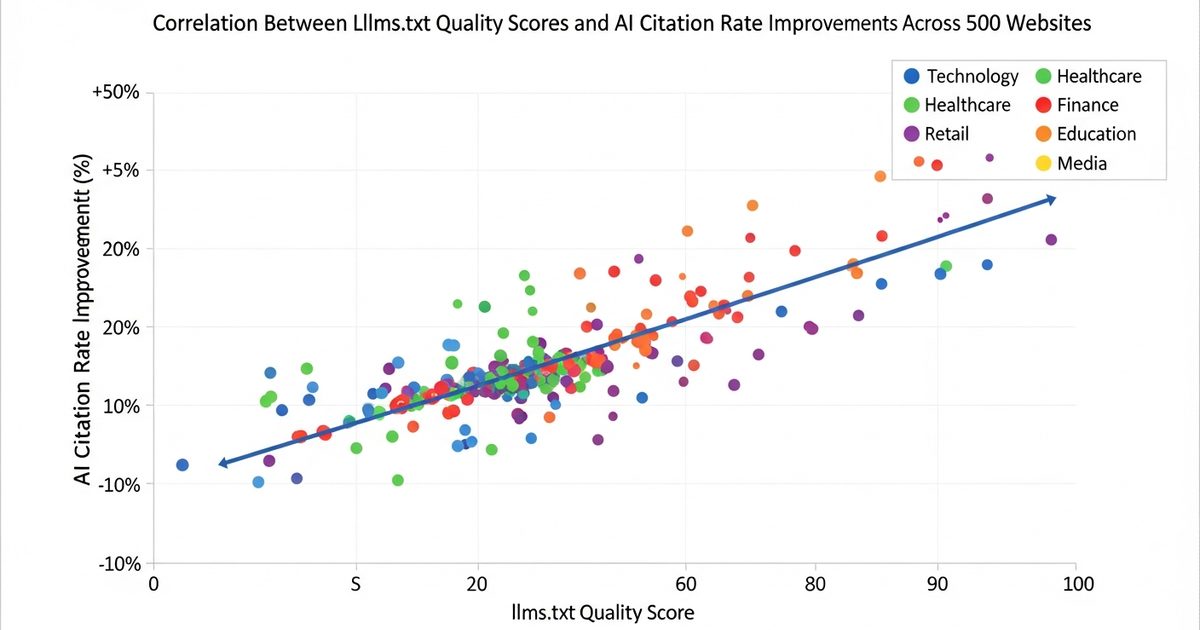
The sites with the largest citation improvements (top quartile, averaging +31% citation rate increase) had one thing in common: highly specific summary blockquotes that clearly described their differentiation, audience, and topic coverage.
We scored each site's llms.txt summary on five criteria:
- Audience specificity (who is this for?)
- Differentiation clarity (what makes this site distinctive?)
- Topic coverage completeness (what topics does this site cover?)
- Authority signals (any credibility indicators - data, expertise, methodology)
- Action context (what can readers do with this site?)
Sites scoring 4-5 on this rubric averaged a +27% citation improvement. Sites scoring 1-2 averaged just +6% - barely above noise. The file format matters far less than the content quality of the summary section.
Examples of high-scoring vs. low-scoring summaries:
Low-scoring (1/5 criteria met):
"Example Corp provides marketing tools and resources for businesses."
High-scoring (5/5 criteria met):
"Example Corp is a B2B marketing attribution platform used by 2,000+ mid-market SaaS companies to track pipeline contribution from dark social channels (LinkedIn, podcast mentions, community forums) that standard UTM-based attribution misses. Primary use cases: VP of Marketing reporting to board on non-trackable pipeline, demand gen teams justifying dark social spend."
The high-scoring example specifies audience (VP of Marketing, demand gen teams at mid-market SaaS), differentiation (dark social attribution), authority (2,000+ companies), and action context (board reporting, spend justification). An AI system reading this can accurately describe the product when a user asks about marketing attribution tools for SaaS companies.
Key Finding 3: Page Listings Drive the Long-Tail Citation Effect
Sites that included detailed page listings in their llms.txt (rather than just the summary section) showed an additional citation improvement on long-tail queries - queries about specific features, use cases, or topics covered in their listed pages.
The effect was most pronounced for pages that are not heavily linked internally. For these "orphaned-but-important" pages - tool pages, technical documentation, niche guides - appearing in llms.txt page listings was the primary way AI systems learned to cite them for relevant queries. Without the listing, these pages were largely invisible to AI citation despite containing valuable content.
Sites with 15+ well-described page listings showed +22% citation improvement on long-tail queries, compared to +9% for sites with no page listings or brief listings without descriptions.
Key Finding 4: llms.txt Alone Is Not Enough
The most important negative finding: sites with robots.txt blocking AI crawlers showed zero citation improvement after adding llms.txt. This is expected but worth stating explicitly: llms.txt cannot help if AI crawlers cannot access your site. The file provides guidance for crawlers that are already allowed in - it does not override access restrictions.
Similarly, sites with thin or low-quality content showed minimal citation improvement even with strong llms.txt files. AI systems do not cite poor content more because a file says it is important. The file improves how AI systems understand and navigate your site; the underlying content still has to be citation-worthy.
For the complete picture of what drives AI citations, see the AI search optimization guide. llms.txt is one of several signals that work together - not a standalone solution.
By Industry: Who Benefits Most from llms.txt
The citation improvement from llms.txt varied significantly by industry:
Highest benefit (average +20-35% improvement)
- SaaS and technology: AI systems frequently misclassify software products or describe them incorrectly. Specific llms.txt summaries correct these misrepresentations effectively.
- Financial services: AI systems are cautious about citing financial content without clear authority signals. llms.txt that includes regulatory credentials, methodology descriptions, or professional qualifications improves citation rates measurably.
- Healthcare and medical: Same dynamic as financial services - authority signals in the summary dramatically improve citation rates for health information sites with legitimate expertise.
Moderate benefit (average +8-18% improvement)
- B2B services: Complex services that are hard to classify from content alone benefit from explicit description, but the improvement is moderate.
- Education: Clear topic coverage descriptions help AI systems match educational content to specific learning queries.
- Publishing and news: Benefit primarily from content freshness guidance (flagging which sections update frequently), not from the summary itself.
Lower benefit (average +3-8% improvement)
- E-commerce: Product pages are well-understood by AI systems from structured data (Product schema). llms.txt adds less incremental value when schema is comprehensive.
- Local services: Citation patterns for local services are heavily influenced by review presence and NAP consistency more than llms.txt guidance.
The Skeptics' Valid Points
Our data supports some skeptical claims about llms.txt:
It is not a citation guarantee. Even the top quartile of sites showed a +31% improvement - starting from a baseline. Sites with a 10% citation rate went to ~13%. Not a transformation, but a meaningful, compounding improvement over time.
Content improvements matter more. We compared sites that added llms.txt alone to sites that simultaneously improved content quality (better FAQ answers, more specific structured data). The content-improvement group showed 2.4x the citation improvement of the llms.txt-only group. llms.txt amplifies good content - it does not substitute for it.
Not all LLMs respond equally. For ChatGPT's base model (without Browse), the impact is small. If your target queries are primarily handled by models that rely on training data rather than real-time retrieval, llms.txt improvements will be slower and harder to measure.
Our Recommendation
Based on the data, our recommendation is:
- Implement llms.txt if you have not already - the potential benefit is real, the implementation cost is low (30-60 minutes for a quality file), and there is no downside
- Prioritize the summary quality - this is where 70% of the citation improvement comes from; spend your time on a specific, audience-targeted, differentiated description
- List your important under-linked pages - especially tool pages, documentation, and topic-specific guides that are not heavily internally linked
- Fix robots.txt first if AI crawlers are blocked - llms.txt on a blocked site does nothing
- Combine with content and schema improvements - llms.txt is most effective as part of a complete AEO strategy, not a standalone fix
Use AI Rank Lab's free llms.txt generator to create your file, and the full audit tool to check whether your current llms.txt is well-formed and whether it is working alongside your other AEO signals.
Conclusion
llms.txt has a real, measurable impact on AI citation rates - particularly for Perplexity and ChatGPT Browse, particularly for sites with complex or easily misclassified products/services, and particularly when the summary is specific and differentiated. The file is not magic - it cannot make poor content citation-worthy or override blocked crawlers - but as one element of a complete AEO strategy, it earns its 30-minute implementation investment.
The most important takeaway: the quality of your llms.txt summary matters far more than the presence of the file itself. A generic two-sentence description gives minimal benefit. A specific, audience-targeted summary with authority signals and clear differentiation drives meaningful citation improvement across the LLMs that support it.
Frequently Asked Questions
Does adding llms.txt actually increase AI citations?▾
Which AI systems support llms.txt?▾
What should I write in my llms.txt summary?▾
Is llms.txt worth implementing if my site is small?▾
Can llms.txt replace good content for AI citations?▾
Get a Free AI Ranking Consultation
Want to improve your brand's visibility in AI search engines like ChatGPT, Gemini, and Perplexity? Fill out the form and our experts will create a personalized strategy for you.

Written by
Devanshu
Chief Marketing Officer & AI Search Optimization Architect
Digital Marketing Strategist & Pioneer in SEO, Answer Engine Optimization (AEO), and Generative Engine Optimization (GEO).


