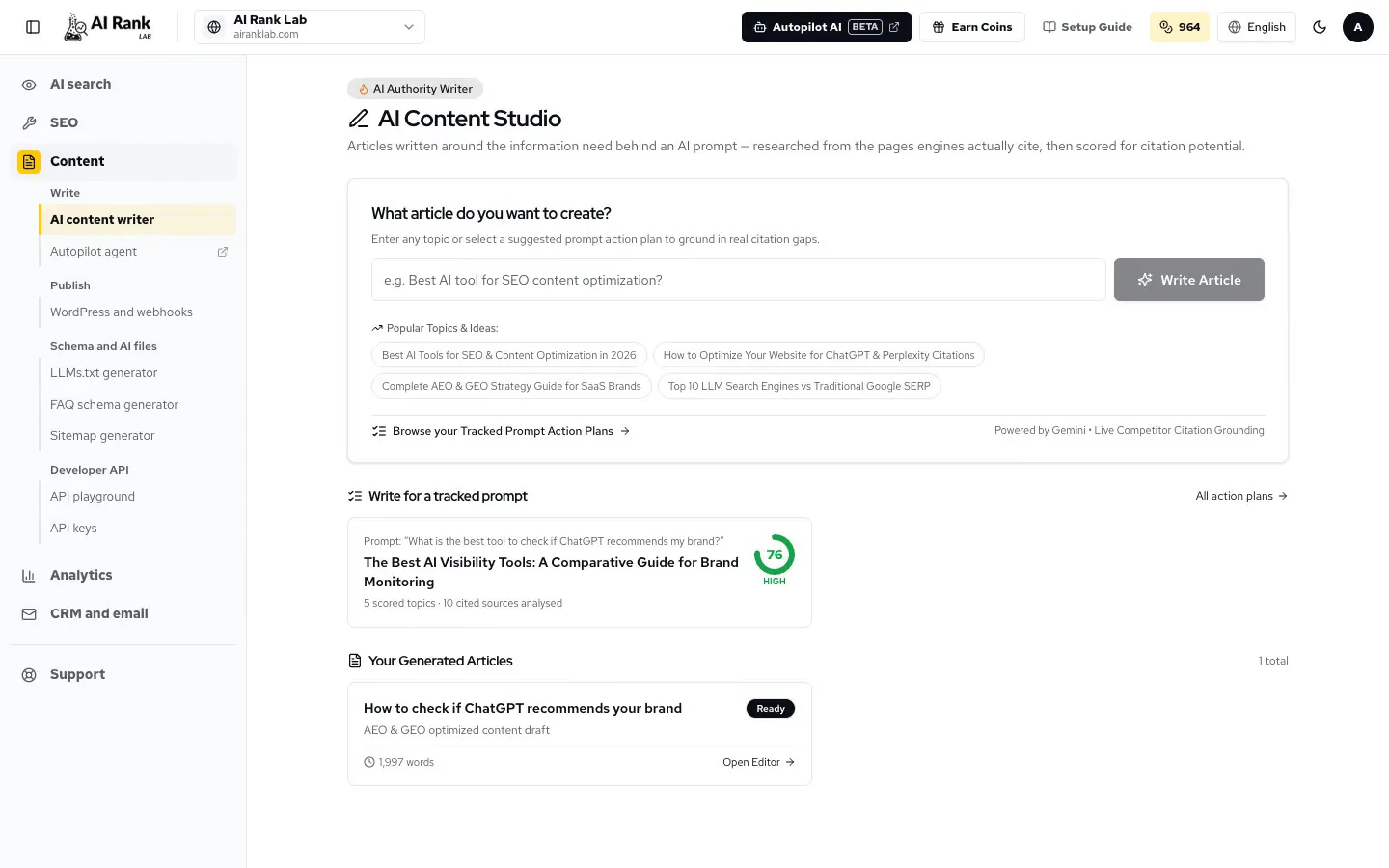
Write articles that AI engines can cite. Each draft is built from the pages ChatGPT, Gemini and Perplexity already cite for your prompt, scored for SEO and AI citation readiness, then published to your site.
Draft · from the Action Plan for one tracked prompt
Illustrative data
Editor1,620 words
How much does an agency CRM cost per seat?
Most agency CRMs charge a flat team price or a fee per seat. Here is what a 10-person team pays on each model, and when per-client billing is cheaper.
Flat team pricing vs per-seat pricing
FAQ: agency CRM pricing
SEO scoreout of 100
87Great
Structure23/25
Keywords21/25
Coverage22/25
Readability8/10
Media4/5
Metadata9/10
credits per full article
200credits per full article
point SEO score in the editor
100point SEO score in the editor
AI citation readiness signals
8AI citation readiness signals
citation re-check after you publish
Weeklycitation re-check after you publish
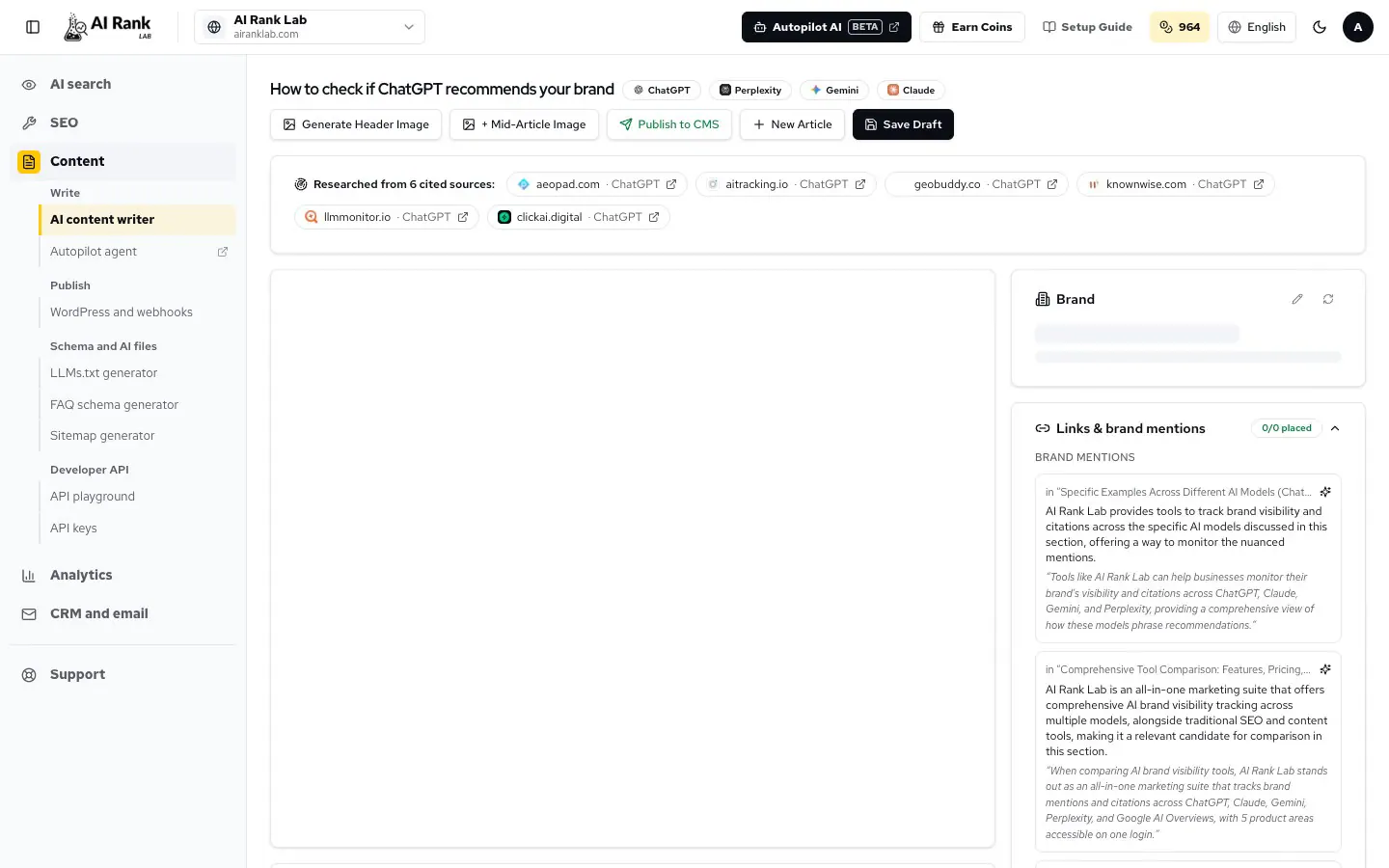
Researched from answers onChatGPTClaudeGeminiPerplexityWordPress
What is an AI content writer for AI search?
An AI content writer for AI search is a tool that drafts pages for the questions people ask ChatGPT, Gemini and Perplexity, not only for Google keywords. In AI Rank Lab it starts from a prompt you track, reads the pages the engines already cite for it, writes the article in Gemini, scores it out of 100 for SEO and checks 8 citation readiness signals before you publish.
It is the writing step of the suite. The keyword planner and Brand Visibility tell you what to write; the writer drafts it; citation tracking shows whether the published page starts being cited.
What the AI content writer does
Most writers start from the Google top 10. This one starts from the answers your buyers read.
Briefs from the pages AI already cites
Pick a prompt you track in Brand Visibility and generate an Action Plan. It reads the pages the engines cited for that prompt, finds what they cover that you do not, and returns topic briefs ranked by citation potential.
Action Plan research: 20 credits
Briefs scored for citation potential
Brand Memory keeps your facts and voice consistent
Agency CRM pricing, per seat vs flatCitation potential 82
Fieldnote vs Pipewise for agencies74
Client portal checklist for agencies61
Briefs come from the 6 pages ChatGPT, Gemini and Perplexity cited for the prompt.
An editor with an SEO score
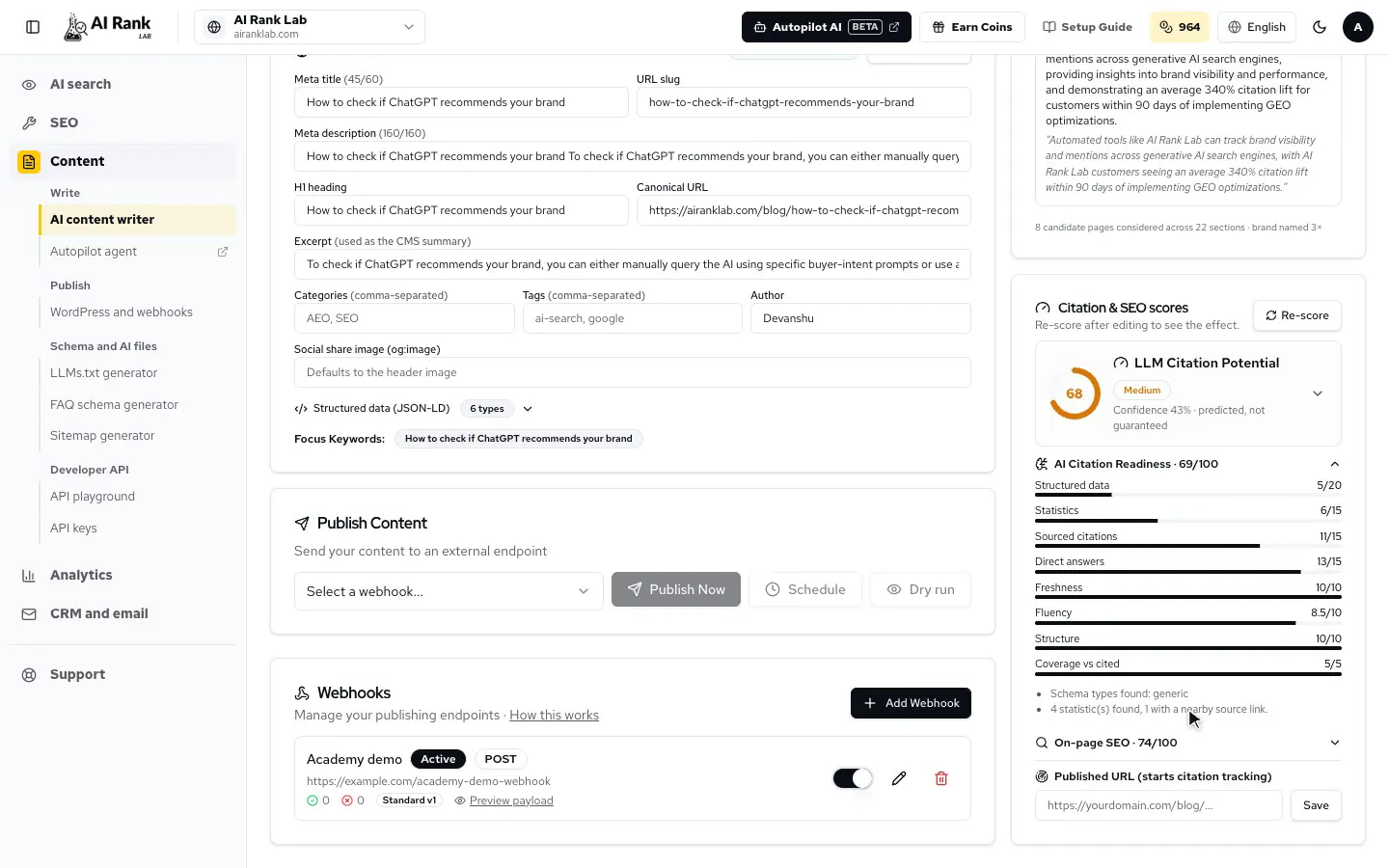
The article streams into the editor with headings, FAQ, internal links and JSON-LD. The SEO score is out of 100: structure (25), keywords (25), topical coverage (25), readability (10), media (5) and metadata (10). Edit, rescore and restore earlier versions.
Improve one section with AI: 20 credits
Humanize a draft: 25 credits
Every save kept as a version
SEO scoreout of 100
87Great
Structure23/25
Keywords21/25
Coverage22/25
Readability8/10
Media4/5
Metadata9/10
AI Citation Readiness, checked by rules
A second score asks whether an AI engine could quote the draft: structured data, sourced statistics, outbound citations, a direct answer, freshness, authoritative tone, technical structure and coverage of what the cited pages cover. Every signal is a check on the HTML, not an AI grading its own writing.
Up to 6 suggestions per draft
Same checks every time, so scores are comparable
AI Citation ReadinessIllustrative · 8 signals
Direct answer in the opening linesPass
Statistics with a named sourceAdd 2
Outbound citations to sourcesPass
FAQ and Article structured dataPass
Freshness: date and recent factsPass
Topics the cited pages coverMissing 1
Publish, then see if it gets cited
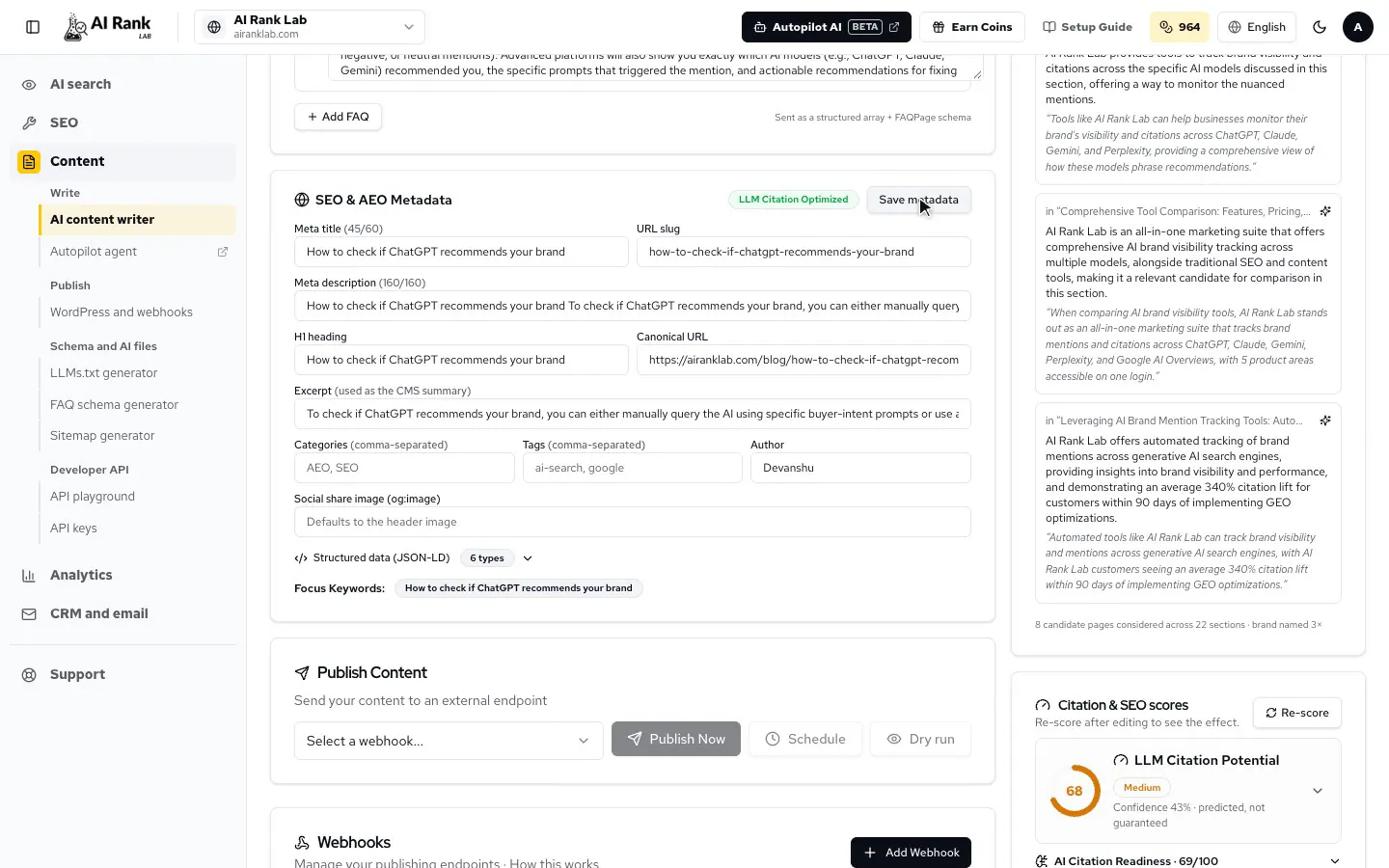
Publish now or schedule to WordPress through the plugin, or to any site through a signed webhook. Theme Memory can render the article in your blog's own markup. After publishing, opt the prompt into citation tracking and it is re-checked weekly.
Pick a tracked prompt and generate an Action Plan, which reads the pages AI engines cited for it and returns topic briefs. Choose a brief and generate the article (200 credits). It streams into the editor with headings, FAQ, links and schema, and shows an SEO score and an AI Citation Readiness score. Edit, then publish or schedule.
How is the content score calculated?
The SEO score is out of 100 and computed by rules on the draft: structure 25 points (H1, H2, H3, hierarchy), keywords 25, topical coverage 25, readability 10, media 5 and metadata 10. AI Citation Readiness is a separate score from 8 checkable signals such as sourced statistics, FAQ schema and a direct answer.
Can I automate content generation?
Partly. Publishing can be scheduled per article, and Autopilot, our AI marketing agent, can run content tasks for you. We still recommend reading each draft before it goes live.
How does WordPress publishing work?
Install the AI Rank Lab WordPress plugin and connect it, or point a signed webhook at any site. Articles are sent with title, meta, body, FAQ and schema, now or on a schedule. Give the webhook one to three sample post URLs and Theme Memory renders articles in your blog's own markup.
What AI models power the editor?
Google Gemini writes and analyses. Images use Gemini image models first, then Imagen 4 and DALL-E 3 as fallbacks. The scores are not AI: they are rule-based checks on the HTML.
Is there a free plan available?
There is no ongoing free plan. Start your free trial (3 days); a full article uses 200 credits. Plans start at 10,000 credits a month.
How can I get a GEO audit for my website content?
Run the free SEO, AEO and GEO audit tool on your site: it crawls pages and scores search, answer-engine and generative-engine readiness with fixes. The content writer then checks each new draft for AI citation readiness before you publish.
Are there tools that track AI content citations?
Yes. AI Rank Lab records the URLs ChatGPT, Claude, Gemini, Perplexity, AI Overviews and AI Mode cite when you run your prompts, and after you publish an article you can opt its prompt into citation tracking, which re-checks it weekly.
What is AI Citation Readiness?
A score for how quotable a draft is for AI engines, from 8 signals: structured data, statistics with sources, outbound citations, a clear direct answer, freshness, authoritative tone, technical structure, and coverage of the subtopics the cited pages cover. The weights come from published GEO research.


 ChatGPT
 Claude
 Gemini
 Perplexity
 WordPress