

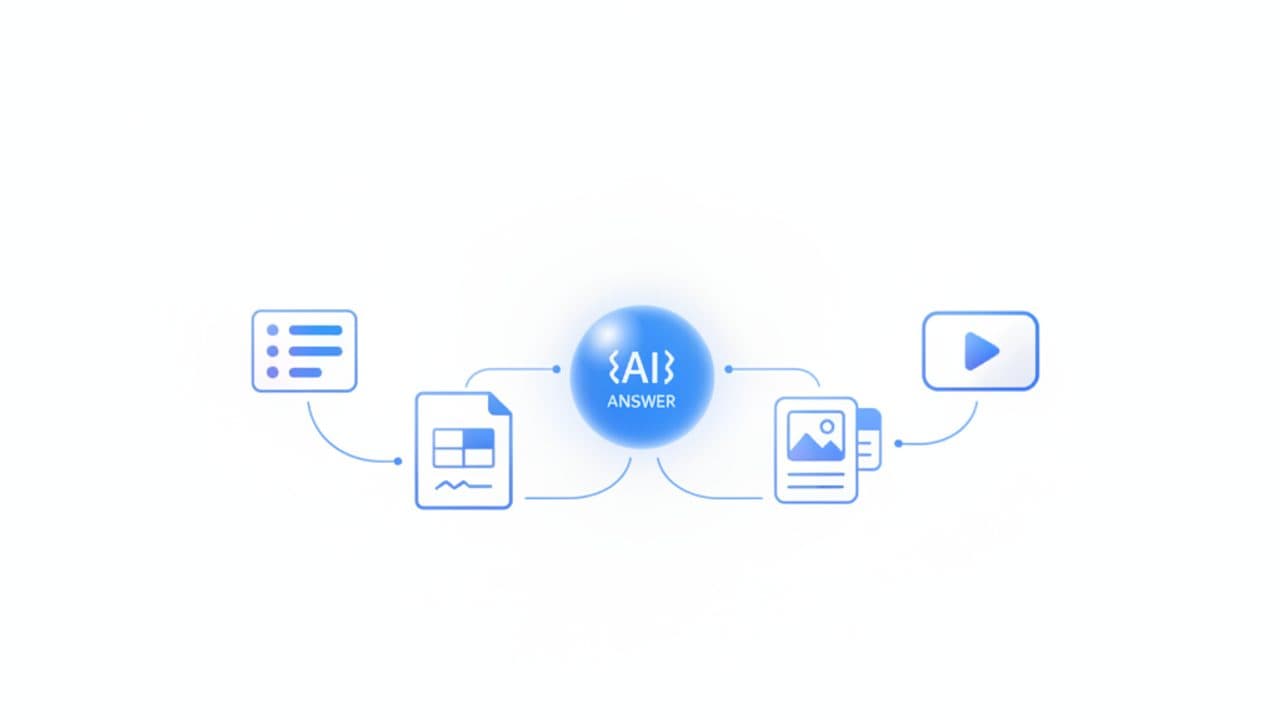
No single content format wins AI citations everywhere. Listicles are the most-cited page type in the largest 2025-2026 studies, but their share ranges from 21.9% to 66.6% depending on which prompts were asked, so the format that gets cited is mostly the format that fits the query: lists for "best" questions, head-to-head pages for "vs" questions, explainers for "what is" questions, product and category pages for buying and local queries, and video mainly on Google's AI surfaces.
This guide puts 19 published studies side by side by content format, not by domain. You get an evidence table with each study's sample and engines, what is known about tables, lists, FAQ blocks, length and video, the places where studies contradict each other and why, a format matrix by query intent, and a test plan for your own category. Studies and figures were checked on October 24, 2026. If you want to know which domains AI engines cite rather than which formats, read what sources LLMs cite instead.
Key takeaways
- Listicles lead, but by how much depends on the prompts. They were 66.6% of cited pages in Otterly's 617,985-citation study, where about three in four prompts asked for rankings, and 21.88% in the Wix Studio / Peec AI study of 1,056,727 citations, which split prompts evenly across four intents.
- Intent predicts format better than industry. In the Wix / Peec data, articles took 45.48% of informational citations, listicles 40.86% of commercial ones and product pages 24.88% of transactional ones.
- Comparison pages win comparison prompts. Otterly found head-to-head comparisons took 62.3% of citations on comparison prompts, while being only 2.2% to 7.9% of citations overall in the two largest studies.
- Tables, lists and FAQ blocks have weak, engine-dependent evidence. The best data is correlational, and a 2,400-test controlled study found format changed answer accuracy by about one point.
- Video is a Google story. In two Otterly experiments, ChatGPT, Claude and Copilot cited the written version and almost never the video; Google AI Overviews and AI Mode cited video the most.
- Length is a proxy, not a lever. Ahrefs found a near-zero correlation (0.04) between word count and AI Overview citations; longer pages correlate with more ChatGPT citations in SE Ranking's data because they cover more.
Which content formats get cited most by AI search engines?
Across the large citation studies, five page types collect most AI citations: listicles, articles (explainers, blog posts, news), product pages, category pages and comparison pages, with forums and video adding a meaningful share only on some engines. The Wix Studio AI Search Lab study, built on Peec AI data, is the most balanced sample: across 75,000 answers from ChatGPT, Google AI Mode and Perplexity it found listicles at 21.88%, articles 16.68%, product pages 13.66%, category pages 11.25%, discussions 7.52%, how-to guides 6.21%, homepages 5.26%, profiles 5.12% and comparisons 2.20% (Wix Studio AI Search Lab, March 2026).
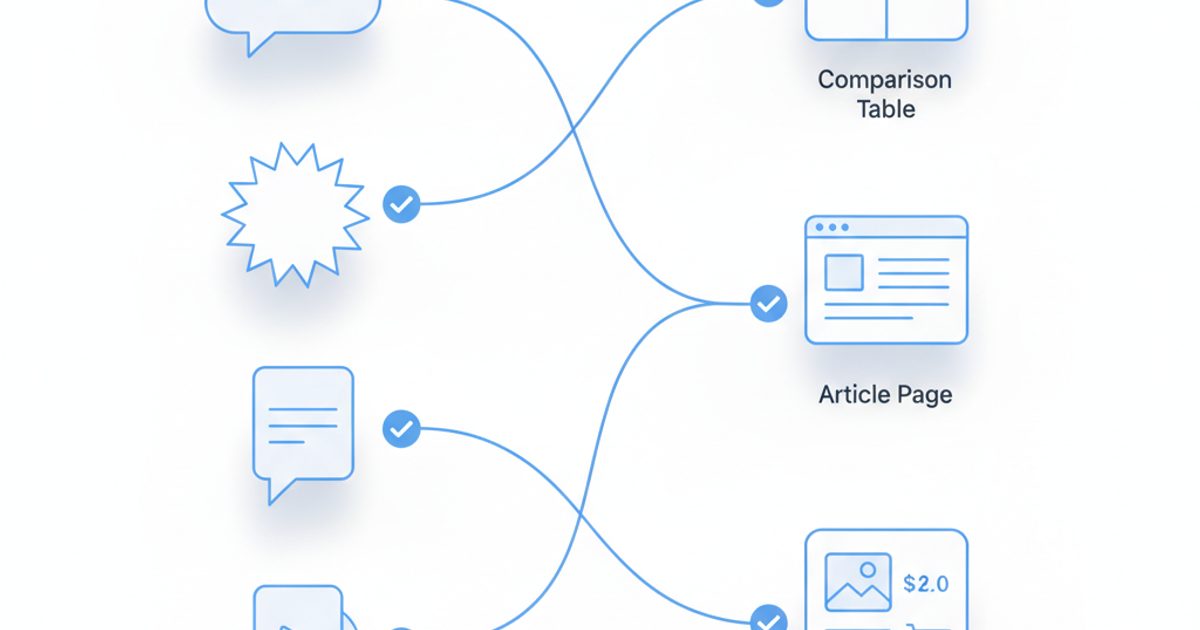
The short version is that AI engines cite the page that already answers the question in the shape the question asks for. A ranking question gets answered from ranked lists. A comparison question gets answered from comparison pages. A buying question gets answered from product and category pages. That is why the honest answer to "which format is best" is a matrix, not a single winner.
The evidence: 19 studies on content formats and AI citations
The studies below measure three different things, and mixing them up is the most common error in articles on this topic:
- Share of citations - what percentage of all cited URLs belong to a format. A common format can have a large share without any single page being likely to be cited.
- Citation rate - how often a page of that format gets cited when it is retrieved or when the query is asked. Peec AI and AirOps measure versions of this; AirOps found only 15% of pages ChatGPT retrieves end up cited.
- Controlled tests - the same content changed in one way and measured. These are rare, small and the only evidence of cause.
Almost every study here is published by a company that sells SEO or AI visibility software or services, including ours. Read them as informed observational data, not neutral science.
Page-type studies
| Study (publisher, date) | Sample and engines | Main format finding | Main caveat |
|---|---|---|---|
| What content do AI engines cite? (Otterly, Oct 14, 2026) | 617,985 citations, 85,330 URLs, 7 engines, 5 US industries, September 2026 | Listicles 66.6% of cited pages; head-to-head comparisons 7.9%; forums, video and social 8.6% | 295 of 400 prompts used words like "best" or "top"; one month |
| Content types most cited by LLMs (Wix Studio AI Search Lab with Peec AI, Mar 23, 2026) | 1,056,727 citations, 75,000 answers, ChatGPT, AI Mode, Perplexity, 5 verticals, 4 intents | Listicles 21.88%, articles 16.68%, product pages 13.66%, category pages 11.25%, comparisons 2.20% | Non-branded prompts only; subgroup sample sizes not published |
| "Best" lists research (Ahrefs, Dec 4, 2025) | 750 top-of-funnel prompts, ChatGPT, 10,000+ third-party URLs | "Best X" lists were 43.8% of cited source page types | Only "best" prompts in software, products and agencies |
| Which content formats AI engines cite most (Something Inc., Q2 2026) | 5,000 B2B prompts run 3 times, ChatGPT, Perplexity, Claude, AI Mode; 6,200 URLs | Comparison and alternatives 31.8%, how-to 22.4%, product and docs 17.6%, research 15.9%, community 12.3% | High-intent B2B prompts; homepages removed; no listicle category |
| Claude citation study (Otterly, Jun 30, 2026) | 379,321 Claude citations, SaaS and tech prompts, June 2026 | Brand, product and service sites 64.0%; forums 1.3%; video 0.3% | Classifies domains, not page formats |
| Citation rate benchmarks (Peec AI, Feb 27, 2026) | 1M+ citations, ChatGPT, AI Mode, Perplexity | Listicles are just under a fifth of ChatGPT URLs and 52% of them are cited twice or more per answer; in AI Mode, category pages perform best at just under 10% | Sampling period not disclosed |
| State of AEO 2026, format findings (HubSpot, updated Jun 2026) | Xfunnel citation data, 6 engines, Dec 2025-Mar 2026 | On ChatGPT, comparison content was cited on 95% of queries and every type on 69%+; AI Overviews ranged from 5% (news) to 42% (blog posts) | A different metric (share of queries citing a type); sample sizes not given |
Structure, length and video studies
| Study (publisher, date) | Sample and engines | Main finding | Main caveat |
|---|---|---|---|
| From retrieved to cited (AirOps, Apr 1, 2026) | 7,500 commercial queries, 217,508 retrieved pages, ChatGPT, 25 on-page signals | Comparison pages with 3 tables earned 25.7% more citations; 7 to 26 list sections 6% to 15.2% more likely to be cited | Correlational; ChatGPT only |
| Ranking factors for ChatGPT (SE Ranking, Nov 24, 2025) | 129,000 domains, 216,524 pages, 20 niches | Pages over 2,900 words averaged 5.1 citations vs 3.2 under 800; pages with FAQ sections averaged 3.8 vs 4.1 without | Raw averages; model version and dates not given |
| How to optimize for AI Mode (SE Ranking, Dec 15, 2025) | 2,328,533 pages, 295,485 domains, 500,000+ prompts | FAQ sections in content 4.9 citations vs 4.4; FAQ schema no meaningful effect; 100-150-word sections best | Domain traffic was the stronger signal (2.4 vs 6.4 citations) |
| Short vs long content in AI Overviews (Ahrefs, Dec 3, 2025) | 174,048 cited pages from 560,346 AI Overviews | Spearman 0.04 between word count and citation; 53.4% of cited pages under 1,000 words | Only pages that were cited, so no comparison with uncited pages |
| Do tables and bullets increase AI citations? (5WPR, Aug 12, 2026) | 2,400 controlled tests, 40 facts, ChatGPT, Claude, Perplexity | Correct-answer rate 93.5% to 94.6% across table, bullet and prose formats; document position mattered about 3x more than format | Supplied documents, not live retrieval; consumer brands only |
| Video vs blog (Otterly, Aug 5, 2026) | 8 story pairs, 16 prompts, 7 engines, first 7 days | Written versions earned 79.5% of format citations, video 20.5%; ChatGPT, Claude and Copilot cited no video | Very small; one week |
| 610 videos experiment (Otterly with onvista, Sep 3, 2026) | 610 videos, 571 articles, 125 German finance prompts, 7 engines, 107 days | Campaign citations grew 3.4x; single-topic clips cited at 27.2% vs 8.6% for full shows; no unlisted video was cited | One publisher, one market; observational |
| Social content types and AI visibility (Goodie, Mar 5, 2026) | 1.8M social citations out of 45.2M, 10 engines, Oct 2025-Feb 2026 | YouTube long videos drew 574,420 citations vs 11,160 for Shorts; LinkedIn articles beat feed posts about 5.8 to 1 | Panel and prompt selection not described |
| Markdown vs HTML (Otterly, Apr 1, 2026) | 2 page pairs, 14 days, 7 AI crawlers tracked | Markdown copies got 0% of AI bot visits and no citations; only HTML pages were cited | One site, two pairs |
| Markdown vs HTML controlled test (Profound, Feb 26, 2026) | 381 pages, 6 sites, 3 weeks, randomized | About one extra median bot visit for Markdown; not statistically significant | Measured bot visits, not citations |
| GEO: Generative Engine Optimization (Aggarwal et al., KDD 2024) | GEO-bench queries, a GPT-3.5 answer engine and Perplexity | Adding quotations, statistics and cited sources raised visibility 30% to 40%; keyword stuffing did not help | Lab setting, older models |
| Structural feature engineering for GEO (Yu et al., arXiv, Mar 31, 2026) | Six generative engines (not named in the abstract) | Structure-only edits improved citation rate by 17.3% | Preprint, not yet peer reviewed |
Which page types get cited most, and why?
The page types that get cited most are the ones that hand an answer engine a ready-made answer for a common prompt shape. Each one has a reason.
Why are listicles cited so often by AI engines?
Listicles are cited often because so many real prompts ask for a ranked set of options, and a list already contains several candidate answers with a reason for each. In Otterly's data, listicles took 73.2% of citations on ranking prompts and still 55.2% on open-ended ones. Claude leaned on them hardest, at 78.2% of its citations. Who publishes them matters too: Otterly found 35.6% of cited listicles came from brands, and 44.8% of cited listicles, comparisons and guides came from publishers that declare they may earn commission. Whether a brand's own "best X" list is worth publishing, and the risks, is covered in our self-promotional listicles analysis, so we will not repeat it here.
Do comparison pages get cited by AI search?
Yes, heavily on comparison prompts and rarely otherwise. Otterly found head-to-head comparisons took 62.3% of citations on comparison prompts but only 7.9% overall; in the Wix / Peec data comparisons were 2.20% and "alternative" pages 0.29% of all citations. ChatGPT is the engine most open to them: comparisons were 16.1% of its citations in Otterly's study, versus 2% to 10% on other engines, and HubSpot's State of AEO data shows ChatGPT citing comparison content on 95% of queries. AirOps adds a structural detail: in ChatGPT, comparison pages with three tables earned 25.7% more citations and pages listing seven distinct price points 15.7% more.
Articles, how-to guides and explainers
Articles dominate informational questions. In the Wix / Peec data, articles took 45.48% of informational citations, ahead of listicles at 21.68% and how-to guides at 9.21%. ChatGPT cited articles 4.38 points above the cross-engine average. How-to guides gain ground when the prompt is open rather than a ranking: Otterly reports them rising from 3.6% to 11% on open-ended prompts, and Something Inc. found how-to content was 22.4% of cited URLs on B2B prompts, second only to comparisons.
Product, category and documentation pages
Product and category pages win when the user is ready to buy or looking for a specific place. In the Wix / Peec data, product pages were 24.88% of transactional citations and 21.95% of navigational and local ones, with category pages at 14.97% and 18.31%. Google AI Mode leans toward them: Peec found category pages were the best-performing type on AI Mode. ChatGPT cites documentation and help centres about three times more than average (6.0% in Otterly's data), and in Ahrefs' "best" list study product pages were the main first-party page type cited for product prompts. For brands, these are the pages you fully control, so they are the cheapest place to start.
Forums and community threads
Forums matter on Perplexity and Google, and barely at all elsewhere. Discussions were 17.35% of Perplexity citations in the Wix / Peec data, more than double the 7.52% average, and Otterly found forums at 11% to 14% of Google AI Overviews and AI Mode citations, almost all Reddit. On ChatGPT, Claude, Gemini and Perplexity in Otterly's data, forums and video stayed under 3%. You cannot publish a forum thread as a brand, so for most companies forums are a participation channel, not a format to produce.
Do on-page structures like tables, lists and Q&A blocks help?
Probably a little, inconsistently, and less than page type, document position or the authority of the site. This is the area where the evidence is weakest and the most repeated statistics are hardest to trace. Google's own guidance is that people appreciate pages "organized by paragraphs and sections" with clear headings, and that "there's no requirement to break your content into tiny pieces for AI" (Google Search Central, AI optimization guide).
Do tables help content get cited by AI?
Tables are associated with more citations on comparison pages, but the only controlled test found they barely change whether a model uses your facts correctly. AirOps found comparison pages with three tables earned 25.7% more ChatGPT citations, which is a correlation across 217,508 retrieved pages. 5WPR then ran 2,400 controlled tests that put the same 40 facts into a table, a bullet, the first sentence of a paragraph and the third sentence: the correct-answer rate only moved between 93.5% and 94.6%. The one effect was attribution on Perplexity, which named the publisher 66% of the time when the fact sat in a table versus 55% when it was buried in the third sentence. Moving the document from the first to a middle slot in the supplied set cut attribution from 71.9% to 39.4%, about three times the formatting effect. A widely repeated claim that ChatGPT citations are "2.3x more likely to include a table" could not be traced to a primary study when we checked, so we have left it out.
Use a table when the content is genuinely tabular - prices, specs, feature comparisons, study summaries - because it helps readers and gives an extractor clean rows. Do not expect a table alone to earn a citation.
Do lists help?
Lists help in the same modest, correlational way. AirOps found ChatGPT pages with 7 to 26 list sections were 6% to 15.2% more likely to be cited, and validation-stage pages with 8 list sections earned up to 26.9% more citations. Lists also make up the listicle format itself, which is the largest single category. There is no controlled evidence that turning prose into bullets changes citations on its own.
Do FAQ sections increase AI citations?
It depends on the engine, and the best dataset shows opposite results in two places. SE Ranking found pages with an FAQ section averaged 4.9 AI Mode citations versus 4.4 without, while FAQ schema markup had no meaningful effect. In its ChatGPT study, pages with FAQ sections averaged 3.8 citations versus 4.1 without, and FAQ schema pages 3.6 versus 4.2; the authors argue FAQs often sit on simpler support pages that earn fewer citations anyway. The sensible reading: an FAQ block that answers real follow-up questions is fine for readers and may help in Google's surfaces; it is not a citation switch. Google states that structured data "isn't required for generative AI search."
Headings and section length
Sections of roughly 100 to 180 words between headings perform best in both SE Ranking datasets: 4.6 ChatGPT citations for 120-180-word sections versus 2.7 for sections under 50 words, and about 4.7 AI Mode citations for 100-150-word sections. Question-shaped headings did not help in the raw ChatGPT data (3.4 versus 4.3 for plain headings) and were neutral in AI Mode (4.6 versus 4.5). The underlying reason sections matter is passage selection: answer engines score and pick passages, not whole pages. We cover how that works in how rerankers pick the passage that gets cited.
Statistics, quotations and sources
Adding verifiable statistics, quotations and cited sources has the oldest and most consistent evidence. The Princeton-led GEO paper found these three methods raised visibility in generated answers by 30% to 40% in its benchmark, while keyword stuffing gave little to no improvement (Aggarwal et al., KDD 2024). AirOps found awareness-stage pages with 5 to 7 statistics had a 20.3% higher citation likelihood in ChatGPT. A 2026 preprint reports that structure-only edits improved citation rate by 17.3% across six engines (Yu et al.), but it is not peer reviewed yet.
Does publishing Markdown versions of pages help AI citations?
No evidence says it does. In Otterly's test, Markdown copies of two pages received 0% of AI bot visits and no citations over 14 days while the HTML versions were cited. Profound's randomized test across 381 pages found about one extra median bot visit for Markdown, which was not statistically significant. Google says you do not need "AI text files, markup, or Markdown to appear in Google Search."
Is video or blog content cited more by AI search?
Written content is cited by every engine; video is cited mainly by Google AI Overviews and AI Mode. When Otterly published the same eight stories as a YouTube video and a transcript-based article, the written versions earned 79.5% of format citations in the first week and every platform cited them, while ChatGPT, Claude and Copilot cited none of the videos. In the larger onvista experiment, 56.1% of video citations came from AI Overviews, 40.0% from AI Mode and 3.9% from ChatGPT; Perplexity, Copilot, Claude and Gemini cited none of the 610 videos. Article citations came mainly from Copilot (43.0%) and ChatGPT (39.2%). So the practical answer is both, with text as the base layer and video as an extra route into Google's AI answers.
Which AI engines cite YouTube videos?
Google's two AI surfaces cite video the most. Otterly's 617,985-citation study found video at 12% to 14% of Google AI Overviews and AI Mode citations, nearly all YouTube, though AI Overviews' video share fell from 15.5% to 9.5% during September 2026. On the other engines, forums and video together stayed below 3%, and Claude cited video for 0.3% of citations in its June study. Perplexity is the open question: it gave video 41.5% of format citations in the eight-story test but cited none of onvista's German finance videos. Channel-level tactics are in our guide to YouTube citations in AI search.
What kind of video gets cited?
Public, single-topic, long-enough-to-explain videos whose titles match the query. In the onvista data, single-stock clips were cited at 27.2% against 8.6% for full daily shows, none of 118 unlisted videos was cited, and median views were almost the same for cited (888) and never-cited (947) videos. Goodie's social-citation study found YouTube long videos drew 574,420 citations against 11,160 for Shorts. "Clip" there means a focused video on one topic, not a Short: specificity wins, not brevity.
Does content length matter for AI citations?
Length on its own barely matters; what longer pages cover does. Ahrefs measured 174,048 pages cited across 560,346 AI Overviews and found a Spearman correlation of 0.04 between word count and citation, with 53.4% of cited pages under 1,000 words and a median of 1,115 words. Median length varied by page type: listings 315 words, video pages 407, articles 1,166. In SE Ranking's ChatGPT data, pages over 2,900 words averaged 5.1 citations against 3.2 for pages under 800 words, and in AI Mode pages over 2,300 words averaged about 5.1 against 4.1 for pages under 500. AirOps found awareness pages of 1,301 to 1,500 words had a 10.8% higher citation likelihood. Google says "there's no ideal page length."
These fit together once you separate the format from the topic. A product listing that answers "price of X" in 300 words is complete; a guide that answers "how do I choose X" needs more room because it covers more sub-questions. Write until the question and its natural follow-ups are answered, then stop.
Do different AI engines prefer different content formats?
Yes, and the differences are large enough that one content plan rarely fits every engine. The table pulls the engine-specific findings from the studies above.
| Engine | Formats that over-index | Formats that under-index | Source |
|---|---|---|---|
| ChatGPT | Comparisons (16.1% vs 2-10% elsewhere), documentation and help centres (about 3x average), articles (+4.38 points) | Video (0% in the eight-story test, 3.9% of onvista video citations), discussions (-4.32 points) | Otterly; Wix / Peec |
| Claude | Listicles (78.2%; 84.6% on buying questions), brand and product sites | Forums (1.3%), video (0.3%) | Otterly (two studies) |
| Perplexity | Discussions (17.35%, more than double average); listicles and articles cited at high rates | Articles (-5.0 points vs average); video results conflict | Wix / Peec; Peec benchmarks; Otterly |
| Google AI Overviews | Listicles (45 per 100 citations), forums and video (23 per 100) | News (5% citation rate in HubSpot's data) | Otterly; HubSpot |
| Google AI Mode | Listicles (rose from about 39% to above 50%), category pages, how-to guides (+1.58 points), video | Discussions (-5.51 points) | Otterly; Peec; Wix / Peec |
| Gemini | Video in one test (20.3% of format citations) | Video in another (none of 610 videos, measured from late July only) | Otterly (two experiments) |
Why do AI citation studies disagree?
Studies disagree mainly because they ask different prompts, classify pages differently and measure different things. The disagreements are informative once you know what drives them.
| Question | One study says | Another says | Most likely reason |
|---|---|---|---|
| How dominant are listicles? | 66.6% of cited pages (Otterly) | 21.88% (Wix / Peec); 43.8% on ChatGPT "best" prompts (Ahrefs) | Prompt mix. 295 of Otterly's 400 prompts asked for rankings; Wix / Peec split prompts evenly across four intents. |
| How often are comparison pages cited? | 2.20% (Wix / Peec) | 7.9% (Otterly); 31.8% (Something Inc.) | Classification and audience. Something Inc. merged comparison and alternatives, removed homepages and used only high-intent B2B prompts. |
| Do FAQ sections help? | Yes in AI Mode, 4.9 vs 4.4 (SE Ranking) | No in ChatGPT raw data, 3.8 vs 4.1 (SE Ranking) | Engine and confounding: FAQ-heavy pages are often thin support pages. |
| Does length matter? | Near-zero correlation in AI Overviews (Ahrefs) | 5.1 vs 3.2 citations for long vs short pages in ChatGPT (SE Ranking) | Engine and design: Ahrefs looked only at cited pages; SE Ranking compared citation counts across all pages. |
| Does Perplexity cite video? | 41.5% of format citations (Otterly eight-story test) | None of 610 videos (Otterly / onvista) | Market and prompt type: English interview stories versus German finance queries, both small samples. |
| Does Claude cite product pages or listicles? | Brand, product and service sites 64.0% (Otterly, June) | Listicles 78.2% (Otterly, September) | Different axes. One counts the publisher type of the domain, the other the page format; brands publish listicles too. |
Three further reasons sit behind most gaps. Share and rate are different metrics: HubSpot's 95% for comparison content is the share of queries where ChatGPT cited at least one comparison page, not a share of citations. Engines change month to month: Otterly saw AI Mode's listicle share climb by more than ten points inside September 2026, and Peec's research notes say a later ChatGPT model shifted retrieval toward product pages after its February benchmark. And secondary summaries drift: some roundups present a share of citations as if it were a citation rate, and some repeat figures, such as the "2.3x tables" claim, that we could not trace to a primary study. Always check the primary page.
Which content format should I use for each type of query?
Match the format to the intent of the prompt you want to be cited for. This matrix combines the Wix / Peec intent split with Otterly's prompt-type split and the engine differences above.
| Query intent (example) | Format most cited | Evidence | What to build |
|---|---|---|---|
| Ranking ("best CRM for small teams") | Listicle | 73.2% of citations on ranking prompts (Otterly); 40.86% of commercial citations (Wix / Peec) | Earn placement in third-party lists; publish your own only if it is honest, disclosed and evidence-backed |
| Comparison ("X vs Y") | Head-to-head comparison | 62.3% on comparison prompts (Otterly); 16.1% of all ChatGPT citations | One page per real matchup, with a comparison table, prices and a clear verdict |
| Informational ("what is X", "why does X happen") | Article or explainer | 45.48% of informational citations (Wix / Peec) | An answer-first explainer with sourced statistics and self-contained sections |
| Procedural ("how do I set up X") | How-to guide, plus video for Google | 9.21% of informational citations; how-to up to 11% on open-ended prompts (Otterly); video 12-14% in Google AI surfaces | A numbered how-to, and a single-topic video with a matching title if Google's surfaces matter |
| Transactional ("buy X", "X pricing") | Product and category pages | 24.88% and 14.97% of transactional citations (Wix / Peec) | Complete product pages: specs, prices, availability, policies in text |
| Navigational or local ("X near me", "X login") | Product, category, homepage and profile pages | 21.95%, 18.31%, 13.56% and 12.89% (Wix / Peec) | Accurate homepage and location pages, and consistent directory profiles |
| Technical or developer ("X API rate limits") | Documentation | About 3x average share on ChatGPT (Otterly) | Public, crawlable docs and help-centre pages, not PDFs behind a login |
How do I test which content formats get cited in my category?
Run your own prompts, record every cited URL, tag each one by format and compare by intent and engine. Published studies tell you the general pattern; your category can differ, as the vertical splits show (listicles were 35.37% of SaaS citations but home repair was led by product pages at 18.52% in the Wix / Peec data).
- Pick 20 to 40 prompts across intents. Include ranking, comparison, informational, procedural and buying prompts that your customers actually ask. Start from real customer language (sales calls, support tickets, search queries), not from your own keyword list.
- Run each prompt on each engine more than once. Answers vary between runs. Across 972 repeated runs of 42 prompt-engine pairs tracked in AI Rank Lab (February to October 2026), 42.9% of pairs flipped between mentioning and not mentioning the brand at least once, and the median overlap of cited domains between consecutive runs was 0.41 (Jaccard). One run tells you little. In AI Rank Lab, brand visibility runs the prompts you choose on ChatGPT, Claude, Gemini, Perplexity, Google AI Overviews and AI Mode when you run them, and stores every run with its cited URLs.
- Tag every cited URL by format. Use a fixed list: listicle, comparison, article, how-to, product, category, homepage, documentation, forum, video, other. Tag by what the page is, not who published it. No tool we know classifies formats reliably for you, so spot-check by hand.
- Compute share by intent and by engine. A pivot of format against intent shows you the shape of answers in your category. The citation tracker lists which of your URLs and which competitor URLs each engine cited.
- Compare against your own page inventory. If comparison prompts cite head-to-head pages and you have none, that is the gap. If ranking prompts cite third-party lists you are missing from, the work is outreach, not publishing.
- Change one thing on some pages and keep others as controls. Add a comparison table to five pages and leave five similar pages alone, or publish a video version of three guides. Our guide to running a GEO experiment covers sample sizes and duration.
- Re-measure for three to four weeks. Rerun the same prompts on a fixed cadence. In AI Rank Lab you rerun them yourself, or opt prompts into the Action Plan citation tracker, which re-checks them weekly.
Tools other than ours can do the measuring step. Disclosure: AI Rank Lab is our product. We list it first because this is our site, and we've kept the same criteria for every tool below. AI Rank Lab covers four LLMs plus Google AI Overviews and AI Mode and pairs tracking with audits and content work. Otterly, Peec AI and Profound, which published several of the studies above, also show the URLs engines cite for your prompts; Profound has added a YouTube citation breakdown, which is useful if video is part of your test.
Limitations of this synthesis
- Vendor research. Nearly every study is published by a company that sells AI visibility software or services. Several are well designed; none is independent.
- Correlation, mostly. Only 5WPR, Profound's Markdown test and the academic papers change one variable on purpose. Everything else shows what gets cited, not why.
- Different taxonomies. "Article", "guide" and "comparison" mean slightly different things in each study. We report each study's own labels rather than forcing them together.
- Snapshots. Most datasets cover one to five months, and engines change models often. Treat any single percentage as a reading on a date.
- No format data of our own. AI Rank Lab stores cited URLs but does not classify them by format, so the format percentages here all come from the named studies. The only first-party figure in this guide is the run-to-run variability number.
The format that gets cited is the one that answers the prompt in the shape it asks for. Build that page, make it complete and sourced, then measure it on the engines that matter to you. If you want to see which formats are cited for your own prompts, AI Rank Lab's AI visibility tracking runs them across six AI surfaces when you run them and keeps every cited URL for comparison.
Get a free AI ranking consultation
Want your brand to show up when ChatGPT, Gemini and Perplexity answer questions in your market? Tell us about your site and our team will send a personalized strategy.


