


If you are replacing ChatGPT at work, the question that decides the purchase is rarely which model writes the nicest paragraph. It is whether the vendor will sign a data processing agreement, whether the plan you can afford includes SAML single sign-on, what happens to your prompts after you send them, and how much you pay per person per month. Nearly every listicle on this subject compares answer quality and stops there.
This comparison is built on the axes a business actually buys on, and every figure below was read off the vendor's own pricing, documentation or privacy page on 16 September 2026. Where a vendor does not publish a number, this article says so instead of filling the gap with a guess. We did not run benchmarks and make no claim about which model reasons best. What follows is a procurement comparison, not a quality shoot-out.
The short answer, by situation
Pick by the constraint you are actually under, not by position in a ranking. Twelve products are covered here because twelve had pricing or policy we could verify at the source.
| Your situation | The pick | Entry price (verified 16 Sep 2026) |
|---|---|---|
| Small team that wants a strong general assistant with admin controls | Claude Team | $25 per seat monthly, $20 annual |
| Already standardised on Microsoft 365 | Microsoft 365 Copilot | $18 per user monthly on annual billing |
| Already standardised on Google Workspace | Gemini in Workspace Business Standard | Bundled into the Workspace seat |
| EU data-residency and open-weight leverage matter | Mistral Le Chat Team | $24.99 per user monthly, $50 minimum |
| Research with citations, and you build your own front end | Perplexity Search and Sonar APIs | $5 per 1,000 search requests |
| Cost per token is the binding constraint | DeepSeek API | From $0.15 per 1M input tokens |
| You want a frontier model billed purely on usage | xAI Grok API | $2 in, $6 out per 1M tokens (Grok 4.6) |
| Retrieval-heavy internal search you control | Cohere | From $0.50 per 1M input tokens |
| Open-weight models, your own fine-tunes, dedicated GPUs | Together AI | From $0.15 per 1M input tokens |
| You need a search and answer API, not a chat seat | You.com | $5 per 1,000 Answer API calls |
| AWS shop wanting a permission-aware assistant over company data | Amazon Q Business | $3 per user monthly (Lite), $20 (Pro) |
| Regulated industry wanting governance and hybrid deployment | IBM watsonx.ai | Pay-as-you-go from $0 per month |
How much does an AI chatbot for business cost per seat, and what is metered instead
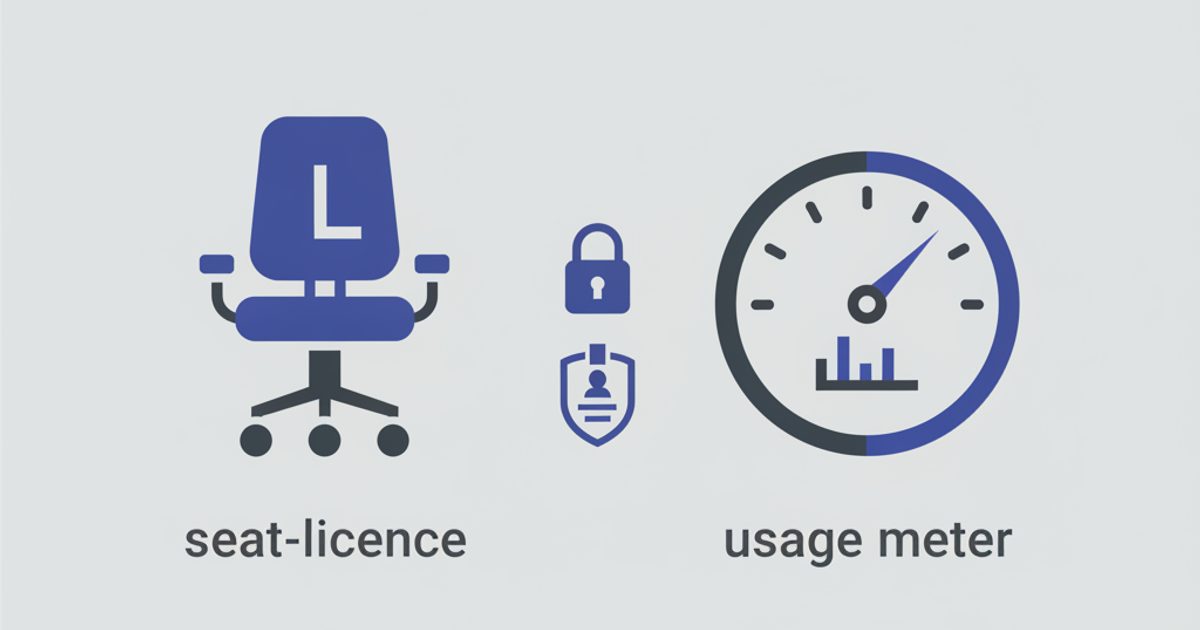
The category has split into two billing shapes, and mixing them up is the most expensive mistake in this purchase. Four of the twelve sell you a seat. The other eight meter you on usage, which means the sticker price is near zero and the invoice is a function of how hard your team uses it.
Seat-priced products, verified 16 September 2026.
| Product | Plan | Monthly billing | Annual billing | Seat rules |
|---|---|---|---|---|
| Claude | Team standard seat | $25 per seat | $20 per seat | 2 to 150 people |
| Claude | Team premium seat | $125 per seat | $100 per seat | Mix and match with standard seats |
| Microsoft 365 Copilot | Copilot Business add-on | $25.20 per user | $18.00 per user | Add-on licence, annual commitment |
| Mistral Le Chat | Team | $24.99 per user | Not published | $50 per month minimum |
| Amazon Q Business | Lite | $3 per user | Not published | Plus index capacity charges |
| Amazon Q Business | Pro | $20 per user | Not published | Plus index capacity charges |
Two of those prices carry conditions worth knowing before you budget. Microsoft's own Copilot business page shows $18.00 per user per month on an annual subscription, described as a discount from $21.00 running through 31 December 2026, with $25.20 as the monthly-billing figure. Budget on $21.00 for year two unless Microsoft says otherwise. Amazon's $3 and $20 tiers are only part of the bill: Amazon Q Business pricing also charges $0.140 per hour for a starter index unit and $0.264 per hour for an enterprise index unit, each holding 20,000 documents, so a production rollout adds roughly $190 per enterprise index unit per month on top of the seats.
Usage-metered platforms, verified 16 September 2026. These have no seat concept at all. You are buying tokens or requests.
| Platform | Unit | Published rate |
|---|---|---|
| DeepSeek (deepseek-flash) | Per 1M tokens | $0.15 in (cache miss), $0.60 out, off-peak |
| DeepSeek (deepseek-v4-pro) | Per 1M tokens | $0.66 in (cache miss), $1.98 out, off-peak |
| xAI Grok 4.6 | Per 1M tokens | $2.00 in, $6.00 out under 200k context |
| xAI Grok 4.3 | Per 1M tokens | $1.25 in, $2.50 out under 200k context |
| Cohere Command R 03-2024 | Per 1M tokens | $0.50 in, $1.50 out |
| Cohere Model Vault (Embed 4, medium) | Dedicated instance | $5.00 per hour or $3,250 per month |
| Together AI (GLM-5.3-Flash) | Per 1M tokens | $0.15 in, $0.50 out |
| Together AI dedicated H100 | Per GPU hour | $3.99 |
| Perplexity Search API | Per 1,000 requests | $5.00, no token charge |
| Perplexity Agent API web search tool | Per invocation | $0.0025 |
| You.com Answer API | Per 1,000 calls | $5.00 |
| You.com Research API | Per 1,000 calls | $12.00 |
| IBM watsonx.ai Standard | Per month, pay-as-you-go | From $1,110 |
| IBM watsonx.ai foundation models | Per 1M input tokens | $0.0636 to $3.18 depending on model |
Google is the awkward entry. Google Workspace pricing is served in local currency, and on the date we checked it returned Indian rupee figures rather than dollars: Starter at Rs 270 per user per month with the Gemini assistant in Gmail, and Business Standard at Rs 864 per user per month, discounted from Rs 1,080, with Gemini in Gmail, Docs, Meet and more. Gemini is bundled into the Workspace seat rather than sold as a separate add-on, and Enterprise is quote-only. Check the page in your own region before you build a model around it.
Perplexity is the other gap, and it is a deliberate one. Its developer documentation publishes exact API rates, but its enterprise seat pricing sits behind a page that will not serve a public request. Numbers for Perplexity Enterprise Pro circulate widely in third-party articles; none of them could be confirmed at the vendor's own page on 16 September 2026, so this article does not print one.
Is it cheaper to buy per-seat licences or pay per token through an API?
For a team of knowledge workers chatting all day, per-seat licences are almost always cheaper. For an application embedded in a product, the API is almost always cheaper. The crossover is easy to estimate, and worth doing before you commit.
Take a $20 seat. At Grok 4.6 rates of $2.00 per million input tokens and $6.00 per million output, that seat is equivalent to a bit over 3 million output tokens a month, which is roughly 2.3 million words of generated text. No individual chatting through a browser gets near that. Run the same sum against DeepSeek's cheaper tier at $0.60 per million output tokens and the $20 buys 33 million output tokens, so the argument gets more lopsided still.
Flip it for software. If your product sends 50,000 automated requests a day, seats are meaningless because there is no person attached to the request, and the only sane billing shape is metered. That is why You.com and Perplexity both sell request-priced APIs, why Together AI prices dedicated H100 capacity at $3.99 per GPU hour for steady load, and why Cohere offers a Model Vault instance at a flat $3,250 a month once your volume makes per-token billing unpredictable.
The practical rule: count the humans and count the machine calls separately, and buy a different product for each. Most companies that overspend on this category bought seats for a workload that had no humans in it.
Do these AI assistants train their models on your company data?
On business plans, generally no by default, but the wording differs in ways that matter to a security review, and consumer tiers of the same products often behave differently.
Anthropic is the most explicit. Its published policy states that by default it will not use your inputs or outputs from its commercial products to train its models, with the exception that submitting thumbs-up or thumbs-down feedback opts that specific conversation in, and feedback conversations are kept for up to five years in a de-identified form. Read Anthropic's own note on model training before your team starts clicking feedback buttons, because that is the one place your data leaks into the training path.
Google is similarly direct. Its generative AI privacy hub for Workspace states that Workspace does not use customer data for training models without the customer's prior permission or instruction, and that content is not human reviewed or used for generative AI model training outside your domain without permission. It also publishes retention in a way almost nobody else does: Gemini in Workspace retains from 90 days to indefinitely as determined by admins, the Gemini app up to 36 months as determined by admins, and Gemini Notebook retains nothing after the session ends.
Microsoft's position on the Copilot business page is that prompts and responses stay within the Microsoft 365 service boundary and are not used to train the underlying language models, with the EU Data Boundary and Advanced Data Residency available on top.
Mistral reserves audit logs and SAML SSO for its Enterprise tier, so a Team-plan buyer is relying on the general terms rather than a negotiated agreement. DeepSeek is the clear outlier and gets its own section below.
Which apps like ChatGPT offer SSO and SAML for enterprise teams
Single sign-on is the line where a pilot becomes a rollout, and the honest summary is that most vendors put SAML one tier above where you expect it. Here is what each vendor publishes.
Claude is unusually generous here: SSO, central billing and admin controls for connectors are listed on the Team plan itself, from two seats up, alongside a stated no-model-training default. Enterprise adds SCIM, audit logs, role-based access with fine-grained permissions, spend limits, a compliance API, custom data retention, network-level access control, IP allowlisting and a HIPAA-ready offering.
Mistral puts SAML SSO and audit logs on Enterprise only. The Team plan gets domain-name verification and data export, which is useful but is not identity federation. Amazon Q Business includes enterprise sign-on at the $3 Lite tier because it inherits AWS IAM Identity Center, which makes it the cheapest route to federated identity in this list. Microsoft and Google both inherit identity from the suite you already pay for, which is the quiet reason those two win so many bake-offs.
The usage-metered platforms mostly do not have a seat model to federate. Cohere, Together AI, DeepSeek and xAI authenticate developers with API keys, and access control becomes your application's problem, not the vendor's.
What admin controls and audit logs to require before rolling out an assistant
Write these into the evaluation before you see a demo, because they are the items that get discovered late and stall the rollout.
- SAML or OIDC single sign-on, on the tier you can afford. Confirm which plan it is on, not merely that the vendor supports it somewhere.
- SCIM provisioning and deprovisioning. Without it, an employee who leaves keeps their chat history and their access. Claude lists SCIM at Enterprise.
- Audit logs you can export. Claude and Mistral both place audit logs at Enterprise. Ask whether the logs cover prompts, admin actions or both, because they are usually not the same feature.
- Configurable retention, with a documented default. Google publishes its retention windows openly. Most vendors do not, so ask for the number in writing.
- A written training-on-your-data commitment. A marketing claim is not a contract term. Get it in the agreement.
- Spend limits and role-based access. On metered products the absence of a spend cap is a budget incident waiting to happen.
- Connector governance. The moment an assistant can read your document store, its permission model becomes your permission model. Amazon Q Business markets permission-aware responses specifically for this reason.
Which ChatGPT competitor is SOC 2 and HIPAA compliant
Compliance claims should be read off a trust page or a vendor's own documentation, never off a comparison table someone wrote from memory. Of the twelve here, these are the claims we could verify at source on 16 September 2026.
Google publishes the broadest set for a competitor in this category: its Workspace privacy hub lists SOC 1, SOC 2 and SOC 3, ISO 9001, ISO/IEC 27001, 27701, 27017, 27018 and 42001 certifications for Gemini, plus FedRAMP High authorisation, while explicitly carving out Gemini Notebook and Gemini in Chrome as not supporting ISO, SOC or FedRAMP at this stage. That carve-out is exactly the kind of detail a generic listicle flattens away.
Anthropic's pricing page names a HIPAA-ready offering at the Enterprise tier rather than a blanket HIPAA claim, which is the correct way to describe it: covered entities still need a business associate agreement. Microsoft's Copilot business page cites GDPR, ISO/IEC 27018 and the Microsoft Data Protection Addendum. You.com states SOC 2 certification with zero data retention available and DPA-ready infrastructure on its pricing page, which is unusually upfront for a developer API. Cohere references SOC 2 and points to a trust centre. IBM sells watsonx around governance as a product feature rather than a checkbox.
Where a vendor did not publish a compliance claim on a page we could read, this article leaves the cell empty rather than inventing one. That is a smaller list than most articles print, and it is the accurate one.
Which AI assistant works best inside Microsoft 365 or Google Workspace
If your company lives in one of the two big suites, the assistant that works inside it usually beats a better standalone product, because adoption is the hard part and the suite assistant is already where the work is.
Microsoft 365 Copilot at $18 per user per month on annual billing is an add-on to licences you already hold, and its pitch is that prompts and responses never leave the Microsoft 365 service boundary. Google went the other way and bundled Gemini into the Workspace tiers rather than charging separately, so Business Standard buyers get the assistant in Gmail, Docs, Meet and more without a second line item. On pure price per head, the bundled Google seat is the cheapest way to put a governed assistant in front of an entire company, provided you were buying Workspace anyway.
The catch in both cases is lock-in of a subtler kind: you get one model family, on the vendor's release schedule. Teams that care about model choice pair a suite assistant for everyday work with one independent assistant for the harder tasks.
Which alternative is best for research with citations
Perplexity remains the reference point for retrieval with sources, and its business shape has changed in a way worth noting. Perplexity's developer pricing now sells a Search API at $5 per 1,000 successful requests with no token charge, Sonar models that combine token pricing with a per-request search fee, and an Agent API that resells models from OpenAI, Anthropic, Google, xAI and others with per-invocation tool charges such as $0.0025 for a web search and $0.005 for a people or finance lookup.
You.com has moved even further in that direction. Its public pricing page is now entirely API-shaped, with a Web Search API at $5 per 1,000 calls, an Answer API at $5 per 1,000 calls, a Research API at $12 per 1,000 calls and a Finance Research API at $110 per 1,000 calls, plus a free tier of 100 web-search queries a day and $100 in starting credit. If you remember You.com as a consumer chat product, the business you would be buying from today is a search and citations infrastructure company.
For a team that just wants cited answers in a browser without building anything, a general assistant with web search switched on now covers most of the need, and the specialist tools earn their keep when you want the citations inside your own product.
Can you run an AI assistant on-premises or in your own private cloud?
Yes, from four of the twelve, and this is the axis where the open-weight vendors separate themselves from the hosted assistants.
Mistral publishes models under Apache 2.0 for research use, with a commercial licence required for commercial deployments, and lists private deployments and white-labelling on its Enterprise plan. Cohere lists private deployments on-premises, in isolated VPCs or in your cloud, alongside its Model Vault dedicated instances. Together AI rents dedicated GPU capacity, from $3.99 per hour for an H100 up to $8.99 for a B200, which is single-tenant rather than on-premises but removes the shared-endpoint objection. IBM watsonx.ai is built for hybrid deployment and prices model hosting at $4.43 to $128 per hour depending on GPU type and quantity, with a free playground tier capped at 300,000 tokens a month for evaluation.
Claude, Microsoft 365 Copilot, Gemini in Workspace, Perplexity, You.com and Amazon Q Business are all hosted services. The nearest equivalents they offer are contractual and network controls, such as the IP allowlisting and network-level access control Anthropic lists at Enterprise, rather than software you run yourself.
Is DeepSeek safe for business data?
It depends entirely on your data residency obligations, and for many companies the honest answer is no. This is not a judgement about model quality, which is genuinely strong for the price.
DeepSeek's own privacy policy states that it collects, processes and stores personal data in the People's Republic of China. It also lists training and improving its machine learning models as a purpose for processing personal data, with an opt-out right rather than an off-by-default position. Read the DeepSeek privacy policy yourself before a pilot, because those two facts alone end the conversation in most regulated industries, in most EU deployments, and in a growing number of public-sector procurement rules.
The economics explain why people keep asking. DeepSeek's published API pricing puts deepseek-flash at $0.15 per million input tokens on a cache miss and $0.60 per million output at off-peak rates, with cache hits down at fractions of a cent, and it publishes an explicit peak and off-peak schedule. That is an order of magnitude below the frontier hosted assistants. If residency is not a constraint for your workload, and plenty of internal tooling genuinely is not sensitive, it is the cheapest credible option here. If residency is a constraint, the right move is an open-weight model on infrastructure you control, which is what Together AI, Mistral and IBM exist to sell.
How to evaluate without buying five subscriptions
Run a two-week evaluation with a fixed shape and you will avoid the two failure modes that dominate this purchase: buying on demo quality, and discovering the security gap after rollout has started.
- Write the security requirements first. Identity, retention, training commitment, audit. Score vendors on these before anyone opens a chat window.
- Separate the human workload from the machine workload. Price seats for the first and tokens for the second, and accept that you will probably buy two products.
- Pilot with ten real people on real work, not a committee. Most seat plans start at two seats, so this costs under $250 for a fortnight.
- Verify every price on the vendor's page on the day you buy, on the billing basis you will actually use. Monthly rates in this category ran roughly 20 to 40 percent above the annual headline across the seat-priced products we checked.
- Check the region. Google served us rupee pricing, Microsoft's discount has a stated end date of 31 December 2026, and vendors routinely publish different figures by market.
The reason to do this rather than trust a comparison table, including this one, is that the numbers move. Everything here is dated 16 September 2026 on purpose. Treat it as a map of how the category is structured, and treat the vendor's page as the price.
よくある質問
What are the best ChatGPT alternatives for business use?▾
How much does an AI chatbot for business cost per seat?▾
Which apps like ChatGPT offer SSO and SAML for enterprise teams?▾
Do these AI assistants train their models on your company data?▾
Which ChatGPT competitor is SOC 2 and HIPAA compliant?▾
Is it cheaper to buy per-seat licences or pay per token through an API?▾
Can I run an AI assistant on-premises or in my own private cloud?▾
Is DeepSeek safe for business data?▾
Which AI assistant works best inside Microsoft 365 or Google Workspace?▾
What admin controls and audit logs should I require before rolling out an AI assistant?▾
Which alternative is best for research with citations?▾
Get a Free AI Ranking Consultation
Want to improve your brand's visibility in AI search engines like ChatGPT, Gemini, and Perplexity? Fill out the form and our experts will create a personalized strategy for you.

著者
Devanshu
Chief Marketing Officer & AI Search Optimization Architect
Digital Marketing Strategist & Pioneer in SEO, Answer Engine Optimization (AEO), and Generative Engine Optimization (GEO).


