


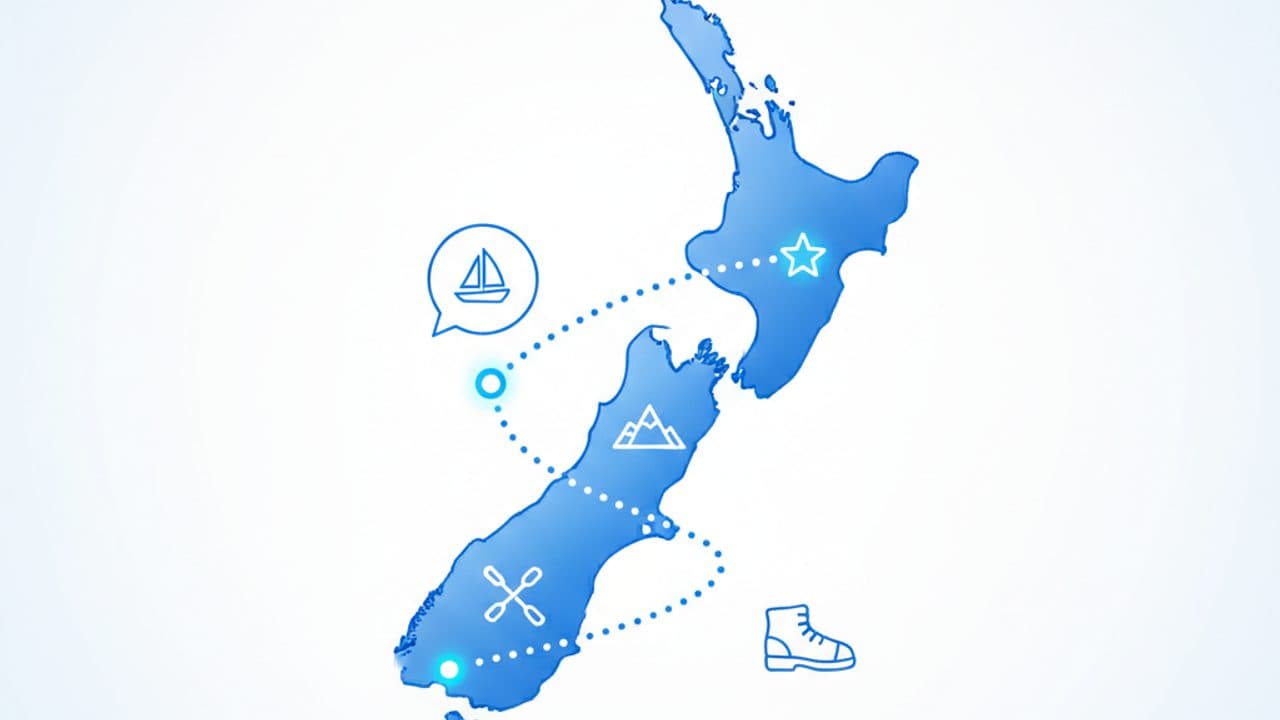
AI trip planners such as ChatGPT, Gemini and Google AI Mode recommend New Zealand operators they can find described clearly and consistently on the open web: the operator's own site, newzealand.com and regional tourism pages, Google Business Profile reviews, Tripadvisor, OTAs, YouTube and forums. In our own test runs on 2 November 2026, the same well-documented operators came up in every engine for a South Island itinerary, while specific prompts (a named park, a family, a price) pulled in smaller operators whose own pages stated the facts the AI needed.
This guide is for New Zealand tourism operators. It shows what six real AI trip-planner answers returned, which sources they drew on, and a practical playbook: your newzealand.com listing, Qualmark, reviews, itinerary-ready facts in NZ$, language versions for your key markets, and how to check and measure the results.
Key takeaways
- AI answers name a handful of operators per stop. In our runs, Dark Sky Project, Shotover Jet, RealNZ and Eco Wanaka Adventures were named by all three engines for a 10-day South Island prompt.
- ChatGPT linked straight to operators' own websites and tagged every link with
utm_source=chatgpt.com, so you can see those visits in GA4. - Google AI Mode cited a mix of operator sites, Tripadvisor, Klook, TourRadar, YouTube, bloggers, a Facebook group and the regional tourism site, and showed Google Business Profile ratings inline.
- A Simplified Chinese prompt for the same trip cited KKday, Viator, Wanderlog and Taiwanese travel blogs, not the named operators' own sites. If you have no page in a market's language, someone else describes you.
- The NZ levers are free or low cost: a newzealand.com listing (Tourism New Zealand database), Qualmark, consistent details everywhere, and a page that states price, duration, season and booking lead time.
- The Government put NZ$800,000 from the International Visitor Levy into making the Tourism New Zealand database AI-ready (July 2026), so an accurate listing there matters more, not less.
Why AI trip planning matters for New Zealand operators now
International tourism is too big a channel to leave to chance. MBIE's International Visitor Survey for the year ending December 2025 puts international visitor spend at NZ$12.5 billion, up 3%, which keeps tourism New Zealand's second-largest export earner after dairy. Stats NZ's International travel release for August 2026 counted 3.71 million overseas visitor arrivals in the August 2026 year, up 307,000.
The planning journey for many of those visitors now starts in a chat box. When a visitor opens an AI trip planner, New Zealand operators compete for a handful of named slots per stop rather than a page of ten links. At TRENZ 2026, Air New Zealand's chief executive told the industry that travellers "will start with the prompt", as TTG Asia reported. Survey data on operator impact is still mixed: WeTravel's 2026 report, summarised by Travolution, found 14% of operators saw more bookings from AI search tools, 8% saw fewer because their offers do not appear, and 78% saw no change. The 8% is the group this guide is written to keep you out of.
What is the Government doing to make NZ tourism visible in AI search?
On 30 July 2026, MBIE announced NZ$800,000 from the International Visitor Conservation and Tourism Levy to upgrade Tourism New Zealand's systems and content so AI tools can use information about tourism businesses more easily, and to expand Tourism New Zealand's AI travel assistant with more regional tourism organisation (RTO) content. Tourism Minister Louise Upston said some operators are harder to find through AI than they should be (Inside Government NZ). Tourism New Zealand also ran operator workshops on AI-driven discoverability in July 2026.
The practical consequence: whatever you put in the Tourism New Zealand database is being prepared for machine reading. If your listing is stale, that stale data is what gets distributed.
What AI trip planners returned for New Zealand itinerary prompts (observed 2 November 2026)
We ran six prompts ourselves on 2 November 2026 to see which operators and sources real answers used. This is a dated observation, not a measured study. Each prompt was run once, in one signed-in browser with Google personalisation on, from outside New Zealand (Google served Tripadvisor's India and Singapore domains, which signals a non-NZ location). AI answers change between runs and users, so treat the names below as examples of the pattern, not rankings.
| Engine and prompt | Operators named (examples) | Sources cited or linked |
|---|---|---|
| Google AI Mode (English): 10-day South Island itinerary in February with tour and activity recommendations | Dark Sky Project, Mt Cook Ski Planes, Eco Wanaka Adventures, Skyline, Shotover Jet, AJ Hackett Bungy, RealNZ, Mitre Peak Cruises, Franz Josef Glacier Guides | YouTube (4 videos), Klook, Tripadvisor, TourRadar (3 tours), Haka Tours, kiwitour.co.nz, International Traveller, independent travel blogs; a sponsored newzealand.com unit appeared under the answer |
| ChatGPT (signed in, web search on): same South Island prompt | Dark Sky Project, The Helicopter Line, Eco Wanaka Adventures, Skyline, Shotover Jet, Dart River Adventures, RealNZ, Cruise Milford, Ezi and GO Rentals | Operators' own websites, every link tagged utm_source=chatgpt.com; NZTA journey planner for road conditions |
| Gemini (Flash): same South Island prompt | Dark Sky Project, Chameleon Stargazing, The Helicopter Line, Eco Wanaka Adventures, Wildwire Wanaka, Skydive Wanaka, Shotover Jet, AJ Hackett Bungy, RealNZ, Southern Discoveries, Rosco's Milford Kayaks, Dart River Adventures | No source links shown; Google Maps place cards for destinations |
| Google AI Mode (English): family of four, 3 days in Rotorua, which Māori cultural experiences to book | Mitai Māori Village, Te Pā Tū, Te Puia, Whakarewarewa, Skyline Rotorua, Redwoods Treewalk, Rotorua Duck Tours | Operator sites (whakarewarewa.com, velocityvalley.co.nz), rotoruanz.com (RTO), Tripadvisor, a Facebook travel group, family travel blogs; Google Business Profile ratings and review counts shown inline |
| ChatGPT: same Rotorua prompt | Mitai Māori Village, Te Puia, Whakarewarewa, Te Pā Tū | Operator sites and rotoruanz.com; a sponsored Klook listing for Te Pā Tū appeared under the answer, priced in a non-NZ currency |
| Google AI Mode (English): beginner kayak and walk day trip in Abel Tasman, which operator and how much | Abel Tasman Kayaks, Wilsons Abel Tasman | Both operators' own product pages (the AI repeated the per-person NZ$ price shown on the operator's page), YouTube, Experience Oz, Agoda; a "Check availability for me" button |
We also ran the South Island prompt in Simplified Chinese on Google AI Mode. It named almost the same operators (Shotover Jet, AJ Hackett Bungy, Eco Wanaka Adventures, RealNZ, Southern Discoveries, Dark Sky Project, Haka Tours), but the citations changed completely: KKday, Viator, Wanderlog, Tripadvisor, newzealand.com and Taiwanese travel sites. None of the named operators' own sites appeared among the citations we could see.
How do AI trip planners decide which New Zealand operators to recommend?
Three patterns stood out in our runs, and they match how the systems are built:
- Consensus wins broad prompts. For "10 days in the South Island", all three engines converged on operators that dozens of blogs, videos and OTA listings already mention. Google says AI Overviews and AI Mode use query fan-out, running multiple related searches across subtopics; an operator that appears across many of those results is more likely to be named.
- Specific prompts reward specific pages. When the prompt asked for a park, an audience or a price, smaller operators appeared, and the AI quoted facts straight from their own product pages. That is the opening for most NZ operators: you will rarely win "best things to do in New Zealand", but you can be the clearest answer to "beginner kayak day trip in Abel Tasman with lunch".
- Trust signals are displayed, not just used. AI Mode put Google Business Profile star ratings and review counts next to each Rotorua recommendation. ChatGPT added a map with ratings. A thin or badly rated profile is visible inside the answer.
Which sources do ChatGPT, Gemini and Google AI Mode use for New Zealand itineraries?
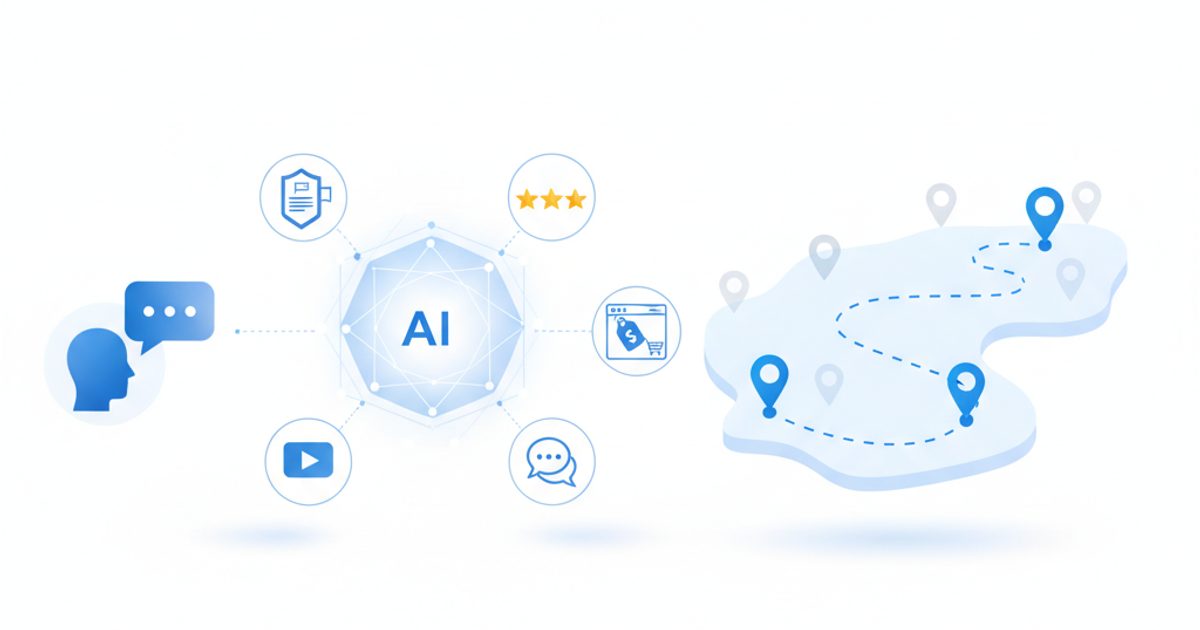
They draw on whatever their search layer retrieves for the prompt and its fan-out queries. In practice that falls into eight source types. Some you control directly, some you influence, and some you can only monitor.
| Source type | Seen in our runs | Your control | What to do |
|---|---|---|---|
| Your own website | ChatGPT linked operator sites; AI Mode quoted operator product pages | Full | One page per product with price, duration, season, inclusions, booking lead time |
| newzealand.com and RTO sites | Cited in AI Mode (English and Chinese) and by ChatGPT (rotoruanz.com) | High | Free listing via the Tourism New Zealand database; RTO listing |
| Google Business Profile and Maps | Ratings shown inline in AI Mode; Gemini used place cards | High | Correct category, hours, photos, booking link; reply to reviews |
| Review platforms (Tripadvisor) | Cited in AI Mode in both languages | Medium | Claim the listing, keep details identical, ask for reviews after trips |
| OTAs and marketplaces (Klook, Viator, KKday, TourRadar, Agoda) | Heavily cited, especially in Chinese; sponsored OTA units in ChatGPT | Medium | Same name, price logic and description as your site; translated listings for Asian markets |
| YouTube videos | Four videos cited for one AI Mode answer | Low to medium | Host creators; publish your own short guides with spoken place and product names |
| Forums and social groups | A Facebook NZ travel group cited twice in AI Mode | Low | Monitor; answer genuinely as the operator where the group allows it |
| Independent travel blogs | Cited in every AI Mode answer | Low | Famils, media kits, accurate fact sheets bloggers can copy |
Video and community sources behave differently by engine. Our guides to which AI engines cite YouTube and Reddit in AI search cover those channels in depth, and our overview of how Kiwis use AI search and which NZ sources get cited gives the wider New Zealand picture.
How do I list my tourism business on newzealand.com?
A newzealand.com listing is free and is created through Tourism New Zealand's Tourism Business Database. Activity, tour, transport and accommodation operators can list, according to the Ōtorohanga District Council's March 2026 how-to guide.
- Go to register.newzealand.com and register for the Tourism Business Database as a New Zealand based operator.
- Once your access is approved, create the business profile: legal and trading name, physical location, contact details and booking link. Use exactly the same name and address as your website and Google Business Profile.
- Create one product listing per experience, in the most specific category available, with accurate images, a description that states what is unique, opening hours, pricing and the booking link.
- Submit for moderation. Tourism New Zealand checks every listing before it goes live; its operator user guide quotes around 5-7 working days, and edits are moderated too.
- Set a reminder to refresh listings each season (summer and winter products, school holiday times, price changes, closures).
Tourism New Zealand's own AI trip planner on newzealand.com, powered by Matador Network's GuideGeek, draws on information from Tourism New Zealand, RTOs and operators, and had about 200,000 unique users since its late 2024 launch according to Matador's press release. That is a vendor figure, but it means your database listing feeds at least one AI planner directly, and the July 2026 funding aims to make the same database easier for other AI tools to use.
Register with your RTO too. In our Rotorua runs, both AI Mode and ChatGPT cited rotoruanz.com. For the NZBN, directory and Map Pack side of this, see our local SEO guide for New Zealand businesses.
Does Qualmark accreditation help with AI recommendations?
Qualmark does not feed ChatGPT or Gemini directly, and no AI engine we tested mentioned it. Its value is indirect: it strengthens your position in Tourism New Zealand channels that AI does cite. Qualmark says on its Why Qualmark page that accredited businesses get almost 4 times more referrals from newzealand.com than non-Qualmark businesses, and that members get priority product listing on newzealand.com where eligible, plus eligibility for Tourism New Zealand famils, KiwiLink and trade content. That referral figure is Qualmark's own claim, not an independent study.
To join, Qualmark's join page says you must be a New Zealand registered company that has operated for about three months; the first evaluation is in person and later reviews are annual and online. The standards are recognised by the Global Sustainable Tourism Council. Fees are listed on a separate Qualmark page; check them on the day you apply. Not everyone agrees it pays off: NZ Pocket Guide argues new operators can defer it. Our view: if Tourism New Zealand channels and trade famils matter to your business, Qualmark is worth it; if you sell mainly to domestic walk-ins, prioritise your own site and reviews first.
Do Google and Tripadvisor reviews affect AI travel recommendations?
Yes, visibly. Google AI Mode showed star ratings and review counts beside each Rotorua recommendation, and Tripadvisor pages were cited in English and Chinese answers. Reviews also supply the descriptive language AI reuses ("great for kids", "small group", "seals at Adele Island"). Ask for reviews after every trip, reply to them, and make sure your Tripadvisor, Google and OTA listings use the same business name and product names as your website.
Does a DOC concession matter for AI visibility?
Indirectly. The Department of Conservation requires a concession for any business or guided activity on public conservation land, including guided walks and kayaking. Stating your concession on your product page ("operating under a DOC concession in Abel Tasman National Park") is a verifiable trust fact, it answers the "is this legitimate?" question travellers ask, and it ties your product to the place name the AI is retrieving for.
What information should a tour operator publish so AI can quote it?
Publish the facts an itinerary needs, as plain text on one product page, in NZ$. In our Abel Tasman run, AI Mode repeated the operator's per-person price and duration straight from its page; operators who hide prices behind a booking widget give the AI nothing to quote, so it quotes an OTA instead.
| Fact | Example wording | Why AI needs it |
|---|---|---|
| Price in NZ$, what it includes | "NZ$xxx per adult, NZ$xx per child (5-14), includes lunch and transfers from Mārahau" | Answers "how much" prompts; avoids stale OTA prices |
| Duration and start times | "Full day, about 8 hours, departs 8.30am" | Lets the AI fit you into a day plan |
| Season and operating months | "Runs October to April; winter programme May to September" | Matches month-specific prompts ("in February") |
| Booking lead time | "Book 3-4 weeks ahead in January and February" | AI answers routinely tell users how far ahead to book |
| Suitability | "No experience needed; minimum age 8; moderate fitness" | Matches family, beginner and age-specific prompts |
| Accessibility | "Wheelchair accessible boat; accessible toilets at base" | Answers accessibility prompts most competitors ignore |
| Location and access | "Meet at our Te Anau base, 2 hours from Queenstown" | Supports routing and driving-time questions |
| Credentials | "Qualmark Gold; DOC concession holder; Adventure Activities registered" | Trust facts the AI can repeat |
| Cancellation and weather policy | "Full refund if we cancel for weather" | Weather-dependent activities are flagged in AI answers |
Write it in sentences and a simple table, not only in images or a JavaScript booking widget. Google states there are no special requirements for AI Overviews and AI Mode beyond being indexed and eligible for a snippet, so the job is to make the page complete, current and crawlable. Schema markup is useful for rich results but is not a requirement for AI answers. Add a short Q&A block for the questions you get by email (rain, kids, what to bring).
Should NZ tourism operators publish content in Chinese, Japanese and other languages?
If a market is a meaningful share of your bookings, yes: at minimum one translated product page per key experience, plus translated OTA listings. In our Chinese-language AI Mode run, none of the named operators' own sites were cited; the answer leaned on OTAs, Tripadvisor and Taiwanese travel blogs, because those were the pages that existed in that language. Use the official data to choose markets:
| Market | Official data | Language action |
|---|---|---|
| Australia | 1.60 million arrivals in the August 2026 year (Stats NZ); NZ$3.8 billion spend in 2025 (MBIE) | English is enough; mention AUD-friendly context and school holiday timing |
| United States | 389,000 arrivals, a record (Stats NZ); NZ$1.9 billion spend, up 13% (MBIE) | English; long-stay and bucket-list framing |
| China | 327,000 arrivals, up 81,000 (Stats NZ); highest median daily spend at NZ$456 (MBIE) | Simplified Chinese product page; Chinese-language OTA listings |
| Taiwan | 66,000 arrivals, a record (Stats NZ) | Traditional Chinese if you see bookings; Taiwanese travel sites were cited in our Chinese run |
| Japan | 4% of August 2026 arrivals (Stats NZ) | Japanese page for high-demand products |
| Germany and Europe | Germany has the longest median stay at 30 days and highest median spend per visitor at NZ$6,716 (MBIE) | English usually works; German for multi-week touring products |
Translate the fact sheet first (price, duration, season, booking), not the marketing copy. Have a native speaker check place names and macrons survive where they should.
How many international visitors come to New Zealand and where are they from?
Stats NZ counted 248,700 overseas visitor arrivals in August 2026, 99% of the 251,100 in August 2019, and 3.71 million in the year to August 2026. Australians made up 51% of August arrivals, China 11%, the United States 6% and Japan 4%. MBIE's survey for 2025 adds that the median visitor stays 9 days and spends a median NZ$2,850; in the December 2025 quarter, walking, hiking, trekking or tramping was the top activity at 73%, followed by visiting other natural attractions at 66%. A 9-day median stay is exactly the "10-day itinerary" prompt we tested.
How can an operator check whether ChatGPT or Gemini recommends their business?
Test the prompts your guests would type, on a schedule you can keep, and record the results the same way each time.
- Write 10-20 prompts from real enquiries: the region plus month ("Queenstown in July with kids"), the activity plus audience ("beginner glacier walk"), and the comparison ("Milford Sound cruise or Doubtful Sound").
- Add language variants for your top non-English market.
- Run each prompt in ChatGPT, Gemini, Google AI Mode and Perplexity, ideally logged out or in a clean profile, and note the date.
- Record whether you are named, your position, which competitors are named, and which URLs are cited.
- Fix what the answer reveals: a wrong price means your page or an OTA listing is stale; a competitor cited from a blog means you need that kind of coverage.
- Repeat monthly and before each season. Single runs vary, so look for patterns over several checks.
Disclosure: AI Rank Lab is our product. We list it first because this is our site, and we've kept the same criteria for every tool below.
- AI Rank Lab runs your itinerary prompts on ChatGPT, Claude, Gemini and Perplexity when you choose, and stores each run so you can compare mentions, position, competitors and cited URLs over time (brand visibility). Its prompt research can suggest prompts for a chosen country and language, and the AI Mode tracker checks Google AI Mode with a country and language set per query, for example New Zealand English or Simplified Chinese. One limit to know: the ChatGPT, Claude, Gemini and Perplexity runs do not emulate a location. Priced in USD from US$69 a month (prices checked 2 November 2026).
- Dedicated AI visibility trackers such as Profound, Peec AI and Otterly.AI also run prompt sets across engines; Profound is built for large enterprise programmes and Peec AI for straightforward prompt tracking.
- Manual checks in each engine cost nothing and are enough for a single-product operator running a dozen prompts a month.
Can operators track bookings that come from ChatGPT?
Yes, partly. In our runs ChatGPT appended utm_source=chatgpt.com to every operator link, so those visits show up as a separate source in Google Analytics 4. Build a GA4 exploration for that source and check whether those sessions reach your booking confirmation page. Google AI Mode and Gemini clicks are harder to separate. Our guide to tracking AI referral traffic in GA4 walks through the setup, and AI Rank Lab's AI bot tracking tag records AI assistant referrals per page if you want it without building reports.
NZ tourism operator checklist for AI trip planners
| Task | Where | How often |
|---|---|---|
| Free listing live and accurate, one listing per product | Tourism New Zealand database (newzealand.com) | Each season |
| Listed with your RTO | Regional tourism website | Yearly |
| Identical business name, address, category, booking link and phone | Website, newzealand.com, RTO, Google Business Profile, Tripadvisor, OTAs | Quarterly |
| One product page per experience with NZ$ price, duration, season, lead time, suitability, accessibility | Your website | Each price change |
| Credentials stated in text (Qualmark, DOC concession, safety registration) | Product pages | When they change |
| Review requests after every trip; replies to reviews | Google, Tripadvisor | Weekly |
| Translated fact sheet and OTA listings for your top non-English market | Website, Klook, KKday, Viator | Yearly |
| Short videos naming the place and product; creator famils | YouTube, social | Each season |
| Prompt test across ChatGPT, Gemini, AI Mode, Perplexity | Manual or a tracker | Monthly |
| ChatGPT referral report and booking conversions | GA4 | Monthly |
Limits of this guide
Our six prompt runs are a snapshot from one browser on one day, with personalisation on and a location outside New Zealand. A traveller in Sydney or Shanghai may see different operators. The operators named above are examples of what the engines returned, not endorsements. The Qualmark referral figure and the GuideGeek user figure are self-reported by those organisations. Visitor figures come from Stats NZ (August 2026 release) and MBIE (year ending December 2025) and will be updated by later releases.
If you want to see which operators AI trip planners name for your region and products, and track it each season, try AI Rank Lab's brand visibility checks with the free signup credits.
Get a free AI ranking consultation
Want your brand to show up when ChatGPT, Gemini and Perplexity answer questions in your market? Tell us about your site and our team will send a personalized strategy.


