


To track ChatGPT traffic in GA4, open Reports > Acquisition > Traffic acquisition and read the AI Assistant channel, which Google added to the default channel group on May 13, 2026. It sorts clicks from ChatGPT, Gemini, Claude, Copilot and other recognized assistants automatically, but only when the browser passes a referrer. For a complete count, add a custom channel group with an anchored source regex, because the built-in channel misses UTM-only app clicks, assistants Google does not recognize, and every visit that arrives with no referrer at all.
This guide gives you exact menu paths, a copy-paste regex we tested against 41 real and decoy source values, the landing-page and key-event reports to build on top, and the evidence for why every GA4 number is a floor: our own GA4 property, plus AI Rank Lab tag data from 28 sites. Menus, Google documentation and all figures were checked on October 18, 2026.
Key takeaways
- GA4 has had a built-in AI Assistant channel since May 13, 2026. It is automatic, referrer-based and not retroactive.
- On our own site (June 1 to October 17, 2026) it caught 666 of 740 identifiable AI-assistant sessions, about 90%. The other 74 sat in Referral, Unassigned and Organic Social.
- Keep a custom AI channel group anyway: it applies to historical data, catches UTM-only sessions such as
chatgpt.com / (not set), and covers assistants like Doubao, Qwen and NotebookLM. - Google's own help-center example regex would file AI software sites such as jasper.ai as assistant traffic and misses Grok and DeepSeek. Anchor your pattern.
- Across 28 sites running the AI Rank Lab tag, 2,710 page views carried
utm_source=chatgpt.combut only 2,087 had a ChatGPT referrer, so at least 623 ChatGPT-tagged page views were invisible to referrer-based reporting. - Google AI Overviews and AI Mode clicks are counted as Organic Search. Search Console's generative AI report shows their impressions, not clicks.
Does GA4 have an AI channel now?
Yes. Google's "What's new in Google Analytics" log records the change on May 13, 2026: when a session's referrer matches a recognized AI assistant, GA4 sets the medium to ai-assistant, the campaign to (ai-assistant), and groups the session under a new AI Assistant channel in the Default Channel Group. Nobody has to configure anything.
Google's default channel group definitions now describe AI Assistant as the channel "by which users arrive at your site from sources like ChatGPT, Gemini, Deepseek, Copilot, or Grok" and state that it excludes AI Overviews and AI Mode, which stay in Organic Search. The release note names ChatGPT, Gemini and Claude. Google has not published a complete list, which is why Search Engine Journal's coverage and most follow-up guides treat Perplexity as unconfirmed.
Three properties of the channel matter for reporting:
- It is referrer-based. A visit with no referrer cannot be recognized, whatever the assistant.
- It is not retroactive. On our property, 56 chatgpt.com sessions in May 2026 were still labelled
referraland only 4ai-assistant; from June the same source was overwhelmingly labelledai-assistant. Year-over-year comparisons break at the rollout date. - It cannot be edited. The default group is fixed. To add sources you build a custom channel group, or edit the property's primary channel group.
Which AI assistants does the AI Assistant channel recognize?
In our own GA4 property, the channel picked up chatgpt.com, gemini.google.com, claude.ai, perplexity.ai and copilot.com, plus a bare source value of gemini with no domain. So in practice Perplexity and Claude are recognized, even though Google's definition page does not list them. It did not pick up doubao.com, chat.qwen.ai, duck.ai, manus.im or notebooklm.google.com, which stayed in Referral, or yuanbao.tencent.com, which GA4 filed under Organic Social. DeepSeek and Grok are named by Google but sent no traffic to our site, so we could not confirm them.
Which AI platforms send referrers, and which don't?
Every major assistant's web app passes a referrer on link clicks; the problem is apps, copied links and the assistants GA4 does not know. The table combines our AI Rank Lab tag data (28 sites, July 2025 to October 2026, counting page views whose document.referrer was an assistant) with what our own GA4 property showed after the May 2026 change.
| Source | Referrer from the web app? | Tracking tag added? | Where GA4 puts it by default |
|---|---|---|---|
| ChatGPT | Yes, chatgpt.com (2,087 referred page views in our tag data) | Yes, utm_source=chatgpt.com per OpenAI's publisher FAQ; missing from most links October 14-16, 2026 | AI Assistant; referrer-less app clicks show as chatgpt.com / (not set) in Unassigned, or as Direct |
| Gemini | Yes, gemini.google.com (629) | We also saw a bare gemini source | AI Assistant |
| Perplexity | Yes, perplexity.ai (457) | Some sessions arrive as source perplexity with medium (not set) | AI Assistant from June 2026 on our property; tagged sessions go to Unassigned |
| Claude | Yes, claude.ai (442) | None observed | AI Assistant |
| Microsoft Copilot | Yes, copilot.microsoft.com (62); GA4 also reports copilot.com | copilot.com / (not set) seen occasionally | AI Assistant |
| DeepSeek, Grok | Named by Google; no traffic in our data | Unknown | AI Assistant per Google's definition |
| Doubao, Qwen, Yuanbao, Duck.ai, Manus, NotebookLM | Yes (observed on our property) | None observed | Referral (Yuanbao: Organic Social) |
| Google AI Overviews and AI Mode | google.com, identical to classic search | No | Organic Search, by Google's definition |
| Assistant mobile and desktop apps | Often no | ChatGPT's UTM can survive | Direct, or Unassigned when only the UTM survives |
What our GA4 property shows: where AI sessions actually land
The built-in channel is good but not complete. We pulled every session source and medium on the airanklab.com GA4 property for June 1 to October 17, 2026 (after the rollout settled) and hand-classified anything that came from an AI assistant. Out of 38,827 sessions, 666 sat in the AI Assistant channel (1.7%). We found 74 more AI sessions elsewhere:
| Where the AI sessions sat | Sessions | Source / medium examples | Why GA4 put them there |
|---|---|---|---|
| AI Assistant channel | 666 | chatgpt.com / ai-assistant, gemini.google.com / ai-assistant, claude.ai / ai-assistant, perplexity.ai / ai-assistant | Referrer matched Google's list |
| Referral | 25 | chatgpt.com / referral, gemini.google.com / referral | Labelled referral despite a known host; cause not documented by Google |
| Unassigned | 32 | perplexity / (not set), openai / (not set), copilot.com / (not set), gemini / (not set) | A utm_source with no utm_medium and no usable referrer |
| Referral or Organic Social (unrecognized assistants) | 17 | doubao.com, chat.qwen.ai, yuanbao.tencent.com, duck.ai, manus.im, notebooklm.google.com | Not on Google's assistant list |
| Total identifiable AI sessions | 740 | The built-in channel caught about 90%; a custom group recovers the other 74 (an 11% lift) | |
Two cautions. This is one site with a marketing and SEO audience, so its 1.7% AI share is not a benchmark; across the 28 sites in our tag data, the median site received just 0.23% of its tracked page views from AI assistants. And none of this counts the visits that arrived with no referrer and no tag, which land in Direct and cannot be separated by any GA4 setting.
Why does ChatGPT traffic show as chatgpt.com / (not set)?
Because the visit carried ChatGPT's utm_source=chatgpt.com tag but no utm_medium, and GA4 did not get a referrer to classify it with. Google's campaign URL documentation says missing UTM parameters produce (not set) values. The usual cause is a click from an app, where the referrer is dropped but the tag on the URL survives. These sessions land in Unassigned, not AI Assistant, so a channel group that matches on source rather than medium is the only way to count them alongside the rest.
The regex for a custom AI channel group (copy-paste)
Use two conditions on Source, joined with OR. The first covers the assistants that send most traffic; the second covers smaller and regional ones we have seen in real referral data. Both are anchored, so they behave the same whether GA4 applies full or partial matching.
Condition 1 - Source matches regex (core assistants):
^(.*\.)?(chatgpt\.com|chat\.openai\.com|chatgpt|openai|perplexity\.ai|perplexity|claude\.ai|claude|gemini\.google\.com|gemini|copilot\.microsoft\.com|copilot\.com|deepseek\.com|grok\.com|meta\.ai)$Condition 2 - Source matches regex (smaller assistants):
^(.*\.)?(notebooklm\.google\.com|vertexaisearch\.cloud\.google\.com|mistral\.ai|qwen\.ai|doubao\.com|yuanbao\.tencent\.com|duck\.ai|manus\.im)$Condition 3 - Medium exactly matches: ai-assistant. This picks up anything Google adds to its own list before you update the regex.
The (.*\.)? prefix allows subdomains such as chat.deepseek.com or www.perplexity.ai, and the bare names (chatgpt, openai, perplexity, claude, gemini) catch UTM-tagged sessions that arrive without a domain. We deliberately do not match all of openai.com: a referral from OpenAI's help or developer docs is not an assistant answer. The vertexaisearch.cloud.google.com host is the redirect that apps built on Google's Gemini API use for search-grounded citation links; we saw it on our property in May 2026.
Why not use Google's example regex?
Because it is loose in both directions. Google's custom channel group help page offers an "AI assistants" example that begins ^.*ai|.*\.openai.*|.*chatgpt.*|.*gemini.*|.*gpt.*|.... Under alternation, ^.*ai matches any source that ends in "ai", and .*gpt.* or .*bard.* match any source containing those letters. Google's Analytics regex documentation says matching is full by default, so we tested each pattern both ways against 22 real assistant source values and 19 decoys. Ten decoys came from our own GA4 data (for example decageo.ai and app.cognizo.ai, two AI-visibility software sites that link to us, plus mail.google.com and temp-mail.org); nine were realistic lookalikes such as jasper.ai, platform.openai.com and geminiwatches.com.
| Pattern | Real assistant sources caught (of 22) | Decoys wrongly matched (of 19) | What goes wrong |
|---|---|---|---|
| Google's help-center example, full match | 15 | 9 | Misses DeepSeek, Grok, Doubao, NotebookLM; counts jasper.ai and AI software sites as assistants |
| Google's help-center example, partial match | 16 | 12 | Also matches mail.google.com and temp-mail.org through ^.*ai |
Short list bard|chatgpt|openai|claude|copilot|gemini|perplexity|grok, full match | 3 | 0 | Only matches a source that is exactly "chatgpt" or "openai"; chatgpt.com fails |
| Same short list, partial match | 12 | 8 | Matches geminiwatches.com and claude-monet.org; misses Meta AI, Mistral, Qwen |
| Our two anchored conditions, either mode | 22 | 0 | None in this test; it must be updated as new assistants appear |
Our pattern passes partly by construction, since we chose the real hosts, so the decoy column is the more useful one. Re-check it every quarter against the Referral and Unassigned rows in your own property, and add any assistant host you find there.
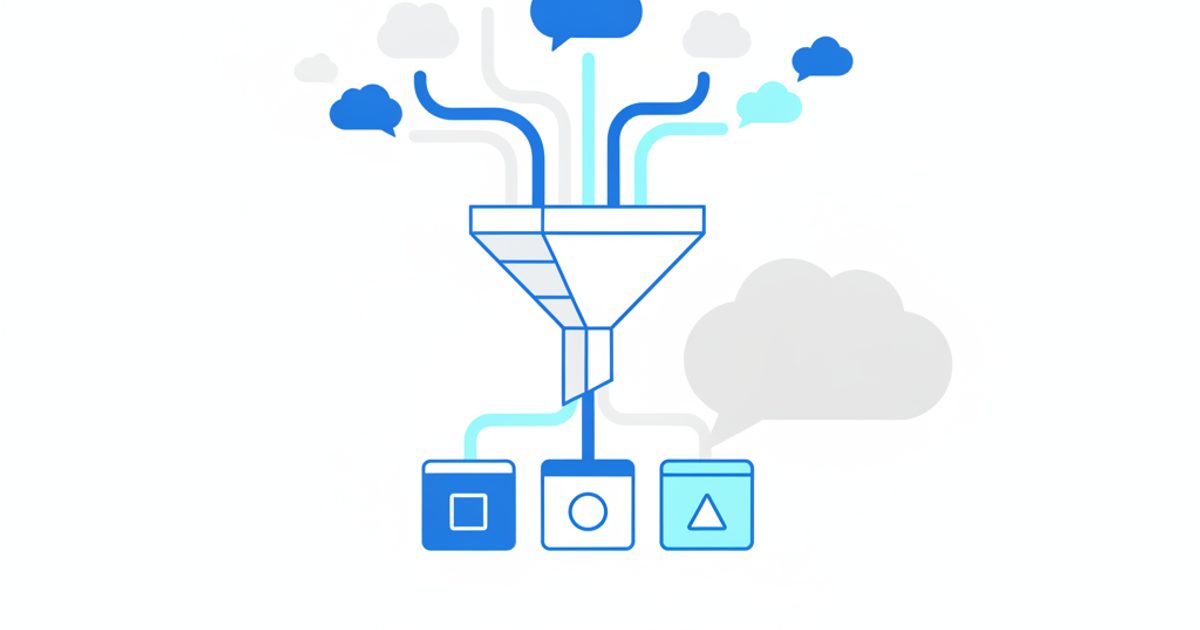
How to create a custom AI channel group in GA4, step by step
You need the Editor role or higher on the property. The setup takes about ten minutes, and because custom channel groups can be applied retroactively, it also gives you AI history from before May 2026, which the built-in channel cannot.
- Go to Admin > Data display > Channel groups.
- Click Create new channel group. GA4 starts you from a copy of the default group, so every existing channel is already there. Name it, for example, "Channels incl. all AI".
- Click Add new channel, name it "AI assistants (all)", then click Add condition group.
- Add the three conditions above (two Source regexes and Medium exactly matches
ai-assistant) and set the operator between them to OR, not AND. Click Save channel. - Click Reorder and drag "AI assistants (all)" to the top of the list, above Referral, Organic Social and Organic Search. GA4 assigns traffic to the first channel whose rule matches, so a channel below Referral never fires. Click Apply.
- Click Save group.
- Open Reports > Acquisition > Traffic acquisition, open the primary dimension dropdown and choose your new group. Then add Session source / medium as a secondary dimension and scan the AI rows for anything that should not be there.
Limits to know, from Google's documentation: standard properties get 2 custom channel groups (360 properties get 5), each group holds up to 50 channels, channel definitions are not case sensitive, custom groups are not in the BigQuery export, and they cannot be used in the Key events paths report. Deleting a group cannot be undone.
To skip the manual build: AI Rank Lab's GA4 integration connects your property over OAuth and reports AI referral traffic per engine, and the AI referral tracking use case shows how it lines that up with the JS tag.
How to see AI landing pages and conversions in GA4
Once the channel exists, two reports answer most questions: which pages AI sends people to, and whether those people convert.
Which landing pages get AI traffic?
- Open Reports > Engagement > Landing page.
- Click Add comparison and set the dimension to your custom group (or Session default channel group exactly matches
AI Assistant). - Sort by Sessions. Pages with AI sessions but weak engagement are usually answering a different question than the one the assistant implied.
For more detail, build an exploration: Explore > Free form, with dimensions Landing page + query string, Session source, Session medium and your custom channel group, and metrics Sessions, Engaged sessions, Key events and Session key event rate. Filter to the AI channel. The query-string version of the landing page is useful because it exposes utm_source=chatgpt.com on sessions that lost their referrer.
How do you measure conversions from AI referral traffic?
Mark the actions that matter as key events (Admin > Data display > Events, then the star next to the event), and the Traffic acquisition report will show Key events and Session key event rate per channel, including your AI channel. For multi-touch questions, use the attribution reports in the Advertising section; because custom channel groups are not available in the Key events paths report, use the default group's AI Assistant channel there.
Read small numbers carefully. On our property, AI Assistant sessions had a 55.1% engagement rate against 60.7% for Organic Search, over 666 sessions; that difference could reverse next quarter. If you would rather ask these questions in plain English than build explorations, our guide to using an AI agent for GA4 covers how that works and where it goes wrong, and automated GA4 reporting covers putting the AI channel into a monthly report.
Why GA4 undercounts AI referral traffic
GA4 counts clicks it can attribute, and AI assistants generate many visits it cannot. The main reasons, roughly in order of size:
- App clicks drop the referrer. A link tapped in an assistant's mobile or desktop app often opens without a referrer. If ChatGPT's tag survives, the session becomes
chatgpt.com / (not set)in Unassigned; if not, it is Direct. - Tags disappear. Profound measured the share of ChatGPT cited answers with a
utm_source=chatgpt.comlink falling from about 99% to roughly 5-12% between October 14 and 16, 2026, as a new answer layout rolled out, before recovering to about 99% by 06:30 UTC on October 16. Annotate that window in your reports. - Mentions without links. An answer that names your brand without linking sends people to Google or to your typed URL, which GA4 records as Organic Search or Direct.
- AI Overviews and AI Mode are inside Organic Search. Google's own channel definition says so.
- Unrecognized assistants. Doubao, Qwen, Duck.ai, Manus and NotebookLM all landed in Referral on our property.
- Consent and blocking. Visitors who decline analytics cookies or block the Google tag are not recorded as normal sessions, whatever channel they came from.
How much AI traffic does GA4 miss?
No one can measure the referrer-less part precisely, but you can put a floor under it. The AI Rank Lab JS tag records both the referrer and the full landing URL. Across the sites running it between July 2025 and October 2026, 2,710 page views carried utm_source=chatgpt.com (29 sites), while 2,087 page views had a chatgpt.com or chat.openai.com referrer (26 sites). Even if every referred page view also carried the tag, at least 623 tagged page views, 23% of them, arrived with no ChatGPT referrer. Some of those are reloads of a tagged URL rather than new visits, but in a spot check of the raw events while writing, the largest group had no referrer at all. These are page-view events, not users, and the true gap is larger, because untagged referrer-less clicks leave no trace.
The same tag data gives a platform split that differs from many published ones:
| Assistant | AI-referred page views | Share of AI referrals | Sites receiving any |
|---|---|---|---|
| ChatGPT | 2,087 | 56.8% | 26 |
| Gemini | 629 | 17.1% | 15 |
| Perplexity | 457 | 12.4% | 7 |
| Claude | 442 | 12.0% | 10 |
| Copilot | 62 | 1.7% | 5 |
| Total | 3,677 | 100% | 28 |
Method: page views whose document.referrer host was an AI assistant, recorded by the AI Rank Lab tag on 28 sites from July 27, 2025 to October 18, 2026, excluding duckduckgo.com. Savvy's 2026 GA4 guide, citing 2025 data, reports ChatGPT at about 78-87% of AI referrals and Claude under 1%. Our sample is sites that installed an AI-visibility tool, which likely over-represents B2B, SaaS and marketing audiences, so read Claude's 12% as a sign that Claude does send clicks, not as a market share. Referral volume also moves with the answers themselves; in our answer stability study, brand mentions flipped at least once in 42.9% of 42 prompt-engine pairs across 968 runs (February to October 2026).
Can you track Google AI Overviews and AI Mode traffic in GA4?
No. Clicks from AI Overviews and AI Mode arrive with the same google.com referrer as a classic result, and Google's channel definitions put them in Organic Search. There is no GA4 dimension that separates them.
What you can see is visibility. Google's Search Generative AI performance reports, announced June 3, 2026 and rolled out to all sites by August 31, 2026, show how often your URLs appeared in generative AI features, by page, country, device and date. They report impressions; the announcement lists no click metric. For Microsoft, Bing Webmaster Tools' AI Performance report (public preview since February 10, 2026) shows citations in Copilot and Bing AI summaries, and grounding queries, but not clicks.
How to triangulate AI traffic: UTM, self-reported attribution and server logs
Because every analytics view undercounts, use three independent signals and look for agreement in trend, not in absolute numbers.
| Method | What it catches | What it misses | Effort |
|---|---|---|---|
| GA4 channel group (built-in plus custom) | Clicks with a referrer or ChatGPT's tag | Referrer-less, untagged visits; AI Overviews and AI Mode | Low, one-time |
| UTM landing URLs | ChatGPT app clicks that kept utm_source=chatgpt.com | Other assistants, and ChatGPT links that were untagged (as in October 2026) | Low: filter Landing page + query string |
| Self-reported attribution | People who saw you in an answer and arrived later by search or typed URL | Recall errors; low response rates | Low: one form field |
| Server logs | User-triggered fetches by ChatGPT-User and Claude-User, a sign of live demand even without clicks | Whether a person ever visited | Medium: log access and parsing |
| Prompt-level visibility tracking | Whether assistants mention and cite you at all | Actual visits | Medium: a tool or manual testing |
Self-reported attribution is the best correction for unlinked mentions. Otterly's July 2026 write-up, "Claude drives 10.6% of our signups. Google Analytics says 0.1%", compared GA4 last-touch data with a "how did you hear about us" field: Claude was 0.1% of signups in GA4 and 10.6% self-reported, ChatGPT 7% against 11%. That is one SaaS company and a survey, but the direction is the point. List each assistant as a separate answer option, alongside Google, so people do not lump them together.
Server logs show the request side. OpenAI's crawler documentation says ChatGPT-User is "not used for crawling the web in an automatic fashion" but for actions a user initiated, and Anthropic's crawler help article describes Claude-User the same way. Rising user-agent fetches on a page with flat GA4 AI sessions usually means people are reading your content inside the answer without clicking. Our explainer on how ChatGPT search works covers which OpenAI agent does what.
To automate this step: the AI Rank Lab AI bot tracking tag records AI assistant referrals and AI bot visits per page, including the landing URL, so you can see referrer and UTM evidence side by side without parsing logs yourself.
Tools that measure what GA4 cannot
Disclosure: AI Rank Lab is our product. We list it first because this is our site, and we've kept the same criteria for every tool below.
- AI Rank Lab - a JS tag for AI referrals and AI bot visits per page, a GA4 connection with plain-English questions, and scheduled prompt tracking across ChatGPT, Claude, Gemini, Perplexity, Google AI Overviews and AI Mode. Best when you want referral data and visibility data in one place.
- Google Search Console - free, and the only first-party source for AI Overviews and AI Mode impressions. No clicks, no other assistants.
- Bing Webmaster Tools - free citation counts and grounding queries for Copilot and Bing AI summaries. The better choice if Microsoft surfaces matter to your audience.
- Profound and Otterly - prompt-monitoring platforms. Profound's large-scale answer collection is how the October 2026 ChatGPT tagging gap was spotted, and Otterly's team published the self-reported attribution comparison above. Strong options if answer monitoring is your main need.
Methodology and limitations
- GA4 property data: airanklab.com, our own site, pulled through the GA4 Data API on October 18, 2026 for May 13 to October 17, 2026 and June 1 to October 17, 2026. Sources were hand-classified as AI assistants. Small rows can differ slightly between monthly and whole-period pulls.
- Tag data: aggregated and anonymised from sites using the AI Rank Lab JS tag; no customer is named. Counts are page-view events, not users or sessions.
- Regex test: run with Python's regex engine using only RE2-compatible syntax, case-insensitive, in full and partial mode. It cannot replace checking your own property's source list.
- Documentation: GA4 menu paths and Google, OpenAI, Anthropic and Microsoft pages were read on October 18, 2026. GA4's interface changes often.
Start with the built-in AI Assistant channel today, add the custom group so you get history and the missing 10%, and pair both with a self-reported field. If you want the referral, UTM and visibility evidence in one dashboard, connect GA4 to AI Rank Lab and install the tag.
Frequently Asked Questions
Does GA4 track ChatGPT traffic automatically now?▾
Why does ChatGPT traffic show as chatgpt.com / (not set) in GA4?▾
Is Perplexity included in the GA4 AI Assistant channel?▾
Is the GA4 AI Assistant channel retroactive?▾
Can I track Google AI Overviews and AI Mode clicks in GA4?▾
How much AI traffic does GA4 miss?▾
Will a custom AI channel group change my existing GA4 reports?▾
How often should I update the AI regex in GA4?▾
Get a Free AI Ranking Consultation
Want to improve your brand's visibility in AI search engines like ChatGPT, Gemini, and Perplexity? Fill out the form and our experts will create a personalized strategy for you.

Written by
Devanshu
Chief Marketing Officer & AI Search Optimization Architect
Digital Marketing Strategist & Pioneer in SEO, Answer Engine Optimization (AEO), and Generative Engine Optimization (GEO).


