


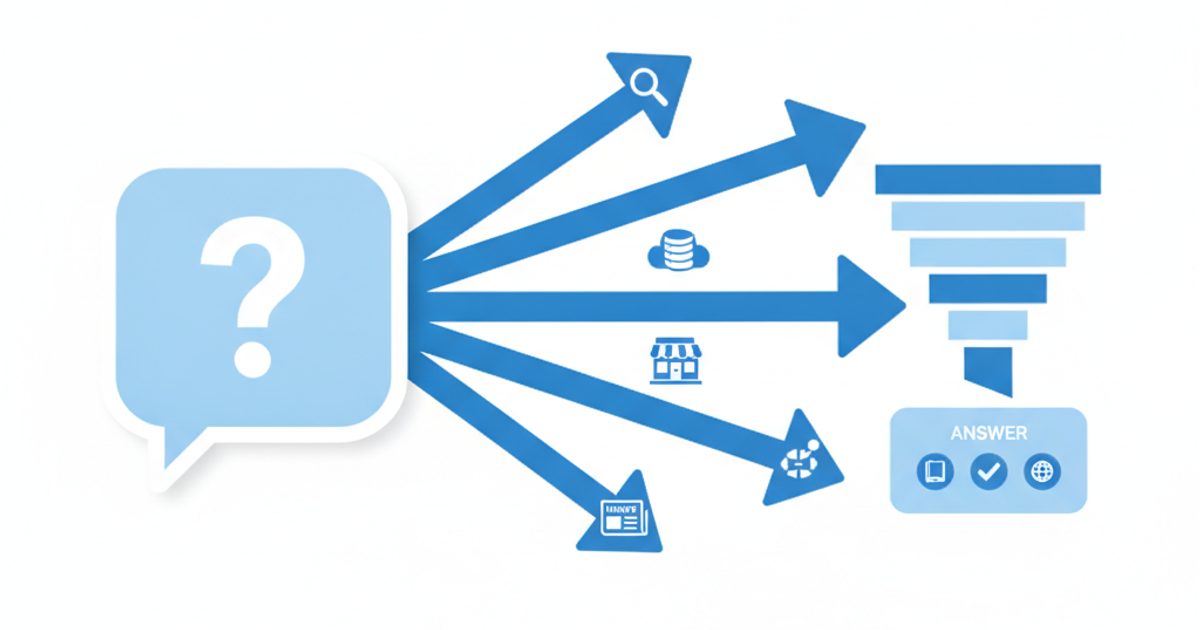
ChatGPT search works in five steps: it decides whether your question needs current information, rewrites the question into one or more search queries, pulls candidate pages from OpenAI's own index and cache and from partner search providers, ranks what it found, and writes an answer that links the pages it used. OpenAI has documented each of those pieces. What it has not published is how much each source counts, which is where most of the confusion (and most of the speculation) comes from.
This guide separates what OpenAI has confirmed in its own docs from what researchers have reverse-engineered, explains the four OpenAI user agents and what each one controls, and gives you a checklist of what a site owner can and cannot influence. It also includes what our own tracking data shows about ChatGPT referral traffic, including the UTM tagging gap of October 8-16, 2026. All sources were checked on October 18, 2026.
Key takeaways
- Confirmed: ChatGPT draws on OpenAI's own "indexed and cached web content" as well as third-party search providers and partner content. OpenAI names Microsoft and Shopify among the providers it may send rewritten queries to.
- Not public: the mix. Reports of an internal index called "Labrador" and of tests weighing it against outside results come from third-party research, not from OpenAI.
- OAI-SearchBot is the switch that matters for search. Block it and your pages stop appearing in ChatGPT search answers. Blocking GPTBot only opts you out of model training.
- Citations are unstable. In our tracking, only a median 7.7% of the domains ChatGPT cited for a prompt showed up in every run of that prompt.
- Count the UTM, not the referrer. 39% of the ChatGPT-tagged page views our tag recorded arrived with no referrer at all.
How to read this article: confirmed vs reported
Every claim below carries one of three labels, because the ChatGPT search conversation mixes them freely and that is how bad advice spreads:
- Confirmed - stated by OpenAI in its help center, developer docs, release notes or announcements.
- Reported - third-party research, reverse engineering of ChatGPT's network traffic, court testimony relayed by journalists, or secondhand statements. Often credible, never official.
- Our data - aggregated, anonymized numbers from AI Rank Lab's prompt tracking and JavaScript tag, with the method and sample size stated next to each number.
How does ChatGPT search work, step by step?
The short answer is a retrieval pipeline: a decision to search, query rewriting, retrieval from several sources, ranking, then a written answer with citations. Here is each step, with its evidence level.
- Decide whether to search. Confirmed: according to OpenAI's help article Searching the web with ChatGPT, ChatGPT may search automatically when a question would benefit from current information. You can also force it by choosing Search from the tools menu or typing "/" in the composer. Reported: RESONEO's February 2026 reverse engineering describes a classifier that scores each prompt and triggers search above a threshold.
- Rewrite the prompt into search queries. Confirmed: when ChatGPT uses partner search providers, it typically rewrites your question into one or more targeted queries, may send more specific follow-up queries after reading the first results, can add a general location inferred from your IP address (not the IP itself), and may use saved memories while rewriting. This is query fan-out, which we explain in detail in our query fan-out guide.
- Retrieve candidate pages. Confirmed: results come from third-party search providers, content supplied directly by partners, and OpenAI's own indexed and cached web content. Reported: the specific providers and their share (see the next section).
- Rank the candidates. Confirmed: OpenAI says ChatGPT ranks search results using multiple factors meant to surface relevant, reliable information, and that placement is not guaranteed. It has not published the factors. Reported: RESONEO describes results from several engines being merged with Reciprocal Rank Fusion, a standard technique for combining ranked lists.
- Write the answer and cite sources. Confirmed: answers that use search can include inline citations, a Sources button that lists cited sources and other relevant links, image source links, and on mobile, maps. The model doing the writing has changed over time: the 2024 launch used a fine-tuned GPT-4o, and since the October 7, 2026 release ChatGPT's chat experience runs GPT-6 (Sol on paid plans, Luna on Free and Go) with a new "Intelligent UI" that can answer with charts, comparisons and interactive elements.
When does ChatGPT search the web instead of answering from memory?
ChatGPT searches when it judges that a question needs fresh or specific information, such as news, prices, scores, local results or anything recent, and answers from its training data otherwise. You can override that judgment by selecting Search manually, or by asking ChatGPT to search the web.
How often does that happen in practice? Reported: Profound's study of US English ChatGPT conversations (October to December 2025; about 730,000 of the conversations contained at least one web citation) found that about 18% of conversations triggered at least one web search, and that the chance of a cited answer falls as a conversation goes on: 12.6% of first turns carried citations, against 4.5% by turn ten.
Two practical consequences follow. First, when ChatGPT does not search, nothing you change on your site today affects that answer, because it comes from training data; that is the part GPTBot governs. Second, the opening question of a conversation is where search, and therefore citation, is most likely.
Where do ChatGPT search results come from?
ChatGPT search results come from a mix of OpenAI's own index and cache, third-party search providers, and licensed or partner data. OpenAI has confirmed all three exist. It has not disclosed how often each one is used, and that share is likely different for news, shopping, local and general queries.
What OpenAI has confirmed
- Third-party providers and partner content. The October 31, 2024 launch post says ChatGPT search uses third-party search providers plus content provided directly by partners, with news and data partners behind weather, stocks, sports, news and maps.
- Named providers. The current help article points users to the privacy policies of Microsoft and Shopify as search providers that may receive rewritten queries. For restaurant reservations, it shows availability from OpenTable, Resy and Yelp.
- OpenAI's own index and cache. OpenAI's help article on offline web search for ChatGPT workspaces describes a mode where ChatGPT searches "OpenAI's indexed and cached web content" instead of calling a live provider. It adds that there is no refresh guarantee for any specific URL and that coverage varies by site, language, region and content type.
Does ChatGPT have its own search index?
Yes. OpenAI's own documentation describes an index and cache it maintains, and OpenAI runs a dedicated search crawler, OAI-SearchBot, to fill it. What remains unconfirmed is how much of everyday, consumer ChatGPT search is answered from that index rather than from outside providers.
The best public evidence on that question is third-party:
- Reported: during the Google search antitrust remedies trial in April 2025, Nick Turley, OpenAI's head of product for ChatGPT, testified that OpenAI was building its own index, that it would likely take years before it could rely on it fully, and that Google had declined OpenAI's 2024 request for search API access (Tech Policy Press).
- Reported: Peec AI's September 2026 analysis found a
result_sourcefield in ChatGPT's server-sent events between May 21 and July 21, 2026 with four values: Labrador, Bright, Oxylabs and SERP. Peec reads Labrador as a family of OpenAI vertical indexes (web, PDF, YouTube, news, Wikipedia, arXiv, local, finance, legal, medical, shopping, images) and the other three as outside scraping channels. Peec does not report how often each value appeared. - Reported: Peec and Otterly AI describe an experiment named
prefer-index-over-serp-v3, which appears to test OpenAI's index against third-party results; Otterly puts it at about 8% of conversations in August 2026. Search Engine Watch asked OpenAI to comment and had no reply at publication.
Does ChatGPT search use Bing or Google?
Microsoft is a disclosed search provider; Google is not. OpenAI's help center lists Microsoft's privacy statement for search, and Microsoft's Web IQ grounding platform, announced in June 2026, has been reported by Otterly and Peec as supporting ChatGPT. We could not find that statement in a Microsoft primary source, so treat it as reported. Google has no partnership with OpenAI according to Turley's testimony, yet several researchers (RESONEO, Peec) report Google results reaching ChatGPT through scraping providers. OpenAI has not confirmed that.
The practical takeaway: ranking well in Bing or Google helps your pages get discovered by the providers ChatGPT may use, but neither ranking is a reliable stand-in for ChatGPT visibility. You have to measure ChatGPT directly.
| Claim | Status | Source | Date |
|---|---|---|---|
| ChatGPT uses third-party search providers and partner content | Confirmed | OpenAI launch post | Oct 31, 2024 |
| Microsoft and Shopify are search providers that may receive queries | Confirmed | OpenAI help center | Checked Oct 18, 2026 |
| OpenAI keeps its own indexed and cached web content | Confirmed | OpenAI help center (offline web search) | Checked Oct 18, 2026 |
| OAI-SearchBot crawls to surface sites in ChatGPT search | Confirmed | OpenAI developer docs | Checked Oct 18, 2026 |
| OpenAI is building its own index; full reliance is years away | Reported (court testimony) | Tech Policy Press | Apr 2025 |
| Internal index family called "Labrador" plus Bright, Oxylabs and SERP channels | Reported (network analysis) | Peec AI | Sep 2026 |
| Experiment testing OpenAI's index against outside results (~8% of chats) | Reported | Peec AI, Otterly AI | Aug-Sep 2026 |
| Microsoft Web IQ grounds ChatGPT answers | Reported, not confirmed by us in a Microsoft source | Otterly AI, Peec AI | Jun 2026 |
| Google results reach ChatGPT via scraping providers | Reported, unconfirmed | RESONEO, Peec AI | 2026 |
What is the difference between OAI-SearchBot, GPTBot and ChatGPT-User?
OAI-SearchBot decides whether you can appear in ChatGPT search, GPTBot decides whether your content may be used to train OpenAI's models, and ChatGPT-User is the agent that fetches a page when a person asks ChatGPT to open it. They are independent: you can allow one and block another. OpenAI's crawler documentation also lists a fourth agent, OAI-AdsBot, for ChatGPT ads.
| User agent | What it does (per OpenAI) | What robots.txt controls | IP list |
|---|---|---|---|
| OAI-SearchBot | Crawls to surface websites in ChatGPT's search features | Disallow it and your pages are not shown in ChatGPT search answers, though they can still appear as plain navigational links. Changes take about 24 hours. | openai.com/searchbot.json |
| GPTBot | Crawls content that may be used to train OpenAI's foundation models | Disallow it to signal your content should not be used for training. It does not affect search eligibility. | openai.com/gptbot.json |
| ChatGPT-User | User-initiated visits, such as a person asking ChatGPT to read a page, or GPT Actions | robots.txt rules may not apply, because a user triggered the visit. Not used to decide search inclusion. | openai.com/chatgpt-user.json |
| OAI-AdsBot | Checks landing pages submitted as ChatGPT ads; visits only those pages | Relevant only if you advertise on ChatGPT. Its data is not used to train foundation models. | openai.com/adsbot.json |
A common setup for a site that wants ChatGPT search visibility but no training use looks like this:
User-agent: OAI-SearchBot
Allow: /

User-agent: GPTBot
Disallow: /
Two details from OpenAI's docs that people miss: if you allow both bots, OpenAI may use a single crawl for both purposes, and the robots.txt fetch itself may carry an extra "robots.txt" marker in the user-agent string. For a full rule set across AI crawlers, see our robots.txt guide for AI crawlers or the free robots.txt generator, and for verifying real bot traffic in your logs, our GPTBot, ClaudeBot and PerplexityBot monitoring guide.
How does ChatGPT choose which sources to cite?
OpenAI says only that ChatGPT ranks results on multiple factors aimed at relevance and reliability, and that placement is not guaranteed. There is no published ranking-factor list and no submission tool. What we can measure is the pattern of citations.
Reported: in Profound's three-month study, a cited answer used about four unique sources on average, and 66% of cited turns used between one and four. Citations were spread wide: the top ten domains took only 12% of all citations, with Wikipedia at about 5% and Reddit at about 3%.
Our data: across 11 ChatGPT prompts that AI Rank Lab ran at least five times each (239 successful runs, February 13 to October 14, 2026), the median overlap of cited domains between consecutive runs of the same prompt was 0.54 (Jaccard similarity, where 1 means identical). Only a median 7.7% of the domains ChatGPT cited for a prompt appeared in every run, and 6 of the 11 prompts flipped between mentioning and not mentioning the tracked brand at least once. These are automated runs, so they may not match a logged-in user's personalized results; the full method is in our AI answer consistency study.
The implication is that "Are we cited by ChatGPT?" is the wrong question. The useful question is "In what share of repeated runs are we cited, and for which prompts?" A single manual check tells you almost nothing.
How do you track traffic from ChatGPT search?
Track ChatGPT visits by the utm_source=chatgpt.com parameter that ChatGPT adds to outbound links, not by the referrer. OpenAI's publisher FAQ has documented the parameter (we could not load that page on October 18, 2026, so we are relying on earlier copies and on what we observe), and it is clearly visible in real traffic.
Our data: between July 27, 2025 and October 18, 2026, the AI Rank Lab JavaScript tag recorded 2,710 page views carrying utm_source=chatgpt.com across 29 sites, compared with 2,087 page views whose referrer was chatgpt.com across 26 sites. Of the 2,710 tagged page views, 1,048 (39%) arrived with no referrer at all. Referrer-only analytics would have filed those visits under Direct.
In GA4, look at session source equal to chatgpt.com, which picks up the UTM, and build a channel group that includes it. Our AI referral tracking for GA4 page shows the setup, and AI bot tracking records AI assistant referrals per page without relying on GA4 at all.
What happened to ChatGPT UTM tags in October 2026?
For about a week after GPT-6 launched, many ChatGPT links went out without the UTM tag, so visits that had been attributed to ChatGPT showed up as Direct. The tags came back on October 15-16. Every piece of this except the GPT-6 launch date comes from third parties; OpenAI has made no public statement, and its release notes do not mention it.
| Date (2026) | What happened | Status | Source |
|---|---|---|---|
| Oct 7-8 | GPT-6 and Intelligent UI roll out to paid plans, then to Free and Go | Confirmed | OpenAI release notes |
| Oct 8, ~18:30 UTC | Share of answers with tagged links starts to slip from about 99% | Reported | Profound |
| Oct 9-13 | On about 500 pages, ChatGPT visits fall by ~31,000 a day while Direct rises by ~26,000 a day | Reported | Adobe's Cedric Huesler, via SEJ |
| Oct 14 | Huesler says OpenAI told him it was a known bug | Reported (secondhand) | SEJ |
| Oct 14, ~19:00 UTC | Tagged answers drop to 5-10% as Intelligent UI answers reach 92-96% | Reported | Profound |
| Oct 15-16 | Fix rolls out; tagged answers back to about 99% by 06:30 UTC on Oct 16 | Reported | Profound, SEJ |
Sources: Search Engine Journal, October 15, 2026 and Profound's incident timeline.
Our data: our sample for this window is small, so read it as a consistency check, not a measurement. From October 9 to 18, our tag saw 52 ChatGPT-tagged page views on two sites, and none of them carried a chatgpt.com referrer. In the 30 days before (September 9 to October 8), 236 of 368 tagged page views on seven sites (64%) did. That matches reports that most ChatGPT clicks still arrive without a referrer even after the tags returned.
What to do: annotate October 8-16 in your reports, compare Direct traffic on the landing pages ChatGPT normally sends you before calling it lost traffic, and keep counting the UTM rather than the referrer.
How do you make your website eligible for ChatGPT search?
Eligibility comes down to letting OAI-SearchBot reach and read your pages. OpenAI's help center says it plainly: allow OAI-SearchBot in robots.txt and make sure your host or CDN allows traffic from OpenAI's published search bot IP addresses. Everything else on this list improves your odds rather than your eligibility.
- Allow OAI-SearchBot in robots.txt, and make the GPTBot decision separately. Check for broad
User-agent: *rules that block it by accident. - Allow OpenAI's IP ranges at the CDN, firewall or bot-protection layer. Many "block AI bots" toggles block OAI-SearchBot too. Compare 403 or 429 responses in your logs against openai.com/searchbot.json.
- Put the main content in the HTML. OpenAI lists heavy script dependence, dynamic loading, logins and personalization among reasons its index may miss a page. Server-render or prerender important pages.
- Make deep pages easy to discover. OpenAI also lists site structure that hides deeper pages. Link important pages from hubs and keep your XML sitemap current.
- Keep pages current and dated. OpenAI gives no refresh schedule per URL, and says freshness depends on the site, crawl access, caching and popularity. Visible "updated" dates help readers and any system that weighs recency.
- Write answer-first, self-contained passages. This one is practitioner consensus rather than OpenAI guidance: a section that answers its own heading in the first sentence is easier to quote. Our 30-day ChatGPT citation playbook covers the content side.
- Be present in the data ChatGPT pulls for your vertical. Restaurants show availability from OpenTable, Resy and Yelp; Shopify is a disclosed provider for shopping. If those apply to you, your listings there are part of your ChatGPT visibility.
- Confirm OAI-SearchBot actually visits. Filter server logs for the OAI-SearchBot token and verify the IPs, then track which URLs ChatGPT cites for your target prompts.
To check steps 3 to 5 across a whole site, the AEO audit crawls your pages and flags SEO, answer-engine and generative-engine readiness issues with suggested fixes. For the second half of step 8, citation tracking records which of your URLs ChatGPT cites for your prompts.
Why is my page not appearing in ChatGPT search?
The most common reasons are a crawl block, a CDN or firewall rule, content that only appears after JavaScript runs, and pages that are new, deep or rarely linked. OpenAI lists exactly these in its offline web search documentation as reasons pages may be missing or stale in its index. It wrote that list for workspace admins, but it is the only place OpenAI explains why its index misses pages, so it doubles as a diagnostic checklist.
| Reason OpenAI gives | How to check | Fix |
|---|---|---|
| robots.txt or similar controls block crawling | Open /robots.txt; look for OAI-SearchBot or a blanket Disallow | Allow OAI-SearchBot; wait about 24 hours |
| CDN or bot-blocking behavior | Search logs for OAI-SearchBot requests with 403, 429 or challenge pages | Allowlist the ranges in openai.com/searchbot.json |
| Page requires login or personalization | Load the page in a private window, logged out | Publish a public version of the key content |
| Content depends on scripts or dynamic loading | Fetch the raw HTML with curl and check the main text is there | Server-side render or prerender |
| Page is new, rarely accessed or low-signal | Check publish date and internal and external links pointing to it | Link to it from strong pages; earn references; give it time |
| Site structure hides deeper pages | Count clicks from the homepage; check the sitemap | Add hub links and keep the sitemap current |
If every row checks out and you are still not cited, the problem is usually relevance or competition, not access: another page answers the prompt more directly, or ChatGPT is not searching for that prompt at all.
What can't you control in ChatGPT search?
You control access and content quality. You do not control most of what happens after that. Specifically, you cannot control:
- Whether ChatGPT searches. The decision is ChatGPT's unless the user forces Search.
- Which provider answers. OpenAI's index, Microsoft, Shopify, partners or reported scraping channels, in an undisclosed mix that OpenAI appears to be actively testing.
- Ranking and citation. There is no published factor list and no guarantee, and our data shows citations change from run to run.
- Indexing speed. OpenAI documents no URL submission tool, no index coverage report and no refresh guarantee for a specific URL.
- Training-data answers. When ChatGPT answers from memory, today's page edits do not apply.
- ChatGPT-User visits. robots.txt may not apply to user-initiated fetches.
- Navigational links. Even after you block OAI-SearchBot, your site can still appear as a navigational link.
- Link tagging. As October 2026 showed, attribution can break without notice.
How do you monitor which URLs ChatGPT cites?
Because results vary between runs, monitoring means running the same prompts repeatedly and recording mentions and cited URLs over time. You can do this by hand in a logged-out browser for a handful of prompts; beyond that, a tool saves time.
Disclosure: AI Rank Lab is our product. We list it first because this is our site, and we've kept the same criteria for every tool below.
- AI Rank Lab - runs your prompts on ChatGPT, Claude, Gemini and Perplexity on a schedule, plus Google AI Overviews and AI Mode, and records mentions, position, competitors and cited URLs. It also connects tracking to fixes through audits, an Action Plan and content publishing. See brand visibility tracking.
- Profound - enterprise-focused, and publishes some of the largest public datasets on ChatGPT citations, such as the study quoted above.
- Peec AI - strong on mechanism research, including the most detailed public analysis of ChatGPT's index.
- Otterly AI - publishes frequent GEO experiments and covers multiple AI engines.
Methodology and limitations
We read OpenAI's help center articles on web search, offline web search and release notes, OpenAI's crawler documentation and its 2024 launch post on October 18, 2026, and analyzed 15 ranking articles and reports on how ChatGPT search works. Third-party findings are labeled "reported" because none has been confirmed by OpenAI; several come from companies that, like us, sell AI visibility tools. We could not load OpenAI's publisher FAQ on the day of writing, and we could not confirm Microsoft Web IQ's role in ChatGPT in a Microsoft primary source. Our first-party numbers come from a small number of sites and prompts, are aggregated and anonymized, and are stated with their sample sizes; they describe our customers' traffic, not the web as a whole.
If you want to see which of your pages ChatGPT actually cites for the prompts that matter to you, and how that changes week to week, start tracking with AI Rank Lab.
常见问题
How does ChatGPT search work?▾
Does ChatGPT have its own search index?▾
Does ChatGPT search use Bing or Google?▾
If I block GPTBot, will my site disappear from ChatGPT search?▾
How long does a robots.txt change take to affect ChatGPT search?▾
Why does ChatGPT traffic show up as Direct in GA4?▾
Can I submit my URLs to ChatGPT search?▾
Does ChatGPT cite the same sources every time?▾
Does ChatGPT-User respect robots.txt?▾
Get a Free AI Ranking Consultation
Want to improve your brand's visibility in AI search engines like ChatGPT, Gemini, and Perplexity? Fill out the form and our experts will create a personalized strategy for you.


