


The 30-Day Reality: What Is Achievable and What Takes Longer
Before the playbook: an honest framing of what is achievable in 30 days. For Perplexity and ChatGPT Browse, where real-time web retrieval is the primary citation mechanism, 30 days of focused AEO work can produce measurable citation rate improvements. The technical fixes (bot access, schema implementation) take effect within days of deployment. Content changes show up in citation data within 1-2 weeks as AI crawlers re-index your pages.
For base ChatGPT (without Browse), which relies on training data, the timeline is longer. Training data updates on a less frequent cycle, and citation changes there reflect an ongoing accumulation of web presence rather than a single 30-day sprint. The 30-day playbook moves all the right levers - including the ones that will influence training data over time - but you should set realistic expectations that Perplexity improvements will be faster and more visible than base ChatGPT improvements.
With that caveat, here is exactly what to do over 30 days.
Pre-Work: The Baseline Audit (Day 0)
Before you start optimizing, measure where you are. Without a baseline, you cannot know if your interventions are working.
Step 1: Test your current citation rate
Identify 20 queries that represent your primary topic cluster - the questions people ask AI engines that should result in your domain being cited. Test each query in ChatGPT, Perplexity, Claude, and Gemini. Record whether your domain is cited (yes/no) and how it is cited (direct link, brand mention, description). Calculate your baseline citation rate: [citations / (queries x LLMs)].
Template to record your baseline:
Query | ChatGPT | Perplexity | Claude | Gemini | Notes
------|---------|------------|--------|--------|------
"[query 1]" | Cited / Not | Cited / Not | ... | ... |
"[query 2]" | ... | ... | ... | ... |
...
Step 2: Run the AEO audit
Run the AI Rank Lab full audit on your domain. This gives you a prioritized list of AEO signal gaps: which AI crawlers are blocked, which pages lack schema, whether llms.txt exists, content citation-readiness scores. This audit output is your work plan for the next 30 days.
Step 3: Identify 5 competitor domains that are being cited
For your 20 test queries, identify which domains are being cited instead of yours. These are your citation benchmarks. What do they have that you do not? Use AI Rank Lab to audit them as well - the gap analysis shows exactly which AEO signals they have that your domain lacks.
Week 1: Technical Foundation (Days 1-7)
Technical fixes have the fastest impact because they are binary: either AI crawlers can access your site or they cannot; either your schema is valid or it is not. Fix these first.
Day 1-2: Fix AI bot access
Check your robots.txt for GPTBot, ClaudeBot, anthropic-ai, PerplexityBot, and Google-Extended. If any are blocked or absent from explicit allow rules, fix them immediately.
Use this robots.txt template as a starting point:
# Standard rules
User-agent: *
Disallow: /admin/
Disallow: /private/

# Traditional search
User-agent: Googlebot
Allow: /

# AI crawlers - explicitly allowed
User-agent: GPTBot
Allow: /

User-agent: ClaudeBot
Allow: /

User-agent: anthropic-ai
Allow: /

User-agent: PerplexityBot
Allow: /

User-agent: Google-Extended
Allow: /

Sitemap: https://yourdomain.com/sitemap.xml
After updating, verify the live file at yourdomain.com/robots.txt and confirm the changes are correct.
Day 3-4: Publish llms.txt
Write and publish your llms.txt file. Remember the highest-impact element is the summary blockquote - make it specific, audience-targeted, and differentiated. Use the formula:
[Site name] is a [specific category] for [specific audience]. [Key differentiator vs. generic alternatives in this space]. Primary use cases: [2-3 specific scenarios your target user is optimizing for].
Add your 10-15 most important pages with brief descriptions. Publish at yourdomain.com/llms.txt. Verify it returns a 200 status.
Day 5-7: Schema audit and quick wins
From your AEO audit output, identify all pages missing FAQPage schema that could support it (informational pages, help content, service pages). Create a schema implementation list prioritized by traffic. Implement FAQPage schema on your 3 highest-traffic informational pages this week. Use AI Rank Lab's schema generator for each.
Also add Article schema to your 5 most important articles if not already present, including author credentials and dateModified.
Week 2: Content Foundation (Days 8-14)
Technical signals get AI engines to your site; content quality determines whether they cite you. Week 2 focuses on the content layer.
Day 8-9: Map your content to AI query patterns
Take your 20 baseline queries and expand them. For each query, ask: is there existing content on our site that directly answers this? If yes, does it answer it in a direct, extractable way (declarative statements, no excessive hedging)? If no, is this a content gap we should fill?
Create a content gap list: queries you should be cited for where either (a) no content exists, or (b) existing content is not optimized for direct answer extraction.
Day 10-12: Optimize existing content for citation-readiness
Pick your 5 highest-priority existing pages and audit them for direct answer density. For each page, identify the top 3 questions a user might ask AI engines that this page should answer. Then ensure those questions and direct answers appear explicitly in the content - not just implied, but stated clearly.
The direct answer template for AEO content:
Question: [Question users ask AI engines]
Direct answer: [One-sentence direct answer]
Detail: [2-4 sentences expanding on the answer with specifics]
Source context: [Why your site is the authoritative source - methodology, data, experience]
This structure maps directly to FAQPage schema question/answer pairs and to the format AI engines prefer for citation extraction.
Day 13-14: Create one new high-value AEO content piece
Identify the single highest-value content gap from your Day 8-9 analysis - the query cluster where you should be cited but have no content. Write a 1,000-1,500 word page specifically designed for AI citation: direct answers to 5-7 questions in the cluster, FAQPage schema on the page, Article schema with author credentials, internal links to your most authoritative related content.
Week 3: Schema Rollout and E-E-A-T (Days 15-21)
Week 3 scales the schema implementation and builds the trust layer.
Day 15-17: Complete schema rollout for priority pages
Complete FAQPage schema implementation on all priority informational pages from your audit output. Target: cover 80% of your highest-traffic informational pages by end of week 3. Use the schema generator for efficiency; do not spend time hand-coding JSON-LD.
For product or service pages, add Product or Service schema as appropriate. For tutorial content, implement HowTo schema.
Day 18-19: Strengthen E-E-A-T signals
AI engines weight author credentials particularly for evaluative and advisory content. Audit your team/author pages:
- Does every published author have a bio page with their credentials?
- Are author bios linked from articles via Article schema's
author.urlfield? - Do author bios mention relevant expertise, certifications, or professional experience?
- Are key pages (especially those targeting evaluative queries) clearly attributed?
Create or update author bio pages for your top content contributors. Link them correctly from Article schema. This single change can meaningfully improve citation rates for evaluative query types within 2-3 weeks.
Day 20-21: Internal link optimization for topic authority
AI engines assess topical authority partly through site structure and internal linking. Pages that are well-linked within a topical cluster signal that your domain has depth on the topic. Audit your internal linking for your primary topic cluster:
- Does your pillar content link to all relevant supporting pages?
- Do supporting pages link back to the pillar?
- Are there orphaned pages (no internal links pointing to them) that should be in the cluster?
Fix the most significant internal linking gaps. This improves both traditional SEO and AEO topical authority signals.
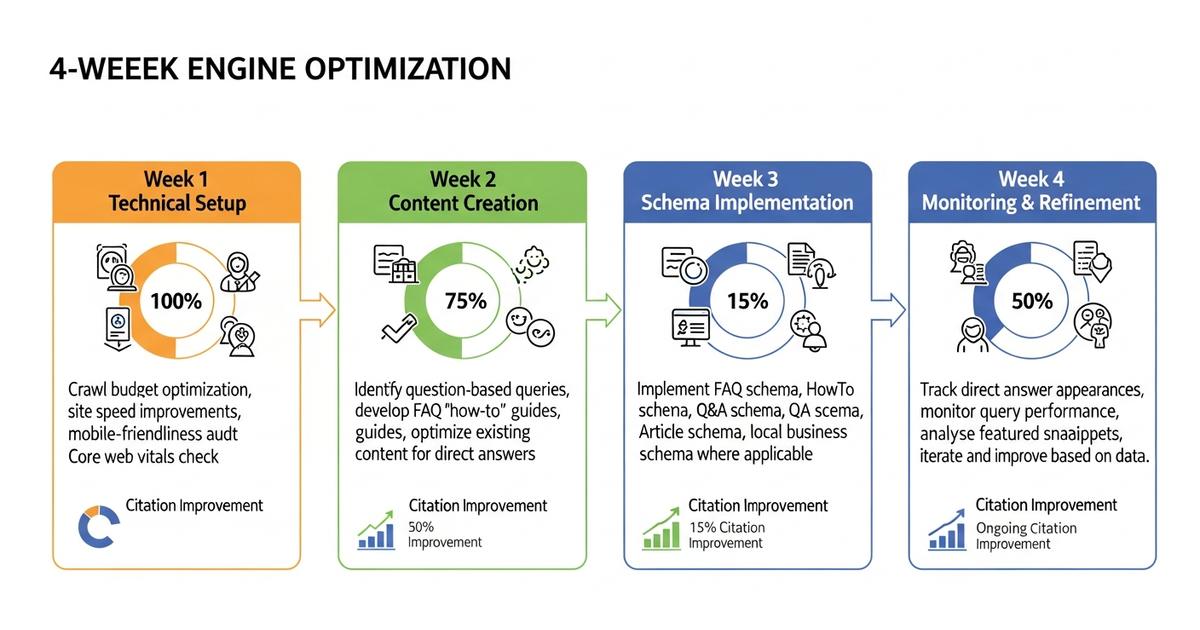
Week 4: Measurement and Iteration (Days 22-30)
Day 22-24: Re-run the baseline test
Re-test your original 20 queries across all four LLMs. Record the updated citation rates using the same template from Day 0. Calculate the change from baseline. You should see meaningful improvement in Perplexity and ChatGPT Browse citation rates if Week 1-3 implementations are complete.
Day 25-26: Analyze what moved and what did not
Compare your before and after results. Which queries improved? Which did not? For the queries that did not improve:
- Is the competitor being cited significantly more authoritative (higher DA, more backlinks)?
- Does your content for that query have strong enough direct answers?
- Is the AI Overview or citation for that query driven by recency (is the competitor's content newer)?
- Are there schema gaps on the specific pages targeting that query?
Day 27-28: Create content for highest-gap queries
For the queries still showing no citation, create one new piece of direct-answer content specifically for the highest-value uncited query. This is not general content - it is a page built around the exact question format users ask AI engines, with a direct declarative answer and FAQPage schema.
Day 29-30: Set up ongoing monitoring
AEO is not a one-time project. Set up the monitoring infrastructure for ongoing improvement:
- AI Rank Lab citation tracking for automated monthly citation rate measurement
- Google Analytics 4 filter for AI referral traffic (perplexity.ai, chat.openai.com, claude.ai, gemini.google.com)
- Monthly manual query test cadence for your top 10 queries
- Quarterly schema coverage audit to catch new pages without schema
The AI search optimization guide covers the ongoing workflow in more depth for teams that want to build a sustained AEO practice beyond the 30-day sprint.
Expected Results: What the Data Shows
Based on data from teams that have completed this 30-day workflow:
- Perplexity citation rate: Average +18-25% improvement after 30 days (improvements visible within 1-2 weeks of schema deployment)
- ChatGPT Browse citation rate: Average +10-15% improvement after 30 days
- Claude citation rate: Average +7-10% improvement (slower reflection in responses due to longer training cycle)
- Gemini citation rate: Average +8-12% improvement (strongly Google-aligned; traditional SEO improvements also help)
Teams that complete only the technical phase (Week 1) see roughly one-third of these improvements. The content and E-E-A-T work in Weeks 2-3 provides the remaining two-thirds. Do not stop after fixing robots.txt and llms.txt.
Conclusion
Getting cited by ChatGPT and other AI engines is not a mysterious process - it follows measurable signals that can be audited, fixed, and tracked. The 30-day playbook covers the complete implementation sequence: technical foundation (bot access, llms.txt), content optimization (direct answers, citation-ready writing), schema (FAQPage, HowTo, Article), E-E-A-T, and ongoing monitoring.
The most important step is the baseline audit. Run the AI Rank Lab audit today to see your current AEO signal gaps - that output becomes your specific prioritized work plan rather than a generic checklist. And once you have implemented the first round, use the citation tracking platform to measure what moved.
Frequently Asked Questions
How long does it take to get cited by ChatGPT?▾
What is the first thing I should do to get ChatGPT to cite my website?▾
Does adding FAQPage schema help with ChatGPT citations?▾
How do I know if my website is being cited by ChatGPT?▾
What content should I create to get cited by AI engines?▾
Get a Free AI Ranking Consultation
Want to improve your brand's visibility in AI search engines like ChatGPT, Gemini, and Perplexity? Fill out the form and our experts will create a personalized strategy for you.

Written by
Devanshu
Chief Marketing Officer & AI Search Optimization Architect
Digital Marketing Strategist & Pioneer in SEO, Answer Engine Optimization (AEO), and Generative Engine Optimization (GEO).


