



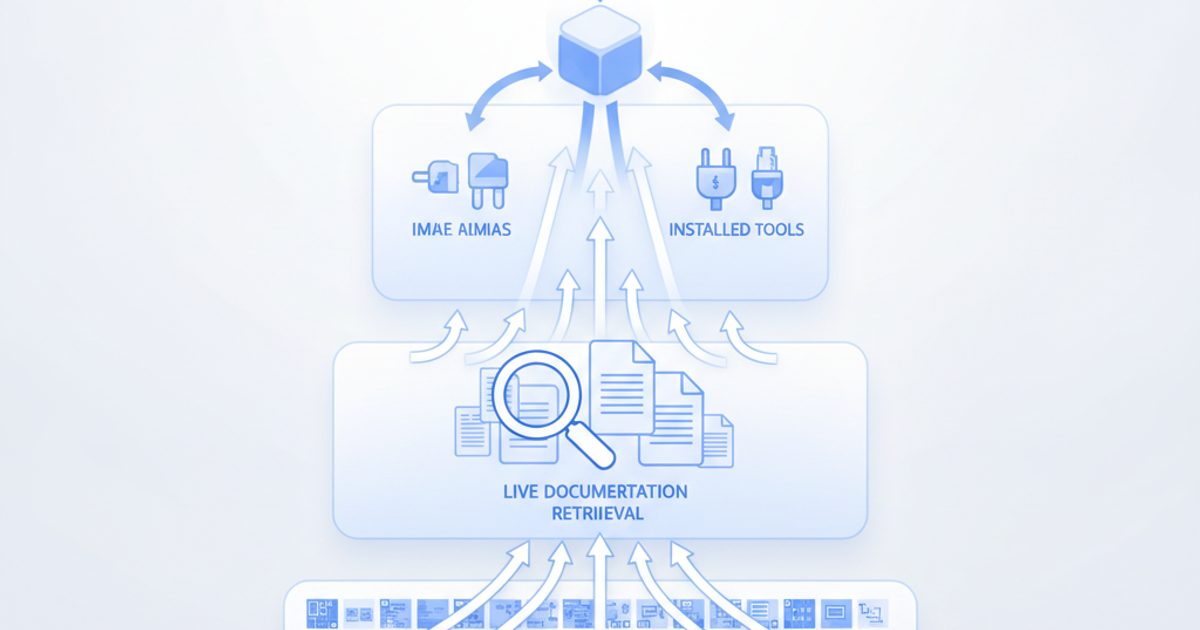
AI coding assistant recommendations come from three places: what the model learned in training, what it looks up live while it works (web search, page fetches, cached indexes), and the tools and project files a developer has plugged in, such as MCP servers and instruction files. Training decides whether your tool is picked when nobody names it. Live docs and tools decide whether the assistant uses it correctly once it is in the conversation. Developer-relations teams can influence both, but not with the same levers.
This guide explains the mechanism with the published studies on what Claude Code, Codex and Cursor actually pick. It includes an assistant-by-assistant table of what each one documents about web and doc access, verified against official docs on October 24, 2026. We also tested 15 developer docs sites for agent-readable features, and the guide ends with a method to measure your recommendation share and a prioritized checklist.
Key takeaways
- When a prompt does not name a tool, the pick mostly comes from the model's training data and the project's stack. In Amplifying's 2,430-response study, Claude Code's most common single pick was "build it yourself", which showed up in 12 of 20 categories.
- Coding agents search the web far less than chat assistants. Profound measured Claude Code searching in 13% of responses against 93% for Claude, so a docs update does not reach most answers right away.
- Agent-readable docs make agents faster and cheaper, not more likely to choose you. Tailwind CSS failed all four of our Markdown and llms.txt checks, yet Claude Code chose it in 68.4% of picks in its category.
- An MCP server helps agents use your product correctly after a developer installs it. It does little for discovery unless you also list it where developers install servers.
- Measure two things separately: propensity (do you get picked when unnamed?) and efficacy (does the agent use you correctly when named?). Run every prompt at least 3 times, because answers change between runs.
- We could not find an AI visibility tracker, ours included, that lists Claude Code, Cursor or Copilot as a standard tracked engine. For now, measuring picks inside them takes your own test harness.
How do AI coding assistants decide which library or API to recommend?
A coding assistant picks a tool from three inputs, roughly in this order of influence:
- Model weights (training data). The model has seen millions of repositories, tutorials and Q&A threads up to its training cutoff. Tools that appear often in good, recent example code become the default. Anthropic's models overview lists a June 2026 training data cutoff for its current models, so anything you shipped after that is invisible to the weights.
- Live retrieval. The agent may run a web search, fetch a docs page, or query a cached search index in the middle of a task. This is how a model learns about a new version or a tool it barely knows.
- Tools and project context. MCP servers, plugins, skills and instruction files such as
AGENTS.mdorCLAUDE.mdadd context the developer chose. The existing code also counts: an agent working in a Next.js repo picks differently from one in a FastAPI repo.
The best public evidence for this ordering is Amplifying's February 2026 report "What Claude Code Actually Chooses". It ran 100 open-ended prompts across 20 categories against four real repositories, with three models (Sonnet 4.5, Opus 4.5, Opus 4.6) and no tool names in any prompt. Of 2,430 responses, 2,073 had an identifiable primary pick. Some categories had near-unanimous winners: GitHub Actions 93.8% for CI/CD, Stripe 91.4% for payments, shadcn/ui 90.1% for UI components, Vercel 76.8% for deployment and 100% in the JavaScript projects. Picks also followed the stack. Railway took 82% of Python deployment picks, and NextAuth.js took 91% of Next.js authentication picks, while Python authentication was 100% custom code.
Why do coding agents build custom code instead of recommending a tool?
Because for many small jobs, writing 40 lines is the cheapest path the agent can see. In the Amplifying data, "Custom/DIY" was the most common single primary pick, at 252 of 2,073 (12%), and it showed up in 12 of 20 categories. Asked to add auth to a Python app, Claude Code wrote JWT and bcrypt handling from scratch. A separate study by Armature, a growth firm that sells to dev tool companies, written up by Pinggy in September 2026, found Claude Code building in-house in 19% of applicable sessions, against about 10% for Codex and Cursor.
The authors' advice is blunt: make your tool clearly better than what an agent can build in 30 seconds, or become the primitive it builds on. If your product is a thin wrapper over something an agent can write from scratch, docs work will not save it.
How long until a new tool shows up in AI coding assistant recommendations?
Through the weights, not until a model trained after your launch ships and enough public code uses you. Until then, you can only appear through live retrieval or a tool the developer installs. Recommendations also shift between model generations. In the Amplifying data, Prisma's share of JavaScript ORM picks fell from 79% on Sonnet 4.5 to 0% on Opus 4.6, while Drizzle rose from 21% to 100%. Celery went from 100% to 0% for Python background jobs. A new model release can change your share overnight, which is why you should re-test after each one.
Academic work points the same way. Twist et al.'s study of LLM library preferences (latest revision June 2026) found models overuse widely adopted libraries such as NumPy, in up to 45% of cases where the ground-truth solution did not need them. Familiar beats suitable, which is a hard default for a newer library to break. A 2026 revision of Zhang et al., covering 170 libraries and six LLMs, found the quality of LLM-generated code differs by up to 84% between libraries with similar functions. Some tools are simply easier for models to write correctly.
Do Claude Code, Cursor, Copilot and ChatGPT read live docs before recommending?
All four can reach the web, but they do it differently and some only when allowed. The table summarizes what each vendor documents, checked against official docs on October 24, 2026, plus the observed search rates from the two public studies.
| Assistant | Documented web and docs access | How extra context gets in | Observed search rate (third-party) |
|---|---|---|---|
| Claude Code | WebSearch (Anthropic's search backend, up to 8 backend searches per call) and WebFetch. WebFetch converts HTML to Markdown, asks for Markdown first in its Accept header, sends a user agent starting Claude-User, reads up to 100,000 characters per call and runs the page through an extraction prompt. In default modes it asks permission per domain, except for a built-in set of preapproved documentation domains. | MCP servers (claude mcp add), plugins and the Anthropic directory, skills, CLAUDE.md | 13% of responses (Profound, July 2026); about 30% of sessions, rising toward 80% in less familiar sectors (Armature, September 2026) |
| Cursor | Agent has a Web tool that "generate[s] search queries and perform[s] web searches", plus a Browser tool that can navigate pages. We found no page for the older @Docs indexing feature in Cursor's current docs index. | MCP via mcp.json, the Cursor Marketplace (plugins are manually reviewed), cursor.directory, Rules, AGENTS.md | About 67% of sessions (Armature) |
| GitHub Copilot | In VS Code, the built-in #web/fetch tool fetches a web page. Copilot Chat on GitHub.com can search with Bing, but that setting is "disabled by default" for individual accounts. | MCP servers in VS Code, the GitHub MCP server, AGENTS.md for the Copilot coding agent | No public study found |
| ChatGPT / Codex | ChatGPT search draws on pages crawled by OAI-SearchBot and fetches pages on request as ChatGPT-User. Codex web search defaults to "cached" mode, an OpenAI-maintained index, and switches to live results with --search or in full-access mode. Codex Cloud's agent phase runs offline unless internet access is enabled. | MCP servers, AGENTS.md | Codex: 94% of sessions (Armature) |
Sources: Claude Code tools reference, Cursor Agent docs, VS Code tools reference, GitHub Copilot settings, Codex approvals and security and OpenAI crawlers. Search-rate studies come from vendors with a commercial interest, use unpublished prompt sets and don't report confidence intervals, so read them as rough figures.
Two practical consequences follow. First, Codex in its default mode reads a cached index rather than your live page, so being in OpenAI's search index matters as much as the page itself. Second, Claude Code's WebFetch hands the model a summary written by a smaller extraction model, not your raw page. A docs page that states versions, commands and limits in plain sentences survives that summary much better than one that relies on tabs, accordions or client-side rendering. Our explainer on how Claude web search works covers the crawlers and index behind it.
Is Claude Code a different answer engine from Claude?
Yes, for measurement purposes. Profound's August 2026 study "Claude and Claude Code are distinct Answer Engines" ran 1,724 prompts and collected 24,135 responses between July 13 and 23, 2026. The two products mentioned only about 20% of the same brands for the same prompt. Claude Code responses listed more brands (6.6 against 5.2) and used tables far more often (54% against 11%). Their agents also visited different pages. Nearly three quarters of Claude Code's agent visits went to documentation, informational and pricing pages, against 5% for Claude's agent, which mostly hit robots.txt files, sitemaps and home pages. Search Engine Journal's write-up notes the page-visit data covers only domains Profound monitors, and that an AI model labeled the page types.
For a developer tool, the takeaway is that your docs and pricing pages are what the coding agent reads. Your homepage and blog matter more to the chat assistant your buyer uses for research.
What makes developer docs usable by AI coding agents?
Docs that agents can use are reachable as clean Markdown, carry a map of every page, state current versions explicitly and tell the agent how to verify them. To see how common this is, we tested 15 docs sites on October 24, 2026. Most are tools that appear as picks or alternatives in the Amplifying and Armature studies.
Method: for each site we requested /llms.txt and /llms-full.txt at the docs root, then took one representative getting-started page and (a) appended .md to its URL and (b) requested the normal URL with an Accept: text/markdown header. A check passed if the response was a 200 with Markdown content. "MCP server" means an official MCP server linked from the vendor's llms.txt or docs. Because we probed one page per site, a site may support a feature elsewhere.
| Docs site | llms.txt | llms-full.txt | .md page | Markdown via Accept header | Official MCP server | Notable agent guidance |
|---|---|---|---|---|---|---|
| Stripe | Yes | No | Yes | Yes | Yes | llms.txt tells agents to check npm or PyPI for the latest version and never hardcode one from training data |
| Anthropic (Claude API) | Yes | Yes | Yes | Yes | Not listed | Very large full-text file (about 47 MB) |
| Vercel | Yes | Yes | Yes | Yes | Yes | Full-text file opens with an agent plugin install command |
| Supabase | Yes | Yes | Yes | Yes | Yes | - |
| Cloudflare | Yes | Yes | No | Yes | Yes | Links an "Agent setup" section |
| GitHub Docs | Yes | No | Yes | Yes | Yes | Points MCP-capable agents to the GitHub MCP server |
| Resend | Yes | Yes | Yes | Yes | Yes | Every Markdown page starts with a pointer to the docs index |
| Clerk | Yes | Yes | Yes | Yes | Yes | Exposes a docs search endpoint that returns Markdown |
| Prisma | Yes | Yes | Yes | Yes | Yes | Tells agents not to rely on training data and to read the changelog first |
| Drizzle ORM | Yes | Yes | No | No | None found | - |
| Sentry | Yes | No | No | Yes | Yes | - |
| Twilio | Yes | No | Yes | Yes | Yes (docs MCP) | - |
| Neon | Yes | Yes | Yes | Yes | Yes (product and no-auth docs MCP) | Publishes a docs MCP server card |
| Tailwind CSS | No | No | No | No | None found | - |
| shadcn/ui | Yes | No | Yes | No | Yes | - |
Totals: 14 of 15 publish llms.txt, 9 of 15 publish llms-full.txt, 11 of 15 serve a .md version of the page we tested, 12 of 15 return Markdown when asked through the Accept header, and 12 of 15 document an official MCP server.
The most useful finding is a counterexample. Tailwind CSS failed all four Markdown and llms.txt checks, yet Claude Code chose it in 68.4% of picks in its category in the Amplifying study. Drizzle, with no Markdown pages in our test, was chosen in 100% of JavaScript ORM picks on Opus 4.6. Agent-readable docs do not create propensity. Training data and real-world usage do. What these docs features change is how quickly and cheaply an agent finds the current, correct answer once it is looking for you.
Does llms.txt help coding agents use my docs?
It helps agents navigate, which saves time and tokens, but it does not make them more accurate or more likely to choose you. Mintlify's July 2026 benchmark ran Claude Code and Codex across 20 docs sites (2,400 runs in four formats). On HTML, agents averaged 2.23 dead-URL errors per task, partly because they kept guessing .md and /llms.txt paths that did not exist. Plain Markdown cut that to 1.42. Markdown pages that linked to the site's llms.txt cut it to 0.11. Accuracy stayed in the mid-to-high 90s in every format. Mintlify sells docs hosting, but it open-sourced the benchmark.
Coding agents behave differently from Google here. Our test of whether llms.txt improves AI citations covers why it does little for search visibility, and the llms.txt proposal itself says the file is mainly for inference-time use by agents rather than training. You can test your file with our free llms.txt checker or generate one with the llms.txt generator.
What should a docs page for agents contain?
Follow these in order. The first four are cheap and help every agent, with or without a plugin:
- Serve Markdown two ways. Support a
.mdsuffix on every page and return Markdown when the request's Accept header asks for it. Claude Code's WebFetch already asks for Markdown first. - Link the map from every page. Put a pointer to your llms.txt at the top or bottom of each Markdown page, as Resend and Mintlify-hosted sites do. That was the change that removed most dead-URL errors in Mintlify's benchmark.
- Tell agents to check versions. Stripe's llms.txt tells agents to look up the latest package version instead of using one from memory. Prisma's tells them to read the changelog before implementing anything. One sentence like this fixes the most common agent failure: confident code for an API that changed after the training cutoff.
- Write specific warnings, not tips. In Microsoft's October 2026 agent experience write-up, a general docs tip led the agent to use the right tool in 1 of 5 runs. A warning that named the failing approach worked in 5 of 5.
- Keep a copy-paste quickstart with pinned, current versions. Microsoft also reports an unpinned scaffolder that produced a project from 2020 while the agent reported success.
- Publish a machine-readable changelog and plain-text limits. Pricing, rate limits and free-tier caps need to be in text the agent can quote. In the Armature study, agents dropped Mailgun for Postmark after reading about Mailgun's one-day log retention on the free tier.
- Make error messages actionable. Agents read CLI and API errors literally. An error that names the fix is documentation the agent reads at exactly the right moment.
Should a developer tool company ship an MCP server?
Yes, if your product has an API or account data an agent would act on, but treat it as an efficacy tool, not a discovery channel. An MCP server only enters a session after a developer installs it, which usually means they have already chosen you. Of the 15 docs sites we checked, 12 already document one. There are two kinds:
- Docs MCP: lets agents search your documentation through tool calls. Twilio and Neon publish one. Neon's needs no authentication.
- Product MCP: lets agents act on the developer's account, such as creating a database or checking an error. Stripe's server also searches Stripe's docs and support articles.
Distribution is what turns a server into reach. List it in the official MCP Registry (in preview, with namespace verification through GitHub or DNS), in the Cursor Marketplace, and in Anthropic's directory as a Claude Code plugin. Then put one install command for each client in your quickstart. Third-party docs indexes such as Context7 also feed version-specific docs to agents, and library owners can submit their libraries.
Test before you assume it works. In Microsoft's runs, a Context7 MCP server gave no meaningful lift on one upgrade task: its tools failed to load in 3 of 5 runs and went unused in the other 2. Microsoft also found that fixing the release notes helped every developer, while a skill helped only the developers who installed it. For SEO-side MCP use, see our guide to MCP for SEO workflows.
Do npm downloads, GitHub stars and registry pages influence AI recommendations?
Not directly at answer time. We found no documentation from any vendor saying a coding agent checks download counts or stars before it recommends a package. Registry and GitHub signals matter in two indirect ways:
- They feed the next model. Public repositories, READMEs and tutorials that use your package are training data. More real usage in good code means a stronger default in future models.
- They are what agents land on. An agent following Stripe's instruction to check the latest version reads the npm or PyPI page. npm's own package.json docs say the
descriptionandkeywordsfields help people discover a package in npm search. Keep them accurate, and keep the README's first screen to install, minimal example and current version.
Also worth doing: ship an AGENTS.md in your starter templates and example repos. The format is supported by Codex, Cursor, the GitHub Copilot coding agent and many others, so every agent working in a project created from your template reads your conventions.
Should I block GPTBot or ClaudeBot on my docs?
Probably not, if you want future models to know your tool. Both vendors separate training crawlers from retrieval agents. Per Anthropic's crawler page, blocking ClaudeBot excludes future content from training, blocking Claude-SearchBot keeps you out of Claude's search index, and blocking Claude-User stops Claude from fetching your pages when a user asks. OpenAI draws the same lines between GPTBot, OAI-SearchBot and ChatGPT-User. For a developer tool, training is how you become the default, so blocking the training crawlers on public docs trades long-term recommendation share for very little.
How do you measure AI coding assistant recommendations?
Measure two numbers. Microsoft's agent experience framework calls them propensity and efficacy:
- Propensity: does the agent choose your tool when the task does not name it? This is your recommendation share.
- Efficacy: when the task does name you, does the agent use your current API correctly, at a reasonable token cost?
A workable method:
- Write 20 to 40 unbranded tasks that real developers would give an agent, such as "add transactional email to this app" or "add a job queue". Phrase each one 2 or 3 ways, the way a developer types into a terminal, not the way a marketer writes a keyword.
- Run them inside real repositories, one per stack you sell into. Amplifying found picks change with the stack, so a single repo will mislead you.
- Use each agent's non-interactive mode (Claude Code's
-pmode, Codex's non-interactive mode, the Cursor CLI) with a fixed model and settings. Record the agent, version and model with every result. - Run each task at least 3 times. In Amplifying's data, only 73% of repeated runs of the same prompt returned the same tool all three times.
- Log four fields: primary pick, alternatives mentioned, whether the agent searched or fetched anything, and which URLs it read. Armature found tools mentioned often but rarely picked, such as PayPal with 139 mentions and 0 picks, so count mentions and picks separately.
- Run a named-task set for efficacy ("add Resend to this app") and score whether the code runs against your current version.
- Check your server or CDN logs for user agents such as Claude-User and ChatGPT-User on docs pages. That shows which pages agents fetch in real sessions.
- Re-run after every major model release and after each docs change, and compare against a run with no plugins or MCP servers loaded.
Expect noise even in simpler settings. Across 972 repeated runs of 42 prompt and engine pairs tracked in AI Rank Lab between February and October 2026, 42.9% of pairs flipped between "brand mentioned" and "not mentioned" at least once. For Claude it was 5 of 11 pairs (45.5%). These are chat-assistant runs, not coding agents, but the lesson carries over: one run is a sample, not a measurement. Our guide to running GEO experiments explains how many runs you need to separate a real change from noise.
Can AI visibility tools track Claude Code or Cursor?
Not as a standard feature, as far as we could verify on October 24, 2026. Profound runs Claude Code in its research, but its published engine list does not name it. The table shows what each option covers.
Disclosure: AI Rank Lab is our product. We list it first because this is our site, and we've kept the same criteria for every tool below.
| Option | Covers | Does not cover | Best for |
|---|---|---|---|
| AI Rank Lab | Runs the prompts you choose on ChatGPT, Claude, Gemini and Perplexity, plus Google AI Overviews and AI Mode, and stores every run with mentions, competitors and cited URLs | Claude Code, Cursor, Copilot and Codex are not tracked engines | The research side: what developers' chat assistants say when they compare tools in your category |
| Profound | Answer-engine tracking at large prompt volumes. It published the Claude versus Claude Code study above | Its published list of tracked engines does not name Claude Code, so ask Profound directly | Enterprises that want very large prompt samples |
| Your own harness | Any coding agent with a non-interactive mode, in your real repos and stacks | Needs engineering time, and model and version changes break comparisons | Propensity and efficacy inside coding agents, the only direct measure |
| Docs platform analytics and server logs | Which agents fetch which docs pages (Mintlify, for example, reports agent traffic for sites it hosts) | What the agent recommended after reading | Finding the pages agents depend on |
For the chat side, AI Rank Lab brand visibility runs your prompts when you choose and keeps each run for comparison. It does not run them on a schedule. Developers evaluating tools still ask chat assistants "what's the best Postgres host for a side project?", and that conversation happens before an agent ever opens a repo.
AI coding assistant recommendations checklist
Ordered by impact for effort. "Propensity" means it helps you get picked. "Efficacy" means it helps agents use you correctly.
| # | Action | Helps | Effort |
|---|---|---|---|
| 1 | Serve every docs page as Markdown (.md suffix and Accept header) | Efficacy | Low on most docs platforms |
| 2 | Publish llms.txt and link it from every Markdown page | Efficacy (fewer dead URLs, fewer tokens) | Low |
| 3 | Add version-check and changelog instructions for agents | Efficacy | Low |
| 4 | State pricing, limits and free-tier caps in plain text | Propensity (agents compare these mid-task) | Low |
| 5 | Allow ClaudeBot, GPTBot, search bots and user agents on public docs | Propensity (future models, search indexes) | Low |
| 6 | Rewrite vague tips as specific warnings and make errors actionable | Efficacy | Medium |
| 7 | Ship AGENTS.md in templates and example repos | Efficacy | Low |
| 8 | Ship a docs or product MCP server, and list it in the MCP Registry, Cursor Marketplace and Anthropic's directory | Efficacy, some discovery | Medium to high |
| 9 | Get your tool into high-quality public example code, starters and framework integrations | Propensity (next model generation) | High, ongoing |
| 10 | Build a propensity and efficacy test harness and re-run it after model releases | Measurement | Medium |
What the evidence cannot tell you yet
Every study cited here has limits. Amplifying tested one agent on four greenfield repos, and Claude extracted the picks with about 85% accuracy on a manual check. Armature published 5,292 of 16,893 runs, used Gemini to play the developer and judge results, and sells growth services to dev tool companies. Profound's prompts and tracked domains are not public. Microsoft's results rest on 5 runs per condition, mostly on its own products. None of them links a change in picks to signups. Our 15-site check is a single-day probe of one page per site, chosen for relevance, not at random. We also could not verify any public data on how often GitHub Copilot searches the web. Treat all of these numbers as direction, and trust your own repeated runs more than anyone's headline.
If you also want to know what ChatGPT, Claude, Gemini and Perplexity tell developers about your category, try AI Rank Lab. Signup includes 100 free credits, enough for one brand visibility prompt run. If you are comparing the coding tools themselves, our roundup of Claude Code alternatives covers them.
Get a free AI ranking consultation
Want your brand to show up when ChatGPT, Gemini and Perplexity answer questions in your market? Tell us about your site and our team will send a personalized strategy.


