


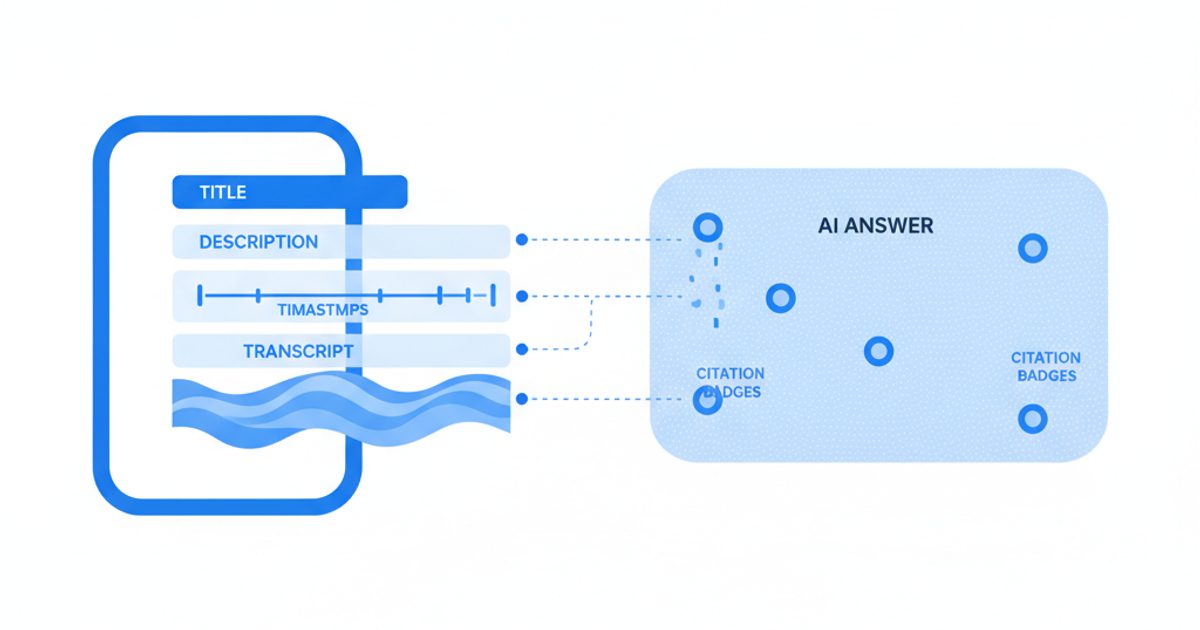
YouTube is one of the most-cited domains in AI answers, but almost all of those citations come from Google's own surfaces: AI Overviews, AI Mode and, depending on the month, Gemini. ChatGPT, Claude and Microsoft Copilot rarely cite videos at all, and Perplexity largely stopped in August 2026. None of these engines watch your video. They read its text: the title, the description, the chapter timestamps and the transcript.
This guide puts the published studies side by side (BrightEdge, OtterlyAI, Peec AI, Profound, Ahrefs, Scrunch, Analyze AI and Meltwater), shows where they agree and where they contradict each other, and adds our own checks: a look at what a crawler actually receives from a YouTube watch page, and a spot check of four live Google AI Overviews run on October 18, 2026. It ends with a production checklist and a measurement workflow. All figures were checked on October 18, 2026.
Key takeaways
- YouTube's AI visibility is mostly a Google story. Every study we reviewed finds Google AI Overviews and AI Mode citing YouTube far more often than ChatGPT, Claude or Copilot. Analyze AI found one YouTube citation in 7,651 ChatGPT answers.
- The numbers are volatile. Meltwater measured a 57.3% month-on-month drop in YouTube citations in September 2026, and Scrunch reports Perplexity stopped citing YouTube almost entirely around August 12, 2026.
- Engines read text, not footage. In our October 2026 spot check, the snippets attached to YouTube citations in AI Overviews were spoken lines from the transcript, and 13 of 19 cited YouTube links pointed to a specific timestamp.
- Popularity barely matters. OtterlyAI found near-zero correlation between views or subscribers and citation frequency. Topic fit and clear metadata matter more.
- Video and articles reach different engines. In two OtterlyAI experiments, videos earned Google citations while written articles earned the ChatGPT and Copilot citations. Plan them as a pair.
- Unlisted videos earned zero citations across 107 days in the onvista experiment. Public listing is a hard requirement.
How often do AI engines cite YouTube?
It depends heavily on the engine, the prompt set and the month, and the studies use different denominators. The best-supported summary is this: YouTube is consistently a top-cited domain in Google's AI surfaces, a minor source in Perplexity for most of 2025-2026, and close to absent in ChatGPT. Treat any single "YouTube gets X% of AI citations" figure with suspicion unless it says which engine and what was counted.
The table below lists the main studies with their own definitions. Read each column on its own terms; the numbers are not directly comparable across rows.
| Study (publisher, period) | What was measured | Google AI Overviews | Google AI Mode | Perplexity | ChatGPT | Other engines |
|---|---|---|---|---|---|---|
| BrightEdge (May 2024 - Sep 2025) | YouTube's share of each engine's citations | 29.5% (#1 domain) | 16.6% (#1 domain) | 9.7% | 0.2% | - |
| OtterlyAI (30 days, 100M+ citations, updated Mar 2026) | Where all YouTube citations came from, by engine | 36.6% | 19.6% | 38.7% | 4.4% | Copilot 0.5%, Gemini 0.2% |
| Profound (Oct - Dec 2025) | YouTube's share of all ChatGPT citations | - | - | - | 0.99% | - |
| Scrunch (May - Jul 2026) | "YouTube citation rate" (definition not stated) | ~27% | ~30% | ~15% | ~0.3% | Gemini ~4%, Copilot ~0.5% |
| Analyze AI (22,295 answers, 460 B2B prompts, published Aug 2026) | Share of answers citing at least one YouTube URL | not tracked | 7.5% | 9.2% | 0.01% (1 of 7,651) | - |
| Meltwater (Sep 2026, 4,000+ consumer prompts, 8 engines) | Raw citation counts and top-domain rank | 23,588 citations, #1 domain | 23,298 citations, #1 domain | not #1 | not #1 | Gemini 2.5 Pro: 33,939 citations, #1 domain |
All of these are vendor studies. Each publisher sells AI visibility tooling, and none has been independently replicated. They are still the best public evidence available, and where several vendors with different prompt sets point the same way (Google high, ChatGPT near zero) the pattern is more trustworthy than any one number.
Why do the YouTube citation numbers disagree so much?
Three reasons explain most of the spread. First, denominators differ: BrightEdge reports YouTube's share of an engine's citations, OtterlyAI reports how YouTube's own citations split across engines, and Analyze AI counts answers that cite YouTube at least once. A 38.7% figure for Perplexity in OtterlyAI's study and a 9.7% figure in BrightEdge's can both be true. Second, prompt sets differ: Meltwater uses unbranded consumer prompts (fast food, automotive, streaming), while Analyze AI uses B2B prompts. Consumer and how-to topics pull far more video. Third, time windows differ, and YouTube's citation share moves a lot from month to month.
What happened to YouTube citations in August and September 2026?
Two separate datasets recorded a sharp fall. Scrunch reports that "around August 12, 2026, Perplexity stopped citing YouTube almost entirely," while YouTube's share rose across Google's AI surfaces. Meltwater's September 2026 report counted 92,855 YouTube citations, down 57.3% from August, with share declining across Perplexity, Copilot, Gemini, AI Overviews, AI Mode and Grok, although YouTube was still the single most-cited source in its dataset. The independent onvista experiment (below) also logged zero video citations from Perplexity across May to August 2026. If your plan depends on Perplexity citing your videos, re-check it against current data before you commit budget.
Which AI engines cite YouTube videos the most?
Google AI Overviews and Google AI Mode cite YouTube the most, consistently, across every study. Here is the engine-by-engine picture, with the strength of the evidence noted.
- Google AI Overviews: top or near-top YouTube citer in BrightEdge, OtterlyAI, Scrunch and Meltwater. Google owns YouTube and already supports YouTube chapters as key moments in Search. Strong evidence.
- Google AI Mode: the same pattern. YouTube was AI Mode's #1 cited domain in both BrightEdge's and Meltwater's data. Strong evidence.
- Gemini: conflicting. OtterlyAI attributed only 0.2% of YouTube citations to Gemini, but Meltwater's September 2026 data has Gemini 2.5 Pro as YouTube's largest source of citations, and in OtterlyAI's own later video-vs-blog test Gemini drove roughly half of all video citations. The difference likely comes down to how each tool queries Gemini (app, API, model version). Weak and inconsistent evidence.
- Perplexity: a meaningful YouTube citer through mid-2026 (9.2% of B2B answers in Analyze AI's data), then a near-stop around August 12, 2026 according to Scrunch. Treat it as unreliable for video right now.
- ChatGPT: close to zero in every study, from 0.2% (BrightEdge) to 0.99% of citations (Profound) to one citation in 7,651 answers (Analyze AI). When ChatGPT does cite YouTube, Profound found 85.4% of those citations point to a specific video, not a channel.
- Claude and Microsoft Copilot: rarely or never. In both OtterlyAI experiments, Claude and Copilot cited only the written versions of the content.
Does ChatGPT cite YouTube videos?
Rarely. Across the studies above, YouTube accounts for well under 1% of ChatGPT's citations, and a B2B dataset found it in 0.01% of ChatGPT answers. It is not a crawling block: we read youtube.com/robots.txt on October 18, 2026 and it contains no rules for OAI-SearchBot, GPTBot or any other AI crawler, and watch pages are open to all user agents. Why ChatGPT seldom cites video is not documented by OpenAI. What is documented, by the Ahrefs study of 75,000 brands, is that brand mentions on YouTube (in titles, transcripts or descriptions) had the strongest correlation with AI visibility of any factor tested, about 0.737 across ChatGPT, AI Mode and AI Overviews. Ahrefs states plainly that correlation is not causation, but it suggests YouTube can shape how ChatGPT talks about a brand even when the video itself is not linked.
What do AI engines actually read from a YouTube video?
Text. No study shows an answer engine citing a video because of something only visible in the footage. The citable surface is the title, the description (including chapter timestamps written into it), the transcript, and the structured data on the watch page. Which of those an engine can reach depends on who runs it.
The transcript
Google demonstrably uses transcripts. Peec AI documented AI Mode building answers both from video descriptions and from auto-generated transcripts. In our own October 18 spot check (detailed below), the text snippets our tracker captured for YouTube citations in AI Overviews were spoken lines from the video, such as a presenter introducing himself, not text from the description. That makes the transcript the most important text you control, and YouTube's own help page warns that automatic captions "might misrepresent the spoken content due to mispronunciations, accents, dialects, or background noise" and tells creators to "always review automatic captions" (YouTube Help). A misheard product name in an auto-caption is a misheard product name in the answer.
Chapters, timestamps and the description
Chapters are written in the description, so they travel with it. YouTube's rules: the first timestamp must be 00:00, a video needs at least three timestamps in ascending order, and each chapter must be at least 10 seconds long (YouTube Help: video chapters). Google Search says it "will prioritize key moments set by you, either through structured data or the YouTube description" (Google Search Central: video best practices). OtterlyAI found that every timestamped YouTube citation in its 30-day dataset came from Google (73% AI Overviews, 27% AI Mode), and description length had the strongest metadata correlation with citation frequency it measured, though still weak at r = 0.31.
What a non-Google crawler can see on a YouTube watch page
We fetched a public watch page on October 18, 2026 as a plain crawler would and checked the raw HTML. It contained the title, the full description (2,431 characters for that video, versus a 160-character meta description), the upload date, the tags and a schema.org VideoObject block. It did not contain the transcript text. The transcript loads from a separate /api/timedtext request, and youtube.com's robots.txt disallows /api/ and /timedtext_video for every user agent. The practical reading, which is our inference rather than anything an AI company has confirmed: a robots-respecting third-party crawler can reliably read your title and description, while Google, which owns the transcripts, can read everything. That fits the data. Engines outside Google lean on the description, and Google surfaces cite timestamped moments from inside the transcript.
| Video element | Readable by Google AI surfaces | Readable by third-party crawlers | Evidence |
|---|---|---|---|
| Title | Yes | Yes (in page HTML) | Our HTML check; OtterlyAI title-match finding |
| Description | Yes | Yes, in full | Our HTML check; Peec AI; OtterlyAI r = 0.31 |
| Chapters / timestamps | Yes, as key moments | Yes, as description text | Google video docs; OtterlyAI (all timestamped citations were Google) |
| Transcript / captions | Yes | Not via a robots-compliant fetch | Peec AI; our AI Overview snippets; youtube.com robots.txt |
| Views, likes, subscribers | Available, but near-zero correlation with citation | Partly | OtterlyAI correlations of -0.02 to -0.03 |
| The footage itself | No evidence it drives citation | No | No study shows it |
Our spot check: four live AI Overviews on October 18, 2026
To see the mechanism rather than just aggregate shares, we pulled the live US desktop Google AI Overview for four queries, two how-to and two B2B, using the AI Rank Lab AI Overview tracker, and counted every cited URL. This is a four-query spot check, not a study, and AI Overview sources change from run to run.
| Query | Type | Cited URLs | YouTube URLs | YouTube links with a timestamp (&t=) |
|---|---|---|---|---|
| how to replace a bike chain | Consumer how-to | 12 | 8 | 5 |
| how to make a pivot table in excel | Software how-to | 11 | 7 (one is a Short) | 6 |
| what is soc 2 compliance | B2B explainer | 9 | 3 | 2 |
| best crm for small business | B2B commercial | 7 | 1 | 0 |
| Total | 39 | 19 (48.7%) | 13 of 19 |
Three things stood out. All four AI Overviews cited at least one YouTube video, and both how-to answers also showed an embedded video card. Most YouTube citations jumped to a specific second of the video, which is the transcript-level matching the studies describe. And the commercial "best CRM" query leaned on listicles from Zapier, Forbes and others plus a Reddit thread, with one YouTube comparison video ("I Tested All 5") among seven sources.
Our tracked prompt data points the same way for B2B. Across 1,592 prompt runs that returned citations in AI Rank Lab (all successful runs to mid-October 2026, 12 tracked domains, six AI engines), youtube.com does not appear among the 20 most-cited third-party domains. The 20th domain on that list was cited in 111 runs, so youtube.com was cited in fewer than 7% of runs, if at all. Judging by the domains that do top the list (software vendors, review platforms such as G2, and directories), this prompt set leans toward B2B software and marketing topics, which is exactly where the studies above find YouTube weakest.
Do views, subscribers or length affect whether AI cites a video?
Views and subscribers show essentially no relationship with citation; format does. OtterlyAI's study measured correlations of -0.03 for views, -0.02 for likes and -0.03 for channel subscribers. 40.83% of cited videos had fewer than 1,000 views, and 35% of channels had fewer than 10,000 subscribers. In the onvista experiment, cited videos had a median of 888 views and never-cited videos 947. A small channel with the right answer can be cited over a large one.
Are YouTube Shorts cited by AI engines?
Occasionally, mostly by Google. Long-form videos took 94% of YouTube citations in OtterlyAI's data and Shorts 5.7%, with playlists, channels and livestreams at 0.3% combined. Video duration itself barely correlated (r = 0.02): cited videos clustered at 10-20 minutes (32.1%) and 5-10 minutes (26.1%). Length is not the lever; a video that fully answers one specific question is.
Should you make a video or a blog post for AI visibility?
Both, because they reach different engines. The experiments published so far find that written pages are cited faster and by more engines, while videos add Google citations that a page alone may not get.
| Experiment | Setup | Result | Caveats |
|---|---|---|---|
| OtterlyAI video-to-blog (Jul 30 - Aug 4, 2026) | 8 interviews, each published as a YouTube video plus a blog article made from its transcript; 7 engines tracked | Written 79.5% vs video 20.5% of format citations on branded prompts. Claude, ChatGPT and Copilot cited only the articles. Video share grew from 15% to 26% during the week. | One week, small counts, vendor-run |
| OtterlyAI x onvista (May 12 - Aug 26, 2026) | Daily live market show sliced into 610 videos plus 571 articles; 125 German finance prompts; 7 engines | Campaign citations grew to 3.4x baseline. Single-topic clips were cited 3.2x as often as full shows (27.2% vs 8.6%). Video citations were 56.1% AI Overviews and 40.0% AI Mode; article citations were 43.0% Copilot and 39.2% ChatGPT. 118 unlisted videos earned zero citations. | One publisher, German market, vendor-run |
| TRYSEO 25 AI-generated videos (Apr 2026) | 25 HeyGen avatar videos on a new channel, each titled to match one German B2B prompt | Share of voice rose on 5 of 6 engines within about 10 days; AI Overviews barely moved | About 10 days of data, one brand, author warns against the tactic |
Two practical lessons come out of these. First, title alignment matters: in the video-to-blog test, the one story where video won had a video title that closely mirrored the article title, and the stories with mismatched titles drew under 3% video citations. Second, narrow beats broad. A five-minute clip titled for one stock answered one question better than an hour-long show covering twelve.
Is YouTube more useful for B2B or B2C AI visibility?
YouTube matters most for consumer, how-to and product-demonstration queries, and much less for B2B shortlist queries. The evidence lines up from several directions. BrightEdge found high YouTube citation for platform tutorials, product reviews and comparisons, pricing and deals content and medical education with action steps, and low citation for strategic planning, abstract concepts and "purely informational content without a visual benefit." Meltwater's consumer-category prompts have YouTube as the #1 source. Analyze AI's B2B data varies sharply by prompt type: developer and productivity software prompts cited YouTube in 22.2% of answers, comparison and alternatives prompts in 7.9%, and recommendation or shortlist prompts in just 3.0%.
| Your query type | Likely value of YouTube for AI citations | What to make |
|---|---|---|
| Consumer how-to, repair, setup | High in Google AI Overviews and AI Mode | Step-by-step video with accurate captions and chapters per step |
| Software tutorials, developer tools | High in Google; moderate in Perplexity before Aug 2026 | Screen-recorded walkthroughs, one task per video |
| Product reviews and comparisons | Moderate to high | Hands-on comparison video plus a written comparison page |
| B2B explainers (what is X) | Moderate in Google | Short explainer video paired with the definitive article |
| B2B "best tool for X" shortlists | Low; review sites and listicles dominate | Prioritize third-party reviews and your own comparison pages; video is supporting |
| Strategy, opinion, abstract topics | Low | Written content first |
Do AI-generated YouTube videos get cited by AI search?
They can be, briefly, but it is a poor strategy. The TRYSEO experiment showed that 25 avatar videos produced in about one working day lifted share of voice on five of six engines within roughly ten days. The author himself does not recommend the approach, the window was short, and the gains may not last. YouTube's monetization policy, renamed from "repetitious" to "inauthentic content" on July 15, 2025, now names "AI-generated content made with generic or unoriginal templates giving the impression of mass production" as ineligible (YouTube channel monetization policies). Separately, YouTube requires creators to disclose realistic altered or synthetic content, such as making a real person appear to say something they did not (YouTube Help: disclosing altered or synthetic content). AI tools for editing, captions and clipping real footage are a different matter, and the onvista experiment shows automated slicing of real expert content working well. If you are choosing tools for that, see our comparison of AI video generators for marketers.
Checklist: how to produce a YouTube video that AI engines cite
Pick a question that real prompts ask, answer it fully in the video, and make every text field state that answer plainly. This checklist is built from the studies above and Google's and YouTube's own documentation.
- Start from prompts, not keywords. List the questions buyers ask AI engines in your category, and check which ones already return YouTube citations in Google AI Overviews or AI Mode. In the onvista data, videos on topics no tracked prompt asked about were cited 1.6% of the time; on-topic listed clips were cited 45.8% of the time. Our guide to AI Mode vs AI Overviews explains why you should check both.
- One video, one question. Cut long recordings (webinars, livestreams, podcasts) into single-topic clips. Keep the full version too.
- Title the video as the answer to the question. Match the wording of your companion article's title. Put the specific entity (product, model, task) in the title.
- Say the key facts out loud, early and plainly. The transcript is the citable text, so state names, numbers and steps in full sentences.
- Review and correct the captions, or upload your own. Check product names, people's names and figures especially.
- Add chapters that start at 00:00, with at least three timestamps and each chapter at least 10 seconds long. Name each chapter as a sub-question or step.
- Write a real description: a two-to-three sentence summary of the answer first, then the chapter list, the key entities, and a link to the companion article. OtterlyAI's cited videos averaged 334-word descriptions.
- Publish it as Public. Unlisted videos earned zero citations across 107 days and seven engines in the onvista experiment.
- Publish the companion article on your own site with the same title and the core answer in text, and embed the video. This is what reaches ChatGPT, Claude and Copilot.
- Mark up your own video pages. If you host a dedicated watch page on your site, give it
VideoObjectstructured data with a unique name, description and thumbnail, and useClipmarkup for key moments, per Google's video SEO guidance. Note that Google treats a blog post with an embedded video as an article, not a watch page. - Keep fast-changing videos current. Update titles, descriptions and pinned comments when facts change, and retire videos that now give the wrong answer.
How to measure YouTube citations in AI answers
Track a fixed set of prompts on each engine separately, count every YouTube URL variant as the same video, and separate your own videos from third-party videos that mention you. Google Search Console will not help here: its reports cover your own property, and citations of your videos point to youtube.com, not your site.
- Build a prompt set of 25-100 questions your buyers ask, split by type (how-to, comparison, shortlist). Our research on what sources LLMs cite shows why the prompt mix changes the result.
- Run them on each engine separately and on a schedule. AI Overviews and AI Mode behave differently, and Perplexity's YouTube behavior changed in August 2026.
- Normalize YouTube URLs before counting. Engines cite the same video as
watch?v=, with&t=timestamps, with language orutm_sourceparameters, asyoutu.belinks or as/shorts/URLs. The onvista team found that treating variants as separate videos would have undercounted video citations by about 60%. - Classify each cited video: yours, a creator or partner's video that mentions you, or a video that ignores you. Analyze AI found only 3.3% of cited YouTube pages named the brand being tracked, so most video citations are topical, not branded.
- Check YouTube Studio. The Reach report's "External sites or apps" card shows traffic "from websites and apps that have your YouTube video embedded or linked to" (YouTube Help), which is where any clicks from AI answers would land.
- Track the companion article's AI referrals in GA4 as well, following our guide to tracking AI referral traffic in GA4.
Tools that can show YouTube citations
Disclosure: AI Rank Lab is our product. We list it first because this is our site, and we've kept the same criteria for every tool below.
- AI Rank Lab: runs your prompts on ChatGPT, Claude, Gemini and Perplexity, and checks Google AI Overviews and AI Mode, recording every cited URL. Citation analytics shows which domains and URLs are cited for your prompts, so YouTube videos appear alongside every other source, and the AI Overview tracker and AI Mode tracker cover the two surfaces where video matters most. It does not group YouTube citations by channel.
- Profound: its YouTube Citation Breakdown (launched August 19, 2026) groups YouTube citations by channel, by video and by video category. That makes it the stronger choice if your main question is which creators shape AI answers in your category.
- Manual spot checks: free, and useful for a handful of high-value prompts, but too variable to trend. In our own tracking data, the cited domains in consecutive runs of the same prompt had a median overlap (Jaccard similarity) of just 0.41, across 968 runs of 42 prompt-engine pairs tracked in AI Rank Lab between February and October 2026.
If you are also investing in community platforms, the same per-engine measurement applies to Reddit's role in AI search, which several of these studies track side by side with YouTube.
Limitations of this analysis
Every external figure here comes from a vendor that sells AI visibility tools, and none of the studies has been independently replicated. Their prompt sets, engines, markets and definitions differ, which is why we report each on its own terms. Our own spot check covers four queries on one day in one market (US, desktop), and our tracked prompt data covers 12 domains weighted toward B2B topics, so neither is representative of all categories. The point about what crawlers can read from a watch page reflects a single fetch on October 18, 2026; YouTube can change its page structure or robots.txt at any time, and AI companies may access transcripts through routes we cannot see. Finally, YouTube citation shares have moved by more than 40% within a month in two datasets this year, so re-check before acting on any number.
Want to see whether your videos, or your competitors', are being cited for the prompts that matter to you? AI Rank Lab's citation analytics tracks the cited URLs across six AI surfaces, including both of Google's.
Häufig gestellte Fragen
How often does YouTube get cited in AI search answers?▾
Which AI engine cites YouTube the most?▾
Does ChatGPT cite YouTube videos?▾
Do AI engines watch YouTube videos?▾
Do YouTube chapters help with AI Overviews?▾
Do I need a lot of views or subscribers to get cited by AI?▾
Is a video or a blog post better for getting cited by AI?▾
Do unlisted YouTube videos get cited by AI search?▾
Are AI-generated YouTube videos a good way to get AI citations?▾
Get a Free AI Ranking Consultation
Want to improve your brand's visibility in AI search engines like ChatGPT, Gemini, and Perplexity? Fill out the form and our experts will create a personalized strategy for you.

Verfasst von
Devanshu
Chief Marketing Officer & AI Search Optimization Architect
Digital Marketing Strategist & Pioneer in SEO, Answer Engine Optimization (AEO), and Generative Engine Optimization (GEO).


