



As of 2 November 2026, Australians can research and compare products conversationally in Google AI Mode, the Gemini app, ChatGPT and Perplexity, then buy on the retailer's own website. Buying without leaving Google (agentic checkout built on the Universal Commerce Protocol, or UCP) is live in Australia only for a small group of selected retailers, and Google's own Merchant Center help says onboarding for other Australian merchants is expected next year. ChatGPT has stepped back from in-chat checkout, and Perplexity's Instant Buy is US-only.
This guide gives Australian retailers a dated availability table built from Google, OpenAI, Perplexity and Microsoft pages plus Australian retail press, a plain explanation of how agentic checkout works for the merchant, an Australian checklist (GST-inclusive feed prices, ACCC single-price rules, shipping, returns, schema and reviews) and a test you can run this week to see whether your products turn up in AI answers.
Key takeaways
- Discovery is live, checkout mostly is not. Conversational shopping results in Google AI Mode and Gemini have rolled out in Australia in English; buying inside Google is limited to selected retailers such as Adore Beauty, Bunnings, Kogan, Petbarn and THE ICONIC.
- Google's two help pages say different things. One lists Australia as an eligible country for UCP checkout "for select merchants"; the onboarding page says Australia is expected "next year". Read that as: launched with partners, not yet open to everyone.
- ChatGPT sends shoppers to your site. Instant Checkout was wound back in March 2026; purchases complete on merchant sites. OpenAI's merchant feed program is for approved partners and does not state Australian eligibility.
- Your Merchant Center feed is the foundation. Prices must be in AUD, include GST and match your landing page and checkout. That rule comes from Google and lines up with the ACCC single-price requirement.
- Mandatory fees need planning now. The Unfair Trading Practices Act 2026 adds drip-pricing rules from 1 July 2027 that cover anywhere a base price appears, which includes product listings.
What AI shopping features are live in Australia right now?
Product discovery is live on every major AI surface Australians use; checkout inside the AI is the exception, not the rule. The table below records each feature's Australian status as we found it on 2 November 2026, with the date and the page we checked. Where an official page does not name Australia, we say "not confirmed" rather than assume.
| Platform | Feature | Australian status (checked 2 Nov 2026) | Date | Source |
|---|---|---|---|---|
| Google Search | AI Mode | Live, English | Rolled out from 8 Oct 2025 | Google ANZ |
| Google AI Mode and Gemini app | Conversational shopping results with price, reviews and inventory | Live, English | Reported 27 Mar 2026 | iTWire |
| Google Search | Virtual try-on for clothes and shoes | Rolled out | Announced 9 Oct 2025 | Google Australia blog |
| Google AI Mode and Gemini app | Agentic checkout (single item, Google Pay) via UCP | Live for selected retailers only; general onboarding expected "next year" | Announced 17 Jun 2026 | Merchant Center Help, Retailbiz |
| Universal Cart (multi-retailer cart with price and stock alerts) | Not in Australia; US first, no Australian date | Announced May 2026 | Retailbiz | |
| Ads in AI Mode | Not confirmed; Google gave no firm Australian date | Stated Oct 2025 | Google ANZ | |
| Google Merchant Center | AI performance insights (share of voice against similar brands) | Announced for Australia "in the coming months"; not confirmed live | 20 May 2026 | Google blog |
| ChatGPT | Product answers and shopping research, click through to buy | ChatGPT is available in Australia; an Australian rollout of the dedicated shopping research experience is not confirmed by OpenAI | Shopping research launched 24 Nov 2025 | SmartCompany |
| ChatGPT | Instant Checkout (buy inside the chat) | Not available; US-only at launch, then wound back | Pivot reported Mar 2026 | Power Retail |
| ChatGPT | Merchant product feeds (Agentic Commerce Protocol) | Approved partners only; no country listed, so Australian eligibility not confirmed | Checked 2 Nov 2026 | OpenAI developer docs |
| ChatGPT | Ads | Live for logged-in adults on Free and Go plans | Rollout from 16 Apr 2026 | TechWyse, quoting OpenAI release notes |
| Perplexity | Instant Buy (checkout with PayPal) | US only | Checked 2 Nov 2026 | Perplexity Help Center |
| Microsoft Copilot | Copilot Checkout | US rollout; Australia not mentioned, so not confirmed | 8 Jan 2026 | Microsoft Advertising |
Why does Google's Australian checkout status look contradictory?
Because Google launched with hand-picked partners before opening onboarding. In June 2026 Google announced at Google Marketing Live in Sydney that Australia was the first Asia-Pacific market to go live with UCP, naming Adore Beauty, Bunnings, Kogan Group, Petbarn and THE ICONIC. The press coverage did not agree on how live it was: Retailbiz said the checkout was "set to roll out", while Ragtrader described the retailers as "among the first retailers trialling the feature".
Google's own documentation, read on 2 November 2026, resolves most of it. The Merchant Center checkout page says the feature "only applies to products with eligibility in the United States, Canada, and Australia" and is "available for select merchants at this time". The separate onboarding page says the rollout is gradual in the US and that Australia and Canada are expected to follow "next year". Neither page gives a count of live Australian merchants, so we cannot tell you how many there are.
Can Australians buy directly inside Google AI Mode and Gemini?
Yes, but only from selected retailers, one item at a time, paying with Google Pay. On an eligible listing in AI Mode or the Gemini app, the shopper sees a Buy button, confirms the purchase with a card saved in Google Wallet, and the retailer fulfils the order. Google's help page notes the feature currently uses standard card numbers stored in Google Wallet, and that only listings carrying the native_commerce checkout-eligibility attribute show the Buy button. Every other product in an AI Mode answer links out to the retailer's site as before.
Which Australian retailers are using Google's agentic checkout?
The five retailers Google named at launch are Adore Beauty, Bunnings, Kogan Group, Petbarn and THE ICONIC. THE ICONIC has said the most about its approach. Its CTO told Inside Retail Asia that it connected a curated part of its catalogue, starting with its own labels AERE, Atmos&Here and Dazie, and that it remains the retailer of record for fulfilment, delivery, service, returns and loyalty. The hardest part, in his words, was "ensuring accuracy, consistency and reliability across the full journey", because size, availability, pricing and delivery promises change constantly. That is the lesson for everyone else: the protocol is the easy part; clean, current product data is the work.
How does agentic checkout work for the merchant?
The merchant stays the merchant of record; Google handles the conversation and the payment confirmation, and passes the order to the merchant's systems. In order:
- A shopper asks AI Mode or Gemini for a product. Google ranks candidates from its Shopping Graph, which Google says holds more than 50 billion product listings, with over 2 billion refreshed every hour. Your Merchant Center feed is how your products get into it.
- If your listing is checkout-eligible, it shows a Buy button. Otherwise it links to your product page.
- The shopper confirms with Google Pay. Your payment service provider processes the payment through a Google Pay integration.
- Google sends the checkout to your systems through UCP. Google's UCP developer guide describes native checkout as the default, with an optional embedded (iframe) checkout for approved merchants with bespoke flows.
- You fulfil, ship, handle returns and support the customer, exactly as with a web order.
We cover the protocol layer itself, including how UCP compares with OpenAI's Agentic Commerce Protocol, in our agentic commerce protocols explainer. This article stays with what an Australian merchant can and should do.
How can an Australian merchant get ready to join?
You cannot switch it on yourself today, but you can be ready when Google opens onboarding. The steps, as Google's onboarding page sets them out:
- Keep your Merchant Center product data and brand assets "as robust and up to date as possible". Google says Merchant Center will alert you to feed, returns or account changes it needs.
- Complete the technical implementation in the UCP developer guide. Google says this is necessary before onboarding begins.
- Set up a Google Pay and Wallet Console account, and confirm your payment service provider supports the Google Pay API (if it does not, it can onboard; processing directly without a provider needs PCI documentation).
- Submit the UCP integration interest form linked from the Merchant Center help page.
- Wait to be selected. Google then gives access to onboarding in Merchant Center, including a sandbox to test the integration.
If you run on a platform, ask the platform first. Shopify's agentic storefronts help page lists Google AI Mode and Gemini, ChatGPT, Microsoft Copilot and Meta as channels, managed under Sales channels > Agentic, but it does not state which countries are eligible. Google also notes that its UCP Checkout Terms of Service currently apply to the US only, another sign that Australian self-serve terms are still to come.
Does ChatGPT shopping work in Australia?
For product discovery, yes; for checkout inside ChatGPT, no. ChatGPT is available in Australia and answers product questions with recommendations that link to retailers. OpenAI launched a dedicated shopping research experience on 24 November 2025 for logged-in users on Free, Go, Plus and Pro plans, and SmartCompany reported OpenAI's statement that the results are organic, drawn from publicly available retail websites, and that chats are not shared with retailers. We could not find an OpenAI page confirming the Australian rollout of that dedicated experience, so treat it as not confirmed.
In-chat buying is off the table for Australian merchants. Instant Checkout launched in the US in September 2025, and in March 2026 OpenAI moved purchases back to merchant-owned sites and apps; Power Retail's analysis framed the result as AI platforms becoming discovery engines while retailer websites stay the conversion engine. OpenAI's commerce documentation says product feed onboarding "is currently available to approved partners" via an application at chatgpt.com/merchants, and names no countries.
What that means in practice: ChatGPT mostly learns about your products by reading your public pages. Make sure OpenAI's search crawler is not blocked in robots.txt, that product pages render price, stock and delivery information in HTML, and that prices are in AUD. Our e-commerce GEO guide for ChatGPT shopping covers the page-level work in detail.
ChatGPT ads are a separate channel. They began rolling out in Australia from 16 April 2026 to logged-in adults on the Free and Go plans, and OpenAI's release notes, as quoted by TechWyse, say "Ads do not influence the answers ChatGPT gives you". Buying ads does not change whether ChatGPT recommends your products in its answers.
Can you buy through Perplexity or Microsoft Copilot in Australia?
Not inside the assistant. Perplexity's Instant Buy help page says the service is "currently available to all users in the United States", and Microsoft's Copilot Checkout announcement describes a US rollout and does not mention Australia. For Australian shoppers both are discovery surfaces: they show products and send people to retailer sites. One useful detail from Perplexity: it says product listings are not sponsored and rank on relevance and ratings, which makes your review data more than a nice-to-have.
What product data do AI shopping tools need from Australian stores?
The same data that already powers Google Shopping ads and free listings, kept accurate and current: a complete Merchant Center feed, GST-inclusive AUD prices that match your site, shipping and returns settings, product structured data, and genuine reviews. Shoppers now write constraint-heavy prompts. THE ICONIC's example was "find me outfits for a winter wedding that can arrive by Sunday", and an AI can only answer that for your products if delivery times and stock are in the data. Use this checklist:
| Item | What to do | Where it lives | Why it matters for AI shopping |
|---|---|---|---|
| Product feed | Submit every product with a specific title, full description, brand, GTIN or MPN, product type, quality images and availability; fix disapprovals first | Google Merchant Center | Feeds are how products enter the Shopping Graph that AI Mode and Gemini draw on |
| Price | AUD, GST included, identical on feed, product page and checkout; never "view price in cart" | Feed and product page | Google requires GST-inclusive prices for Australia; mismatches get listings disapproved and AI answers show the wrong price |
| Total price display | Show a single total price including GST, at least as prominent as any component; disclose a known minimum delivery charge | Product pages, ads, emails | Australian Consumer Law single-price rule |
| Mandatory fees | List any booking, processing or service fees alongside the base price | Site, app, ads | Drip-pricing rules start 1 July 2027 |
| Shipping | Set Australian delivery services, rates and handling and transit times, by state if they differ | Merchant Center shipping and returns, or OfferShippingDetails markup | "Arrive by" prompts need delivery times to filter on |
| Returns | Add a return policy with window, methods, restocking fee and change-of-mind terms that match your site | Merchant Center return policies, or MerchantReturnPolicy markup | Google shows return policies with listings and verifies them against your site |
| Product schema | Product with Offer (price, priceCurrency AUD, availability), GTIN, brand, shipping and return details | Product page JSON-LD | Lets Google and AI crawlers read price and stock from the page itself |
| Reviews | Collect genuine product reviews and mark up only reviews shown on the page | Product page, Merchant Center product reviews | Perplexity ranks products partly on ratings; AI answers summarise review themes |
| Stock sync | Update availability as often as your platform allows, ideally automatically | Feed schedule or Merchant API | Recommending an out-of-stock product loses the sale and the shopper's trust |
| Conversational attributes | Add the new descriptive attributes where they fit your products | Merchant Center feed | Google says retailers worldwide can now use them to match conversational queries |
Do Merchant Center prices need to include GST in Australia?
Yes. Google's price attribute specification lists Australia among the countries where you must "provide the product price, including any value-added tax (VAT) or Goods and Services Tax (GST)". The price must also match your landing page and checkout in amount and currency, and must not change based on the shopper's location. The only exception Google describes is business-to-business pricing in specific cases; consumer retailers should always submit the GST-inclusive figure.
What do ACCC pricing rules mean for your product feed?
Your feed price, your product page and any AI answer that repeats them should all show the same single, all-in price. Under the Australian Consumer Law, if you show part of a price you must also show the total as a single figure, as prominently as any component, and that figure includes GST and other taxes and charges. The ACCC's price display guidance is the authority; WA Consumer Protection's summary adds that the single price "does not usually have to include postage", unless the business knows of a minimum charge that must be paid.
A second change is coming. The Competition and Consumer Amendment (Unfair Trading Practices) Act 2026 received Royal Assent on 6 July 2026 and its drip-pricing rules start on 1 July 2027. According to Clayton Utz's October 2026 analysis, mandatory transaction-based charges such as booking, processing or service fees must be shown "at the same time as the base price", close to it and prominently, wherever a base price appears, including websites, apps and ads. Optional extras, payment surcharges and taxes such as GST are excluded. If your store adds a compulsory handling or service fee at checkout, plan now to show it next to the price in your feed-driven listings too. This is general information, not legal advice.
Which shipping and returns details should you set?
Set them in Merchant Center even if your schema already carries them. Google's merchant listing documentation ranks the sources when they conflict: product-level feed data first, then Merchant API settings, then Merchant Center or Search Console settings, then page markup. Google's return policy help asks for the policy URL, countries, return window, accepted conditions, return methods, restocking fee and refund timing, and says returns must cover more than faulty goods, such as change-of-mind returns. Google reviews each policy against your site, so keep the wording identical.
What product schema do Australian stores need?
At minimum, Product with name, image and an Offer carrying a price above zero and priceCurrency of AUD; then add availability, GTIN, brand, shippingDetails and hasMerchantReturnPolicy. Structured data is not required for AI features, but it is the cleanest way to put price, stock and delivery into the HTML that ChatGPT, Perplexity and Google all read. To automate this step, AI Rank Lab's free schema generator produces Product JSON-LD you can paste into a template.
How do I test whether my products appear in AI shopping answers?
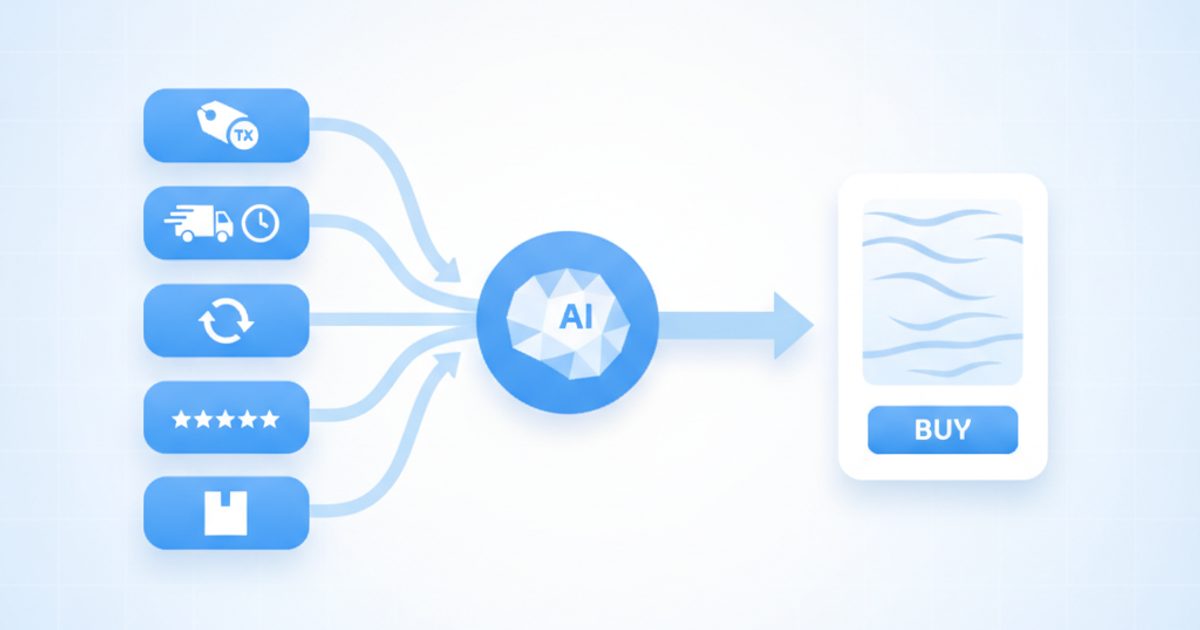
Run a fixed set of real shopping prompts from an Australian context on each AI surface, record what comes back, and repeat monthly. AI answers vary from run to run, so one check proves little; a stable prompt set over time shows the trend. A practical protocol:
- Write 15 to 25 prompts across three types. Category prompts ("best cordless drill under A$200"), comparison prompts ("Brand A vs Brand B robot vacuum") and constraint prompts ("waterproof hiking boots that can arrive in Melbourne by Friday"). Use Australian words and A$ amounts, because that is how your customers ask.
- Run them in Google AI Mode and the Gemini app from Australia. Use a signed-out or private session to reduce personalisation. Record whether your product appears, which retailer is shown, the price shown and whether there is a Buy button.
- Run them in ChatGPT and Perplexity. Add "in Australia" and "in AUD" to the prompt, since these assistants do not always localise. Record whether your store is named or linked, and which page they cite.
- Check accuracy, not just presence. Compare the price, stock and delivery claims in each answer with your live site. A wrong price usually points to a feed or page mismatch.
- Measure the clicks. In GA4, watch referrals from chatgpt.com, perplexity.ai and gemini.google.com; our guide to tracking AI referral traffic in GA4 shows the setup. Traffic from AI Mode and AI Overviews is reported inside Search Console's web search data, not as a separate referrer.
- Repeat monthly with the same prompts and note any changes you made to the feed or pages in between.
Disclosure: AI Rank Lab is our product. We list it first because this is our site, and we've kept the same criteria for every tool below.
- AI Rank Lab automates steps 2 to 4: the AI Mode tracker takes a country and language per query, so you can set Australia, and records which URLs are cited; brand visibility runs on ChatGPT, Claude, Gemini and Perplexity store every run for comparison. Those LLM runs do not emulate an Australian location, so keep "in Australia" in the prompt. The e-commerce AEO/GEO checker audits product pages for the data gaps above.
- Google Merchant Center is free and is the only place that shows feed disapprovals, price mismatches and return-policy verification status. Start there.
- A spreadsheet and a private browser window work for a small catalogue. It is slower but costs nothing and makes you read every answer.
Use this table to turn what you see into a fix:
| What you see in the AI answer | Likely cause | What to do |
|---|---|---|
| Competitors appear, you do not | Products missing or disapproved in Merchant Center, or thin titles and attributes | Fix disapprovals, add GTINs, specific titles and product type |
| Your product appears with the wrong price | Feed and landing page out of sync, or a GST-exclusive figure somewhere | Align feed, page and checkout; check the feed fetch schedule |
| Shown as out of stock when it is not | Stale availability in the feed or page markup | Increase feed update frequency or use automatic item updates |
| Listed in AI Mode but no Buy button | You are not in the UCP checkout program, which is the normal case in Australia today | Nothing to fix yet; prepare for onboarding |
| ChatGPT or Perplexity names you but cites an old page | Outdated pages still crawlable, or the current page is hard to read | Redirect or update old pages; put price and stock in HTML |
| Delivery or returns answers are wrong | Policies missing in Merchant Center or inconsistent with your site | Set shipping and return policies and match the site wording |
What should Australian retailers ignore for now?
Anything that depends on in-chat checkout outside Google, or on Google features with no Australian date. Specifically:
- Paid "UCP integration" packages before Google invites you. Google's onboarding page says Australia is expected next year and participation is by selection. The feed and data work in the checklist is worth doing now; a custom checkout build can wait for the terms.
- Building for ChatGPT Instant Checkout. OpenAI wound it back; ChatGPT sends shoppers to your site.
- Perplexity and Copilot in-chat checkout. Both are US-only on their own pages.
- Universal Cart planning. It launches in the US first with no Australian date.
- llms.txt files as a shopping tactic. Google says in its guide to generative AI features in Search that Search itself does not use them.
- Rewriting product titles to mimic prompts. AI systems understand synonyms; specific, accurate titles beat keyword-stuffed ones.
- Survey headlines as a plan. A March 2026 survey of 1,000 Australian online shoppers by Commerce and PayPal found 63% interested in trying an AI shopping tool but only 4% wanting AI help at checkout (Mediaweek). Both sponsors sell commerce products, so treat the numbers as directional; they still point to discovery as the priority.
Which steps fit your kind of store?
Every store should fix its feed and price display now; what comes next depends on your platform and size.
| Store type | Do now | Do when Google opens Australian onboarding |
|---|---|---|
| Shopify store | Check Sales channels > Agentic in your admin; connect Merchant Center; fix GST-inclusive pricing and policies | Follow Shopify's guidance on direct checkout for Google; review the terms before enabling |
| Large retailer on its own platform | Audit feed accuracy and stock sync; confirm your payment provider supports the Google Pay API; read the UCP developer guide | Submit the interest form, build in the sandbox, start with a curated range as THE ICONIC did |
| Small store not yet in Merchant Center | Set up Merchant Center free listings, shipping and returns; add Product schema | Ask your platform or agency about UCP support; do not build custom |
| Marketplace-only seller | Improve marketplace listing data (titles, GTINs, images, reviews); AI answers often cite the marketplace page | Depends on whether your marketplace joins UCP; ask it |
For the wider picture of how Australians use AI search beyond shopping, see our Australian AI search statistics, and for how AI Overviews behave on local queries, our guide to Google AI Overviews in Australia.
How we researched this article
We checked every availability claim on 2 November 2026 against the platform's own page where one exists: Google Merchant Center Help, Google's developer documentation and blogs, the Google Australia blog, Perplexity's Help Center, Microsoft Advertising and OpenAI's developer documentation. OpenAI's help centre and merchant pages, and the ACCC's pages, did not load for our research tools on the day, so OpenAI's shopping research and checkout details come from OpenAI's developer docs plus dated reporting by SmartCompany, Power Retail and TechWyse, and the price display rules are confirmed through WA Consumer Protection's summary. We read 15 Australian and global articles ranking for AI shopping in Australia; most report Google's June launch or survey numbers, and none gives Australian merchants a dated status table or a feed checklist tied to Australian pricing law.
Limitations: we did not run test checkouts or prompt tests for this article, and AI Rank Lab has no Australia-specific product visibility dataset yet, so there is no first-party data here. Statistics from Google, Commerce and PayPal are the companies' own. Availability changes quickly; where an official page did not name Australia we marked the feature "not confirmed". Nothing here is legal advice.
If you want to run the monthly product visibility test without the spreadsheet, AI Rank Lab's AI Mode tracker and e-commerce checker cover it, priced in USD from $69 a month, with 100 free credits at signup.
Get a free AI ranking consultation
Want your brand to show up when ChatGPT, Gemini and Perplexity answer questions in your market? Tell us about your site and our team will send a personalized strategy.


