


The AI Shopping Shift: What It Means for E-commerce Brands
E-commerce product discovery is changing. A growing segment of online shoppers - particularly in higher-consideration categories like electronics, home goods, software, and specialty items - now asks AI engines for product recommendations before or instead of going to Google Shopping or Amazon. "What is the best air purifier for a 1,000 square foot apartment" or "recommend a laptop under $1,500 for video editing" are now common queries that get answered by ChatGPT, Perplexity, and Gemini before the user ever visits a retailer.
The brands that appear in those AI recommendations are not necessarily the ones with the largest advertising budgets or the highest Google rankings. They are the ones whose products are best described, best documented, and most reliably cited by the underlying data sources AI engines trust. This is GEO (Generative Engine Optimization) for e-commerce - and it requires a different playbook than traditional e-commerce SEO.
How AI Engines Generate Product Recommendations
Understanding the mechanism helps you optimize for it. AI engines generate product recommendations through a combination of:
- Training data: Reviews, editorial content, comparison sites, and product information crawled from the web and used to train the LLM. ChatGPT's base knowledge of products comes from this layer.
- Real-time retrieval: Perplexity and ChatGPT Browse fetch current web content at query time. Product schema, review pages, and structured product data are read and cited in real-time responses.
- Shopping integrations: Google's Gemini integrates with Google Shopping data. Microsoft Copilot integrates with Bing Shopping. These integrations allow AI engines to show current prices, availability, and product images.
For real-time retrieval systems (Perplexity, ChatGPT Browse), optimization focuses on the content and signals that exist on the live web - product schema, review aggregation, and content quality. For training-data-dependent systems (base ChatGPT, Claude without Browse), the pathway is slower - building the presence on the web that will be crawled and incorporated into future training runs.
Product Schema: The Non-Negotiable Foundation
Product schema is the starting point for e-commerce GEO. Without it, your products are HTML with images. With it, your products are structured data entities that AI engines can extract, compare, and cite in shopping responses.
For AI engine citation, the most critical Product schema fields are:
- name: Match this exactly to how the product appears in editorial reviews and comparison content - inconsistency between your schema name and external references reduces citation confidence
- description: Write this for use-case matching, not just features. "Designed for apartments under 1,200 sq ft with HEPA filtration for pet dander and smoke" is more citable for specific buyer queries than "Premium air purifier with HEPA filter"
- brand: Required for brand-specific queries and brand authority signals
- aggregateRating: Average rating and review count - AI engines use this as a proxy for product quality confidence
- offers.price: Current pricing - freshness matters for real-time retrieval systems
- offers.availability: Must be accurate; AI engines do not recommend out-of-stock products
- category: Use a hierarchical category that matches how buyers search ("Electronics > Air Purifiers > HEPA Air Purifiers for Pets")
Use AI Rank Lab's free schema generator to build the correct JSON-LD for your product pages, and the full audit to check schema coverage across your catalog.
Review Optimization: The Most Underrated GEO Signal for E-commerce
AI engines heavily weight review presence and quality when generating product recommendations. The sources they draw from include your own product page reviews, G2/Capterra/Trustpilot reviews (for software), consumer review aggregators, and editorial comparison sites. Three tactics matter most:
Aggregate your reviews in schema
The aggregateRating field in Product schema communicates your review summary to AI engines in machine-readable format. A product with 4.7 stars from 342 reviews communicates quality confidence that AI engines factor into recommendation selection. Missing aggregateRating means AI engines have to guess at your product's quality standing.
Include review content that matches use-case queries
AI engines often cite specific review language when recommending products. If your reviews say "perfect for small apartments" and a user asks "best air purifier for small apartments," that review language increases citation probability. Encourage specific, use-case-mentioning reviews rather than generic positive sentiment. Your post-purchase email sequence should prompt reviewers to describe their specific use context.
Build editorial review presence off-site
AI engines cite editorial review sources - Wirecutter, RTINGS, PCMag, Tom's Guide, and category-specific review publications - more heavily than first-party product pages for certain query types. Getting your product reviewed by relevant editorial sources, and ensuring those reviews are current and positive, is a GEO signal that extends beyond your own domain.
Product Category Authority Content
Beyond individual product pages, e-commerce GEO requires category-level authority content. This is the content AI engines use to match your brand to category queries - not just specific product queries.
For a home goods brand, category authority content looks like:
- Buying guides with FAQPage schema: "How to choose an air purifier for your home" with direct answers to the questions buyers ask AI engines
- Comparison content: "HEPA vs MERV air purifiers: which do you need?" with structured comparison data
- Use case content: "Best air purifiers for pet owners", "Best air purifiers for allergies" - with FAQPage schema directly answering which of your products are best for each use case
This content serves double duty: it ranks in traditional Google search AND provides the citation content that AI engines use to recommend your brand for category-level queries.
Direct Answer Content for Product Queries
One of the highest-leverage e-commerce GEO tactics is creating content that directly answers the specific questions buyers ask AI engines. Not generic content about your product category - content that specifically answers the most common AI queries about your products and category.
How to find these queries:
- Test your product category in ChatGPT, Perplexity, and Gemini. What questions do buyers ask? What comparative queries come up?
- Check Google Search Console for question-format queries your site ranks for - these often match AI query patterns
- Look at the "People Also Ask" boxes on Google for your category - these are often the same questions asked in AI engines
For each high-value query, create a page or section with FAQPage schema that provides a direct, specific answer. "What is the best air purifier for 1,000 sq ft?" should have a page with FAQPage schema that directly answers this question with your product recommendation, why it is appropriate, and who it is best for.
E-commerce GEO by Product Category
Consumer Electronics
Electronics AI citations are heavily driven by specification accuracy and comparison content. AI engines frequently answer "best laptop for [use case]" queries by citing review sites and brand spec pages. Ensure your product spec data is accurately structured (using Product schema with detailed additionalProperty fields for specs), and create content that maps your products to specific use cases with clear spec justifications.
Home and Garden
Home product recommendations in AI are driven by space/use-case matching. Products described in square footage, room type, or specific use contexts ("for bathrooms," "for pet owners," "for rentals") get cited more specifically for relevant queries. Category authority content (buying guides, space-specific recommendations) is particularly effective for this vertical.
Fashion and Apparel
Fashion is one of the harder e-commerce categories for AI recommendation because queries are highly subjective. The most effective GEO in fashion focuses on specific occasions and fit contexts ("best dress for summer weddings," "workwear for petite frames") rather than generic product descriptions. User-generated content and style-specific review language helps AI engines match products to specific fashion queries.
Health and Beauty
Health and beauty product recommendations from AI engines are heavily influenced by ingredient transparency, certifications (clean beauty, cruelty-free, dermatologist-tested), and skin/hair type specificity. Schema and content that explicitly maps products to specific skin concerns ("for oily skin," "for hyperpigmentation") with FAQPage schema on those use cases drives targeted citation.
Monitoring and Measuring E-commerce GEO
E-commerce GEO measurement requires tracking:
- Product citation rate: How often are your specific products mentioned by name in AI responses to relevant category queries?
- Brand citation rate: How often is your brand mentioned as a recommended source, even when specific products are not named?
- Competitive citation gap: Which competitors' products are cited instead of yours for your target queries?
- AI referral traffic: Clicks from Perplexity.ai and chat.openai.com to your product and category pages
- Schema coverage: Percentage of your catalog with valid Product schema (the audit identifies gaps)
AI Rank Lab's audit tool checks schema coverage and AEO signals for your domain, providing the diagnostic data you need to prioritize GEO investment.
Conclusion
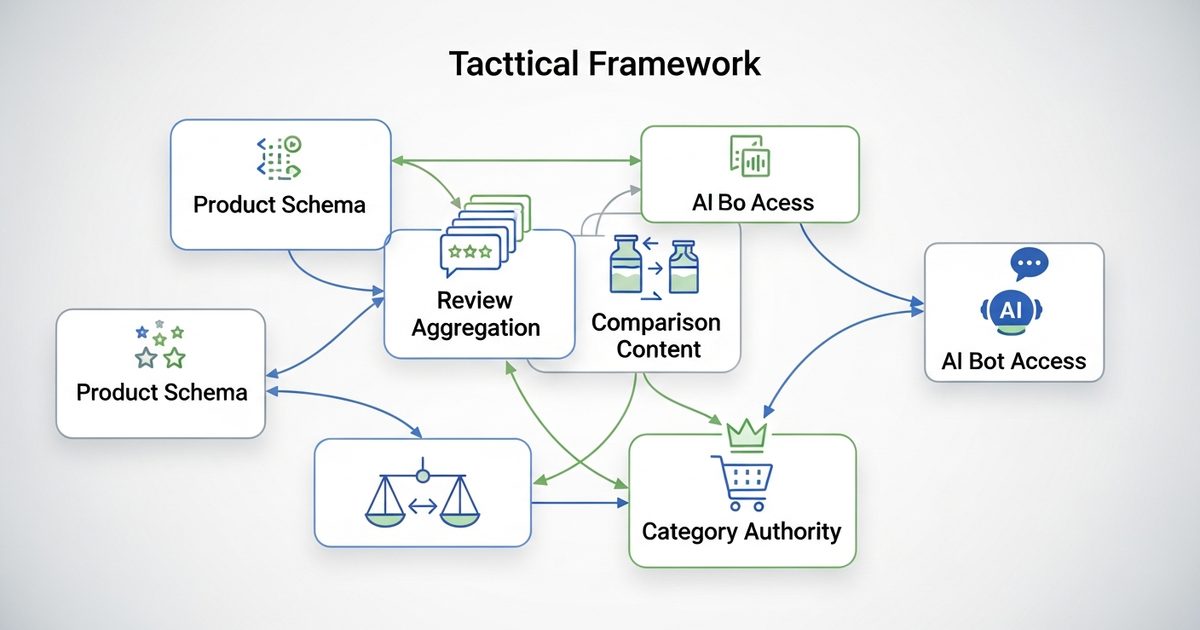
E-commerce GEO is an emerging but already measurable channel. The brands that are winning AI product recommendations in 2026 have invested in the signals that make their products citation-ready: Product schema with use-case-specific descriptions, review aggregation in schema, category authority buying guides with FAQPage schema, editorial review presence, and precise AI bot access configuration.
The barriers to entry are low compared to traditional e-commerce SEO - you do not need a massive backlink campaign or years of domain authority building. You need accurate, specific, well-structured product data and content that directly answers the questions buyers ask AI engines. Start with the AI Rank Lab audit to see where your current signals stand, use the schema generator to build Product schema for your priority pages, and track your citation rate improvement as you implement.
Frequently Asked Questions
How do I get my products recommended by ChatGPT and Perplexity?▾
What product schema fields matter most for AI shopping citations?▾
Does product schema alone get products into AI shopping responses?▾
How is e-commerce GEO different from traditional e-commerce SEO?▾
What is the fastest way to improve e-commerce AI search visibility?▾
Get a Free AI Ranking Consultation
Want to improve your brand's visibility in AI search engines like ChatGPT, Gemini, and Perplexity? Fill out the form and our experts will create a personalized strategy for you.

Written by
Devanshu
Chief Marketing Officer & AI Search Optimization Architect
Digital Marketing Strategist & Pioneer in SEO, Answer Engine Optimization (AEO), and Generative Engine Optimization (GEO).


