


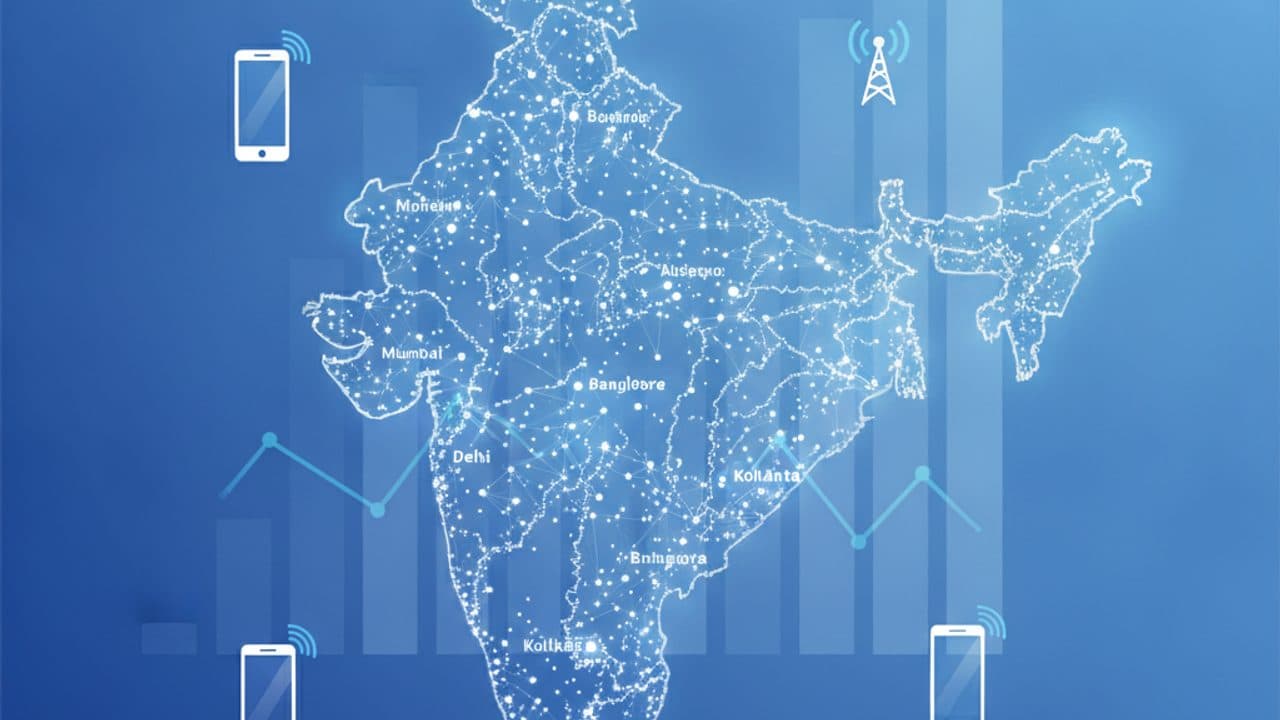
India had 1,114.17 million internet subscriptions at the end of June 2026, 448.08 million of them rural, according to the telecom regulator (TRAI Performance Indicators, April-June 2026). That is a count of connections. The count of people is lower: the ITU estimate published by the World Bank puts 70% of India's population online in 2025 (World Bank, ITU data). On the AI side, ChatGPT sent 50.39% of AI chatbot referrals from India in October 2026 and Gemini 35.11% (StatCounter), and the government's IndiaAI Mission had 45,000+ GPUs in its shared pool by June 2026 (Press Information Bureau).
This page puts India's official internet and AI numbers in one place, each with its source and the period it covers. Every source was opened and checked on 11 November 2026, so this is data to November 2026. Nothing here is a 2027 measurement. The newest telecom figures are for September 2026 and the newest household survey is from early 2025, and we say which is which. You also get two things most India roundups skip: a table that explains why "internet users in India" has four different answers, and a list of popular AI figures we could not confirm at the source.
Key statistics
- 1,114.17 million internet subscriptions in India on 30 June 2026, up 1.96% in a quarter. Without machine-to-machine SIMs the count is 1,014.88 million. (TRAI)
- 70% of India's population used the internet in 2025, against a world figure of 73.6%. (World Bank, ITU data)
- 448.08 million rural internet subscriptions, or 49.07 per 100 rural residents, against 129.03 per 100 in urban areas, June 2026. (TRAI)
- 28.39 GB of mobile data per wireless data subscriber per month in April-June 2026, at an average Rs 7.13 per GB. (TRAI)
- 86.3% of Indian households had internet access at home and 85.5% had at least one smartphone, January-March 2025. (MoSPI, CMS: Telecom 2025)
- 98.06% of search engine referrals in India came from Google in October 2026. (StatCounter)
- 50.39% of AI chatbot referrals in India came from ChatGPT in October 2026, with Gemini at 35.11%. (StatCounter)
- 7.2% of global Claude.ai usage came from India in August 2025, second only to the United States. (Anthropic Economic Index)
- Rs 10,371.92 crore over five years is the approved outlay of the IndiaAI Mission, which reported 45,000+ GPUs by June 2026. (PIB, February 2026; PIB, August 2026)
How many internet users does India have?
About seven in ten Indians use the internet, and the country has more than 1.1 billion internet subscriptions. Both statements are correct because they count different things. TRAI counts connections reported by operators. The ITU and the national statistics office estimate people. Kantar counts "active" users from a field survey. Mixing them is the most common error on pages about India's internet.
| Measure | Figure | What it counts | Period | Source |
|---|---|---|---|---|
| Internet subscriptions | 1,114.17 million | Connections reported by 1,577 service providers, including machine-to-machine SIMs. One person with two SIMs counts twice. | 30 June 2026 | TRAI (government, measured count) |
| Internet subscriptions without M2M | 1,014.88 million | The same count with machine-to-machine connections removed | 30 June 2026 | TRAI, Table 1.36 |
| Individuals using the internet | 70% of population | People who used the internet in the last three months (ITU definition) | 2025 | World Bank, from the ITU indicators database (intergovernmental estimate) |
| Households with internet at home | 86.3% | Households with access to an internet facility within the premises | January-March 2025 | MoSPI (government survey, 34,950 households) |
| Active internet users | 958 million | "Active" users as defined by the ICUBE field survey | 2025 | IAMAI and Kantar, as listed on IAMAI's media page (industry study) |
| Internet users | 1.04 billion | An analyst model that blends ITU, GSMA, regulator and ad-platform data | October 2026 | DataReportal, Digital 2027: India (industry estimate) |
Which should you quote? For "how many people", we would use the ITU figure of 70%, because it is an estimate of individuals built on household surveys and it is comparable across countries. The series moved from 55.9% in 2022 to 60.3% in 2023, 64.9% in 2024 and 70% in 2025 (World Bank, values read from the World Bank data API on 11 November 2026). The world figure for 2025 is 73.6%, so India is a little below the global line, not above it. The ITU's own release put the world at about 6 billion people online in 2025, with 85% of urban residents and 58% of rural residents using the internet (ITU Facts and Figures 2025, November 2025).
For "how big is the market for connections, data and devices", use TRAI. Its number is a hard count, published every quarter, and it splits by state, operator and technology. It is not a headcount. TRAI's own table shows the difference machine-to-machine SIMs make: 1,114.17 million with them, 1,014.88 million without (TRAI, June 2026). Dual-SIM phones push the figure up further, and shared phones push the number of real users the other way.
The IAMAI and Kantar figure of 958 million active users for 2025, with 57% of them rural, is an industry study. We confirmed the headline on IAMAI's own media listing dated 29 January 2026 but could not open the full report, so we do not quote its smaller findings. Press coverage describes the sample as more than 87,000 people across over 400 towns and 1,000 villages (Business Today, 29 January 2026).
How many internet and broadband subscribers does TRAI report?
TRAI reported 1,114.17 million internet subscribers on 30 June 2026, of which 1,087.50 million were broadband and 26.67 million narrowband. Broadband here means a connection capable of at least 2 Mbps. Wireless connections were 1,066.43 million and wired 47.73 million (TRAI Performance Indicators, April-June 2026, released 12 October 2026).
| Indicator (30 June 2026) | Figure | Change over March 2026 |
|---|---|---|
| Total internet subscribers | 1,114.17 million | +1.96% |
| Broadband subscribers | 1,087.50 million | +2.03% |
| Narrowband subscribers | 26.67 million | -0.89% |
| Wired internet subscribers | 47.73 million | +2.58% |
| Wireless internet subscribers | 1,066.43 million | +1.93% |
| Fixed wireless access (5G FWA, Wi-Fi, satellite and others) | 18.36 million | +7.33% |
| Internet subscribers per 100 population | 77.94 | See note below |
| Total telephone subscribers | 1,348.08 million | +1.31% |
Source: TRAI, snapshot and Table 1.36. Measured counts reported by operators.
Mobile carries almost all of it. TRAI says 94.07% of internet subscribers connect through mobile devices and only 4.28% through a wired line. Fixed wireless is the fast-growing corner: 18.36 million subscribers in June 2026 against 8.21 million a year earlier, a rise of 123.58%.
The newer monthly release covers broadband only. At the end of September 2026 India had 1,107.68 million broadband subscribers including machine-to-machine connections, and 1,013.87 million without them (TRAI Press Release 140/2026, 27 October 2026). If you want the closest regulator figure to "broadband connections used by people", that second number is the one.
Two things in the TRAI series we would not take at face value
First, the year-on-year growth. TRAI prints 11.10% growth in internet subscribers between June 2025 (1,002.85 million) and June 2026. But the series jumps from 1,028.61 million in December 2025 to 1,092.79 million in March 2026, a 6.2% rise in one quarter by our arithmetic, when every other quarter in the table grew between 1% and 2%. The report carries a footnote about Bharti Airtel's machine-to-machine connections being added to its wireless base. We could not confirm that this explains the jump, so we would not describe 11.10% as organic growth.
Second, the per-100 figure. The report shows 72.09 internet subscribers per 100 population in March 2026 and 77.94 in June, an 8.12% rise against 1.96% growth in subscribers. Those two cannot both describe the same population base. Quote the June figure with its date and do not chart it against earlier quarters.
Which operators hold India's internet subscribers?
Two companies hold more than four in five connections. Reliance Jio had 532.21 million internet subscribers (47.77%) and Bharti Airtel 398.31 million (35.75%) in June 2026. Vodafone Idea followed with 135.98 million (12.21%) and state-owned BSNL with 29.91 million (2.68%). The top five providers together held 98.63% of all internet subscribers (TRAI, Table 1.39).
Rural versus urban India, and which states have the most subscribers
Urban India has 666.09 million internet subscriptions and rural India 448.08 million, so rural areas hold about 40.2% of connections (our calculation from TRAI data, June 2026). Per head the gap is much wider: 129.03 subscriptions per 100 people in urban areas against 49.07 in rural areas. Urban India has more connections than residents. Rural India has roughly one for every two.
Uttar Pradesh has the most internet subscriptions of any state, followed by Maharashtra. The table adds TRAI's rural and urban columns for each state; the totals and rural shares are our arithmetic.
| State (30 June 2026) | Rural (million) | Urban (million) | Total (million) | Rural share |
|---|---|---|---|---|
| Uttar Pradesh | 72.19 | 83.20 | 155.39 | 46.5% |
| Maharashtra including Mumbai | 36.83 | 93.27 | 130.10 | 28.3% |
| Karnataka | 22.90 | 48.79 | 71.69 | 31.9% |
| West Bengal including Kolkata | 29.14 | 41.27 | 70.41 | 41.4% |
| Tamil Nadu including Chennai | 20.92 | 47.68 | 68.60 | 30.5% |
| Bihar | 41.94 | 25.73 | 67.67 | 62.0% |
Source: TRAI, Table 1.38 (state-wise internet subscriber base).
Density tells a different story from volume. By telecom service area, Delhi has 309.29 internet subscriptions per 100 people, Karnataka 103.78 and Maharashtra 100.97. Bihar, which TRAI reports together with Jharkhand, has 52.31, the lowest in the country, and Uttar Pradesh with Uttarakhand has 58.39 (TRAI, Table 1.42). Delhi's number probably says more about SIMs registered in the capital than about residents. We left Kerala's rural and urban split out because the printed rural figure (252.54 per 100) looks like a misprint.
The gender gap is larger than the rural gap
Among Indians aged 15 and above, 72.1% of rural men had used the internet in the previous three months but only 57.6% of rural women. In urban areas the figures were 85.5% and 74.0%. For ages 15 to 29 the gap nearly closes: 92.7% of rural and 95.7% of urban young people had used the internet (MoSPI, Comprehensive Modular Survey: Telecom 2025, January-March 2025, 34,950 households and 142,065 people surveyed). This is the most recent official household survey on internet use. It is now more than 18 months old and the regulator's rural count has grown since.
Phone ownership is where women fall behind. Among those aged 15 and above, 80.7% of rural men owned a mobile phone against 48.4% of rural women (MoSPI). More rural women use the internet (57.6%) than own a phone (48.4%), which points to shared handsets and is one reason subscription counts and user counts never line up.
How much mobile data do Indians use, and on what devices?
The average wireless data subscriber in India used 28.39 GB a month in April-June 2026, up from 26.70 GB the quarter before. Operators earned an average Rs 7.13 per GB, down from Rs 7.51. Monthly revenue per wireless user was Rs 187.12 (TRAI, quarter ending June 2026).
- 84,424 petabytes of mobile data were used in the quarter, 8.30% more than in January-March 2026.
- 44.36% of that volume ran on 5G and 55.50% on 4G. 2G and 3G together were about 0.15%.
- 1,045.55 million wireless data subscribers were on the networks at the end of June 2026.
- 12.94 million subscribers used 5G fixed wireless access, split almost evenly between urban (49.80%) and rural (50.20%).
All four from TRAI. Government material from February 2026 adds that 5G was available in 99.9% of districts (PIB).
India browses on phones, and those phones run Android. Mobile accounted for 84.21% of web page views from India in October 2026, desktop 15.17% and tablet 0.62% (StatCounter). Android had 94.84% of mobile page views and iOS 5.1% (StatCounter, October 2026). StatCounter measures page views on sites that carry its tag, so read these as traffic shares, not device ownership.
On ownership, the official figure is that 85.5% of households had at least one smartphone in early 2025: 82.1% in rural areas and 91.3% in urban areas (MoSPI). A site built for Indian readers is a site built for a mid-range Android phone on mobile data. Page weight and server response matter more here than in desktop-heavy markets, which is why we keep a separate guide to web hosting in India.
Language
We found no current official count of internet users by language, so we publish none. What the official and company sources do show is the direction. Google's AI Mode worked in English and Hindi in India and added Bengali, Kannada, Malayalam, Marathi, Tamil, Telugu and Urdu in October 2025 (Google India blog, 8 October 2025). The government's Bhashini translation platform supported 36+ languages by February 2026 (PIB). Our guide to multilingual GEO covers how to handle more than one language on a site.
How many people in India use ChatGPT and other AI tools?
There is no official Indian statistic for AI chatbot use. No TRAI report, MoSPI survey or government backgrounder we opened measures how many people use ChatGPT, Gemini or any other assistant. What exists is company data, and it describes how Indians use these products more reliably than how many do.
OpenAI: young users, and more work use than the world average
OpenAI's first country report describes India as "one of the largest markets of ChatGPT weekly active users" and a top five country for API users, without giving a user count (OpenAI, How India uses ChatGPT, February 2026, consumer plans only). Its measured findings:
- Users aged 18 to 24 send just under half of all ChatGPT messages in India, against about one-third globally. Ages 18 to 34 together send about 80%.
- Around 35% of consumer messages in India are work-related, against around 30% worldwide.
- Indian users ask about coding at nearly 3 times the global median rate. Telangana, Karnataka and Tamil Nadu rank first, second and third for coding use.
- A little under 60% of users have a typically masculine first name. OpenAI infers this from names and says the gap has been closing.
Anthropic: second-largest country for Claude, far below its population weight
India produced 7.2% of global Claude.ai usage, second behind the United States at 21.6% (Anthropic Economic Index, September 2025 report, based on 1 million conversations from 4 to 11 August 2025). The same report gives India an AI Usage Index of 0.27, meaning usage is about a quarter of what its working-age population would predict. Over half of Indian usage was coding, against roughly a third globally. Anthropic repeated the second-place ranking when it announced a Bengaluru office (Anthropic, 7 October 2025).
Put the two together and the picture is consistent: India is large in absolute terms, low per head, young, and unusually technical.
Google and news use
Google says people in India are its "largest user base for both voice and visual search globally" (Google India blog, 8 October 2025). It gave no number. For news specifically, 18% of the Reuters Institute's Indian sample used AI chatbots for news each week, a figure the report singles out as high (Reuters Institute Digital News Report 2025). The Institute warns that its India sample is primarily English-speaking online users and is not nationally representative (Digital News Report 2026, India). The 2026 India page reports 58% using YouTube for news and does not repeat the chatbot figure, so the 18% is a 2025 number for an urban, English-reading audience.
AI figures about India we could not confirm at the source
| Claim in circulation | Where it traces to | What we found |
|---|---|---|
| India has 100 million weekly ChatGPT users | An article by Sam Altman in The Times of India, 15 February 2026, as reported by TechCrunch | We could not open the original article or OpenAI's own page. OpenAI's India report from the same month, which we did open, gives no user count. Treat it as a reported CEO statement. |
| Monthly and daily app users for ChatGPT, Gemini and Perplexity in India | App-intelligence estimates quoted in press coverage | Third-party panel estimates, not company disclosures. We found no original page to cite and left the numbers out. |
| A share of Indian internet users who "use AI features" | Press coverage of the IAMAI and Kantar report | We could not open the report. The definition reportedly includes voice search and photo filters, which is far broader than chatbot use. |
| India ranks in the top three for AI "vibrancy" and second for GitHub AI projects | Stanford publications, as cited by the government in PIB | We opened the government page but not the Stanford tables behind it, so we cite no figure. |
For how these products compare worldwide, see our AI chatbot market share report.
Search engine and AI chatbot market share in India
Google sent 98.06% of search engine referrals from India in October 2026. Bing sent 1.11%, Yahoo 0.35% and DuckDuckGo 0.33% (StatCounter, India). Worldwide, Google's share that month was 91.05% and Bing's 4.8% (StatCounter, worldwide), so India is one of the most Google-dependent large markets. The wider picture is in our search engine market share report.
| AI chatbot (October 2026) | India | Worldwide |
|---|---|---|
| ChatGPT | 50.39% | 51.58% |
| Google Gemini | 35.11% | 28.86% |
| Perplexity | 8.9% | 15.04% |
| Claude | 3.33% | 2.3% |
| Microsoft Copilot | 2.27% | 2.18% |
Sources: StatCounter, India and StatCounter, worldwide. Share of referral page views, not users.
Gemini is stronger in India than in the world as a whole, by about six points, and Perplexity is weaker. That would fit a market where 94.84% of mobile page views come from Android, though StatCounter does not publish a cause.
Read these shares with care. StatCounter counts a click from a chatbot to a website that carries its tag. In its own words, "It's the click to a website that we measure, not the actual search queries that were performed" (StatCounter FAQ). A chatbot that answers without sending anyone anywhere scores nothing. So 50.39% means ChatGPT sent half of the chatbot-referred visits StatCounter saw from India. It does not mean half of Indian chatbot users are on ChatGPT, and it cannot be added to the search engine figures.
IndiaAI Mission: budget, compute and datasets
The IndiaAI Mission was approved in March 2024 with an outlay of Rs 10,371.92 crore over five years (PIB, Democratising AI in India, 10 February 2026). Its reported output grew quickly during 2026. The two government backgrounders below were published six months apart.
| Indicator | February 2026 backgrounder | August 2026 backgrounder |
|---|---|---|
| GPUs in the shared compute pool | 38,000+, offered at Rs 65 per hour | 45,000+ (as of June 2026) |
| AIKosh datasets | 7,541 | Over 14,000 (as of July 2026) |
| AIKosh AI models | 273 | 331 (as of July 2026) |
| Foundation model proposals selected | 12 startups, from more than 500 proposals | 20 proposals, from 506 applications |
| Projects using subsidised compute | Not stated | 237 projects, 93.18 lakh GPU hours (by August 2026) |
| Data and AI labs | 31 launched | Not stated |
Sources: PIB, 10 February 2026 and PIB, 13 August 2026. These are government-reported programme figures, not independently audited counts.
Two details are useful if you are building on this. The Rs 65 per hour GPU rate is described by the government as nearly one third of the global average cost. And the fellowship targets are specific: support for 500 PhD scholars, 5,000 postgraduate students and 8,000 undergraduates (PIB). We tried to read live dataset counts from AIKosh on 11 November 2026 and the page did not load them, so the July 2026 figure is the latest we can stand behind.
What this means for Indian businesses that want to appear in AI answers
Three conclusions follow from the numbers, and one caution.
- Google is still the door. With 98.06% of search referrals, AI Overviews and AI Mode reach more Indians than any standalone chatbot. Google's documentation says "There are no additional requirements to appear in AI Overviews or AI Mode": a page has to be indexed and eligible to show with a snippet (Google Search Central). Start there.
- Track ChatGPT and Gemini before anything else. Together they sent 85.5% of chatbot referrals from India in October 2026 (our sum of the two StatCounter shares).
- Write for the phone and for more than one language. Mobile is 84.21% of page views, and AI Mode in India now works in nine languages, counting English and Hindi.
The caution: the AI audience measured so far is young, urban and technical. If you sell to rural households or older buyers, the 448.08 million rural connections are real, but nothing published shows those users asking chatbots for product advice yet. We do not know when that changes.
If you want your own numbers, AI Rank Lab's brand visibility tracking runs the prompts you choose on ChatGPT, Claude, Gemini and Perplexity and records whether your brand is mentioned and which URLs are cited. Its AI Overview and AI Mode checks take a country and language per query, so you can check India in Hindi or English. The four chatbot runs do not emulate a location, which is a limit to know before you read the results. Plans are billed in rupees through Razorpay; the pricing page has current prices. Our AI search optimization guide for India covers what to do with the findings.
Methodology
We set one rule: a number goes in only if we opened the page or document that first published it and read the figure there. Sources were opened on 11 November 2026, which is the data cutoff.
- Order of preference. Government and intergovernmental sources first (TRAI, MoSPI, the Press Information Bureau, the ITU series carried by the World Bank), then companies reporting their own data (OpenAI, Anthropic, Google, StatCounter), then university research (Reuters Institute). Two industry estimates, IAMAI with Kantar and DataReportal, appear once each for comparison and are labelled.
- How we read the documents. The TRAI reports, the MoSPI press note, the February PIB backgrounder and OpenAI's India report are PDFs; we extracted the text and read the tables directly. World Bank values were read from its data API for indicator IT.NET.USER.ZS.
- Our own arithmetic is marked where it appears: the rural share of subscriptions, state totals, the December-to-March jump and the combined ChatGPT and Gemini share. Everything else is as printed.
- Kinds of number. TRAI figures are operator-reported counts. MoSPI and Reuters Institute figures are survey shares. The ITU figure is a modelled estimate. StatCounter figures are shares of tagged page views. IndiaAI figures are programme reporting by the government. There are no forecasts on this page.
- What we left out and why. UPI and digital payment volumes, because the NPCI statistics page refused our request and we would not copy the figures from news reports. MeitY's website and the IndiaAI portal, because neither returned readable content. Speed-test rankings, app-download estimates, time-spent figures, market-size forecasts and any "percent of Indians using AI" figure without an openable original. Microsoft's AI diffusion report and Stanford's AI Index tables, which we could not open in full.
- Known weak points. The household survey is from early 2025. TRAI's year-on-year growth and per-100 series have the breaks described above. Company AI data covers consumer plans of single products. AI Rank Lab's own data is not used anywhere on this page.
Drafting was assisted by AI. Every figure was checked against the sources below. When TRAI publishes its July-September 2026 quarterly report, we will update the tables and change the date on this page then, not before.
Sources
- The Indian Telecom Services Performance Indicators, April-June 2026. Telecom Regulatory Authority of India. 12 October 2026.
- Highlights of Telecom Subscription Data at the end of September 2026 (Press Release 140/2026). Telecom Regulatory Authority of India. 27 October 2026.
- Results of Comprehensive Modular Survey: Telecom, 2025 (press note). Ministry of Statistics and Programme Implementation. 29 May 2025.
- Democratising AI in India (backgrounder). Press Information Bureau, Government of India. 10 February 2026.
- Semiconductor and AI Revolution (backgrounder). Press Information Bureau, Government of India. 13 August 2026.
- Individuals using the Internet (% of population), India. World Bank, from the ITU World Telecommunication/ICT Indicators Database. Last updated 11 November 2026.
- Facts and Figures 2025 press release. International Telecommunication Union. 17 November 2025.
- Search engine market share, India. StatCounter Global Stats. October 2026.
- Search engine market share, worldwide. StatCounter Global Stats. October 2026.
- AI chatbot market share, India. StatCounter Global Stats. October 2026.
- AI chatbot market share, worldwide. StatCounter Global Stats. October 2026.
- Desktop vs mobile vs tablet market share, India. StatCounter Global Stats. October 2026.
- Mobile operating system market share, India. StatCounter Global Stats. October 2026.
- Frequently asked questions (method). StatCounter Global Stats. Checked 11 November 2026.
- How India uses ChatGPT: early evidence from OpenAI Signals. OpenAI. February 2026.
- Anthropic Economic Index report: uneven geographic and enterprise AI adoption. Anthropic. September 2025.
- Expanding our global operations to India. Anthropic. 7 October 2025.
- Supercharging Search for India: new languages in AI Mode, Search Live debuts. Google India. 8 October 2025.
- Digital News Report 2026: India. Reuters Institute for the Study of Journalism, University of Oxford. June 2026.
- Digital News Report 2025: executive summary. Reuters Institute for the Study of Journalism, University of Oxford. June 2025.
- Media listing for the Internet in India 2025 report. Internet and Mobile Association of India. 29 January 2026. Industry study; full report not opened.
- Digital 2027: India. DataReportal (Kepios). 4 November 2026. Industry estimate.
- India's internet user base tops 950 million as rural growth, AI drive adoption. Business Today. 29 January 2026. News, used for the survey's reported sample only.
- India has 100M weekly active ChatGPT users, Sam Altman says. TechCrunch. 15 February 2026. News, cited only as the trail for an unconfirmed claim.
- AI features and your website. Google Search Central. Checked 11 November 2026.
To see how AI assistants describe your business in India, start with a brand visibility check. Sign-up includes 100 free credits and needs no card.
Get a free AI ranking consultation
Want your brand to show up when ChatGPT, Gemini and Perplexity answer questions in your market? Tell us about your site and our team will send a personalized strategy.

