


AI share of voice is your brand's share of all brand mentions in AI-generated answers to a fixed set of prompts: your mentions divided by the mentions of every brand in those answers, times 100. It is a competitive ratio, not a hit rate, so it only means something next to the prompt set, engines, competitor list and time window that produced it. Two variants matter just as much: citation share of voice (whose website the answers link to) and position-weighted share of voice (who gets named first).
This guide gives you all three formulas, one worked dataset that produces four different "share of voice" numbers for the same brand, spreadsheet formulas you can paste, a side-by-side of how Profound, Peec AI, Semrush and Ahrefs define the metric, sample-size math based on our own repeated-run data, and a reporting template for leadership. Tool definitions were checked on October 18, 2026.
Key takeaways
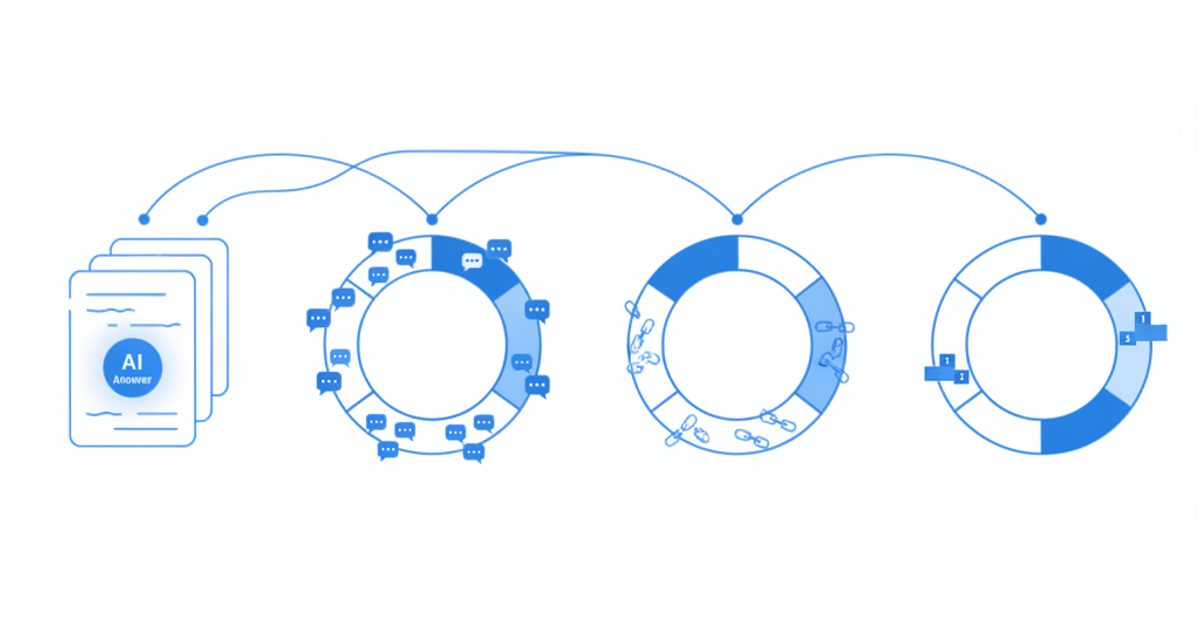
- Three formulas, three answers. Mention share counts names in the answer, citation share counts links to your site, and position-weighted share rewards being named first. In our worked example the same brand scores 17.5%, 44.0% and 14.3%.
- Share of voice is not presence rate. "Mentioned in 35% of answers" is a visibility rate. Share of voice divides by all brand mentions, so it falls when competitors crowd the answer.
- The denominator decides the number. Counting only the four brands you chose instead of every brand the AI named moved our example from 17.5% to 22.6%.
- Single runs are samples. Across 968 repeated runs of 42 prompt-engine pairs in AI Rank Lab, 42.9% of pairs flipped between mentioning and not mentioning the brand at least once. Report windows, not snapshots, and show a margin of error.
- There is no sourced universal benchmark. Published "good" bands disagree and often measure different metrics. Benchmark against your named competitors and your own market share instead.
What is AI share of voice?
AI share of voice measures how much of the brand conversation inside AI answers belongs to you. You define a set of prompts your buyers ask, run them on engines such as ChatGPT, Claude, Gemini, Perplexity and Google's AI features, record every brand each answer names, and calculate your portion of the total.
The idea is borrowed from advertising. In classic media planning, share of voice was a brand's share of all advertising exposure in its category, and John Philip Jones argued in Harvard Business Review in 1990 that comparing share of voice with share of market is a better way to set budgets. AI share of voice keeps the ratio but swaps paid exposure for something you cannot buy directly: being named in an answer.
The vendors that track it agree on the core ratio. Profound's glossary defines share of voice as "how often your brand is mentioned compared with all brands", and Peec AI's documentation gives the formula as your mentions divided by total brand mentions, times 100.
How is AI share of voice different from mention rate or visibility?
Mention rate (also called visibility or presence rate) asks "in what share of answers did we appear?" Share of voice asks "what share of all brand mentions were ours?" The difference is the denominator: answers versus mentions.
A brand that appears in every answer has a 100% mention rate, but if four other brands appear in every answer too, its share of voice is 20%. Peec's own example shows the gap: 4 mentions against a competitor's 12 across 10 chats is 40% visibility but 25% share of voice. Some popular guides publish the presence-rate formula under the share-of-voice name, which is one reason published numbers rarely line up. Report both, label both, and never swap one for the other between reporting periods.
Mention metrics also say nothing about traffic. A mention puts your name in front of the user; a citation gives them a link. We cover why that distinction changes how you read a report in brand mentions vs citations in AI search.
How do you calculate AI share of voice? The three formulas
Use one formula per question you want answered, and report them side by side rather than blending them into one score.
| Metric | Formula | Unit counted | Question it answers |
|---|---|---|---|
| Mention share of voice | Your brand mentions / all brand mentions x 100 | Brand named in the answer text, at most once per answer | How much of the recommendation conversation do we own? |
| Citation share of voice | Citations to your domain / citations to all tracked brands' domains x 100 | A linked source URL on a domain a brand owns | When answers point to a brand's own site, how often is it ours? |
| Position-weighted share of voice | Sum of your weights / sum of all brands' weights x 100, where weight = 1 / position | Each mention, weighted by its order in the answer | Are we the first name or an afterthought? |
| Mention rate (for context) | Answers naming your brand / all answers x 100 | Answers | How often do we show up at all? |
Mention share of voice
This is the default, and the one Profound and Peec document. Count each brand at most once per answer, even if the answer names it three times, or long answers will dominate the total. Include every brand the answer names in the denominator, not only the competitors you chose to track; the section on competitor sets explains why.
Citation share of voice
Citation share of voice tracks the links under the answer, not the names inside it. Most citations in AI answers go to third-party sites: in Trakkr's panel of 48.4 million citation appearances across 529,165 domains (October 2025 to August 2026), the most-cited domain, youtube.com, held 3.47% of the total, followed by Wikipedia at 1.83% and Reddit at 1.74%. That is why the competitive version of the formula divides by citations to the tracked brands' own domains. If you prefer the share of all citations (Profound calls this "Citation Share"), report it separately and expect single-digit numbers.
Citation share is also concentrated at the URL level. Peec AI's analysis of more than 1 million citations found that on ChatGPT the 31% of URLs cited an average of two or more times per answer account for 59% of all citations, and that 64% of URLs Perplexity retrieves are never cited at all. A few pages usually carry your whole citation share.
Position-weighted share of voice
Position weighting gives a first mention more credit than a fifth. The common scheme is 1/position: first = 1.0, second = 0.5, third = 0.33, and so on. Semrush says its Enterprise AIO share of voice considers both frequency and position, though it does not publish the weights.
Treat it as a secondary metric. SparkToro and Gumshoe.ai ran 12 prompts through ChatGPT, Claude and Google's AI 2,961 times and found less than a 1 in 100 chance of getting the same brand list twice, and the same order roughly once in 1,000 runs. Their conclusion was that visibility percentage across many prompts and runs is a reasonable metric, while a single "ranking position" is not. Averaged over hundreds of answers, position still separates "usually first" from "usually last"; read on any one answer, it is noise.
Worked example: one dataset, four different numbers
The numbers below are an illustrative dataset we built to show how the formulas diverge; they are not customer data. The setup: 20 prompts, 4 engines, 3 runs each, for 240 answers. 228 of the answers named at least one brand, for 480 brand mentions in total, and the answers carried 1,440 citations. "Others" are brands the engines named that the team had not put on its tracking list.
| Brand | Answers naming it (mention rate) | Mentions by position (1st / 2nd / 3rd / 4th+) | Mention SOV | Position-weighted SOV | Own-domain citations | Citation SOV (tracked set) |
|---|---|---|---|---|---|---|
| Your brand | 84 (35.0%) | 24 / 30 / 18 / 12 | 17.5% | 14.3% | 66 | 44.0% |
| Competitor A | 132 (55.0%) | 90 / 30 / 9 / 3 | 27.5% | 32.5% | 48 | 32.0% |
| Competitor B | 96 (40.0%) | 54 / 30 / 9 / 3 | 20.0% | 21.7% | 30 | 20.0% |
| Competitor C | 60 (25.0%) | 18 / 24 / 12 / 6 | 12.5% | 10.6% | 6 | 4.0% |
| Others (untracked) | - | 42 / 36 / 24 / 6 | 22.5% | 20.8% | - | - |
| Total | 240 answers | 228 / 150 / 72 / 30 | 480 mentions | 334.5 weight | 150 | 100% |
How the numbers are built, for your brand:
- Mention rate: 84 answers / 240 answers = 35.0%.
- Mention share of voice: 84 / 480 mentions = 17.5%.
- Position-weighted share of voice: (24 x 1) + (30 x 0.5) + (18 x 0.333) + (12 x 0.25) = 48.0 weight; 48.0 / 334.5 = 14.3%. Positions of 4 or lower are scored as 4 here.
- Citation share of voice: 66 / 150 citations to tracked brands' domains = 44.0%. As a share of all 1,440 citations it is 4.6%.
- Closed-pool share of voice: drop "Others" from the denominator and mention share becomes 84 / 372 = 22.6%.
Four lessons sit in that one table. First, the same brand is third on mentions, falls further behind on position, and leads on citations, which is a common pattern for brands whose content is strong but whose brand is less well known than the category leader. Second, the closed-pool figure flatters everyone by about a fifth. Third, 22.5% of the conversation went to brands nobody was tracking, which is the early warning a closed list hides. Fourth, citation share of all sources (4.6%) and citation share of the tracked set (44.0%) are different metrics with very different sizes, so a report must say which one it shows.
How do you calculate AI share of voice in a spreadsheet?
Log one row per answer, one row per brand mention, and one row per citation, then let formulas do the counting. This layout works in Google Sheets and Excel.
- Answers tab: answer_id, prompt, engine, run_date. One row for every answer, including answers that name no brand, because they belong in the mention-rate denominator.
- Mentions tab: answer_id (column A), brand (column B), position (column C). One row per brand per answer, each brand at most once per answer. Normalize names first: map "HubSpot CRM" and "HubSpot" to one brand, and decide up front whether a product and its parent company count as one.
- Citations tab: answer_id (A), cited_url (B), domain (C), owner_brand (D). Leave owner_brand blank when the domain belongs to a third party such as Reddit, YouTube or a review site.
- Summary tab: put each brand name in column H, then use the formulas below in the same row.
| Metric | Formula (brand name in H2) |
|---|---|
| Mention rate | =COUNTIF(Mentions!B2:B5000,H2)/COUNTA(Answers!A2:A5000) |
| Mention share of voice | =COUNTIF(Mentions!B2:B5000,H2)/COUNTA(Mentions!B2:B5000) |
| Position-weighted share of voice | =SUMPRODUCT(IFERROR((Mentions!B2:B5000=H2)/Mentions!C2:C5000,0))/SUMPRODUCT(IFERROR(1/Mentions!C2:C5000,0)) |
| Citation share of voice (tracked set) | =COUNTIF(Citations!D2:D5000,H2)/COUNTA(Citations!D2:D5000) |
| Citation share of all sources | =COUNTIF(Citations!D2:D5000,H2)/COUNTA(Citations!B2:B5000) |
| Margin of error, 95% (share in I2, n in J2) | =1.96*SQRT(I2*(1-I2)/J2) |
Format the results as percentages. The position-weighted formula needs Excel 365 or Google Sheets to evaluate IFERROR inside SUMPRODUCT; in older Excel versions, enter it as an array formula. Add an engine column filter (or a pivot table) to produce the same metrics per engine, which you should always look at before the pooled number.
How do Profound, Peec AI, Semrush and Ahrefs define share of voice?
They do not define it the same way, so a 30% in one tool and a 30% in another are not the same achievement. Here is what each vendor's own documentation says, checked October 18, 2026.
| Tool | What its share of voice counts | Weighting | Prompts come from | Source |
|---|---|---|---|---|
| AI Rank Lab | Your mentions / (your mentions + mentions of the competitors you name), across scheduled runs | None in the share; average position, mention rate and citation rate reported separately | Your prompt set | Our product (see disclosure below) |
| Profound | Brand mentions / all brand mentions across tracked responses; Citation Share and Visibility Score are separate metrics | None stated; Average Position is separate | Your tracked prompts | Profound glossary |
| Peec AI | Your mentions / total brand mentions x 100 | None; Position and Sentiment are separate | Your tracked prompts | Peec docs |
| Semrush AI Visibility Toolkit | "Percentage of mentions your brand receives in AI-generated answers compared to competitors in your market"; Brand Performance data updates weekly | Semrush says its Enterprise AIO version factors in frequency and position; exact weights not published | Semrush's prompt database plus tracked prompts | Semrush KB |
| Ahrefs Brand Radar | "The % of brand impressions you own when compared to competitors" | Mentions weighted by Google search volume of the prompt, which Ahrefs calls "a modeling choice, not a measured relationship" | Google People Also Ask corpus and Ahrefs' keyword database, not your own prompts | Ahrefs methodology |
Two practical consequences. Ahrefs answers "how much of the demand-weighted market do we own?" without you building a prompt set, while Profound, Peec and AI Rank Lab answer "how do we do on the prompts we chose?" Both are legitimate, and they will not match. And because none of these tools sees inside the engines, all of them are sampling answers; Google itself states that Search Console's new generative AI performance report (June 2026) shows your own impressions, pages, countries and devices in AI Overviews and AI Mode, with no competitor data. Share of voice on Google's AI surfaces therefore has to come from a tracker, and should be read next to your Search Console numbers, not instead of them. Our Semrush AI Visibility Toolkit review goes deeper on how Semrush's data is collected.
How do you choose the prompt set and competitor set?
The formula takes a minute; the prompt set and competitor list decide whether the number means anything. Freeze both before your first measurement and change them only with a new baseline.
Building the prompt set
- Start from buyer questions, not your positioning. Pull wording from sales calls, support tickets, on-site search, Reddit threads and People Also Ask. Prompts written around your own taglines inflate your share.
- Cover the funnel in fixed proportions. For example, 50% category and "best X for Y" prompts, 30% comparison and alternative prompts, 20% problem or how-to prompts. Keep the proportions stable so a mix change does not look like a share change.
- Exclude branded prompts from the headline number. "Is [your brand] good?" will mention you every time. Track them in a separate group for accuracy and sentiment.
- Tag every prompt by topic, funnel stage, persona and market, so you can report share of voice per segment, not just one blended figure.
- Size it to the decision. Several published guides start at 20 to 50 commercially relevant prompts; others recommend 100 to 200 for broad categories. The sample-size section below shows why more prompts usually beat more runs.
Because engines expand each prompt into many sub-queries before retrieving sources, close paraphrases can return different brands. That is a reason to include two or three phrasings of your most important questions rather than one.
Choosing competitors: open pool or closed pool?
Use an open pool for the denominator and a named list for reporting. An open pool counts every brand the answers name; a closed pool counts only the competitors you entered. Closed pools are simpler and comparable over time, but they overstate everyone's share and they miss new entrants, as the worked example's 22.5% "Others" shows.
- Named list: 5 to 8 direct competitors you lose deals to, plus one or two aspirational category leaders.
- Discovery pass: once a month, list every brand the engines named that is not on your list. Any brand that appears in more than a few percent of answers goes on the list for the next baseline.
- Entity rules: write down how you treat aliases, sub-brands, resellers and marketplaces (is "Amazon" a competitor or a channel?), and apply the same rule every period.
If your tool only supports a closed list, state that on every report and keep the list fixed, so the trend is honest even if the level is high.
How many prompts and runs do you need for a reliable number?
Enough that the change you care about is larger than the noise. AI answers are not repeatable, so each answer is a sample, and a share of voice from a few dozen answers can swing by double digits with nothing changing.
Our own data shows how much. Across 968 successful runs of 42 prompt-engine pairs tracked in AI Rank Lab between February 13 and October 14, 2026 (only pairs with 5 or more runs), 18 pairs (42.9%) flipped between mentioning and not mentioning the tracked brand at least once, and two consecutive runs of the same prompt shared a median of only 41% of their cited domains. Sources churned most on Gemini (median overlap 0.26) and least on Perplexity (0.59). The full method and limits are in our AI answer stability study. Even "deterministic" settings do not fix this: one study of five LLMs configured for determinism found accuracy varied by up to 15% across runs.
The same data says where to spend your sample budget. 24 of the 42 pairs (57%) gave the same mention verdict on every run, so for those prompts extra runs added almost no new information. Repeated runs of one prompt are correlated, which means 20 prompts run 10 times is worth much less than 200 independent answers. Add prompts before you add runs, keep 2 to 3 runs per prompt per engine per window to smooth the flips, and pool runs over a 2 to 4-week window.
To size the error, treat share of voice like a proportion and use the standard normal-approximation interval, p +/- 1.96 x sqrt(p(1-p)/n), from the NIST Engineering Statistics Handbook. For a conservative n, use the number of distinct prompt-engine pairs, not the number of answers.
| n (prompt-engine pairs) | 95% margin if your share is about 20% | 95% margin if your share is about 50% | What it can detect |
|---|---|---|---|
| 50 | +/- 11.1 pts | +/- 13.9 pts | Only large gaps between brands |
| 100 | +/- 7.8 pts | +/- 9.8 pts | Quarter-on-quarter moves of 10+ points |
| 200 | +/- 5.5 pts | +/- 6.9 pts | Moves of 6 to 7 points |
| 400 | +/- 3.9 pts | +/- 4.9 pts | Moves of 4 to 5 points |
| 1,000 | +/- 2.5 pts | +/- 3.1 pts | Small, steady gains |
Applied to the worked example: 20 prompts on 4 engines is 80 prompt-engine pairs, so a mention share of voice of 17.5% carries a margin of about +/- 8.3 points. A move from 17.5% to 22% next month would be within noise. The NIST page also notes this interval gets unreliable for very small samples or shares near 0%, where the Wilson interval is the better choice; if your tool supports it, resampling by prompt (a bootstrap) is better still.
Should you combine engines into one share of voice?
Report each engine separately first, then a pooled number with the weighting written down. Engines disagree: Trakkr's engine benchmark of 825,343 prompts found an average model agreement of 43.3%, and a brand can lead on one engine while being absent on another. Pooling raw counts across engines is fine if every engine gets the same number of answers. If you want to weight engines by importance, weight them by where your audience actually is. As one reference point, ChatGPT sent 56.8% of 3,677 AI-referred page views recorded by the AI Rank Lab tag across 28 sites (July 2025 to October 2026), followed by Gemini (17.1%), Perplexity (12.4%), Claude (12.0%) and Copilot (1.7%). Referral share is not usage share, and yours will differ, so measure your own before using it as a weight.
What is a good AI share of voice?
There is no sourced, universal benchmark, and you should be wary of anyone who gives one without a method. "Good" depends on how many brands compete in your answers, your category and which formula is used.
The published bands disagree partly because they measure different things:
| Source | Metric the band applies to | "Leader" band | Sourced? |
|---|---|---|---|
| Alex Birkett | Responses mentioning you / all responses (a presence rate) | 50% to 90% | Author's experience, bottom-of-funnel prompts |
| LLM Pulse | Mention share of all brand mentions | 40% to 70% | No source given |
| geotoolbox | Mention share of all brand mentions | 50% and above | A synthesis of other guides, labeled as orientation only |
A 60% presence rate and a 60% mention share are very different positions, so these bands cannot be compared with each other or with your tool's number unless the formula matches. Reference points that are sourced:
- The fair-share line. With N brands regularly named, an equal split is 100 / N. With five brands, 20% is parity; above it you over-index. Trakkr suggests this as an orientation line, not a target.
- Category spread is huge. In SparkToro's study, one hospital brand appeared in 97% of ChatGPT responses for its query, headphone brands appeared in 55% to 77%, and brand design agencies only reached the 30s to 40s percent. Compare within your category, never across.
- Citation share of all sources stays small. If the most-cited domain in a 48-million-citation panel holds 3.47%, a single-digit citation share of all sources can be a leading position.
- Share of voice versus share of market. Borrowing Jones's logic, the most useful benchmark is your AI share of voice compared with your actual market share. If your share of voice is below your market share, AI answers under-represent you, which is a concrete problem to fix.
The benchmark that matters most is your own trend against the same named competitors, on the same prompt set, beyond the margin of error. If you also track a composite score, our explainer on how an AEO score is measured shows how those blend these inputs.
How do you report AI share of voice to leadership?
Give one table, one trend line and one decision. Leaders need to know whether the change is real, who moved, and what you will do, not the raw prompt logs. A reporting row looks like this (example values from the worked dataset, with a hypothetical prior window):
| Metric | This window | Prior window | Change | Margin (+/-) | Read |
|---|---|---|---|---|---|
| Mention rate | 35.0% | 22.5% | +12.5 pts | 10.5 pts | Signal - confirm next window |
| Mention share of voice | 17.5% | 15.0% | +2.5 pts | 8.3 pts | Within noise - hold |
| Citation share of voice (tracked set) | 44.0% | 36.0% | +8.0 pts | 10.9 pts | Within noise - watch |
| Top competitor mention share | 27.5% (A) | 29.0% (A) | -1.5 pts | 9.8 pts | No change |
| Untracked brands' share | 22.5% | 18.0% | +4.5 pts | - | Run a discovery pass |
Around that table, keep the report to one page:
- Scope line: prompts, engines, markets, runs, window and formula, for example "80 prompt-engine pairs, 4 engines, US English, 240 answers, Sept 15 to Oct 12, open-pool mention share".
- Headline: one sentence on the change that cleared the margin of error, or "no significant change".
- Per-engine split: a small table, because a pooled number can hide a loss on one engine.
- Segment view: share of voice by funnel stage or topic, which is where actions come from.
- Drivers: the cited pages and third-party sources behind the biggest moves, from your citation data.
- Actions and owners: two or three fixes, each tied to a prompt segment.
What not to do: do not show a single run as a trend, do not change the prompt set without re-baselining, and do not present position-weighted share as "our ranking in ChatGPT".
Tools that automate AI share of voice tracking
Disclosure: AI Rank Lab is our product. We list it first because this is our site, and we've kept the same criteria for every tool below. The criteria: which formula the tool documents, whether you control the prompt set, and what you can do with the result.
- AI Rank Lab. Brand visibility tracking runs your prompts on ChatGPT, Claude, Gemini and Perplexity on a schedule and records mention, position, sentiment, competitors mentioned and cited URLs for every run; separate AI Overview and AI Mode trackers cover Google. Competitor analysis and the citation tracker report mention share and competitor citation share against the competitors you name, and the Action Plan and content tools turn gaps into fixes. Plans start at $69 per month (pricing checked October 18, 2026). Limitation: its share of voice uses the competitors you enter, a closed pool, so run a periodic discovery pass for unlisted brands.
- Profound. A clear public glossary, with Share of Voice, Visibility Score, Citation Share and Average Position defined separately, and a matrix view across engines, topics and competitors. A strong choice for enterprise teams that want governance and scale.
- Peec AI. Documents a plain mention-share formula with a worked example and keeps visibility, position and sentiment as separate metrics, which makes its numbers easy to reproduce in a spreadsheet. A good fit for teams that want a simple, transparent setup.
- Semrush AI Visibility Toolkit. Share of voice sits inside the Brand Performance reports, updated weekly, with a large prompt database alongside your tracked prompts. The better choice if your SEO team already lives in Semrush, though the position weighting is not published.
- Ahrefs Brand Radar. Weights mentions by search demand and builds prompts from People Also Ask, so you get a market-level share of voice without writing a prompt set. Best when you want a demand-weighted view of a whole category rather than performance on your own questions.
- A spreadsheet. The formulas above work with manual logging for 20 to 50 prompts. It is the cheapest way to start and the best way to learn what the metrics mean; it stops scaling once you need daily runs across several engines.
Limitations of AI share of voice
- It is a sample of your prompts, not of real user conversations. No tool sees what actual users asked or were shown, and personalization, memory and location change answers.
- API and app answers can differ. Many trackers query engines through APIs with search enabled; consumer apps may behave differently.
- Brand detection is automated. Aliases, misspellings and brands with common-word names cause miscounts. Spot-check a sample of answers every period.
- A mention is not an endorsement. A brand named as "avoid for enterprise" still counts. Pair share of voice with sentiment or a recommended-answer flag.
- Share of voice is not revenue. Connect it to AI referral traffic and pipeline before claiming business impact.
The bottom line
AI share of voice is easy to calculate and easy to get wrong. Pick the formula that answers your question, write down the counting rules, use an open denominator, size your sample so changes beat the margin of error, and report mention share, citation share and mention rate together. If you would rather not maintain the spreadsheet, AI Rank Lab's competitor analysis tracks mentions, citations and competitor share on a schedule so you can read trends instead of snapshots.
الأسئلة المتكررة
What is AI share of voice?▾
What is the formula for AI share of voice?▾
Is share of voice the same as visibility or mention rate?▾
How many prompts do I need to measure AI share of voice?▾
How often should I run each prompt?▾
What is a good AI share of voice?▾
Should I track only my named competitors?▾
Can I measure share of voice in Google AI Overviews with Search Console?▾
Why do different tools give me different share of voice numbers?▾
Get a Free AI Ranking Consultation
Want to improve your brand's visibility in AI search engines like ChatGPT, Gemini, and Perplexity? Fill out the form and our experts will create a personalized strategy for you.

بقلم
Devanshu
Chief Marketing Officer & AI Search Optimization Architect
Digital Marketing Strategist & Pioneer in SEO, Answer Engine Optimization (AEO), and Generative Engine Optimization (GEO).


