


A Distinction That Changes How You Read Every Visibility Report
Here is a scenario that plays out constantly. A marketing team runs an AI visibility report, sees their brand mentioned in 60 percent of relevant ChatGPT answers, and celebrates. Six months later, AI search has driven almost no measurable traffic to their site. What went wrong?
Usually, nothing went wrong with the measurement - it was read incorrectly. The team tracked mentions and assumed they would behave like citations. They do not. In AI search, a brand mention and a citation are fundamentally different outcomes, and as one widely-cited tool review put it bluntly, "these are two different metrics, and they should be measured differently." Getting this distinction right is the difference between an AI visibility strategy that drives traffic and one that just feels good in a slide deck.
What Is a Brand Mention?
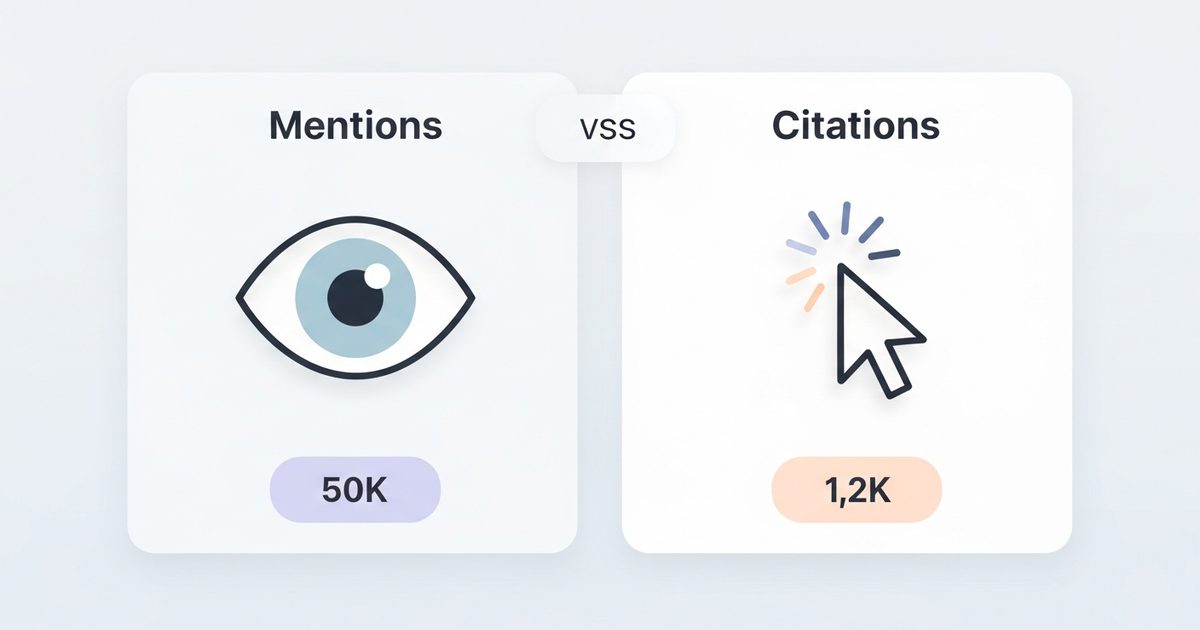
A brand mention is when an AI engine names your brand in its answer without necessarily linking to you. Ask Claude "what are good alternatives to Notion" and if it replies with a paragraph that includes your product name, that is a mention. The engine knows your brand, associates it with the topic, and considered it worth surfacing.
Mentions measure brand awareness inside AI. They tell you that the model's understanding of your category includes you. That is genuinely valuable - a user reading that answer now knows your brand exists and that an AI engine considered it credible enough to name. But a mention, on its own, does not send anyone to your website. The user has your name, not a path to your door.
What Is a Citation?
A citation is when the AI engine references your content and links to your site as a source. Perplexity is the clearest example - it footnotes its answers with numbered source links, and clicking one takes the user straight to the cited page. When your URL is one of those sources, you have a citation.
Citations measure content authority and traffic potential. The same review drew the line precisely: mentions represent "brand visibility," while citations represent "actual content visibility" - the moment an AI engine treats your specific page as the evidence behind its answer. A citation is the AI-search equivalent of a ranking link: it is clickable, it drives referral traffic, and it signals that the engine trusts your content enough to stake its answer on it.
Why the Difference Matters So Much
They predict completely different outcomes
Mentions predict awareness; citations predict traffic. If your goal is for AI engines to recommend your brand by name when users ask for options, mentions are the metric to grow. If your goal is to drive clicks and conversions from AI search, citations are what you optimize for. A team chasing traffic while measuring only mentions will be confused by a strong-looking report that produces no visitors.
They have different root causes
You earn mentions largely through brand presence - being written about across the web, building category association, accumulating the kind of signals that teach a model your brand belongs in a given conversation. You earn citations through content quality and structure - publishing genuinely useful pages, formatting them so AI engines can extract clean answers, and being crawlable and fresh enough that real-time engines pull you in. The same content investments do not move both metrics equally.
They require different fixes
If you are mentioned but rarely cited, your brand is known but your content is not being treated as a source - usually a signal problem (missing schema, thin pages, weak direct-answer formatting, or crawl access issues). If you are cited but rarely mentioned, your content is trusted on specific queries but your brand lacks broad category presence. The remedy is different in each case, which is exactly why collapsing both into one number hides the problem.
The Trap of the Aggregate Score
Many tools roll mentions and citations into a single visibility score. That is fine as a headline, but some platforms go further and combine the two into one aggregate metric with no way to separate them - a limitation reviewers have specifically flagged as a weakness. When mentions and citations are blended, you lose the ability to diagnose. A score of 65 could mean "mentioned everywhere, cited nowhere" or "cited on a few pages, mentioned rarely," and those two situations call for opposite strategies.
The practical takeaway: when evaluating an AI visibility tool, confirm it reports mentions and citations as distinct metrics. The ability to separate brand visibility from content visibility is not a nice-to-have - it is the core of useful AI visibility data.
How to Track Both Properly
A complete picture requires watching four things together:
Mention rate: the share of relevant AI answers that name your brand. Track per platform, because mention behavior varies a lot between ChatGPT, Perplexity, and Gemini.
Citation rate: the share of answers that link to your site as a source. This is your traffic-driving metric - watch it most closely if AI referral traffic is the goal.
Mention-to-citation ratio: of the answers that mention you, how many also cite you? A wide gap between the two is the single most actionable signal in AI visibility - it means awareness exists but your content is not being trusted as the source, and closing that gap is where traffic gains come from.
Share of voice on each: how your mention and citation rates compare to named competitors on the same queries.
Closing the Gap Between Mentions and Citations
For most brands, the realistic opportunity is converting mentions into citations - you are already known, you just are not being linked. That conversion is a content and technical exercise:
Make your pages extractable. Clear headings, direct answers near the top, and FAQ structure give AI engines clean material to quote and cite.
Add the right schema. Structured data, especially FAQPage markup, is one of the strongest predictors of whether your content gets pulled as a source.
Stay crawlable and fresh. If GPTBot, ClaudeBot, or PerplexityBot cannot reach your pages - or your content is stale - you will be mentioned from the model's memory but never cited from your live site.
This is where tracking and diagnosis need to connect. Seeing your mention-to-citation gap is step one; knowing which fix will close it is step two. AI Rank Lab pairs brand visibility tracking with crawler monitoring and AEO analysis, so a low citation rate comes attached to the reason - whether that is a blocked crawler, missing schema, or content that needs restructuring.
The Bottom Line
Mentions tell you AI engines know your brand. Citations tell you they trust your content enough to send users to it. Both matter, but they answer different questions and demand different work. Any AI visibility report that blends them into one number is hiding the information you most need. Track them separately, watch the gap between them, and you will always know whether your next move should be building brand presence or earning content trust. For a broader look at the tools that do this well, see our comparison of the best AI visibility tracker tools, or start with the fundamentals in our complete guide to AI visibility tracking.
Frequently Asked Questions
What is the difference between a brand mention and a citation in AI search?▾
Which is more valuable, mentions or citations?▾
Why am I mentioned in AI answers but not cited?▾
Should an AI visibility tool track mentions and citations separately?▾
How do I turn AI mentions into citations?▾
Get a Free AI Ranking Consultation
Want to improve your brand's visibility in AI search engines like ChatGPT, Gemini, and Perplexity? Fill out the form and our experts will create a personalized strategy for you.

Written by
Devanshu
Chief Marketing Officer & AI Search Optimization Architect
Digital Marketing Strategist & Pioneer in SEO, Answer Engine Optimization (AEO), and Generative Engine Optimization (GEO).


