


An AEO score is a composite measurement of how visible and citable your website is across AI answer engines - ChatGPT, Claude, Perplexity, Gemini, and similar platforms. It is to answer engine optimization what a domain authority score is to traditional SEO: a single number that summarizes your overall position, backed by a set of weighted signals that tell you exactly where to improve.
But unlike domain authority, which is a proxy metric that correlates with rankings, an AEO score is directly connected to citation rates - the actual frequency with which LLMs cite your brand or content when answering queries in your topic area. This makes it a more actionable metric: improving the score has a measurable, direct effect on the outcome you care about.
This guide explains how AEO scores are calculated, which signals matter most for each LLM, how to read a full AEO report, and what benchmarks to target by business type.
What an AEO Score Actually Measures
An AEO score is not a single data point - it is a weighted composite of multiple signals that together predict how often and how confidently an LLM will cite your content. Different AEO analysis tools weight these signals differently, but the underlying factors are consistent across the field.
At its core, an AEO score answers three questions:
Can the LLM access your content? If GPTBot, ClaudeBot, or PerplexityBot is blocked from crawling your site, your score in that dimension is zero regardless of content quality.
Does the LLM understand what your content is about? Entity clarity, schema markup, and consistent brand definition determine how confidently an LLM can classify and retrieve your content.
Does the LLM trust your content enough to cite it? This is the authority layer - topical depth, E-E-A-T signals, inbound references from authoritative sources, and the volume and quality of external citations your content has earned.
A high AEO score indicates your site scores well across all three dimensions. A low score in any one dimension - even if the others are strong - caps your citation potential until that dimension is addressed.
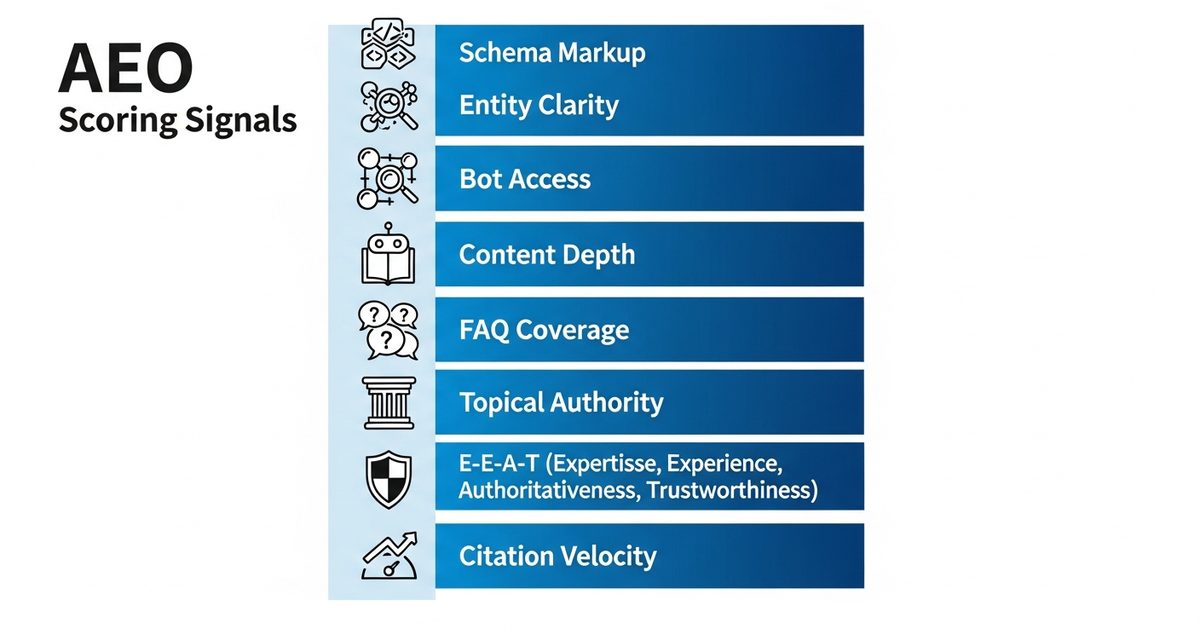
The 8 Signals That Drive Your AEO Score
Based on the signals tracked by AI Rank Lab's AEO audit tool and cross-validated against observed citation patterns across LLMs, these are the eight factors with the highest measurable impact on AEO scores:
1. Bot Access and Crawlability
The most binary signal: either AI crawlers can access your content or they cannot. GPTBot (ChatGPT), ClaudeBot (Claude), PerplexityBot (Perplexity), and Google-Extended (Gemini) each have their own user-agent strings that need to be explicitly allowed in your robots.txt - or at minimum not blocked. A site with any of these bots blocked receives a zero for that LLM's crawl access signal, which hard-caps citation rates in browsing mode regardless of content quality.
Weight in overall AEO score: High. No other optimization matters for a given LLM if the crawler is blocked.
2. Entity Clarity
LLMs need to understand what your brand is before they can confidently cite it. Entity clarity measures how consistently and completely your brand is defined across your own site, your schema markup, and external references. Organization schema on your homepage, consistent brand name formatting across all web properties, and clear product category definitions all feed this signal.
Inconsistencies - different brand name spellings, conflicting product category descriptions, absence from reference databases like Crunchbase or LinkedIn - reduce entity clarity and directly reduce citation confidence.
Weight in overall AEO score: High, particularly for brand query citation rates.
3. Schema Markup Coverage
Structured data is how you communicate your content in a format LLMs can extract and cite with precision. The most impactful schema types for AEO: FAQPage (highest per-page citation lift), Article and BlogPosting, Organization, Product or SoftwareApplication, and BreadcrumbList for topical context. Schema coverage is scored on both presence (does the type exist?) and completeness (are all recommended properties populated?).
Weight in overall AEO score: High. FAQPage schema in particular has a direct, measurable effect on citation rates for FAQ-matched queries.
4. Content Depth and Structure
LLMs prefer comprehensive sources. Content depth is measured by word count relative to query complexity, heading hierarchy clarity, semantic coverage of the topic (are related subtopics addressed?), and the presence of citable data points - statistics, benchmarks, specific claims with attribution. A page that covers a topic comprehensively outperforms a superficial page for citation purposes even when both are technically accessible and schema-tagged.
Weight in overall AEO score: Medium-high. More impactful for category and research queries than for brand queries.
5. FAQ Coverage
Independently scored from schema because it covers both the presence of FAQ schema and the quality and relevance of the questions themselves. FAQ coverage measures how many of the actual queries your target audience is asking ChatGPT or Claude are matched by FAQ entries on your key pages. A page with 8 well-targeted FAQ entries mapped to real user queries scores significantly higher than a page with FAQPage schema containing 3 generic questions.
Weight in overall AEO score: Medium-high. FAQ coverage is one of the most directly improvable signals with high per-unit impact.
6. Topical Authority
How completely does your site cover its primary topic area? Topical authority is measured by the breadth and depth of content across a topic cluster: how many related subtopics are covered, whether there are content gaps relative to your primary competitors, and whether your coverage is connected by clear internal linking. A site with 25 comprehensive articles covering all angles of a topic is cited more confidently than a site with one strong article on the topic, even if that single article is excellent.
Weight in overall AEO score: Medium. The highest-impact signal for category-level citation rates but takes the longest to build.
7. E-E-A-T Signals
Experience, Expertise, Authoritativeness, and Trustworthiness signals are the authority layer of the AEO score. These include: named authors with verifiable credentials, About and Contact pages with clear organizational identity, external backlinks from authoritative sources, citations from industry publications, and presence on reference databases. LLMs are trained on content that includes E-E-A-T signals as quality markers, and they carry those learned preferences into citation decisions.
Weight in overall AEO score: Medium. More influential for YMYL (Your Money Your Life) topics and for initial brand establishment than for ongoing citation rate maintenance.
8. Citation Velocity
How recently and how often has your content been cited in external sources? Citation velocity is a proxy for content freshness and current relevance - LLMs weight recently cited content more heavily than content that earned citations years ago but has not been referenced recently. This includes both traditional backlinks and mentions in the broader web ecosystem that LLMs crawl: industry blogs, news coverage, social media discussions, and forum threads.
Weight in overall AEO score: Medium. More impactful for time-sensitive topic areas than for evergreen reference content.
How AEO Scores Differ Across LLMs
A critical insight that many businesses miss: your AEO score is not a single number - it varies across LLMs because each platform weights signals differently.
ChatGPT places particularly high weight on bot access (GPTBot must be allowed), FAQPage schema matched to real query phrasing, and content that has earned recent backlinks from authoritative domains. Its training data and browsing retrieval both favor sources with strong traditional web authority signals.
Claude weights entity clarity and E-E-A-T signals more heavily than most LLMs. Claude is notably more conservative about citing sources it cannot clearly identify as authoritative organizations with clear topical expertise. Named authors, clear organizational identity, and verifiable credentials improve Claude citation rates meaningfully more than they affect ChatGPT rates.
Perplexity is the most actively crawling of the four major LLMs and places the highest weight on content freshness and recent citation velocity. Because Perplexity is built as a search product, it weights content that is currently ranking well in traditional search more heavily than the other LLMs. Content that ranks in the top 5 for a query is more likely to be cited by Perplexity than by ChatGPT for the same query.
Gemini integrates most tightly with Google's data infrastructure. Google Search Console data, Google My Business profiles, Google-indexed structured data, and Google-verified author entities all influence Gemini citation behavior more directly than they influence the other three LLMs. If you have strong Google authority, Gemini citation rates tend to outperform your other LLM scores.
A complete AEO report shows your score broken down by LLM, which allows you to diagnose cross-platform patterns. If your Claude score is significantly lower than your ChatGPT score, the diagnostic almost always points to entity clarity or E-E-A-T gaps. If your Perplexity score is low while ChatGPT is strong, the issue is usually content freshness or traditional search ranking deficiencies that Perplexity inherits.
How to Read Your AEO Report
A full AEO report from a tool like AI Rank Lab's AEO analysis feature contains several distinct sections that serve different purposes:
Overall Score and Benchmark
Your composite AEO score, typically expressed as a number from 0-100 or a letter grade, with a benchmark showing how it compares to sites in your category. A score of 72/100 means little without knowing whether the average site in your vertical scores 45 or 85. Industry benchmarks by vertical vary significantly: enterprise software companies typically see category averages around 60-70, while health and finance sites often score lower due to E-E-A-T requirements and conservative LLM citation behavior in YMYL topics.
Per-LLM Breakdown
Separate scores for ChatGPT, Claude, Perplexity, and Gemini. Read this section looking for large gaps between LLMs - a gap of more than 15 points between your best and worst performing LLM almost always indicates a specific diagnostic finding rather than a general quality issue. Cross-LLM gaps are faster to close than overall score improvements because they usually have a specific technical root cause.
Signal-Level Findings
The prioritized list of specific issues found during the audit, sorted by impact. This is the most actionable section of any AEO report. Each finding should include: the specific issue (e.g., "GPTBot blocked in robots.txt"), the impact on your score if fixed (e.g., "+12 points"), the effort required to fix it (e.g., "Low - single robots.txt edit"), and the specific fix instructions. High-impact, low-effort findings should be addressed first - they are your fastest path to score improvement.
Competitor Comparison
Your AEO score compared to 3-5 competitors for the same keyword set. This section reveals whether your citation rate gaps are absolute (your content has genuine quality or technical issues) or relative (your content is adequate but a competitor has specifically outpaced you on a signal like FAQ coverage or topical authority). Absolute gaps require fixing your own content; relative gaps require understanding specifically what the competitor is doing better.
Citation Rate Trends
If you have historical data from ongoing monitoring, the report includes citation rate trend lines per LLM per keyword cluster. Improving trends that do not yet show in your overall score are a leading indicator that your optimization work is having the intended effect - LLM citation patterns typically lag optimization changes by 3-8 weeks.
AEO Score Benchmarks by Business Type
As rough guidance, here are realistic AEO score targets by category:
B2B SaaS (0-2 years old): Starting scores typically 20-40. Target 60+ within 6 months of active optimization.
B2B SaaS (established, 2+ years): Well-optimized sites typically 65-80. Top performers in competitive categories reach 85+.
E-commerce: Category averages lower (40-55) due to thin product page content. Content-rich brands reach 65-75.
Professional services (law, finance, health): E-E-A-T requirements make high scores harder to achieve. Category average 45-60, top performers 70-75.
Media and editorial: High topical authority and citation velocity typically push scores to 70-85 for established publishers.
Local business: Lower ceilings due to thin content depth and limited topical authority; 50-65 is a strong result.
From Score to Action: Prioritizing AEO Improvements
The purpose of an AEO score is not the score itself - it is the prioritized action plan it generates. When reading your AEO report, follow this sequence:
Fix access blockers first. Any bot access issue (blocked crawlers, login walls protecting key content, aggressive rate limiting) is a prerequisite fix before any other optimization has impact on the affected LLMs. These fixes are typically low effort and high impact.
Address entity clarity second. If your brand query citation rates are significantly lower than your category query citation rates, you have an entity clarity issue. Fix Organization schema, standardize your brand name across all web properties, and ensure Crunchbase/LinkedIn/Wikipedia entries are accurate and complete. This work has a fast feedback cycle - typically 4-6 weeks to see citation rate improvement.
Implement schema on priority pages third. Start with FAQPage schema on your 3-5 highest-traffic pages or most-targeted query pages. Write 6-8 questions per page that match real user query phrasing. This is the highest-leverage per-page optimization available in AEO.
Expand content depth fourth. Identify the pages with the highest potential citation value (high query volume, relevant to your offering, currently under-performing in LLM citations) and expand them to comprehensive coverage with clear heading structure, supporting data, and internal linking to related content. This takes longer to show in citation rates but drives the most durable improvement.
Build topical authority fifth. Map your full topic cluster, identify content gaps relative to competitors, and systematically fill those gaps. This is a 3-6 month program rather than a quick fix, but it is the work that drives category-level citation rate improvements that the earlier steps cannot achieve alone.
Run your first full AEO audit with AI Rank Lab's free AEO checker to get your baseline SEO, AEO and GEO readiness score and a prioritized list of the specific findings with the highest impact on your citation rates.
Frequently Asked Questions
What is an AEO score?▾
What is a good AEO score?▾
What are the most important AEO ranking signals?▾
Why is my AEO score different for ChatGPT vs Claude?▾
How long does it take to improve an AEO score?▾
Can I check my AEO score for free?▾
Get a Free AI Ranking Consultation
Want to improve your brand's visibility in AI search engines like ChatGPT, Gemini, and Perplexity? Fill out the form and our experts will create a personalized strategy for you.

Written by
Devanshu
Chief Marketing Officer & AI Search Optimization Architect
Digital Marketing Strategist & Pioneer in SEO, Answer Engine Optimization (AEO), and Generative Engine Optimization (GEO).


