

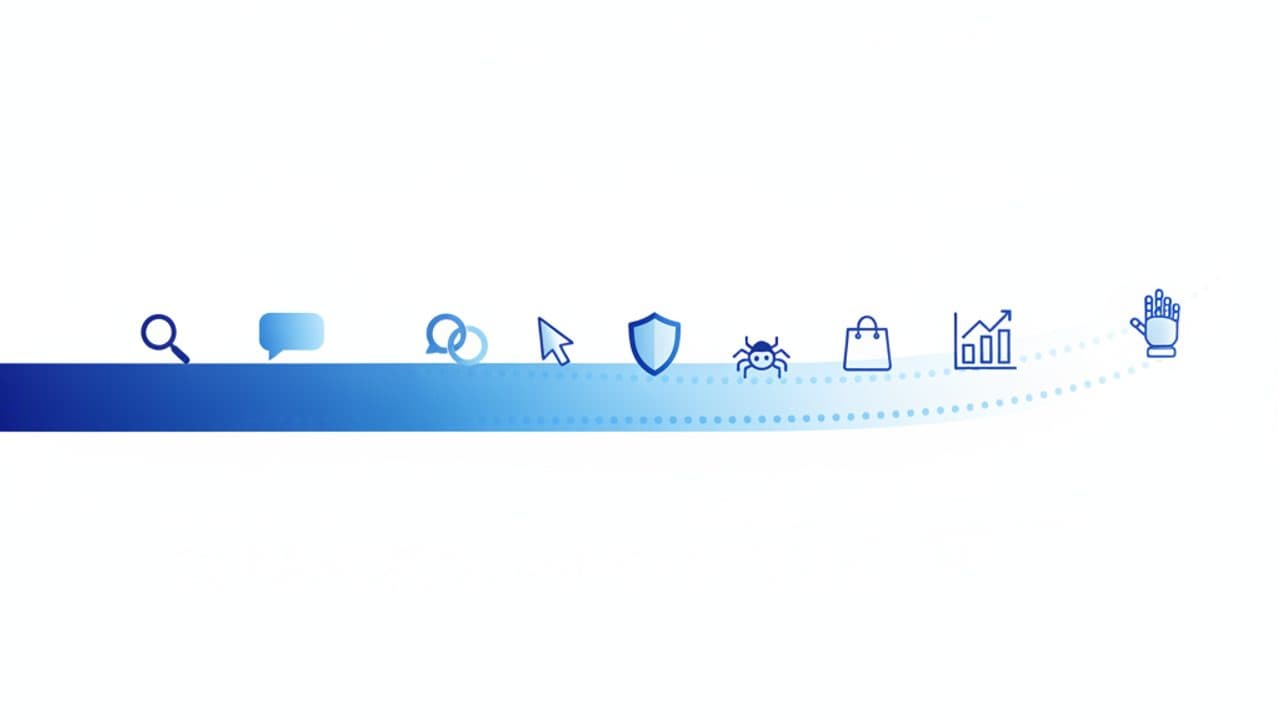
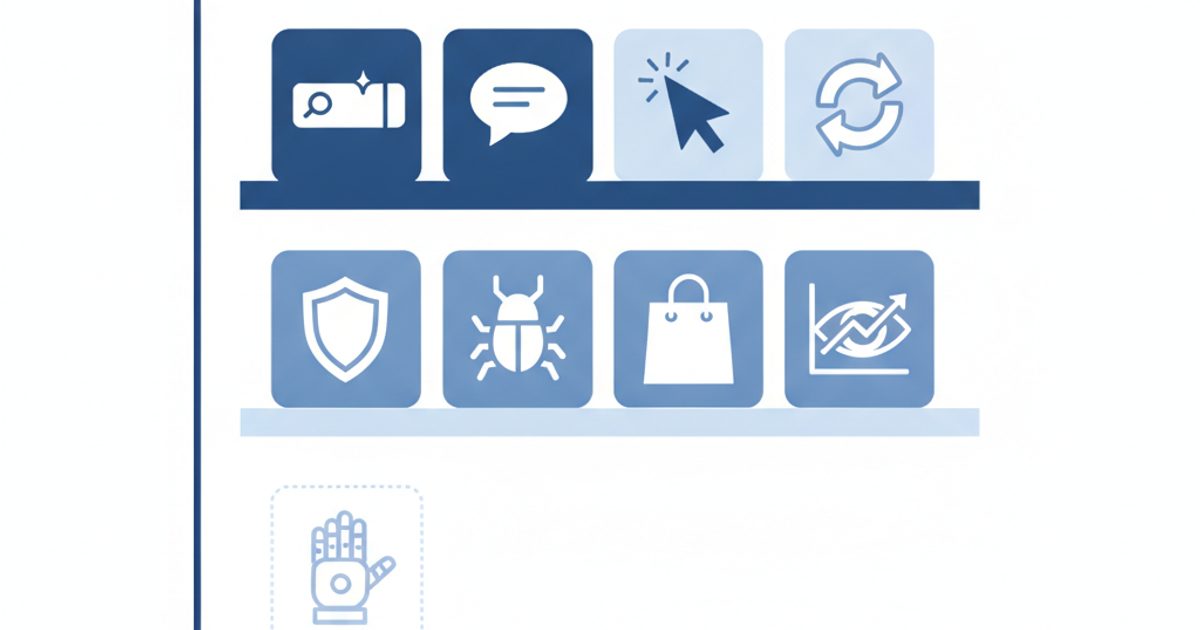
The SEO trends for 2027 are already visible in numbers published during 2026. Nine shifts have evidence behind them: Google AI Mode passed one billion monthly users and its queries run three times longer than classic searches; about half of US adults now use AI chatbots; clicks fall sharply on results pages that show an AI summary; AI answers change from one run to the next; self-ranked "best" lists and attempts to manipulate AI answers are being pushed down; AI crawlers take far more pages than they send visitors; AI-referred shoppers convert well but are still few; measurement is moving from clicks to impressions and citations; and software agents have started to browse and buy.
For each shift you get the 2026 evidence with its source and date, what follows for 2027, what we would do about it, how confident we are, and the result that would prove us wrong. Every number below was checked against its source on 11 November 2026. Nothing here is 2027 data, because none exists yet.
Key takeaways
- Google says AI Mode has passed 1 billion monthly active users (Alphabet Q2 2026 remarks, 22 July 2026) and that its queries are on average three times longer than traditional searches (Q3 2026 remarks, 28 October 2026).
- 49% of US adults use AI chatbots and 42% use them to search for information (Pew Research Center, 5,119 adults, 17-23 February 2026).
- Searchers clicked a result on 8% of Google visits that showed an AI summary and 15% of visits that did not (Pew, 68,879 searches, March 2025).
- In our own tracking, 44.4% of prompt-engine pairs switched between mentioning and not mentioning the brand at least once across repeated runs (997 runs, 45 pairs, February to November 2026).
- Four of the nine shifts are high-confidence outright. One, agents that buy for people, is low-confidence, and we say so.
The nine shifts at a glance
This table is the whole article in one view. The sections after it give the detail and the limits of each piece of evidence.
| Shift | 2026 evidence | What to do in 2027 | Confidence |
|---|---|---|---|
| 1. AI Mode is a billion-user surface with long queries | 1 billion monthly active users; queries 3x longer (Alphabet, July and October 2026) | Cover the sub-questions of a topic on one page, each with a direct answer | High |
| 2. Chatbots are a mainstream way to look things up | 49% of US adults use them; 42% search for information with them (Pew, February 2026) | Check what the two most-used assistants say about your brand and category | High for the US |
| 3. Fewer clicks where an AI summary shows | 8% vs 15% click rate (Pew, March 2025); 58% lower top-result CTR (Ahrefs, December 2025) | Stop forecasting traffic from position alone; split reporting by query type | High on direction, medium on size |
| 4. AI answers vary run to run | 44.4% of pairs flipped on brand mention; 0.41 median cited-domain overlap (our data, 997 runs) | Report rates over repeated runs, never a single answer | High |
| 5. Gaming the answer is being punished | Self-promoter left out in 224 of 323 cited cases (Lily Ray, June 2026); spam policy now covers AI responses (Google, 15 May 2026) | Publish lists with criteria, dated prices and real limits; drop hidden-prompt tricks | Medium |
| 6. AI crawlers take more than they refer | Anthropic 38,065.7 pages crawled per referral, OpenAI 1,091.4, Google 5.4 (Cloudflare, July 2025) | Decide access by bot purpose: training, search or user action | Medium to high |
| 7. AI referrals are small but convert | AI-referred US retail visits converted 60% higher (Adobe data, July 2026); median 0.18% of tracked page views on sites using our tag | Build an AI-referral segment and compare conversion on your own site | Medium for retail, low elsewhere |
| 8. Measurement moves to impressions and citations | Search Console generative AI reports show impressions, worldwide since 31 August 2026 | Track AI impressions, mention rate and cited URLs each month | High |
| 9. Agents start to browse and buy | "User action" crawling up more than 15x in 2025 (Cloudflare); Universal Commerce Protocol announced (Google, January 2026) | Make pages and checkout usable by a browser agent; do not rebuild around it | Low |
Is SEO still worth doing in 2027?
Yes. Every AI feature Google runs retrieves its sources from the ordinary Search index, so a page that is not indexed and eligible for a snippet cannot be cited at all. Google's own guide to optimizing for generative AI features (published 15 May 2026) says structured data "isn't required for generative AI search", that there is "no requirement to break your content into tiny pieces", and that you do not need new machine-readable files to appear. The work that earns a citation is the work that earns a ranking.
The money says the same thing. Alphabet reported 17% revenue growth in Search and Other for the second quarter of 2026 (CEO remarks, 22 July 2026), in the same remarks that announced a billion AI Mode users. Search is not shrinking. What is changing is where on the page the answer sits and who gets the visit.
So the biggest change for 2027 is to the scorecard, and less to the craft. Crawlable pages, clear answers, original information and honest sourcing still do the work. The nine shifts below change what you measure and what you stop doing.
1. AI Mode has a billion users, and their queries are three times longer
Google AI Mode is now one of the largest search surfaces in the world by Google's own count. "Since expanding AI Mode globally last October, we've surpassed 1 billion monthly active users," Sundar Pichai said on 22 July 2026. A Google post dated 3 June 2026 put AI Overviews at more than 2.5 billion monthly active users. On 28 October 2026 he added that AI Mode queries are "on average three times longer than traditional searches" and that one in five use voice, images or documents.
Two limits. These are Google's figures, with no public definition of "active" and no independent count. And a monthly user may have used AI Mode once. The independent check we have is survey data: 60% of US adults say they read AI summaries at the top of search results (Pew, February 2026).
What changes in 2027: more demand arrives as long, multi-part questions. Google's guide describes how the model handles them: it generates "a set of concurrent, related queries" and fetches results for each. Your page can be retrieved for a sub-query you never targeted, and skipped for the head term you did.
What to do: for each topic you care about, write down the eight to twelve questions a long prompt would split into, and make sure one page answers each of them directly under its own heading. We explain the mechanism in query fan-out explained, and the Google-side numbers are collected in our AI Mode and AI Overviews statistics.
Confidence: high. What would prove it wrong: Alphabet stops reporting AI Mode users or reports a fall, or your AI Mode impressions in Search Console stay flat for two quarters while ordinary web impressions grow.
2. Half of US adults use AI chatbots, and 42% search for information with them
Chatbot use in the US moved from a third of adults to about half in two years. Pew Research Center found that 49% of US adults use AI chatbots, up from 33% in 2024, and that 24% use them daily (survey of 5,119 adults, 17-23 February 2026). The 2024 question was asked only of people who had heard of chatbots, so the two years are not a perfect like-for-like. The figure that matters most for search: 42% of US adults say they use chatbots to search for information.
A second series points the same way. The share of US adults aged 18 to 64 using generative AI rose from 45% in August 2024 to 62% in May 2026, according to the Real-Time Population Survey reported by the Federal Reserve Bank of St. Louis (1 September 2026). It is higher than Pew's number because it leaves out people over 64 and asks about generative AI in general.
Pew also shows where the audience is. ChatGPT is used by 44% of US adults, Gemini by 24%, Copilot by 17% and Claude by 6%.
What changes in 2027: for a US audience, an assistant is a normal place to ask "which one should I buy" or "who does this near me". A brand that is absent or described wrongly there loses consideration before any search happens.
What to do: take the ten to twenty questions your buyers ask, run them in ChatGPT and Gemini first because that is where the users are, and write down what each says about you and which pages it cites. Fix wrong facts on the pages it cites, starting with your own.
Confidence: high for US adults. We did not verify a comparable 2026 series for other countries for this article, so treat everything outside the US as unproven here. What would prove it wrong: Pew's next wave shows chatbot use flat or falling, or the share who search with chatbots drops.
3. Do AI Overviews reduce clicks to websites? Yes, where they appear
Three different methods agree on the direction. Pew tracked the browsing of 900 US adults in March 2025 and found they clicked a traditional result on 8% of Google visits that showed an AI summary, against 15% of visits that did not. A link inside the summary was clicked on 1% of those visits, and 18% of the 68,879 searches in the study produced a summary (Pew, 22 July 2025).
Ahrefs measured it from the keyword side. Across 300,000 keywords, an AI Overview "now correlates with a 58% lower average clickthrough rate for the top-ranking page", with position-one CTR on AI Overview keywords falling from 0.073 in December 2023 to 0.016 in December 2025 (Ahrefs, 4 February 2026). That is a vendor study and a correlation, with informational keywords also falling over the same period.
Publishers see it in their analytics. The Reuters Institute Digital News Report 2026 cites Chartbeat data showing Google organic search traffic to more than 2,500 sites down 33% globally between November 2024 and November 2025.
These numbers measure different things, so do not average them. Pew's is behaviour per visit, Ahrefs' is CTR per keyword, Chartbeat's is traffic to news sites. We would quote Pew for "what do people do" and your own Search Console for "what happened to us".
What changes in 2027: informational pages earn fewer visits per impression than the CTR curves in your old forecasts assume. Pages people must visit to finish a task hold up better: tools, pricing, comparisons with current data, anything interactive.
What to do: stop projecting traffic as position times a fixed CTR. Split your queries into those that show an AI summary and those that do not, and report them separately. Give informational content a goal other than sessions, such as assisted conversions or branded search growth. Our zero-click search strategy covers the KPIs.
Confidence: high on direction, medium on size, because the best behavioural data is from March 2025. What would prove it wrong: a repeat of Pew's panel shows the gap closed, or your CTR by position holds steady on queries where AI Overviews appear.
4. Why do AI answers change every time you ask?
Because assistants generate each answer fresh and retrieve a different mix of pages each time, the same prompt gives different brands and different sources on different runs. We measured how much. Across 997 repeated runs of 45 prompt-engine pairs tracked in AI Rank Lab between 13 February and 10 November 2026 (only pairs with five or more successful runs), 20 pairs, or 44.4%, flipped between mentioning and not mentioning the tracked brand at least once.
Sources moved more than mentions. The median overlap of cited domains between one run and the next was 0.41 on a 0 to 1 scale (Jaccard similarity). A median of 3.6% of the domains an engine cited for a prompt appeared in every run. Over all runs, a prompt drew on a median of 2.76 times as many distinct domains as any single run showed.
| Engine | Prompt-engine pairs | Runs | Median cited-domain overlap between consecutive runs | Pairs where brand mention flipped |
|---|---|---|---|---|
| Gemini | 14 | 283 | 0.26 | 28.6% |
| ChatGPT | 12 | 248 | 0.50 | 58.3% |
| Claude | 12 | 235 | 0.52 | 41.7% |
| Perplexity | 6 | 224 | 0.59 | 66.7% |
Read this with its limits. The sample is small and not random: the prompts were chosen by the people tracking them, our whole dataset covers 16 tracked domains, and six Perplexity pairs is too few to rank engines on. One Google AI Overview pair with seven runs is in the total and left out of the table. The earlier snapshot and method are in our AI answer stability study.
What changes in 2027: a screenshot of one AI answer stops counting as evidence, for you or against a competitor. Visibility becomes a rate.
What to do: run each prompt at least five times per engine before you claim anything, report "mentioned in 7 of 10 runs", and treat the cited sources as a pool that you sample. This is the reason AI Rank Lab brand visibility stores every run of a prompt, so you can compare runs over time.
Confidence: high that the variance is real, medium on the exact figures. What would prove it wrong: engines start serving cached or deterministic answers, or a larger sample shows consecutive-run overlap close to 1.
5. Self-promotional lists and manipulating AI answers are losing ground
Two things happened in 2026 that point the same way. The first is field evidence. SEO analyst Lily Ray tracked 100 B2B "best [category] software" queries at three checkpoints (15 April, 15 May and 8 June 2026). Eighty triggered an AI Overview, and where a brand's own list was cited, the brand was left out of the recommendation in 224 of 323 cases, about 69% (Search Engine Journal, 18 June 2026). Earlier, she showed six sites built on self-ranked lists losing between 29% and 49% of their Sistrix US visibility from mid-to-late January 2026 (3 February 2026). Google has not confirmed an update for that period.
The second is policy, and it is not in doubt. Is manipulating AI answers against Google's spam policies? Yes. Google's spam policies now name "attempting to manipulate generative AI responses in Google Search", and the Search Central changelog records the clarification on 15 May 2026. Google's AI optimization guide tells writers: "Don't just recycle what others on the internet have already said."
What changes in 2027: ranking yourself first in a list with no criteria carries a cost in classic results and buys little in the answer. Hidden instructions to models, stuffed "AI-friendly" text and fake consensus are spam, with the penalties that implies.
What to do: if you publish a "best" list, state the criteria, apply them to every entry including your own, show prices with the date checked, and write down each product's real limits. If your product does not belong in the category, leave it out. We went through the evidence in self-promotional listicles and AI citations.
Confidence: medium. The policy text is certain. The field evidence is one analyst, six sites and 100 queries, and Google has not said the January drops were aimed at lists. What would prove it wrong: the affected sites recover without changing their lists, or a repeat of the 100-query study finds self-promoters included most of the time.
6. AI crawlers take far more pages than they send visitors
The gap between crawling and referring is measured, and it is wide. Cloudflare counted how many pages each company's bots fetched for every visitor it referred. In July 2025 the ratio was 38,065.7 to 1 for Anthropic, 1,091.4 for OpenAI, 194.8 for Perplexity, 40.7 for Microsoft and 5.4 for Google. Training accounted for 79% of AI crawling that month, up from 72% a year earlier (Cloudflare, 29 August 2025).
For scale, AI bots averaged 4.2% of HTML requests on Cloudflare's network between 1 January and 2 December 2025, next to 4.5% for Googlebot alone (Cloudflare Radar 2025 Year in Review). A Cloudflare post from 1 July 2026 says 52% of crawler requests were for AI training as of June 2026, up from 22% in spring 2025. That post uses a different classification, with a large "mixed-use" group, so its 52% cannot be set beside the 79% above.
What changes in 2027: access becomes a decision you make per bot and per purpose. Google has joined in: its 3 June 2026 post says it began testing a control that lets site owners decide whether their site appears in and grounds generative AI Search features, and states plainly that sites that opt out "will not receive traffic or impressions from our generative AI features".
What to do: should you block AI crawlers in 2027? Our position: if your content is the product you sell, block training-only bots and keep the search and user-action fetchers. If you sell something else and content is how people find you, allow them, because a blocked page cannot be cited. Check your server logs before deciding, since a tag-based analytics tool will not see most crawlers. The full dataset is in our AI crawler statistics.
Confidence: medium to high. The ratios are one network's data from July 2025, the newest month we could verify. What would prove it wrong: newer Cloudflare figures show the ratios for OpenAI and Anthropic falling by an order of magnitude, which would mean assistants had started sending real traffic.
7. Does AI referral traffic convert better than search traffic?
In US retail, the published data says yes, and the volume is still small. Adobe's analytics data, as reported by Digital Commerce 360 on 19 August 2026, showed AI-referral traffic to US retail sites up 62% year over year in July 2026, with those visits converting at a rate 60% higher than non-AI traffic and producing 53% more revenue per visit. Adobe bases this on more than 1 trillion visits to US retail sites. Its own holiday forecast of 28 September 2026 expects AI traffic to retail sites to rise 130% year over year this season. That last number is a forecast, and Adobe is a vendor measuring its own customers.
Now the counterweight from our own data. On sites running the AI Rank Lab tag, 32 recorded at least one visit referred by an AI assistant between 27 July 2025 and 11 November 2026, and the median site got 0.18% of its tracked page-view events that way. These are page views with an AI assistant as the referrer, not unique users, and assistants that strip the referrer are missed. Still, 0.18% is not a channel you rebuild a plan around.
What changes in 2027: AI referrals become a segment worth its own row in the report, because the visits are few and unusually valuable. They do not replace organic search as the source of volume.
What to do: create an AI-referral segment in GA4 and compare its conversion rate with organic search on your own site before you believe anyone's benchmark, including ours. Match sessions whose referrer is an assistant domain such as chatgpt.com, gemini.google.com, claude.ai or perplexity.ai.
Confidence: medium for retail, low outside it. We found no measured conversion data of similar size for B2B or services. What would prove it wrong: over a full quarter, your AI-referral segment converts at or below organic search with enough visits to trust the comparison, or Adobe's conversion gap narrows in its 2027 reports.
8. How do you measure AI search visibility in 2027? Impressions and citations
Google now reports AI visibility as impressions, and nothing more. The generative AI performance reports in Search Console, announced on 3 June 2026 and available to all websites worldwide since 31 August 2026, show "how often URLs from your site appeared in generative AI features in Search and Discover", broken down by page, country, device and date. The announcement names no click metric and no query list. When we checked in October 2026 we found no API or export for the report either.
Google is equally clear about outside tools: "No third-party tool has access to our internal ranking or AI systems." A tracker can run a query and read the answer that comes back. It cannot see Google's internals, and neither can we.
What changes in 2027: the monthly report gains three lines that are not clicks. AI impressions from Search Console. Mention rate, from repeated prompt runs on the assistants your buyers use. And citations: which of your URLs get cited, and how your share compares with named competitors.
What to do: take a baseline of all three in January and hold the prompt set fixed so later months compare. For the Google side, the AI Rank Lab AI Mode tracker checks a query by country and language and lists the cited URLs, and the citation tracker shows which domains and URLs engines cite for your prompts. Whatever tool you use, apply shift 4 and sample each query more than once.
Confidence: high. What would prove it wrong: Google adds clicks and queries to the generative AI reports or opens an API for them. Reporting would then swing back toward clicks, and we would be glad of it.
9. Will AI agents buy products on behalf of shoppers in 2027?
Some will, and nobody has published how many. The evidence is early. Cloudflare's 2025 review reports that AI "user action" crawling, meaning fetches made because a person asked an assistant to do something, grew more than 15 times during 2025 according to its section heading and more than 21 times from January to early December according to its text. Both figures are on the page, and we could not reconcile them. Either way the base was tiny: user action was 3.2% of AI crawling in July 2025 (Cloudflare).
On the commerce side, Google announced the Universal Commerce Protocol on 11 January 2026, co-developed with Shopify, Etsy, Wayfair, Target and Walmart, to power checkout on eligible product listings in AI Mode and the Gemini app for eligible US retailers. Google's AI optimization guide now points site owners to best practices for agent-friendly websites and says protocols like UCP "are emerging". We could not find a platform that has disclosed how many purchases agents complete.
What changes in 2027: a share of visits to product and booking pages will come from software acting for a person. That software needs to read prices, stock and options from the page and get through the form.
What to do: the cheap things. Put key product facts in HTML text, label form fields properly, avoid checkout steps that only work with a mouse, and keep product feeds accurate. Our agent-ready website checklist lists the tests. Do not fund a rebuild on this evidence.
Confidence: low. What would prove it wrong: by the end of 2027 no major platform has reported agent checkout volume, and user-action fetches remain a low single-digit share of AI crawling.
What we are not predicting, and why
Most 2027 prediction posts we read state forecasts as facts. Of the eleven ranking pages we analyzed, two cite no statistics at all, and only one attaches a confidence level and a test to each prediction. These are the claims we looked at and decided we could not stand behind.
| Claim in circulation | Why we do not make it |
|---|---|
| AI will answer most informational queries by a named quarter of 2027 | No measured series supports a date. The one behavioural measurement we verified is Pew's: 18% of Google searches produced an AI summary in March 2025. |
| AI assistants will overtake Google as a traffic source | Nothing we opened shows it. On sites using our tag the median AI-referral share is 0.18% of tracked page views. |
| Zero-click searches will pass a specific percentage | The figures quoted come from different panels and definitions, and several pages give two numbers for the same metric. |
| llms.txt will become a standard for visibility | Google's changelog entry of 15 June 2026 says these files are not needed for Google Search and have no effect on visibility there. |
| Market share figures for ChatGPT, Gemini or Perplexity at the end of 2027 | The available "share" numbers measure referral traffic or survey usage, not queries, and none is a forecast we can check. |
| What the November 2026 core update changed | It began on 10 November 2026 and Google's status dashboard showed no end date when we checked on 11 November. It is too early. |
A quarterly review routine for 2027
Each shift above comes with a test, so check the tests on a calendar. This takes about half a day per quarter.
- Read the two Google disclosures. Alphabet's quarterly CEO remarks for AI Mode and AI Overviews figures, and the Search Central changelog for policy changes. Note anything that moves shift 1, 5 or 8.
- Pull Search Console. Generative AI impressions by page for the quarter, and CTR by position for your top informational queries. Compare with the previous quarter (shift 3 and 8).
- Re-run your fixed prompt set. At least five runs per prompt per engine. Record mention rate and the cited URLs (shift 2 and 4).
- Check the AI-referral segment in GA4. Sessions, conversion rate and revenue against organic search (shift 7).
- Review bot access. Look at server logs for the main AI user agents and confirm your robots.txt still matches the decision you made (shift 6).
- Test one product or booking page with a browser agent. Can it read the price and reach the last step of the form (shift 9)?
- Update the confidence column. Write down which tests were met and change what you do. If a falsifier fired, say so in the report.
How we chose these nine
We started from the candidate shifts that had a 2026 measurement or a Google statement behind them, opened each source on 11 November 2026, and kept a shift only if the number was on the page. Two candidates were merged because they describe the same behaviour from two sides (self-ranked lists and the spam policy on AI manipulation), which is why the count is nine.
What we left out. Adobe's own blog and report pages for its later 2026 retail figures timed out when we tried to open them, so the July 2026 numbers are quoted from Digital Commerce 360's report of Adobe's data, and we did not use the later months. We did not use any market-size forecast, any statistic that a ranking page quoted without a source, or any number from our own crawler logs, which our tag does not capture reliably. Our first-party figures come from an aggregated, anonymized export dated 11 November 2026. AI Rank Lab is our product, so read our own numbers with that in mind. The sample sizes are next to each one.
If you want your own baseline for shifts 2, 4 and 8, AI Rank Lab gives 100 free credits on sign-up with no card, enough for about one brand visibility prompt run.
Get a free AI ranking consultation
Want your brand to show up when ChatGPT, Gemini and Perplexity answer questions in your market? Tell us about your site and our team will send a personalized strategy.


