


A zero-click search is a search that ends without the searcher clicking through to any website, because the results page itself answered the question. In the first four months of 2026, 68% of U.S. Google searches ended that way, according to SparkToro's analysis of Similarweb clickstream data, and AI Overviews, AI Mode and chat assistants are pushing the share higher. Chasing the lost clicks won't fix this. What works is measuring and winning the visibility you get without them, while protecting the queries that still send visitors.
This guide covers the current numbers from named primary studies, with dates, samples and caveats side by side. It also explains why AI answers speed up zero-click behavior, which query types still earn clicks, a KPI set showing where each metric comes from and what it misses, a content playbook, and a reporting template for a boss or client. All figures and product details were checked on October 24, 2026.
Key takeaways
- About two in three U.S. Google searches now end without a click. SparkToro measured 68.01% for January-April 2026, up from 60.45% in 2024. Part of that jump comes from switching data panels, so read it as a trend, not a precise change.
- AI Overviews now have causal evidence against them. In the first randomized field experiment on them (1,065 users, January-February 2026), showing an AI Overview cut outbound organic clicks by about 40%.
- Informational queries take the hit. Navigational, transactional, branded and local queries hold up much better. Plan content by intent, not by volume.
- AI assistants do not replace the lost clicks. Among 30 sites running our tracking tag that received any AI referral, the median site got 0.21% of its page views from AI assistants.
- Change the headline KPI. Report impressions, AI mention rate, citation share, branded search demand and the conversion value of the clicks you still get, not just organic sessions.
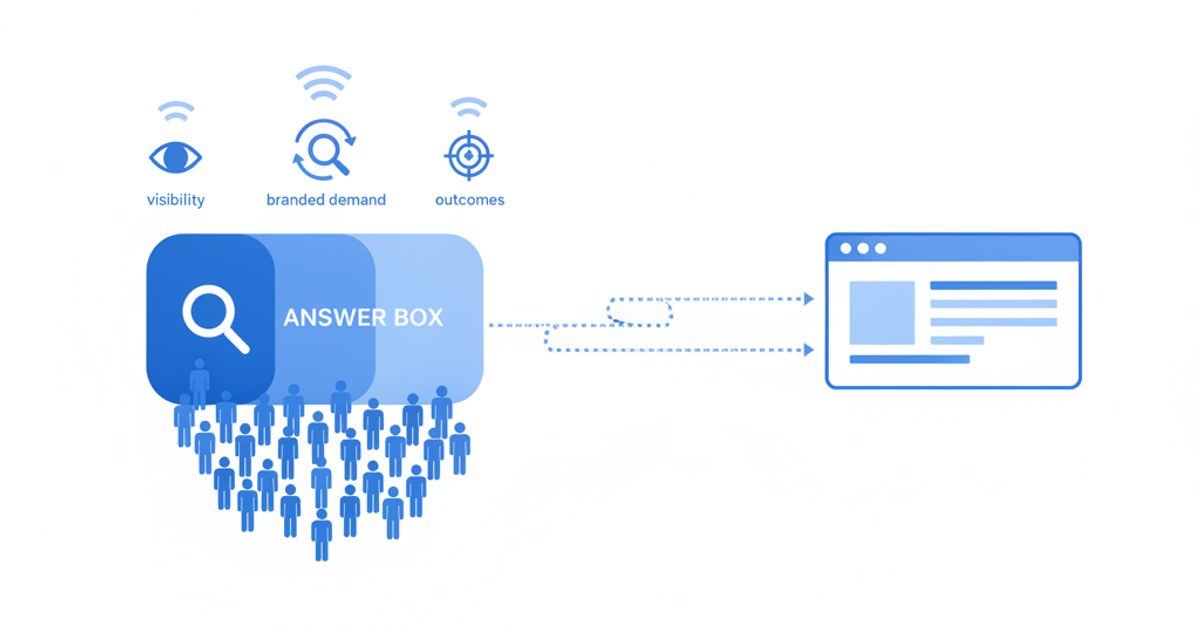
- Report in three lines: visibility, demand, outcomes. That way a falling traffic chart on definition queries isn't mistaken for an SEO failure.
What is zero-click search?
Zero-click search means a query gets resolved on the search engine's own page and the searcher never visits a publisher's site. The answer might come from an AI Overview, a featured snippet, a knowledge panel, a local pack, a weather or calculator box, or an AI Mode conversation. It is an industry term for an outcome, not a Google product or metric. Search engines don't publish it, so outside researchers estimate it from clickstream panels.
The definition changes the number. SparkToro's studies count a click on a Google-owned property such as Maps or YouTube as a click, and count a follow-up search as no click. So even the headline zero-click rate understates how few searches reach the open web. Zero-click marketing is a term popularized by SparkToro co-founder Rand Fishkin. It's the strategy side: publishing content that delivers its full value where people already are (the results page, social feeds, AI answers), instead of treating every piece as bait for a visit. Zero-click SEO is the search-specific version: earning visibility, citations and brand recall from results that may never produce a session.
How many Google searches end without a click in 2026?
Roughly two out of three. The best-sourced 2026 figure comes from SparkToro, published in June 2026: 68.01% of U.S. Google searches ended without a click from January through April 2026. That compares with 60.45% in 2024 and about 49% in 2019. The data comes from Similarweb's U.S. desktop and mobile web panel, weighted two-thirds mobile. It excludes the Google app, where SparkToro expects zero-click rates to run even higher (method details as reported by TechWyse's coverage of the study). The table below lines up every major study with its method, so you can see which number answers which question.
| Study | Published | Method and sample | Key finding |
|---|---|---|---|
| SparkToro (Similarweb data) | June 2026 | U.S. clickstream panel, Jan-Apr 2026, desktop and mobile web, weighted two-thirds mobile, Google app excluded | 68.01% of searches ended with no click (60.45% in 2024). Only 0.34% of searches moved into AI Mode. |
| Agarwal and Sen, SSRN working paper | April 2026, revised June 2026 | Randomized field experiment: 1,065 U.S. desktop Chrome users, Jan 7-Feb 10 2026, 68,089 searches | Hiding AI Overviews raised outbound organic clicks per search from 0.37 to 0.62. Zero-click probability was 0.73 with an AI Overview and 0.54 without. |
| Seer Interactive | April 2026 | 53 brands, 5.47M queries, 2.43B organic impressions from Search Console, Jan 2025-Feb 2026 | Organic CTR on AI Overview queries fell from 3.19% (Jan 2025) to 1.31% (Dec 2025), then partly recovered to 2.36% (Feb 2026). Queries without one stood at 3.82%. |
| Ahrefs | February 2026 | 300,000 keywords, aggregated Search Console desktop CTR, Dec 2023 vs Dec 2025 | Position-1 CTR on AI Overview keywords fell from 0.073 to 0.016, about 58% below the forecast without an AI Overview (its 2025 study found 34.5%). |
| Reuters Institute (Chartbeat data) | January 2026 | 2,500+ news sites, Nov 2024 vs Nov 2025 | Google search referrals fell 33% globally. Media leaders expect a further 43% drop within three years. |
| Pew Research Center | July 2025 | Browsing data from 900 U.S. adults, March 2025, 68,879 unique searches | Users clicked a traditional result on 8% of visits with an AI summary vs 15% without. They clicked a link inside the summary on 1% of visits. |
| Semrush (AI Mode) | July 2025 | About 69M U.S. desktop sessions, May 1-July 5 2025 | 92-94% of AI Mode sessions were zero-click. Only 6-8% led to an external site. |
| SparkToro (Datos data) | July 2024 | U.S. and EU clickstream panel, 2024 | 58.5% U.S. and 59.7% EU zero-click. 360 of every 1,000 U.S. searches sent a click to the open web. |
| Bain and Company | February 2025 | Survey of 1,117 U.S. consumers, December 2024 | 80% rely on zero-click results for at least 40% of their searches. Bain estimates a 15-25% drop in organic traffic. |
Sources: Agarwal and Sen (SSRN), summarized in detail by PPC Land; Seer Interactive; Ahrefs; Reuters Institute via Oxford DPIR; Pew Research Center; Semrush; Search Engine Land on SparkToro 2024; Bain.
Why do zero-click estimates differ between studies?
They measure different things. Clickstream studies (SparkToro, Semrush) measure the share of search sessions with no click. CTR studies (Ahrefs, Seer) measure clicks per impression for a set of keywords. Pew measures clicks per visit to a results page, and Bain's survey records what people say they do. Panels change too. SparkToro's 2024 study on Datos data reported 58.5% for the U.S., while its 2026 post restates 2024 as 60.45% on the new Similarweb basis. So the 2024-to-2026 rise is directionally right, but don't read it as a precise 7.56-point change. PPC Land's September 2026 explainer lists published estimates from about 22% to 68% depending on panel, device and definition.
Pick the study that matches your question. For "how often do people stop at Google?", use SparkToro. For "what happens to my CTR when an AI Overview appears?", use Ahrefs or Seer. For "does the AI Overview itself cause the drop?", use Agarwal and Sen, because it is the only randomized design. If you want the CTR side in more depth, our AI Overviews CTR drop study breaks it down by query type and industry.
Why do AI Overviews, AI Mode and chat answers accelerate zero-click?
An AI answer synthesizes several sources into one response, so the reason to visit any single source shrinks, and the citation links shown beside the answer get very few clicks. Pew found users clicked a link inside an AI summary on just 1% of visits. Three mechanisms drive this:
- The answer replaces the scan. Classic results made you compare ten snippets and click one. An AI Overview does the comparing for you. Google's AI features documentation describes a query fan-out technique that runs related searches across subtopics to assemble that answer, so one response can cover what used to take several visits.
- Citations are footnotes. A link inside an AI Overview supports the answer rather than competing with it. Most readers stop once the answer looks complete.
- AI Mode is a conversation. Follow-up questions happen inside Google, which is why 92-94% of AI Mode sessions in Semrush's 2025 data never left it. AI Mode's reach is still small, though: SparkToro measured only 0.34% of searches moving into AI Mode in early 2026.
Do AI Overviews actually cause fewer clicks?
Yes, for informational queries, and the evidence is now experimental rather than correlational. Saharsh Agarwal (Indian School of Business) and Ananya Sen (Carnegie Mellon) used a Chrome extension to randomly hide AI Overviews for real users. Hiding them raised outbound organic clicks per search from 0.37 to 0.62. Put the other way, showing an AI Overview cut organic clicks by about 40% (the paper reports 39.8%). The effect was concentrated in informational queries, which were 71% of the sample. For navigational and transactional queries, the effect could not be distinguished from zero. Users who had AI Overviews hidden reported no difference in satisfaction, and the clicks that did happen looked the same on bounce rate and time on page. The paper is a working paper, US desktop only, and its figures may change in later revisions.
Google's position is different. In an August 2025 post, Head of Search Liz Reid wrote that "total organic click volume from Google Search to websites has been relatively stable year-over-year" and that Google is sending "slightly more quality clicks". She published no figures. Both claims can hold at once: more searches overall, fewer clicks per informational search, and the remaining clicks spread differently. Reid says they are moving toward forums, video, podcasts and first-hand perspectives.
Do ChatGPT and other AI assistants send meaningful traffic?
Not yet, for most sites. Between July 2025 and October 2026, the AI Rank Lab tracking tag recorded 3,764 page views referred by AI assistants, detected by referrer host. Among the 30 sites that received any, the median site got 0.21% of its tracked page views from AI assistants. ChatGPT sent 55.8% of those referrals, Gemini 17.9%, Perplexity 12.5%, Claude 12.2% and Copilot 1.6%. These are page-view events, not unique users. Visits that arrive without a referrer are missed, and the sample leans toward marketing-aware sites. The takeaway: for most brands, being named by an AI assistant is a visibility event, not a traffic event, and you have to measure it that way. Our guide to tracking ChatGPT traffic in GA4 covers how to capture what does arrive.
Which types of searches still get clicks?
Clicks survive on searches where people need to do something on a site, want a specific brand, or need more than a summary. Searches for facts, definitions and simple how-tos are the ones that disappear. Seer found AI Overviews on about 36% of informational queries, versus 8% of commercial and 5% of transactional queries. Pew found AI summaries on 60% of searches that began with a question word and 53% of searches of ten or more words, but only 8% of one- or two-word searches. SparkToro reports that branded, local and high-intent transactional queries are the least affected.
| Query type | Example | Click risk | Evidence | What to do |
|---|---|---|---|---|
| Definitions and quick facts | "what is a vesting schedule" | Very high | Experimental click loss concentrated in informational queries | Keep one strong answer page for visibility and citation. Do not forecast traffic from it. |
| Long, question-shaped queries | "how do I know if my sourdough starter is dead" | High | Pew: summaries on 60% of question-word and 53% of 10+ word searches | Answer-first passage that carries your name or data, so a citation still builds recall |
| Utility and lifestyle lookups | weather, TV listings, horoscopes, unit conversions | Very high | Reuters Institute: steepest publisher losses in these categories | Move effort to owned channels and formats a summary cannot replace |
| Complex how-to and troubleshooting | "migrate a WordPress multisite to separate installs" | Medium | A summary lists the steps, but the work needs detail, code and screenshots | Depth, tools and downloadable assets that make the click worth it |
| Comparisons and commercial research | "best payroll software for 20 employees" | Medium | Seer: AI Overviews on about 8% of commercial queries; AI answers shortlist brands by name | Get on the shortlist: comparison pages, third-party reviews, AI mention tracking |
| Transactional | "buy 60 inch standing desk" | Low | Seer: about 5% show AI Overviews; no significant effect in the experiment | Classic SEO, product feeds and merchant listings; protect rankings |
| Navigational and branded | "acme login", "acme pricing" | Low | No significant experimental effect; SparkToro: least affected | Grow brand demand and own every feature on your branded results page |
| Local | "emergency plumber near me" | Medium for the website, low for the business | Clicks often go to Maps, calls or directions, which count as clicks in SparkToro's data but never reach your site | Google Business Profile and reviews; measure calls and direction requests, not sessions |
How do I find zero-click queries in Search Console?
Look for queries where your position held steady but CTR fell. That pattern means the results page changed, not your ranking. Here is the workflow we use:
- In Search Console, open Performance > Search results and turn on clicks, impressions, CTR and average position.
- Use the Compare tab to set the last three months against the same three months a year earlier, which removes seasonality.
- Export the query table. Flag queries where average position moved by less than about one place but CTR fell by a third or more while impressions held or grew. This threshold is our working heuristic, not a Google definition.
- Tag intent. A regex filter such as
^(what|how|why|when|who|is|does|can)isolates question queries, and your brand name isolates navigational ones. - Open the Generative AI report to see which pages earn impressions in AI Overviews and AI Mode. It shows impressions only, by page, country, device and date, with no clicks or queries (see Google's help page and our guide to the report).
- Check the live results for your top 20 flagged queries: is there an AI Overview, and does it cite you? AI Rank Lab's AI Overview tracker runs this check across a list of queries you choose and keeps each run, so you can compare results over time.
- Sort every flagged query into one of three buckets: keep for clicks, keep for visibility, or deprioritize.
What KPIs should replace organic traffic in a zero-click world?
Measure three things separately: exposure (how often you are seen and named), demand (whether that exposure makes people look for you), and outcomes (what the clicks you still get are worth). Bain recommends shifting metrics toward "search impressions and AI reach" but doesn't say how. The table names a source for each metric and the blind spot to disclose when you report it.
| KPI | What it tells you | Where to get it | Blind spot |
|---|---|---|---|
| Non-branded search impressions | How often you appear in Google results, AI features included | Search Console Performance report (AI Overviews and AI Mode roll into the Web search type) | The main report does not split impressions by surface |
| AI feature impressions | Exposure in AI Overviews and AI Mode, by page | Search Console Generative AI report | Impressions only: no clicks, no queries, no competitors, and no API access |
| AI mention rate | Share of tracked prompts where an AI engine names your brand | Prompt tracking across ChatGPT, Claude, Gemini, Perplexity, AI Overviews and AI Mode | Answers change from run to run, so you need repeated runs |
| Citation share | Share of cited URLs or domains that are yours for a prompt set | Citation tracking | A citation is not a click, and not the same as a mention |
| AI share of voice | Your mentions as a share of all brand mentions in your category | Prompt tracking with named competitors | Only as good as the prompt set behind it |
| Branded search demand | Whether exposure turns into people searching for you | Search Console queries containing your brand; Google Trends | Lags, and is also moved by ads and PR |
| AI assistant and direct sessions | Visits that arrive without a search click | GA4 AI Assistant and Direct channels | GA4's AI Assistant channel excludes AI Overviews and AI Mode, which it counts as Organic Search |
| Conversions per organic session | Whether fewer clicks are better clicks | GA4 key events and your CRM | Small samples on low-traffic pages |
| Self-reported attribution | Influence that no tracker sees | "How did you hear about us?" field on forms and sales calls | Imprecise, but it captures recommendations from AI answers that never produced a visit |
The GA4 channel rule is documented in Google Analytics' default channel group definitions. Mention, citation and share-of-voice metrics are easy to mix up. Our explainers on brand mentions vs citations and AI share of voice formulas define each one precisely.
Why one snapshot isn't a KPI: AI Rank Lab tracked 972 runs of 42 prompt-engine pairs between February 13 and October 22, 2026, counting only pairs with at least five successful runs. In that data, 42.9% of pairs flipped between mentioning and not mentioning the tracked brand at least once. Consecutive runs shared a median of just 41% of cited domains. Report mention rates over many runs and a rolling window, never a single check.
How do you optimize content for zero-click search?
Write so the answer carries your name even when nobody clicks, and give people reasons to click that a summary can't replace. Google says AI features have no extra requirements beyond normal Search eligibility: a page must be indexed and eligible for a snippet to be shown or cited (Google's guide to optimizing for generative AI features). Beyond that baseline, four moves matter.
1. Write answer-first passages worth quoting
Lead each section with a one- to three-sentence direct answer, then expand. Put the distinctive element in the sentence most likely to be lifted: your number, your named method, your product. "Most invoices are paid in 30 days" helps nobody find you. "Across 12,000 invoices we processed, the median was paid in 34 days" gets attributed. You don't need special markup or "chunked" text. Google states that its systems understand multi-topic pages and synonyms.
2. Publish owned data an answer has to attribute
Original numbers, benchmarks and test results are hard to paraphrase without naming a source. Seer found that on informational queries, brands cited in the AI Overview averaged 2.07% organic CTR, against 0.94% for brands on the same results that were not cited. Seer itself warns that this is correlation: stronger brands may simply be cited more often. Cyrus Shepard's April 2026 review of winning and losing sites found the content that keeps growing tends to be proprietary, experience-based, niche-focused, and lets the user complete a task.
3. Build brand demand so the next search is yours
Branded queries are the most click-resilient class, so every impression that creates memory feeds the safest traffic you have. In SparkToro's 2026 study, Fishkin's advice was to build the brand on the platforms where your audience already spends time, rather than expect search alone to deliver the same referral volume. In practice: give frameworks and reports a consistent name, show up in the third-party sources AI engines cite (reviews, forums, video), and make sure your branded results page answers pricing, login and support queries cleanly.
4. Keep click-worthy pages click-worthy
Invest in what a summary can't deliver: calculators, configurators, templates, interactive comparisons, original research downloads, community and anything that completes a task. Liz Reid's account of where clicks are moving (forums, video, podcasts, first-hand perspectives) points the same way. Don't build more ten-sentence definition pages to replace lost traffic. That is the one move this data argues against.
What content formats work for zero-click marketing?
- Answer passages on your own site, written to be cited, each with your name, data or method inside the answer sentence.
- Native social posts that deliver the full insight without needing a link: carousels, short video, threads.
- YouTube videos, which appear in Google results and AI answers, so your channel gets the view even when your site does not.
- Charts and data cards with your brand on the image, so the source travels with the screenshot.
- Newsletters and communities, the owned audience that doesn't depend on any results page.
- Forum and community answers under your real name with clear disclosure, in places AI engines already cite.
- Podcast and webinar appearances, where the recommendation happens in the listener's ear and shows up later as a branded search.
How do I report zero-click performance to a boss or client?
Report three lines on one page: visibility (are we seen more?), demand (are more people looking for us?) and outcomes (are leads and revenue holding?). Then explain the traffic line with outside evidence, so a decline on informational queries isn't read as a ranking failure. This sequence works for monthly reporting:
- Reset the baseline. Split organic traffic into branded and non-branded, then by the intent buckets above. Report informational losses separately, with context: two-thirds of U.S. searches end without a click, and position-1 CTR on AI Overview keywords sits about 58% below forecast.
- Lead with visibility. Non-branded impressions, AI feature impressions from the Generative AI report, and AI mention rate and citation share against two or three named competitors.
- Show demand. Branded impressions and clicks, direct sessions, and AI assistant referrals.
- Close with outcomes. Organic conversions, pipeline, revenue per organic session, and self-reported attribution answers.
- State the next decisions. Name which queries you're moving from traffic goals to visibility goals, and which click-worthy assets you're building to replace the lost sessions.
| Report section | Metrics | Compare against | Example narrative line |
|---|---|---|---|
| Visibility | Non-branded impressions, AI feature impressions | Same period last year | "We appear in more searches than last year. Fewer of them end in a visit, mostly on definition queries." |
| AI visibility | Mention rate, citation share, share of voice | Named competitors, 4-week rolling average | "ChatGPT and Gemini name us in more of our tracked buying prompts; Perplexity still favors a competitor." |
| Demand | Branded impressions and clicks, direct and AI assistant sessions | Same period last year | "Branded search is rising, which is where awareness shows up first." |
| Outcomes | Organic conversions, pipeline, revenue per organic session | Same period last year and target | "Leads from organic held steady on fewer sessions, so each visit is worth more." |
| Context | Industry zero-click benchmarks | Named studies with dates | "Two-thirds of U.S. Google searches now end without a click (SparkToro, 2026)." |
If you report for several brands, AI Rank Lab's white-label reports pull mention, citation and traffic data into one branded document.
What zero-click mistakes should you avoid?
- Chasing traffic on dead queries. Writing more definition and quick-fact pages to replace lost sessions spends budget where the experimental evidence says clicks are gone.
- Reading a CTR drop as a ranking drop. Check average position first. If it held, the results page changed, not your page.
- Forecasting with old CTR curves. Position-1 CTR models built before AI Overviews overstate traffic for informational keywords.
- Measuring AI visibility from one run. With 42.9% of tracked prompt-engine pairs flipping at least once in our data, a single check is noise.
- Blocking AI features out of frustration. Google's controls for limiting AI feature use (
nosnippet,data-nosnippet,max-snippet,noindex) also restrict your regular snippets, so model the cost before you use them. - Buying AI optimization myths. Google says there is no special schema or AI text file needed to appear in AI Overviews or AI Mode. Spend the effort on substance.
- Hiding your best answers. Bain recommends dropping PDFs and gated content that AI systems can't read. An answer behind a form can't be cited.
- Treating zero-click as zero value. People who never visited still read your name in an answer. If you don't measure that exposure, it looks like nothing happened.
Which tools measure visibility without the click?
Disclosure: AI Rank Lab is our product. We list it first because this is our site, and we've kept the same criteria for every tool below. The criteria: does it measure exposure, demand or outcomes, and on which surfaces?
- AI Rank Lab runs the prompts you choose on ChatGPT, Claude, Gemini, Perplexity, Google AI Overviews and AI Mode, and stores every run so you can compare them. It records mentions, position, sentiment, competitors and cited URLs (brand visibility, citation tracker). It connects GA4 and Search Console for the demand and outcome lines, and pairs tracking with audits, an Action Plan (whose citation tracker re-checks the prompts you opt in each week) and content to close gaps. It cannot import Search Console's Generative AI report, because Google offers no API for it.
- Google Search Console (free) is the only first-party source for your real impressions in AI Overviews and AI Mode. It's the better choice for ground truth on Google exposure, though it shows impressions only and no competitors.
- Google Analytics 4 (free) covers AI assistant referrals, direct traffic and conversions. It's the better choice for the outcomes line, as long as you remember AI Overview and AI Mode visits land in Organic Search.
- Semrush and Ahrefs bring large keyword databases with SERP-feature and AI Overview presence at scale, plus AI visibility products (Semrush's AI Visibility Toolkit, Ahrefs Brand Radar). They're the better choice when you need market-wide keyword data rather than your own prompt set.
- SparkToro does audience research: which sites, social accounts and podcasts your audience uses. It's the better choice for the zero-click marketing side, deciding where to publish when search won't send the visit.
The bottom line
Zero-click search is now the majority outcome on Google, and AI Overviews have measurably sped it up for informational queries. AI assistants don't send enough visits to make up the difference. The workable strategy is to sort your queries by whether clicks still exist, keep click-worthy assets for the ones that do, write citable, data-rich answers for the ones that don't, and report visibility, demand and outcomes instead of sessions alone. To see how often AI engines name and cite you without the click, AI Rank Lab's brand visibility tracking measures it across six AI surfaces.
Get a free AI ranking consultation
Want your brand to show up when ChatGPT, Gemini and Perplexity answer questions in your market? Tell us about your site and our team will send a personalized strategy.


