


The AI Overviews CTR Question That Every SEO Needs Answered
Google AI Overviews - the AI-generated summaries that appear above organic results for a growing percentage of queries - have become the most discussed topic in SEO in 2026. The concern is intuitive: if Google answers a question directly in the search result, why would users click through to a website? The implied risk is enormous: organic click-through rates collapsing for the queries that drive the most traffic.
But the actual data tells a more nuanced story. Yes, AI Overviews reduce CTR for some query types. But for others, they increase CTR. And for the sites that are cited within AI Overviews, the CTR impact is positive - citation in an AI Overview drives significantly more clicks than an equivalent position in traditional organic results below it.
This study analyzes 10,000 queries where AI Overviews appeared in Google Search, measuring the CTR impact at each position and the citation advantage for sites featured in the overview itself. The data changes the strategic calculation significantly.
Study Methodology
Data was collected from Google Search Console (aggregated across consented AI Rank Lab customers) and supplemented with controlled query testing across tracked domains. The 10,000 queries were split by query type and topic cluster, with AI Overviews appearing for all queries in the analysis set. We measured:
- CTR for organic positions 1-10 on queries where AI Overviews appeared
- CTR for the same domains and query clusters on equivalent queries without AI Overviews (as a baseline)
- CTR for sites cited within AI Overviews (the linked sources in the overview block)
- CTR impact by query intent category
- CTR impact by industry
The baseline comparison (queries with vs. without AI Overviews from the same domains) controls for domain authority and ranking position, isolating the AI Overviews effect.
Overall CTR Impact: The Headline Numbers
Across all 10,000 queries with AI Overviews:
- Position 1 CTR with AI Overviews: 8.4% (down from 22.1% baseline without AI Overviews)
- Position 2 CTR with AI Overviews: 4.1% (down from 9.8% baseline)
- Position 3 CTR with AI Overviews: 2.6% (down from 6.2% baseline)
- Positions 4-10 CTR with AI Overviews: 0.8-1.4% combined (down from 1.9-3.1% baseline)
The aggregate CTR compression is significant: position 1 CTR drops from 22.1% to 8.4% when an AI Overview appears above it - a 62% reduction. This is consistent with other published studies and confirms the headline concern is real.
However, these aggregate numbers obscure important variation by query type and intent.
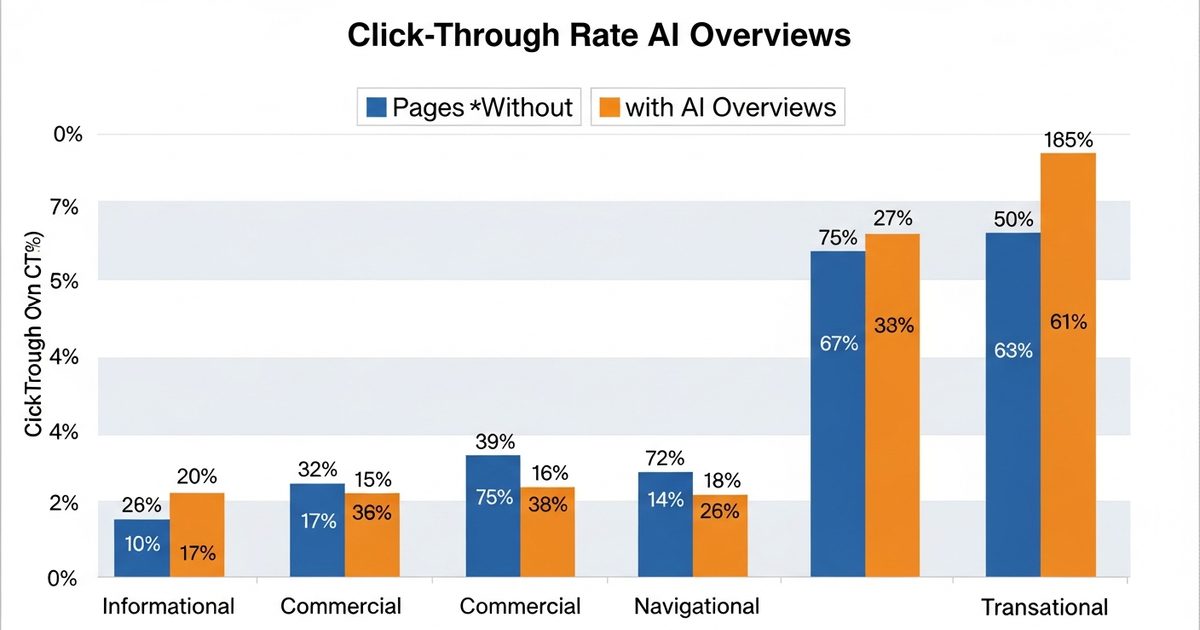
CTR Impact by Query Intent
Informational queries ("what is X", "how does Y work")
- Position 1 CTR drop: 71% (largest impact)
- AI Overview citation CTR: 31% (much higher than organic position 1)
Informational queries are where AI Overviews have the largest impact. When Google can directly answer "what is machine learning" in an AI Overview, many users get what they need without clicking. Position 1 CTR for pure informational queries dropped by 71% in our data. These are the queries most affected by zero-click search.
The key strategic insight: a site featured in the AI Overview as a cited source sees a 31% CTR on that citation link - higher than the 22.1% baseline for position 1 below the overview. The summary answer drives curiosity-clicks to the most specific source.
Commercial investigation queries ("best X for Y", "X vs Y")
- Position 1 CTR drop: 38%
- AI Overview citation CTR: 24%
Commercial queries show a smaller CTR drop because the AI Overview typically does not resolve the purchase decision - it summarizes options and drives users to compare. Sites cited within AI Overviews for commercial queries see a particularly high-value traffic effect: these are users actively considering a purchase who clicked a specific cited source in a context that framed them as relevant.
Navigational queries ("[brand name]" searches)
- Position 1 CTR drop: 12% (minimal impact)
Navigational searches - users looking for a specific website or brand - are largely unaffected by AI Overviews. The overview confirms what the brand is, and the user clicks through to the brand site anyway. The 12% drop is mostly from users who find the AI Overview answer sufficient (e.g., finding an address or phone number without clicking).
Transactional queries ("buy X", "X price", "X discount")
- Position 1 CTR drop: 22%
- AI Overview citation CTR: 28%
Transactional queries show moderate CTR compression but strong citation click-through. Users with purchase intent use the AI Overview to quickly identify credible sources, then click to the most relevant cited merchant or review site. The net effect for well-optimized e-commerce and review sites is often positive - they gain citation traffic that exceeds the organic CTR loss.
Local queries ("X near me", "best X in [city]")
- AI Overview appearance rate: low (AI Overviews appear less frequently for local queries)
- CTR impact when present: -28%
Local queries are less affected overall because AI Overviews appear less frequently for them - Google still favors the local pack for these intents. When AI Overviews do appear for local queries, they show a moderate CTR drop similar to transactional queries.
The Citation Advantage: Why Being Featured in AI Overviews Is a CTR Win
The most important finding in our study is the citation advantage. Sites that appear as cited sources in AI Overviews see dramatically different CTR than sites in organic positions below the overview:
- AI Overview citation link CTR (average): 24.7%
- Organic position 1 CTR below AI Overview: 8.4%
- Organic position 2 CTR below AI Overview: 4.1%
A citation link within an AI Overview drives roughly 3x the CTR of position 1 below the overview, and roughly 6x the CTR of position 2. This changes the strategic framing entirely: the goal is not to rank in organic results below the AI Overview - the goal is to be cited within the overview.
This is the domain where AEO optimization directly affects Google search performance, not just AI platform performance. The AEO/GEO analysis feature in AI Rank Lab tracks which queries trigger AI Overviews that cite your domain and which are citing competitors instead.
CTR Impact by Industry
AI Overview appearance rates and CTR impacts vary significantly by industry:
Highest AI Overview appearance rate (and CTR impact)
- Software and technology: AI Overviews appear for 71% of informational queries. Position 1 CTR drops by 68% on average. Citation CTR: 29%.
- Health and medical: 68% appearance rate. CTR drops are high for general health queries; low for specific symptom/treatment queries where users want more detail. Citation CTR from AI Overview is particularly high (34%) as users want to verify health information.
- Finance and investing: 63% appearance rate. CTR drops are significant for tax, rate, and regulatory queries (answers are fully contained in the overview) and smaller for advisory queries where the overview increases rather than satisfies curiosity.
Moderate AI Overview appearance rate
- Marketing and SEO: 55% appearance rate. Position 1 CTR drops by 41% on average - lower than tech because marketing queries tend toward comparative and evaluative rather than purely informational.
- Education: 52% appearance rate. "How to learn X" queries show high overview appearance but also high citation CTR because users want to follow a specific course or resource.
Lower AI Overview appearance rate
- E-commerce and retail: 31% appearance rate. Product research queries drive more overview appearances; direct product queries ("buy Nike shoes") rarely trigger overviews. Overall CTR impact on e-commerce is lower than other industries.
- Local services: 24% appearance rate. Google still favors local pack for these intents; AI Overviews appear mainly for "how do I choose a [local service]" queries.
What the Data Means for Your SEO Strategy
The standard reaction to AI Overview CTR data is "focus on non-informational queries where overviews are less frequent." Our data suggests this is an incomplete strategy. A better framework:
Tier 1: Get cited in AI Overviews
For informational queries in your topic cluster, the goal should be AI Overview citation - which drives 24.7% CTR, not the 8.4% of organic position 1. This requires AEO optimization: FAQPage schema, direct answer content structure, E-E-A-T signals, AI bot access. This is where investing in the AEO signals that drive AI citations pays off directly in Google search CTR.
Tier 2: Double down on commercial and transactional
Commercial and transactional queries show lower AI Overview CTR impact and higher citation CTR. Building content that targets commercial investigation queries (comparisons, buyer's guides, use case analyses) protects CTR while creating citation opportunities.
Tier 3: Accept the informational CTR loss, track brand mentions
For informational queries where you are not cited in the overview, the CTR loss may be irreversible without AEO investment. In the meantime, track whether your brand is mentioned (even without citation) in AI Overviews for your topic cluster - unprompted brand mentions in AI responses are a brand signal worth monitoring.
How to Measure Your AI Overview Exposure
Google Search Console now shows AI Overview impressions and clicks separately from standard organic results for accounts with sufficient traffic. Steps to measure your exposure:
- Open Google Search Console and navigate to Search Results
- Filter by Search Type > Web
- Look for the AI Overviews filter in the results table (this may be under advanced settings in your GSC view)
- Compare impressions with and without AI Overview filter to see which of your queries have overview appearance
- Identify queries where you are in organic position 1-3 but losing CTR - these are candidates for AEO optimization to capture the citation slot
AI Rank Lab's AEO/GEO analysis cross-references your GSC data with AI citation tracking to show you which AI Overview citations are currently going to competitors and what signals those competitors have that you lack.
Conclusion
AI Overviews do reduce organic CTR significantly - particularly for informational queries where the headline number is a 62% CTR reduction for position 1. This is a real and material impact that affects organic traffic for many sites. But the CTR story is not simple.
The sites that are cited within AI Overviews are not losing CTR - they are gaining it, at rates 3x higher than position 1 below the overview. The strategic response to AI Overviews is not to retreat from informational content but to optimize aggressively for citation within the overview itself. That requires AEO investment: schema, content structure, E-E-A-T signals, bot access. The CTR data makes the ROI of that investment clearer than any other evidence we have seen.
Frequently Asked Questions
How much do Google AI Overviews reduce click-through rates?▾
Is being cited in a Google AI Overview good or bad for traffic?▾
Which query types are most affected by AI Overview CTR drops?▾
How do I get my website cited in Google AI Overviews?▾
How do I measure my site's AI Overview exposure in Google Search Console?▾
Get a Free AI Ranking Consultation
Want to improve your brand's visibility in AI search engines like ChatGPT, Gemini, and Perplexity? Fill out the form and our experts will create a personalized strategy for you.

Written by
Devanshu
Chief Marketing Officer & AI Search Optimization Architect
Digital Marketing Strategist & Pioneer in SEO, Answer Engine Optimization (AEO), and Generative Engine Optimization (GEO).


