


Answer Engine Optimization has moved from early-adopter territory to mainstream marketing investment. The AEO market in 2026 is characterized by rapidly growing enterprise adoption, emerging specialized tooling, and early ROI data that is making the business case for AEO investment increasingly compelling. This report synthesizes the key statistics, trends, and forecasts marketing leaders need.
Key AEO Market Statistics for 2026
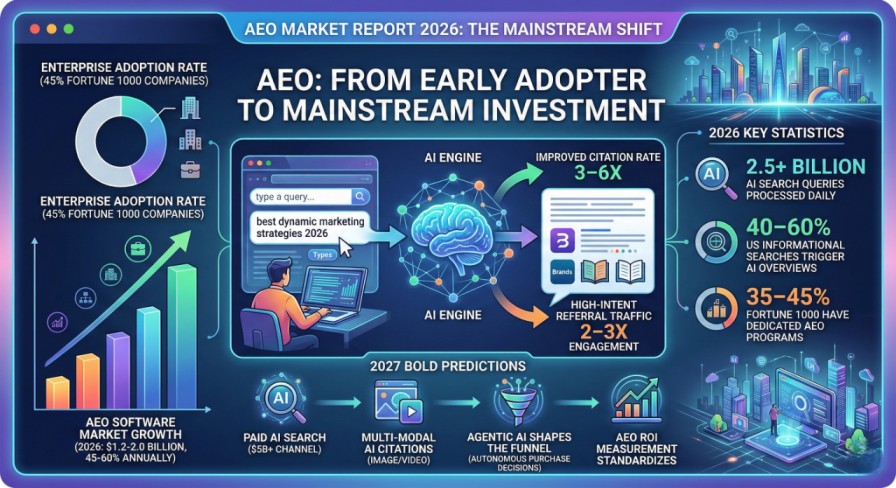
AI search query volume: Estimated 2.5+ billion AI-assisted search queries processed daily across all platforms
Google AI Overview penetration: 40–60% of US informational searches now trigger AI Overviews
Click-through impact: Pages appearing in AI Overviews see 15–30% reduction in traditional organic CTR; pages cited in AI answers gain brand attribution at scale
Enterprise AEO adoption: Estimated 35–45% of Fortune 1000 companies now have dedicated AEO programs or include AEO in agency briefs
AEO tool market: The AEO software market is estimated at $1.2–2.0 billion in 2026, growing at 45–60% annually
Content investment shift: 42% of B2B content marketers report reallocating budget from traditional SEO content to AEO-optimized content (Content Marketing Institute, 2026)
Adoption Trends by Company Size
Company Size | AEO Adoption Rate | Primary Focus |
|---|---|---|
Enterprise (1000+ employees) | ~45% | Brand protection, share of voice |
Mid-market (100–999) | ~25% | Competitive differentiation |
SMB (10–99) | ~12% | Cost-effective visibility |
Micro (under 10) | ~5% | Early adopter advantage |
The adoption gap between enterprise and SMB represents a significant opportunity for SMBs willing to invest in AEO early - the competitive landscape in AI search is currently less crowded than traditional SEO for most niches.
ROI Benchmarks from Early AEO Adopters
Based on data from AI Rank Lab customers and industry surveys, early AEO adopters report:
Citation rate improvement: Brands implementing full AEO programs (schema markup + answer-first content + LLMs.txt + E-E-A-T) report 3–6x improvement in AI citation rate over 6 months
Brand awareness: 67% of AEO practitioners report improved unaided brand awareness in their target market (attributable partly to AI citation exposure)
Qualified traffic: AI-originated referral traffic shows 2–3x higher engagement rates (time on site, pages per session) versus average organic traffic - users arriving from AI citations are highly intent-driven
Cost efficiency: AEO programs typically deliver better ROI per content dollar than pure SEO content programs due to the winner-takes-all citation dynamic
Emerging AEO Investment Areas
Forward-looking AEO programs in 2026 are investing in:
Original research programs: Dedicated budget for proprietary surveys, experiments, and data publication - the highest-value content type for AI citations
AI citation monitoring platforms: Specialized tools (like AI Rank Lab) tracking citation rates across ChatGPT, Gemini, Perplexity, and Claude
Author authority programs: Investment in expert author development, external publication profiles, and speaking opportunities
Schema automation: Technical tools that automatically generate and maintain schema markup across large content libraries
AI content auditing: Regular audits of how AI engines currently describe and represent the brand
Bold Predictions for 2027
Paid AI search emerges as a major ad channel: All top AI search platforms will have ad products by end of 2026; 2027 will see the first "AI search CPM" metrics standardized
AEO becomes a standard marketing discipline: "AEO Manager" and "AI Search Strategist" roles become common job postings; AEO certifications emerge from major marketing education platforms
Multi-modal AI citations: AI engines begin citing image, video, and audio content - opening new AEO opportunities beyond text
Agentic AI reshapes the funnel: AI assistants begin completing purchase decisions on users' behalf - brands that are the trusted source for the AI "doing the research" capture outsized commercial value
AEO ROI measurement standardizes: The industry converges on standard AEO KPIs (citation rate, AI share of voice, AI impressions) that appear in standard marketing dashboards
The brands that invest seriously in AEO in 2026 are not just solving a current traffic problem - they are securing positions in AI systems that will compound in value as AI search penetration continues to accelerate.
AEO Investment ROI: A Deeper Analysis
AEO Investment Area | Avg. Time to First Results | Reported Impact (Early Adopters) | Difficulty |
|---|---|---|---|
FAQPage schema markup | 2–4 weeks | 2.3× citation rate improvement | Low |
Answer-first content reformatting | 4–8 weeks | 40–60% lift in AI summary inclusion | Medium |
LLMs.txt deployment | 2–6 weeks | 15–25% improvement in AI crawler coverage | Low |
E-E-A-T author program | 3–6 months | 35–50% trust signal improvement | High |
Original research content | 1–3 months (per study) | 5–10× citation rate vs. synthesis content | High |
AI citation monitoring | Immediate visibility | Enables 2–3× faster iteration cycle | Low (tool-based) |
Full AEO program (all above) | 6–12 months | 3–6× total AI citation rate improvement | High |
The AEO Investment Decision Framework
Not every organization needs to invest equally in every AEO component. Use this framework to prioritize based on your current situation:
Baseline: Schema + LLMs.txt (all organizations): FAQPage schema and an LLMs.txt file are low-effort, high-impact technical wins that every organization should implement regardless of budget. Combined implementation time: 4–8 hours for most sites.
Content-heavy sites (50+ articles): Prioritize answer-first reformatting of your top 20 pages. These pages generate the majority of AI citations and represent the highest ROI for content investment.
B2B/enterprise brands: E-E-A-T author authority programs deliver disproportionate ROI. AI engines trust named experts with verifiable external profiles - invest in 2–3 visible author authorities per key topic cluster.
Research/data-driven organizations: Original research programs are the highest-ceiling AEO investment. A single industry survey with 200+ respondents and novel findings can generate AI citations across dozens of queries for 12–24 months.
Large content operations (1000+ pages): Schema automation tools and AI citation monitoring platforms become essential at scale - manual implementation doesn't scale and manual tracking doesn't provide actionable data fast enough.
2027 Predictions: Detailed Analysis
Five bold predictions for the AEO landscape in 2027, with supporting rationale:
Paid AI search becomes a $5B+ ad channel by end of 2027: ChatGPT Ads (in testing as of early 2026), Perplexity's sponsored answers program, and Google's AI Overview ad placements are all scaling. Advertisers will follow user attention. Early estimates put combined AI search ad revenue at $3–5B in 2027.
AEO certifications launch from major education platforms: Google, HubSpot, and LinkedIn Learning are expected to launch AEO/AI search certification programs in 2026–2027 as demand for credentialed practitioners grows. "Certified AEO Specialist" will appear on job postings by Q3 2027.
Multi-modal AI citations go mainstream: Text-only AI citations will give way to image, video, and audio citations as AI engines add multi-modal retrieval. Brands with rich media content libraries optimized for AI consumption will gain new citation channels unavailable to text-only competitors.
Agentic AI transforms commercial search: AI agents that execute multi-step purchase research autonomously will handle 10–20% of B2B research tasks by end of 2027. Brands positioned as trusted sources in their AI systems' training data and retrieval indexes will capture disproportionate commercial value from this shift.
AEO ROI measurement standardizes: The industry will converge on a standard "AI Share of Voice" metric - the percentage of AI-generated answers in a given topic category that cite your brand. This metric will appear in standard marketing analytics dashboards alongside organic share of voice.
The AEO Opportunity Window
The data consistently shows that AEO is still in the early-majority adoption phase. Approximately 55–65% of organizations that will eventually invest in AEO have not yet started. This represents a shrinking but still significant window of competitive advantage for early movers:
AI citation authority is path-dependent: brands cited more frequently accumulate more signals that lead to more future citations
Category ownership in AI answers is real: in most niches, 2–3 brands dominate AI citations for core topics - late movers face meaningful incumbency barriers
The average time to meaningful AEO results (3–6 months) means brands that start in early 2026 will have established positions before the 2026 holiday buying season and before the majority of competitors begin investing
Common Mistakes in AEO Investment Planning
Treating AEO as a one-time project: AEO is an ongoing program - AI engines update their source preferences, new platforms emerge, and content must be kept current. Budget for ongoing investment, not a one-time sprint
Measuring AEO success with traditional SEO metrics: Organic click-through rates, ranking positions, and organic traffic tell an incomplete story. Direct AEO KPIs (citation rate, AI share of voice, AI-originated traffic) must be tracked separately
Over-investing in platforms without market share: Concentrate 80% of initial AEO effort on ChatGPT (64% share), Gemini (21.5%), and Google AI Overviews before optimizing for niche AI engines
Under-investing in content freshness: AI engines heavily favor content updated within 30 days (3.2× more citations vs. older content). A quarterly content refresh program delivers significant ROI
Ignoring brand citation monitoring: Without measuring what AI engines currently say about your brand, you cannot identify reputation gaps, competitor vulnerabilities, or citation growth opportunities
Key Takeaways: AEO Market Report 2026
35–45% of Fortune 1000 companies have AEO programs in 2026 - the mainstream adoption phase has begun
The AEO software market is estimated at $1.2–2.0 billion, growing at 45–60% annually - the tooling ecosystem is maturing
Early AEO adopters achieve 3–6× improvement in AI citation rates with full programs over 6–12 months
AI-originated referral traffic shows 2–3× higher engagement than average organic traffic - intent is high when users arrive from AI citations
The fastest-ROI AEO investments are schema markup (2.3× citation improvement) and LLMs.txt deployment (15–25% crawler coverage improvement)
The 2027 horizon brings paid AI search, multi-modal citations, and agentic AI - brands invested in AEO now will be best positioned to capitalize
The competitive advantage window is real but closing - the majority of AEO opportunity still exists for brands that begin investing now
Start building your AEO program with AI Rank Lab - the platform purpose-built for measuring and improving AI search performance. Request a demo today.
Frequently Asked Questions
What percentage of companies have AEO programs in 2026?▾
What ROI can companies expect from AEO investment?▾
How large is the AEO software market in 2026?▾
What are the most important AEO investments for 2026?▾
Will paid AI search advertising become significant?▾
What is the predicted AEO landscape in 2027?▾
Get a Free AI Ranking Consultation
Want to improve your brand's visibility in AI search engines like ChatGPT, Gemini, and Perplexity? Fill out the form and our experts will create a personalized strategy for you.

Written by
Devanshu
Chief Marketing Officer & AI Search Optimization Architect
Digital Marketing Strategist & Pioneer in SEO, Answer Engine Optimization (AEO), and Generative Engine Optimization (GEO).

