



Ahpra's advertising rules cover everything a practice publishes to attract patients, including its website, Google Business Profile and social media, and section 133 of the National Law bans testimonials about clinical care in that advertising. So an Australian health practice can't build search or AI visibility by showcasing patient praise. It earns that visibility with verifiable practitioner details, accurate directory listings and plain-English clinical and cost information that search engines and AI answers can quote.
This guide quotes the rules directly from ahpra.gov.au (checked 2 November 2026), maps what is and isn't allowed on each channel, shows which sources AI answers actually cite for health questions according to the largest published studies, and finishes with a checklist. It is written for dentists, physiotherapists, GPs, psychologists, chiropractors and cosmetic clinics, and for the agencies that market them.
Not legal advice. This article is general information about marketing and search, not legal advice, and it gives no medical advice. Ahpra says it can't tell you whether a particular advertisement complies, so check anything you're unsure about with your professional indemnity insurer, medical defence organisation or a health lawyer.
Key takeaways
- Your website and Google Business Profile are advertising. Section 133 applies to any person advertising a regulated health service, so practice owners and agencies are covered, not only registered practitioners.
- Clinical testimonials are banned; reviews on platforms you don't control are not yours to remove. Ahpra says advertisers aren't responsible for removing testimonials on third-party platforms they can't control. Republishing, curating or replying to them in a way that discusses care is where the risk starts.
- AI answers rarely cite individual clinics for health questions. In LLM Pulse's US study of 824,997 health citations (April-July 2026), hospitals and providers made up 1.0% of citations. Your realistic wins are provider-choice, procedure and cost questions, not symptom advice.
- Entity data does the work testimonials can't. Ahpra registration numbers, qualifications, a current healthdirect Service Finder listing and accurate practitioner profiles give search engines and AI systems facts they can check.
- Penalties are real. Ahpra lists maximum penalties of A$60,000 per offence for individuals and A$120,000 for bodies corporate.
What do Ahpra's advertising rules actually say?
The core rule is section 133 of the Health Practitioner Regulation National Law. Ahpra's Advertising and the law page (reviewed 2 September 2025) sets it out: a person must not advertise a regulated health service, or a business that provides one, in a way that:
- "is false, misleading or deceptive or is likely to be misleading or deceptive"
- "offers a gift, discount or other inducement to attract a person to use the service or business", unless the advertisement states the terms and conditions of the offer
- "uses testimonials or purported testimonials about the service or business"
- "creates an unreasonable expectation of beneficial treatment", or
- "directly or indirectly encourages the indiscriminate or unnecessary use of regulated health services."
The detail sits in the Guidelines for advertising a regulated health service, which took effect on 14 December 2020 and apply across all regulated professions. Two points matter most for search. First, the guidelines say advertisers "must be able to substantiate claims made in advertising" with acceptable evidence. Second, advertising may breach the law where it "contains price information that is unclear, inexact or vague", which matters for the cost pages AI answers like to quote.
A 2022 proposal to lift the testimonial ban was withdrawn before the amending Act passed, so the ban still stands. The same 2022 amendments raised the penalties: Ahpra lists a maximum of A$60,000 per offence for individuals and A$120,000 per offence for bodies corporate, applying in every state and territory, including Western Australia since July 2024. National Boards can also take disciplinary action against registered practitioners, and Ahpra notes that consumer law and TGA rules on therapeutic goods advertising can apply to the same content.
Do the rules apply to my website, Google Business Profile and social media?
Yes. The guidelines define advertising as "all forms of verbal, printed and electronic communication that promotes" a regulated health service, and they name websites and social media directly. Treat your homepage, service pages, blog, Google Business Profile description and posts, review replies, social captions, paid search ads and email newsletters as advertising. Because the law binds "a person", it also binds the agency, copywriter or SEO consultant who writes the content, not only the practitioner whose name is on it.
What counts as a testimonial, and what doesn't?
Ahpra's testimonial tool defines testimonials as "recommendations or positive statements about the clinical aspects of a regulated health service used in advertising." Clinical aspects cover symptoms, diagnosis, treatment and outcomes. A statement is only caught if it is about a regulated health service, used in your advertising, and refers to a clinical aspect.
Comments about non-clinical matters are not testimonials. Ahpra gives "comments about customer service or communication style" as examples that may be used. Think "easy parking, friendly reception, they ran on time" (usable) versus "my back pain was gone after two sessions" (not usable). Ahpra also warns against selective editing: "Only publishing complete and unedited reviews that are not testimonials will help to avoid breaching" the requirements. Cutting the clinical sentence out of a glowing review to make it usable is exactly the editing it warns about.
Can a health practice use Google reviews in its marketing?
A practice can let patients review it on Google, but it can't turn clinical reviews into advertising. The line falls between reviews that exist on a platform you don't control, which are not your responsibility, and anything you do with them, which may be.
Are you responsible for reviews on sites you don't control?
No. Ahpra's testimonial tool says "Advertisers are not responsible for removing (or trying to have removed) testimonials" on platforms they don't control. Where a booking site or review platform advertises a health service and the practitioner can't control its reviews function, "The owner of the online booking site or review platform is responsible for compliance." Ahpra's guidance doesn't name Google specifically, but patient reviews on Google are written on Google's platform and you can't switch them off.
Pages you do control are different. On your own website or business social media accounts, "whoever has control over the website" is responsible, and Ahpra says compliance "may be achieved by disabling the reviews/testimonials functions" where you can't edit or remove reviews.
Can you respond to Google reviews?
Carefully. Ahpra says advertisers "should take care if they choose to engage with reviews on third-party websites", because a reply can be treated as using a testimonial to advertise. Privacy adds a second constraint. The RACGP's guidance on responding to online reviews says that "if the reviewer is identifiable, you must not confirm or reveal whether they attended your practice", even if they have shared details themselves.
A reply that stays on the safe side of both rules is short, generic and moves the conversation offline. For example: "Thank you for taking the time to leave feedback. We can't discuss anyone's care online, but our practice manager would welcome a call on [practice number]." It doesn't thank anyone for praising a treatment result, repeat clinical details or confirm the person is a patient. Many practices simply don't reply to positive clinical reviews at all.
Can you ask patients to leave reviews?
Yes, with conditions from two directions. Google's Maps user-contributed content policy prohibits offering "incentives - such as payment, discounts, free goods and/or services" for reviews, and bans businesses from trying to "selectively solicit positive reviews from customers." Avant, a medical defence organisation, gives matching advice in its guidance on testimonials: if you invite reviews, invite all patients, not just the ones you expect to be happy, and never reward a positive review. So a neutral "we'd value your feedback" message sent to every patient is fine; a follow-up only to patients who rated you five stars is not.
Can you show your star rating or embed a review widget?
Ahpra's own pages don't address star ratings or widgets directly. Avant's reading is that you can display a rating or award symbol from a review site "as long as you don't publish, or link to, the reviews" behind it. An embedded Google reviews carousel on your homepage does the opposite: it republishes reviews on a page you control, and any that discuss clinical care become testimonials in your advertising. Review widgets are a common default in website templates, which makes them one of the easiest problems to fix: remove the widget.
What is allowed on each channel: website, Google Business Profile, social and directories
The table below maps the rules quoted above onto the places a practice actually publishes. "High risk" means the content is likely to breach section 133 or the guidelines as written; it isn't a ruling on any specific piece of content.
| Channel | Generally allowed | Not allowed or high risk | Basis |
|---|---|---|---|
| Practice website | Practitioner names, qualifications and Ahpra registration numbers; procedure explainers with risks and recovery; clear fee schedules; complete, unedited non-clinical feedback | Clinical testimonials; embedded Google review feeds; edited reviews; "painless", "guaranteed" or outcome promises; discounts without terms and conditions | s133(1)(a)-(d); testimonial tool |
| Google Business Profile (your content) | Accurate name, categories, hours, services, photos of the premises and team; factual posts; generic review replies | Replies that discuss treatment or confirm someone is a patient; offers without terms; keywords stuffed into the business name (also against Google's guidelines) | Testimonial tool; RACGP; Google Business Profile guidelines |
| Google reviews (patients' content) | Patients posting reviews; inviting every patient to review | Incentives for reviews; inviting only happy patients; copying reviews onto your site or ads | Testimonial tool; Google Maps content policy; Avant |
| Your social media pages | Educational posts that meet the guidelines; disabling reviews where you can't moderate them | Resharing or "liking" patient posts about outcomes; leaving clinical reviews live on a page you control; influencer content you haven't checked | Testimonial tool; cosmetic guidelines |
| Booking and review platforms you don't control | Accurate practice and practitioner details | Non-compliant content you wrote yourself, such as profile blurbs with outcome claims | Testimonial tool ("you may still control other content") |
| healthdirect Service Finder (NHSD) | Accurate services, hours, billing type and practitioner details | Stale details that send patients to the wrong place | NHSD guidance |
Which sources do AI answers cite for health questions?
For general health questions, AI answers mostly cite large publishers, medical reference sites, video and forums, not individual practices. Government sources and clinics each make up a small share. We found no published study of Australian health queries, so the two largest studies available are from Germany and the US. Treat them as directional for Australia, not as Australian data.
| Study | Sample | What it found |
|---|---|---|
| SE Ranking, published January 2026 | 50,807 German-language health queries, 465,823 Google AI Overview citations, one snapshot from Berlin in December 2025 | YouTube was the most-cited domain (4.43% of citations). German and international government health bodies plus academic journals made up about 1% combined. Only 36% of AI-cited URLs also ranked in Google's organic top 10. |
| LLM Pulse, published August 2026 (a vendor study) | 824,997 citations to non-branded US health questions across ChatGPT, Perplexity, Gemini, AI Overviews and AI Mode, April-July 2026 | PubMed Central was the top domain (4.08%), ahead of YouTube (3.27%). Government and institutional sources were 3.4% of citations; hospitals and providers were 1.0%. Social and forum content was 8.5% of AI Overview citations versus 1.9% for ChatGPT. |
Google has also shown it will pull AI Overviews from some health queries. In January 2026, after a Guardian investigation into misleading answers about liver test ranges, TechCrunch reported that Google had removed AI Overviews for those specific queries, while variants still produced summaries. The demand is large: OpenAI said in January 2026 that more than 230 million people ask health and wellness questions on ChatGPT every week (OpenAI).
What does this mean for an Australian practice?
It means you should match your effort to the type of question. In Australia, the obvious trusted sources for health information are healthdirect (a government-funded service), state health departments, professional colleges and associations, and the Ahpra public register. A suburban physio or dental practice won't outrank those for "what causes sciatica", and trying to would push you towards the kind of outcome claims section 133 prohibits.
Three types of question are realistic for a practice to be cited on:
- Provider choice: "bulk billing GP in [suburb] open Saturday", "women's health physio near [suburb]". These depend on accurate listings, location pages and Google Business Profile data. Our guide to "near me" queries in AI answers covers the mechanics.
- Procedure explainers: "what happens at a first psychology appointment", "how long does a dental implant take to heal". Practice pages that explain a process factually, with risks, can be cited here.
- Cost and rebate questions: "how much is a physio appointment with private health", "is a skin check covered by Medicare". Clear, sourced cost pages are rare, which makes them citable.
How can a practice get cited in AI answers without testimonials?
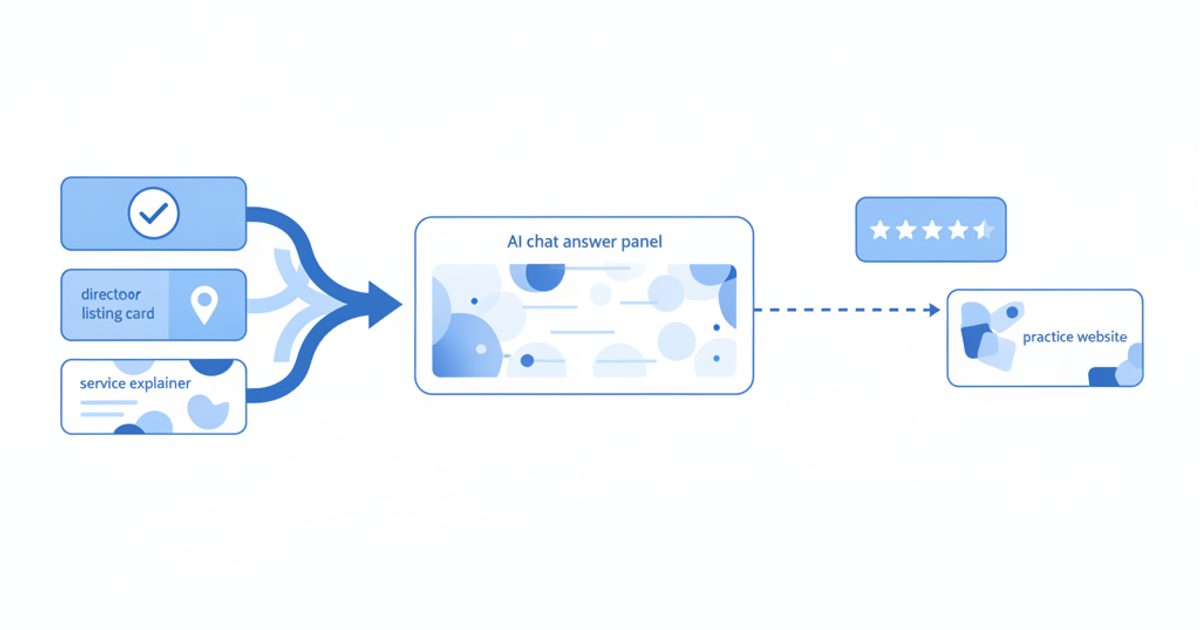
By giving AI systems facts they can verify and passages they can quote, instead of praise they can't use. Google says there are no additional requirements to appear in AI Overviews or AI Mode: pages must be indexed and eligible for a snippet, and the same quality systems apply. For health, Google's helpful content guidance adds that its systems "give even more weight to content that aligns with strong E-E-A-T" for topics that "could significantly impact the health, financial stability, or safety of people." That favours exactly the things a compliant practice can offer: named, qualified authors and verifiable credentials.
- Make every practitioner verifiable. A profile page per practitioner with full name, profession, qualifications, Ahpra registration number and a link to the Ahpra public register, which Ahpra describes as its list of "every health practitioner who is registered to practise in Australia".
- Fix your directory footprint. Claim or correct your healthdirect Service Finder listing, your Google Business Profile and your profiles on booking platforms so names, addresses, hours and services match everywhere.
- Publish one explainer per service you actually offer. What it is, who it suits and doesn't suit, what happens, risks, recovery time and cost, reviewed and signed by a named practitioner.
- Publish your fees. A clear fee page with Medicare and private health context answers the questions patients ask AI tools and that competitors leave vague.
- Remove what puts you at risk. Review carousels, edited "patient stories", "painless" claims and undated discount banners. Compliance problems also undermine trust signals.
- Check what AI answers say about you, then repeat. See the measurement section below. AI Rank Lab's SEO-AEO-GEO audit can automate the technical part of this step by crawling your site for indexing, structure and schema issues.
What practitioner details and schema should your website include?
Every practitioner should have a page with the facts a patient, a search engine and an AI system would want to check, and those facts should match the Ahpra register and your directory listings exactly. Inconsistency is the main thing that makes an entity hard to resolve.
| Detail | Where it should appear | Why it matters |
|---|---|---|
| Full registered name and profession | Practitioner page, Google Business Profile, Service Finder, booking platforms | Lets systems match your page to the Ahpra register entry |
| Ahpra registration number | Practitioner page, with a link to the public register | A unique, checkable identifier (three letters and 10 digits) |
| Qualifications and specialist registration, if held | Practitioner page and bio | Only practitioners with specialist registration may use specialist titles |
| Services offered at each location | Service pages, Google Business Profile services, Service Finder | Answers provider-choice questions such as "who does X near Y" |
| Hours, billing type, languages spoken, accessibility | Location page, Google Business Profile, Service Finder | The details local AI answers repeat most |
| Author and clinical reviewer bylines with review dates | Every clinical and cost page | Google asks for accurate authorship "where readers might expect it" |
Is there an Ahpra-safe way to describe expertise?
Yes: state facts and let readers judge. "Registered physiotherapist with a Master of Sports Physiotherapy, 12 years in practice" is a verifiable statement. "Sydney's leading knee specialist" is not, and the guidelines say only practitioners with specialist registration in a recognised specialty can use the relevant specialist title. If a practitioner isn't registered as a specialist, wording that implies they are "is likely to mislead the public".
Which schema types fit Australian practitioners?
Use schema.org markup to state the same facts in machine-readable form, but don't expect it to win AI citations by itself: Google says structured data isn't required for its generative AI features and there's no special markup for them. Schema.org restructured its medical types in version 24. IndividualPhysician now means "An individual medical practitioner" and links to the clinic through practicesAt; there are also MedicalClinic, Dentist and Physiotherapy types. Schema.org has a US provider number property (usNPI) but nothing for Australia, so put the Ahpra number in a generic identifier. For professions without their own type, such as psychologists, use Person with hasCredential and link to the practice with worksFor.
{
  "@context": "https://schema.org",
  "@type": "IndividualPhysician",
  "name": "Dr Jane Example",
  "medicalSpecialty": "https://schema.org/PrimaryCare",
  "identifier": {
    "@type": "PropertyValue",
    "propertyID": "Ahpra registration number",
    "value": "MED0000000000"
  },
  "practicesAt": {
    "@type": "MedicalClinic",
    "name": "Example Street Medical Centre",
    "address": { "@type": "PostalAddress", "addressLocality": "Brunswick", "addressRegion": "VIC", "addressCountry": "AU" }
  },
  "url": "https://www.example.com.au/practitioners/jane-example"
}
Replace the placeholder values with real ones and validate the result before publishing. AI Rank Lab's free schema generator can draft the markup, and our guide to entity SEO for AI search explains why consistent identifiers matter more than the markup itself.
How do you write clinical and cost content that is compliant and citable?
Write the way a careful practitioner explains a procedure in a consultation: what it is, what happens, what the risks are, what it costs and when it isn't the right option. That style meets the "acceptable evidence" and "no unreasonable expectation" tests and produces self-contained passages that AI systems can quote.
- Lead with the direct answer. "A standard dental implant usually takes several months from placement to the final crown, depending on healing" is quotable. A paragraph about "transforming your smile" is not.
- Include risks and who it isn't for. Balanced information is both what the guidelines expect and what makes a page look trustworthy to a reader.
- Avoid minimising and outcome language. Ahpra's cosmetic guidelines list "safe", "gentle", "simple", "quick" and "easy" as terms that "should not be used without clear information about risks". The same caution is sensible on any service page.
- Cite your evidence. If you say a treatment helps a condition, link to the guideline or study that supports it. Ahpra's guidelines expect claims to be substantiated.
- Make prices exact. State the fee, what it includes and whether there is a gap. If you offer a new-patient discount, state its terms and conditions in the same place, as section 133(1)(b) requires.
- Source Medicare details to MBS Online. Name the relevant item numbers and link to MBS Online, the Department of Health, Disability and Ageing's listing of Medicare-subsidised services, rather than quoting a rebate amount that will go out of date. Explain that out-of-pocket costs depend on the patient's circumstances.
- Put a clinician's name on it. A named author or reviewer, with a review date, is what Google's guidance asks for and what an AI system can attribute.
If you use AI tools to draft any of this, the advertising rules still hold whoever controls the advertising responsible for it. Ahpra's separate guidance on using AI in healthcare is about clinical use, but its principle carries over: "Practitioners must apply human judgment to any output of AI." Have a practitioner check every clinical statement before it goes live.
What extra rules apply to cosmetic procedures?
Cosmetic advertising carries a second layer of rules. The Medical Board's guidelines for cosmetic surgery advertising (issued 1 July 2023) and Ahpra's guidelines for advertising higher risk non-surgical cosmetic procedures (in effect from 2 September 2025, listed on Ahpra's advertising hub) add requirements that hit search and social content hard. Before-and-after images must be genuine, unedited and taken in comparable conditions, with a prominent warning that outcomes "are only relevant for this patient". Images of people under 18 must not be used. Practitioners should disable reviews, comments and tagging on social pages where possible, and liking or resharing a patient's post can count as using a testimonial. Practitioners are responsible for content that influencers and ambassadors publish for them.
How do practices build local visibility without testimonials?
Local visibility for a health practice comes mostly from listings and location data, and none of that requires testimonials. Three places carry most of the weight.
Google Business Profile
Google's guidelines for representing your business name doctors and dentists as individual practitioners. A practitioner may have their own profile if they are public-facing and can be contacted at the verified location, and the profile name "should include only the name of the practitioner", while the practice keeps a separate profile for the location. A solo practitioner at a branded practice should share one profile in the format "[brand/company]: [practitioner name]". Titles such as "Dr" are allowed; keywords and suburbs in the business name are not. Our Google Business Profile guide for Australian businesses covers categories, verification and posts in detail.
healthdirect Service Finder and the NHSD
healthdirect's Service Finder is fed by the National Health Services Directory (NHSD), which is funded by Australian governments and managed by Healthdirect Australia. According to healthdirect's provider page, the NHSD covers more than 200 types of health services, Service Finder receives "over a million searches each month", and the same data helps clinicians find providers for referrals. Services should review their listing "at least every 12 months"; public listings can be corrected with the "Suggest an edit" button. For many practices this is the most authoritative Australian listing they can control, and few marketing guides mention it.
Booking platforms and professional directories
Booking platforms carry their own review systems, and Ahpra places compliance for those reviews on the platform owner where you have no control. You're still responsible for anything you write there, such as profile blurbs. If your professional association runs a find-a-practitioner directory, keep that profile current too. The goal across all of these is identical details: same practice name, address, phone number, hours and practitioner list.
How do you check whether AI answers mention your practice?
Run the questions patients actually ask, in the engines they use, with Australian location settings where the engine supports them, and record who gets cited. One run proves little; check the same set monthly.
- Write 20-30 prompts across the three question types: provider choice (include your suburb), procedure explainers and cost. Skip symptom questions you shouldn't be answering.
- Check Google first. AI Overviews appear in ordinary Australian searches; see our explainer on Google AI Overviews in Australia for how they behave here. Note which URLs are cited, not just whether you are mentioned.
- Check ChatGPT, Gemini, Perplexity and Claude. Put the suburb in the prompt text, because results vary by location.
- Record citations, not only mentions. If healthdirect, a booking platform or a competitor is cited for your suburb, that tells you which listing or page to fix.
- Track Google's view in Search Console. The Generative AI performance report shows impressions and clicks from AI features; our Search Console Generative AI report guide explains how to read it.
Tools that can do steps 2 to 4 for you:
Disclosure: AI Rank Lab is our product. We list it first because this is our site, and we've kept the same criteria for every tool below.
- AI Rank Lab: the AI Overview tracker and AI Mode tracker check queries with a country and language setting, so you can run them as Australia/English and see which URLs Google cites. Brand visibility tracking runs your prompts on ChatGPT, Claude, Gemini and Perplexity when you run them and stores each result for comparison; those runs don't emulate a location, so include the suburb in the prompt. Priced in USD, from US$69 a month.
- Google Search Console: free, and the only first-party source of Google AI feature impressions. It doesn't show competitors or other AI engines.
- A spreadsheet and a browser: for a single-location practice with 20 prompts, a monthly manual check is workable. Use a logged-out or private window and note the date, because answers change between runs.
Ahpra-aware SEO and AI search checklist for health practices
Work through this list once, then repeat the review items every quarter. If you collect patient data through forms or automated tools on the site, also read our note on the Privacy Act automated decision-making changes.
| Area | Check | Rule or source |
|---|---|---|
| Website | No clinical testimonials, patient stories or embedded review feeds anywhere on the site | s133(1)(c); Ahpra testimonial tool |
| Website | No outcome promises, "painless"/"guaranteed" language or unsupported claims | s133(1)(a), (d); advertising guidelines |
| Website | Every discount or offer states its terms and conditions | s133(1)(b) |
| Practitioners | Profile page per practitioner with registration number linked to the Ahpra register | Ahpra public register |
| Practitioners | "Specialist" used only by practitioners with specialist registration | Advertising guidelines; National Law s115, s118 |
| Content | Each service page explains process, risks, recovery and cost, with a named clinical reviewer and date | Advertising guidelines; Google helpful content guidance |
| Content | Medicare information names item numbers and links to MBS Online | MBS Online |
| Schema | Practitioner and clinic markup matches visible page content and the register | schema.org |
| Google Business Profile | Practice and practitioner profiles follow Google's practitioner rules; no keywords in names | Google Business Profile guidelines |
| Reviews | Review invitations go to all patients with no incentives; replies are generic and don't confirm patient status | Google Maps content policy; RACGP; Avant |
| Social | Reviews disabled on pages you control where you can't moderate them; no resharing of outcome posts | Testimonial tool; cosmetic guidelines |
| Directories | healthdirect Service Finder listing reviewed in the last 12 months | NHSD guidance |
| Measurement | 20-30 prompts checked monthly across Google and the main AI assistants; Search Console reviewed | This guide |
Section 133 and the guidelines change rarely, but supporting guidance does change; the non-surgical cosmetic guidelines are the most recent example. Re-check Ahpra's advertising hub before a site rebuild or a new campaign, and remember that nothing here replaces advice from your indemnity insurer or a health lawyer.
If you want to see which pages Google's AI features cite for your suburb and services, you can run your key queries with the AI Rank Lab AI Overview tracker set to Australia and compare the results month to month.
Get a free AI ranking consultation
Want your brand to show up when ChatGPT, Gemini and Perplexity answer questions in your market? Tell us about your site and our team will send a personalized strategy.


