

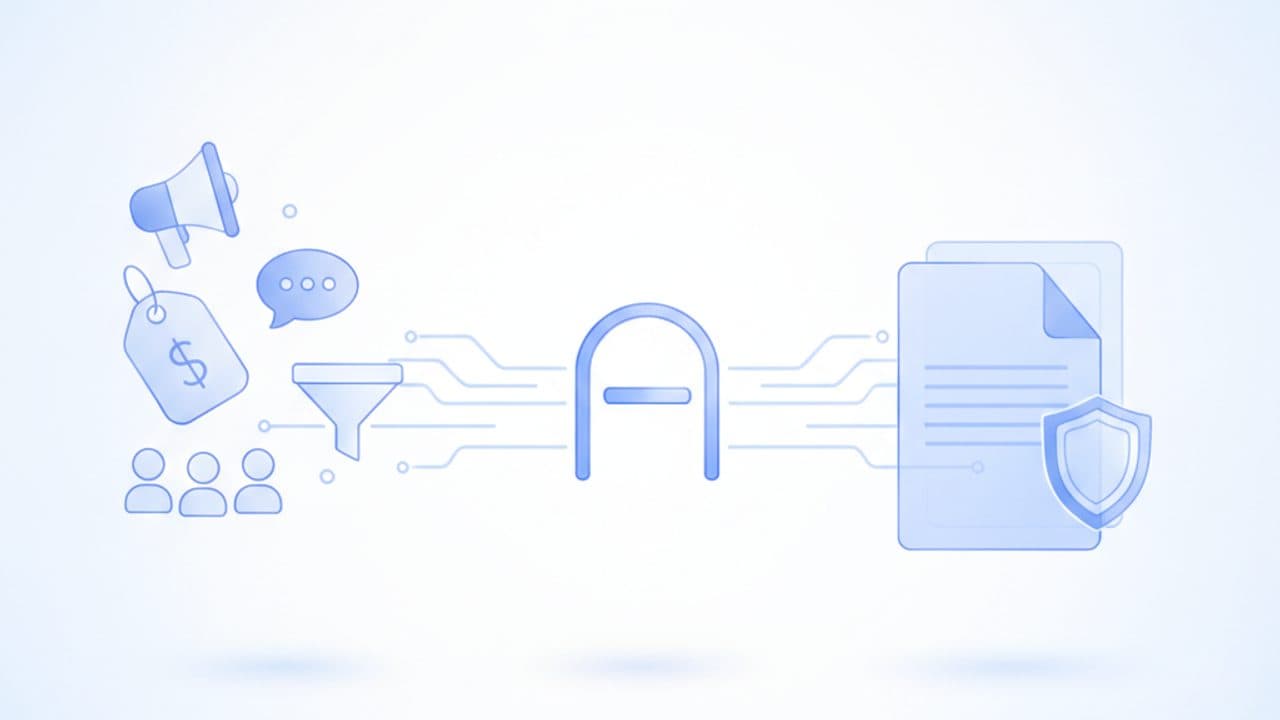
From 10 December 2026, new Australian Privacy Principles 1.7 to 1.9 require any business covered by the Privacy Act to say in its privacy policy when a computer program makes, or substantially and directly helps make, a decision that could significantly affect someone's rights or interests using their personal information. For most marketers, AI-written content, SEO tools and broad audience targeting will not trigger the rule, but personalised pricing, automated eligibility checks, account bans and programmatic advertising for significant goods or services such as credit, insurance, housing, health care and jobs can.
This guide translates the automated decision-making Privacy Act amendments and the OAIC's final September 2026 guidance into marketing terms: which uses of AI in your stack are likely in scope and why, what your privacy policy has to say, who carries the obligation when the AI belongs to a vendor, what non-compliance can cost, and a 10-step audit you can run before the deadline. Sources were checked on 2 November 2026.
Not legal advice. This article is general information written by a marketing software company, not a law firm. It quotes the legislation and the regulator, but whether a particular tool is in scope depends on facts only you know. Use it to prepare for a conversation with your privacy lawyer, not to replace one.
Key takeaways
- The rule starts on 10 December 2026 and applies to decisions made after that date, even if the tool was set up or the data was collected earlier.
- It is a transparency obligation: your privacy policy must list the kinds of personal information used and the kinds of decisions made solely or substantially by computer programs. It does not ban automation or create a right to contest.
- All three limbs must be met: a computer program you "arranged for", a decision that could significantly affect an individual, and personal information used in it.
- The OAIC's fact sheet lists personalised pricing for significant goods and programmatic advertising relating to the sale of significant goods or services as generally in scope. Several pre-September explainers said the opposite about programmatic, so older advice may be stale.
- A human sign-off does not automatically take a decision out of scope, and buying the tool from a vendor does not move the obligation to the vendor.
- APP 1.7 is now on the section 13K civil penalty list, so a non-compliant policy can draw an infringement notice from the OAIC without going to court.
When do the Privacy Act automated decision-making rules start?
The rules start on 10 December 2026. They were inserted by Schedule 1, Part 15 of the Privacy and Other Legislation Amendment Act 2024, which received Royal Assent on 10 December 2024 and set Part 15 to commence "the day after the end of the period of 24 months" from that date. The Act's commencement table gives the date as 10 December 2026.
Two timing details matter for marketing teams:
- No grandfathering for old systems. The application provision (item 89) says the rule applies to decisions made after commencement, whether the arrangement with the computer program, the use of personal information or the collection of that information happened before or after that date. A pricing engine you switched on in 2023 is covered from 10 December if it meets the test.
- The guidance is final. The OAIC published its resources on 30 September 2026: an updated APP 1 Guidelines chapter, a fact sheet, a flowchart and a supplementary sheet for government agencies, after 90 written submissions. Articles written before that date were guessing at where the OAIC would land.
What does APP 1.7 actually require?
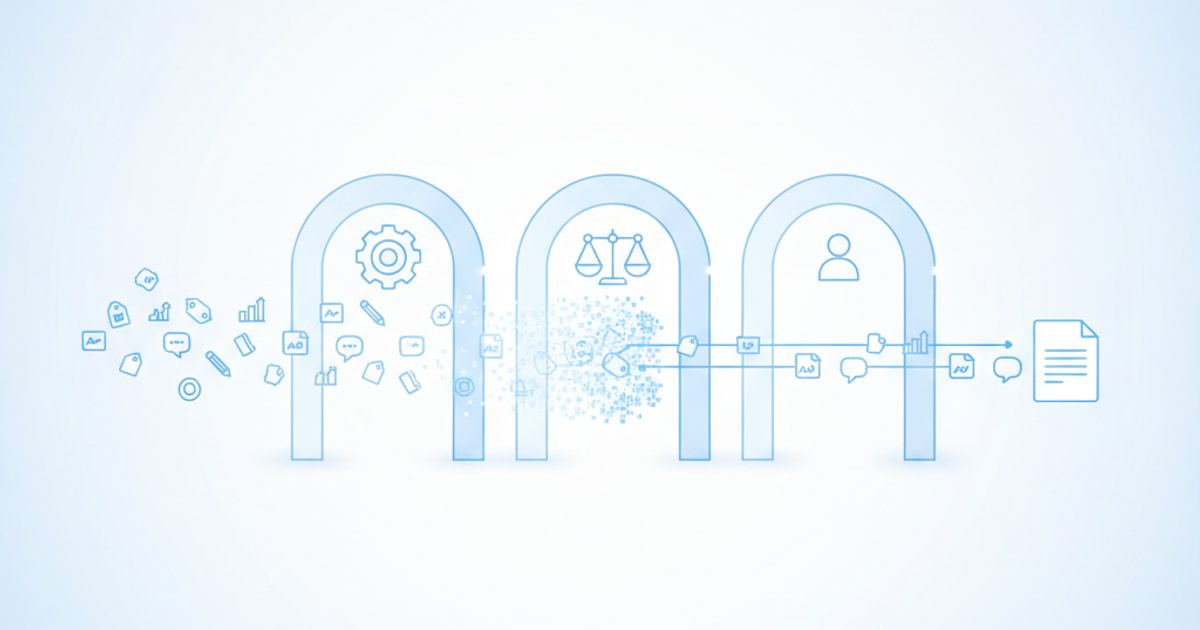
APP 1.7 requires your privacy policy to contain the information in APP 1.8 when three conditions are all met. The wording in the Act is:
"(a) the entity has arranged for a computer program to make, or do a thing that is substantially and directly related to making, a decision; and (b) the decision could reasonably be expected to significantly affect the rights or interests of an individual; and (c) personal information about the individual is used in the operation of the computer program to make the decision or do the thing that is substantially and directly related to making the decision."
APP 1.9 then widens what counts as a decision: making a decision "includes refusing or failing to make a decision", doing a thing includes refusing or failing to do it, and a decision can affect someone "whether the rights or interests of the individual are adversely or beneficially affected". For marketers, that means not showing an offer, not calling a lead back or not approving an account can each be a decision.
The table below puts each limb next to the OAIC's interpretation and what it means in a marketing stack.
| Limb | What the OAIC says | What it means for marketers |
|---|---|---|
| A computer program you arranged for | Interpreted broadly: rule-based processes, AI and machine learning, "software, apps or word-processing tools" and generative AI including chatbots. "Arranged for" covers in-house builds, procured third-party programs, configuring off-the-shelf software and relying on advisory outputs. | Your CRM rules, CDP audiences, ad platform bidding, pricing engine, chatbot, spreadsheet scoring formula and an AI assistant your staff use all qualify as programs. This limb is almost always met. |
| Substantially and directly related to a decision | "Substantially means where it is a key factor in facilitating the human's decision making; and directly means where the thing has a direct connection with making the decision." Advisory or determinative outputs can both qualify. | A lead score your sales team follows almost every time, or a price the system sets on its own, is likely substantial. A tool that drafts copy no one uses to decide anything about an individual is not. |
| Could significantly affect rights or interests | "More than trivial and must have the potential to considerably influence the circumstances or outcomes for the individual concerned." Vulnerability counts: a decision can be significant for a child or a person experiencing vulnerability even if it is minor for others. | This is the limb that decides most marketing cases. Access to credit, insurance, housing, health care, jobs, education, essential food, utilities and telecoms are on the OAIC's list. Choosing which shoe ad someone sees is not. |
| Uses personal information | The OAIC flowchart notes programs are only in scope "to the extent that an APP entity uses personal information to make or inform a decision". | Aggregate, de-identified reporting falls outside. Anything keyed to a customer record, email, device ID linked to a person, postcode plus purchase history and similar does not. |
What counts as a "computer program" for marketing?
Almost everything. The OAIC's APP 1 Guidelines (version 2.0, September 2026) say a wide range of technologies are likely to fall within the definition, "including commonly-used software, apps, or word-processing tools", and that generative AI tools used to generate text, images, videos or code, including chatbots, "all fall within the definition". The OAIC's own worked example is a spreadsheet formula that ranks people. So the question is never "is this AI?" but "does this program make or drive a significant decision about a person?"
The guidelines also set a clear limit: where a human makes the decision and uses software "for purposes other than facilitating the decision-making (such as using a word processing program to document a decision), this will not be captured".
What does "significantly affect" mean in practice?
The OAIC lists the rights and interests it would "generally" treat as significant: access to essential food and nutrition, health care, emergency or aged care, physical assistance, financial assistance, educational services, essential banking and credit, telecommunications, essential utilities, employment opportunities and housing. On advertising specifically, paragraph 1.63 of the guidelines says the use of computer programs "to target individuals with content and advertisements may have a significant effect on an individual if, for example, it results in differential and/or personalised pricing for provision of, or access to, significant goods or services, or limits access to employment opportunities."
Size of the effect is not the only test. In the OAIC fact sheet, a grocery platform charging between A$0.89 and A$3.72 more per item by postcode is treated as significant because the difference "can compound over time" and affects access to essentials like baby formula and medication.
Which marketing uses of AI are in scope?
Most content and visibility work is out of scope; decisions about price, eligibility, access and job opportunities are where the risk sits. The table applies the Act and the OAIC guidance to common marketing uses of AI. "Likely" columns are our reading of the published guidance, not a legal opinion, and the answer can change with your industry and audience.
| Marketing use of AI | Likely in scope? | Why | What to disclose if it is |
|---|---|---|---|
| AI-written blog posts, ad copy, images and video | Unlikely | The output is content for an audience, not a decision about an individual. Comparable to the word-processing exclusion in paragraph 1.40. | Nothing under APP 1.7. Separate OAIC advice on not entering personal information into public generative AI tools still applies. |
| SEO tools, AI visibility tracking, keyword and rank tracking | Unlikely | These analyse public web pages, search results and AI answers, not decisions about individual customers. | Nothing under APP 1.7. |
| Aggregate analytics and attribution (GA4 reports, MMM) | Unlikely | Reporting on groups informs budget decisions, not decisions about a person. | Nothing under APP 1.7; normal APP 1.4 content about collection still applies. |
| Broad segments, lookalikes and retargeting for everyday goods | Usually unlikely | Seeing or not seeing an ad for non-essential goods is rarely "more than trivial". Watch the vulnerability rule if outputs differ materially for vulnerable cohorts (paragraph 1.66). | Usually nothing; disclose if you target vulnerable groups with materially different treatment. |
| Programmatic advertising for credit, insurance, housing, health, education or utilities | Likely | The fact sheet lists "programmatic advertising relating to the decision to sell significant goods or services" as generally in scope. | Kinds of data used for targeting (e.g. location, browsing behaviour, inferred financial status) and that programs decide who is shown which offers. |
| Job ads targeted by algorithm | Likely | Paragraph 1.63 and the fact sheet's recruitment example: targeting that "limits access to employment opportunities" is significant. | Kinds of profile data used and that programs decide which candidates see roles. |
| Personalised or dynamic pricing (by postcode, device, history) | Likely for significant or essential goods; case by case otherwise | The fact sheet lists differential and personalised pricing "in the sale of significant goods" as generally in scope, and the flowchart uses differential pricing as its example of significant impact. | Kinds of data that move price (address, purchase history, demand) and that programs set or adjust prices offered to individuals. |
| Lead scoring that decides who sales contacts | Depends on what is being sold | Not contacting someone is a decision under APP 1.9. For a software demo request it is unlikely to be significant; for finance, insurance, housing, health or education it can be, especially if staff almost always follow the score. | Kinds of data scored (enquiry details, behaviour, firmographic data) and that programs prioritise or deprioritise enquiries. |
| Pre-qualification or eligibility checks in forms and funnels | Likely | Approving or rejecting credit, insurance or service applications is on the OAIC's list of in-scope decisions. | Kinds of data assessed and that programs approve, decline or route applications. |
| Automated account suspension, fraud or bot blocks at checkout | Possibly | The guidelines treat fraud tools that "may prevent access to significant goods or services" as disclosable, and give an account-suspension example that is significant for a vulnerable user. | Grouped description: fraud-prevention programs using identity, device and location data to permit, flag or deny access. |
| Chatbot that answers questions | Unlikely | A chatbot is a computer program, but answering FAQs is not a significant decision. | Nothing under APP 1.7; OAIC advises labelling public chatbots as AI. |
| Chatbot or workflow that approves refunds, credits or escalations | Possibly | The OAIC uses automated refund approval and automatic complaint escalation as examples of "arranged for". Significance depends on the amount and the person. | Kinds of data used and that programs approve or decline refunds or route complaints. |
| Product recommendations and personalised content on site | Unlikely for most retail | Recommending products is not usually significant unless it changes price or access to essentials. | Usually nothing; disclose if recommendations gate access or pricing for essential goods. |
A note on stale advice: in April 2026, before the OAIC published anything final, ADMA's briefing for advertisers said most automated processes that simply facilitate ad transactions would not meet the bar. That is still a fair description of everyday programmatic buying for ordinary goods. But the OAIC's September fact sheet now names programmatic advertising tied to the sale of significant goods or services as generally in scope. If your category is lending, insurance, property, health, education, energy or telecoms, plan on the narrower reading. Allens' October 2026 analysis makes the same point: the guidance gives no further help on advertising for significant goods, which "raises the question of where the line sits for targeted advertising generally".
For context on where AI already sits in Australian marketing stacks, see our roundup of AI tools Australian businesses use and the wider AI SEO trends in Australia.
Does a human review take a decision out of scope?
Not automatically. The fact sheet says a decision "may be within scope of the transparency obligation even where a computer program output does not replace the entire decision-making process or is subject to human review", and that the OAIC considers machine learning or generative AI outputs used in significant decisions "would generally fall within scope of the transparency obligation unless subject to extensive human oversight and control".
The guidelines list the factors that decide whether an advisory output is "substantially and directly related":
- how much staff rely on the output (the more they follow it, the more determinative it is)
- whether a human can override it, and how often they actually do
- whether the output is advisory or determinative
- whether the decision-maker can see what the program did and why
- how deeply the program is built into the workflow
In the OAIC's example, managers use a generative AI tool to suggest bonuses, with HR oversight and written director approval. It is still in scope because the output is relied on as a key factor. It would only drop out if staff interrogated outputs, set narrower parameters, used other evidence and documented why they diverged. For a sales team that "reviews" an AI lead score but follows it nine times in ten, that is a useful benchmark.
Who is responsible when the AI belongs to a vendor?
You are, if you use it to make the decision. The guidelines say the OAIC "generally expects that the APP 1.7-1.9 transparency obligation typically remains with the APP entity who is using personal information to make a decision", and that entities "may still be required to comply with APP 1.7 where they have a contractual arrangement in place with another entity who provides them with a computer program". Configuring an off-the-shelf tool or relying on its recommendations counts as "arranged for".
The OAIC also expects software providers to "provide clear, high-level information about how their software can be used to make decisions" so that customers can write their policies. In practice, ask your ad platform, CDP, pricing and CRM vendors for that description now. ADMA's view is that in walled gardens the obligation generally sits with whoever's data drives the decision: the advertiser for its own first-party data, the platform for its own. That is an industry position, not OAIC guidance, so treat it as a starting point for your contract review.
What must your privacy policy say about automated decisions?
If you are in scope, APP 1.8 requires three things in your privacy policy:
- the kinds of personal information used in the operation of the computer programs
- the kinds of decisions made solely by those programs
- the kinds of decisions where the program does a thing "substantially and directly related to making the decision"
The OAIC adds expectations about how it is written. The information should be in plain language, grouped logically, specific enough "to be meaningful to a reasonable person", structured so people can ask for more, and "framed in a way that allows the information and the decision to be challenged or contested". You can group decisions and data types, but sensitive information such as health information or biometric templates must be called out clearly rather than buried under a broad label.
There is a narrow exclusion for commercial-in-confidence information. You can keep how a model weights its inputs private if disclosure would genuinely harm you, but not the fact that you use personal information to make the decision. Corrs' October 2026 summary puts it simply: businesses can usually protect how a tool works, but not that it is used.
What does a compliant section look like?
The OAIC's examples use a short section headed "Decisions made by computer programs" with two lists: the kinds of personal information, then the kinds of decisions. Adapted to a hypothetical online insurance comparison business, the structure looks like this (an illustration of the format, not wording to copy):
Decisions made by computer programs. We use computer programs, including machine learning tools supplied by our technology partners, that use the following kinds of personal information: contact and identity details, your postcode, the answers you give in our quote forms, your browsing behaviour on our site and your previous enquiries. These programs make the following kinds of decisions on their own: which quotes and prices are displayed to you, and whether an enquiry is eligible for a call-back. They also help our staff decide which enquiries to prioritise for follow-up. You can contact us to ask for more information about these decisions.
Keep the section true. If your systems do something the policy does not mention, the policy is non-compliant no matter how well it reads.
Does the small business exemption apply?
Yes, for now. The ADM rule sits inside the Australian Privacy Principles, so it only binds APP entities. The OAIC's small business page still says "A small business is one with an annual turnover of $3 million or less", and most such businesses are outside the Act. The exemption has not been removed by the 2024 Act, and none of the tranche 2 summaries we reviewed report it being repealed.
The exemption has limits that catch marketers more often than they expect. A small business is covered regardless of turnover if it:
- trades in personal information, such as buying or selling contact lists
- provides a health service
- is related to a business that is covered by the Act
- provides services under a Commonwealth contract
- is a credit reporting body, operates a residential tenancy database or is accredited under the Consumer Data Right
- is a reporting entity under the AML/CTF Act
- has chosen to opt in
If you run an agency under A$3 million that builds automated pricing or eligibility funnels for larger clients, your clients are almost certainly APP entities and will need the information from you.
What happens if your privacy policy is non-compliant?
Breaching APP 1.7 can now attract an infringement notice without going to court. Item 87 of the 2024 Act added APP 1.7 to the list in section 13K of the Privacy Act, the civil penalty provision for which the OAIC can issue infringement and compliance notices. Section 13K sets a maximum of 200 penalty units, and for a listed corporation the infringement notice amount is 200 penalty units per alleged contravention.
The Commonwealth penalty unit is A$364 for contraventions on or after 1 July 2026 (it was A$330 before), so 200 units is A$72,800. That is why figures differ between sources: the OAIC's December 2025 announcement quoted penalties of "up to $66,000", calculated at the earlier rate. Serious interferences with privacy are dealt with under separate provisions with much higher maximums.
The OAIC is already checking privacy policies. In its December 2025 announcement, it said its first compliance sweep would begin in the first week of January 2026, covering about 60 businesses across six sectors: rental and property, chemists and pharmacists, licensed venues, car rental companies, car dealerships, and pawnbrokers and second-hand dealers, assessed against APP 1.4. Privacy Commissioner Carly Kind said: "The first building block of better privacy practices is a clear privacy policy." As of 2 November 2026 we could not find published outcomes of that sweep, and the OAIC has not announced an ADM-specific sweep. Expect privacy policies to stay a target once the new content requirement is live.
Note what the rule does not do. As Allens points out, it is "a transparency measure only": no right to contest a decision and no duty to notify individuals directly.
A 10-step audit checklist for your marketing stack
Run this before 10 December 2026 and keep the working notes. The steps follow the order of the OAIC flowchart.
- Confirm you are an APP entity. Check turnover and the exceptions above, including related bodies and trading in personal information.
- Inventory every program that touches customer data. Ad platforms, CDP and audiences, CRM and lead scoring, pricing and promotions engines, chatbots, fraud and bot tools, form logic, plus any AI assistants staff use without IT approval. HWL Ebsworth flags this "shadow AI" as a common blind spot.
- Write down the decision each one makes or informs. Include the negative versions: who is not shown an offer, not contacted, not approved, not given a discount.
- Remove the obvious non-decisions. Content generation, SEO and AI visibility tools, and aggregate reporting usually drop out here.
- Test significance. Does the decision touch price or access to credit, insurance, housing, health, employment, education, essential goods, utilities or telecoms? Could it treat children or vulnerable people materially differently?
- Test "substantially and directly". For advisory outputs, record how often staff follow them, whether override is realistic, and whether they can see why the program produced its output.
- List the kinds of personal information each in-scope program uses. Flag sensitive information and inferred data separately.
- Get vendor descriptions in writing. Ask each provider for the high-level description the OAIC expects them to supply, and check your contracts say who holds the decision-making judgement.
- Draft and publish the new privacy policy section. Use the two-list structure, plain language and a contact route for questions, and make sure it matches what your systems actually do.
- Set a review trigger. Assign an owner and re-run steps 2 to 9 whenever you add a tool, switch on a new AI feature or a vendor changes how its product decides.
A simple worksheet keeps the audit consistent across teams:
| Column | What to record | Example entry |
|---|---|---|
| Program and owner | Tool name, vendor, internal owner | Quote engine, in-house, Growth team |
| Decision | What it decides or recommends, including refusals | Sets the premium shown; hides some products by postcode |
| Solely or assisted | Program decides alone, or staff rely on it | Solely |
| Significance | Which right or interest, and any vulnerable cohort | Access to insurance; price differences by area |
| Personal information used | Kinds of data, flag sensitive or inferred | Postcode, age, claims history (self-reported) |
| Outcome | In scope, out of scope, or cautious inclusion | In scope: disclose in policy section |
| Evidence | Where the reasoning and vendor material is kept | Vendor statement on file; review date set |
Where you are unsure, the OAIC's advice is explicit: entities in doubt "should take a cautious approach and include information in their APP privacy policy necessary to comply with APP 1.8 requirements".
What else should marketers fix while they are in the policy?
Three related obligations are worth handling in the same pass:
- Generative AI inputs. The OAIC's guidance on commercially available AI products recommends, as best practice, that businesses "do not enter personal information, and particularly sensitive information, into publicly available generative AI tools", and treats personal information inferred or generated by AI as a collection under APP 3.
- Chatbot labelling. The same guidance says public-facing AI tools such as chatbots should be "clearly identified as such to users".
- Direct marketing opt-outs. APP 7 opt-out requirements sit on the same section 13K list as APP 1.7, so an unsubscribe flow that does not work carries the same infringement-notice risk.
If AI tools also drive your measurement, our guide to tracking AI referral traffic in GA4 covers that side, which works on aggregate data rather than decisions about individuals.
What is deferred to tranche 2 of the Privacy Act reforms?
The bigger changes are still in draft. On 31 August 2026 the Attorney-General's Department released an exposure draft of the Privacy Amendment (Personal Data Protection) Bill 2026, with submissions closing on 18 September 2026. The department says the Bill "remains subject to further consideration by government", and no start date has been announced.
According to MinterEllison's summary of the draft, the proposals most relevant to marketers are:
- a requirement that collection, use and disclosure be "fair and reasonable in the circumstances", with the best interests of the child as a primary consideration
- consent before "trading" personal information, which includes disclosure for direct marketing purposes
- a simple means to opt out of direct marketing, with a carve-out for ad-supported services that give users a genuine choice
On automated decisions specifically, HWL Ebsworth notes the Government has indicated a likely further right for individuals to request meaningful information about how substantially automated decisions with legal or similarly significant effect are made. None of the summaries of the August 2026 draft we reviewed confirmed whether that right is included, and the small business exemption is not reported as changing. Treat the 10 December disclosure rule as the only ADM obligation that is certain today.
Where AI Rank Lab fits
Disclosure: AI Rank Lab is our product. Tools like ours analyse public web content, search results and AI answers to show how a brand appears in ChatGPT, Gemini and Google's AI features; they do not make decisions about individual customers. That is our reading of the test, not a compliance statement about any product, including ours. If you are working on how your brand shows up in AI search, including in Google AI Overviews in Australia, you can see how AI Rank Lab tracks brand visibility. For anything about your privacy policy, speak to a qualified privacy lawyer and read the OAIC guidance directly.
Get a free AI ranking consultation
Want your brand to show up when ChatGPT, Gemini and Perplexity answer questions in your market? Tell us about your site and our team will send a personalized strategy.


