


Local Search Is Changing: AI Is Now Part of the Decision Journey
Local business owners have been laser-focused on Google Business Profile, local pack rankings, and Google Maps for years. That remains important - Google organic local search is still the dominant channel for most local businesses. But a growing segment of local service queries now starts with a conversational AI engine question. "What is a good plumber in Austin?" or "find me a reliable mechanic near downtown Chicago" or "recommend a family dentist in my area" are queries that users are asking ChatGPT, Perplexity, and increasingly Google's own AI features with conversational intent.
Local AEO (Answer Engine Optimization for local businesses) is the set of tactics that improve how AI engines find, understand, and recommend local businesses in response to these queries. It overlaps with traditional local SEO but requires different signals - and most local SEO strategies do not yet address it.
How AI Engines Handle Local Queries
AI engines handle local queries differently than traditional search engines, and understanding the mechanism determines the right optimization strategy:
Real-time web retrieval (Perplexity, Google AI Mode)
Perplexity and Google's AI features actively fetch local content at query time. They read review sites, local directories, and business websites to generate local recommendations. For these systems, the optimization path is similar to traditional local SEO: your business needs to be listed accurately in the sources these systems trust (Google Business Profile, Yelp, TripAdvisor, local directories) and your website needs to have accurate, structured local information.
Training data recommendations (ChatGPT base)
ChatGPT's base model (without Browse) recommends local businesses based on what it learned during training - which means it tends to recommend well-known establishments with a significant web presence: businesses mentioned in articles, reviews, and local coverage. A newer or smaller local business may be invisible to base ChatGPT regardless of its Google rankings.
Google AI Overviews for local
Google's AI Overviews appear for local queries less frequently than for informational queries, but their appearance is growing for "how to find" and evaluative local queries ("how do I choose a good plumber," "what to look for in a dentist"). Optimization for Google AI Overviews on local queries follows traditional local SEO combined with FAQPage schema for service-related questions.
The Core Local AEO Signals
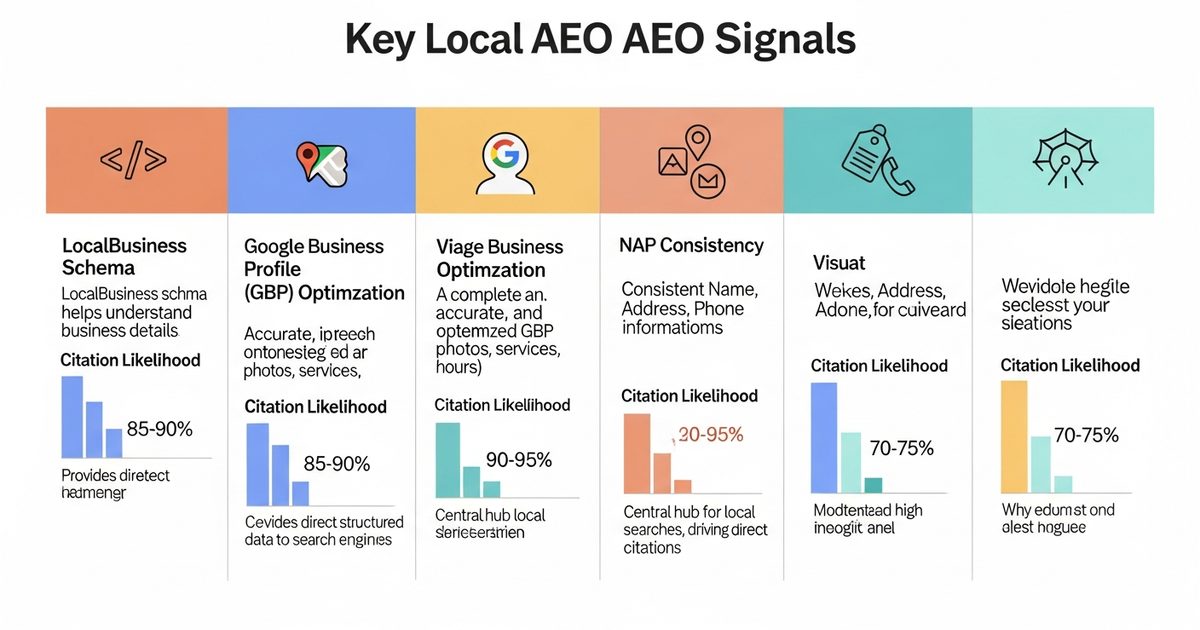
1. LocalBusiness Schema
LocalBusiness schema is the structured data type that explicitly tells AI engines and search engines what your business is, where it is located, what it does, and when it operates. This is the local equivalent of the Organization schema covered in other guides - it defines your business as a citable entity.
Key LocalBusiness schema fields for local AEO:
- @type: Use the most specific sub-type available (Dentist, Plumber, Restaurant, AutoRepair, etc.) - not generic LocalBusiness
- name: Exact business name as it appears on your Google Business Profile and all directories
- address: PostalAddress with streetAddress, addressLocality, addressRegion, postalCode, addressCountry
- telephone: Your primary contact number
- openingHoursSpecification: Your current hours - AI engines use this to recommend businesses that are open
- priceRange: $ through $$$$ - helps AI engines match recommendations to budget queries
- aggregateRating: Average rating and review count from customer reviews
- hasMap: Google Maps URL for your location
- servesCuisine: (for restaurants) or equivalent service descriptor
2. NAP Consistency
NAP (Name, Address, Phone number) consistency across all online listings is a foundational local AEO signal. AI engines that aggregate information from multiple sources need consistent NAP to correctly identify and cite the same business entity. If your name appears as "Joe's Plumbing" on your website and "Joe's Plumbing Services LLC" on Yelp and "Joseph's Plumbing" on a local directory, AI engines may not correctly merge these into a single entity - reducing citation confidence.
Run a NAP consistency check across your Google Business Profile, Yelp, TripAdvisor, Facebook, Apple Maps, Bing Maps, and major local directories. Fix inconsistencies before optimizing other signals.
3. Review Volume and Quality
AI engines use review data extensively for local recommendations. A business with 200 reviews averaging 4.6 stars is a confident recommendation; a business with 3 reviews averaging 4.5 stars is not - even if the average is similar. Volume and recency matter alongside average rating.
For AI engine citation specifically, review content that matches query language matters. If reviewers describe your plumbing business as "emergency plumber," "responsive," "fixed a burst pipe at 2am," those descriptions match emergency plumbing queries. Your post-service follow-up should prompt satisfied customers to leave specific reviews rather than generic positive sentiment.
4. Service Area Content with FAQPage Schema
Beyond your business homepage, creating content that answers the local service questions AI engines receive drives citation for specific service queries. Examples:
- "What do plumbers typically charge for water heater replacement in Austin?" - FAQPage schema on a page about your water heater services with local pricing guidance
- "What should I look for when choosing a dentist for my family?" - FAQPage schema on a new patient page with what makes your practice a good choice
- "How long does a dental cleaning take?" - Direct answer content that matches the conversational queries potential patients ask AI engines
5. Google Business Profile Optimization
For AI engines that use Google's data (Google AI Overviews, Google AI Mode, and systems that incorporate Google's knowledge graph), your Google Business Profile is a primary source of local entity data. Optimize it specifically for AI citation:
- Category accuracy: Use the most specific primary category available - not generic "Professional Service"
- Description: Write the business description as if explaining to a new patient/customer what makes your business the right choice - this language may be used by AI engines in recommendations
- Q&A section: Answer the questions your customers ask most frequently - Google's AI features use this content for local recommendation responses
- Posts: Regular Google Business Profile posts with service updates and current offers improve freshness signals for AI features
Local Industry Tactics
Restaurants and Food Service
Restaurant AI recommendations are driven by cuisine type specificity, dietary accommodation coverage (vegan, gluten-free, halal), occasion context ("best for a date," "good for groups"), and neighborhood specificity. Your website and schema should address all these dimensions. The Q&A section on Google Business Profile is particularly important for restaurants - diners ask AI engines about dietary options, parking, reservation availability, and price range constantly.
Healthcare Providers
Healthcare AI citation requires strong E-E-A-T: provider credentials (MD, DDS, licenses) in Article schema on your team pages, insurance acceptance listed clearly, specific conditions and procedures covered, and whether you accept new patients. AI engines are conservative about healthcare recommendations without clear credentials - make yours explicit in structured data.
Home Services (Plumbers, Electricians, HVAC)
Home service AI recommendations are heavily driven by emergency availability, service area specificity, licensing/bonding status, and review recency. Content that directly answers "how much does [service] cost in [city]?" or "what should I do if [emergency situation]?" with your contact information visible drives local AEO citation for emergency intent queries.
Professional Services (Law, Accounting, Consulting)
Professional service AI citations are dominated by specialization specificity and credential transparency. A family law attorney focused on divorce mediation gets cited for divorce-related queries; a general attorney with no specialization content does not. FAQPage schema covering common questions in your practice area, combined with clearly listed credentials and bar admissions, drives citation for practice-area-specific queries.
Measuring Local AEO Performance
Local AEO measurement is harder than national AEO because location context varies by user. Practical approaches:
- Test your business category queries manually in ChatGPT, Perplexity, and Google AI Overviews for your service area - "best [your service type] in [your city]" and "[your service type] near me" with your location set
- Track AI referral traffic from Perplexity.ai and chat.openai.com in Google Analytics 4
- Monitor Google Business Profile Q&A for AI-sourced queries that you can use to improve your FAQ content
- Use AI Rank Lab's audit tool to check LocalBusiness schema validity and NAP signal consistency
For most local businesses, the AI Rank Lab starter plan provides enough citation tracking and audit coverage to manage local AEO without a specialist.
Conclusion
Local AEO is still early, but the trajectory is clear: AI engine queries for local services are growing, and the businesses that establish their AEO signals now will be well-positioned as that traffic grows. The fundamentals are not dramatically different from good local SEO - accurate NAP, strong reviews, Google Business Profile optimization - but they require extension into structured data (LocalBusiness schema), direct answer content (FAQPage schema for local service questions), and explicit AI bot access.
Run the AI Rank Lab audit on your local business website to see where your current AEO signals stand. The gaps are usually achievable - a one-time schema implementation and content update can move a local business from invisible to recommended in AI local search within a few weeks.
Frequently Asked Questions
How do local businesses get cited in AI answer engines like ChatGPT and Perplexity?▾
What is LocalBusiness schema and do I need it?▾
Does Google Business Profile help with AI search citations?▾
How important are online reviews for local AI recommendations?▾
What content should local businesses create for AI search?▾
Get a Free AI Ranking Consultation
Want to improve your brand's visibility in AI search engines like ChatGPT, Gemini, and Perplexity? Fill out the form and our experts will create a personalized strategy for you.

Written by
Devanshu
Chief Marketing Officer & AI Search Optimization Architect
Digital Marketing Strategist & Pioneer in SEO, Answer Engine Optimization (AEO), and Generative Engine Optimization (GEO).


