


The New Imperative: Optimizing for AI Engines
Search as we knew it is changing at a pace most marketers underestimated. ChatGPT now processes over 1 billion queries every week, and it accounts for 87.4% of all AI referral traffic to websites. Gartner projects a 25% decline in traditional search traffic by 2026. At the same time, 60% of searches already end without a single click - users get their answer inside the search interface and never visit a website.
In this environment, ranking on page one of Google is no longer enough. The brands winning in 2026 are the ones being cited inside AI-generated answers. When an AI engine mentions your brand, the payoff is substantial: brands cited by AI see 35% more organic clicks and 91% more paid clicks. And when AI-referred visitors do land on your site, they convert at 2x the rate of organic search visitors.
This shift has created demand for an entirely new category of marketing software: AEO (Answer Engine Optimization) and GEO (Generative Engine Optimization) tools. These platforms help you measure where your brand stands in AI-generated answers, diagnose why you are being overlooked, and fix the content issues that prevent citation.
In this guide, we cover the 7 best AEO and GEO tools for 2026, with a breakdown suited to enterprise teams, mid-market companies, and agencies.
How We Evaluated These Tools
Not all AEO/GEO tools are equal. We assessed each platform across four capability dimensions:
Monitoring: Does it track how often and where your brand is cited by ChatGPT, Claude, Gemini, and Perplexity?
Auditing: Does it diagnose why your content is not being cited - missing schema, weak authority signals, poor FAQ coverage?
Optimization: Does it provide actionable content recommendations to improve citation rates?
Content delivery: Does it help you create or publish the optimized content?
We also assessed pricing accessibility, ease of onboarding, and whether the tool serves a specific segment better than others.
1. AI Rank Lab - Best Overall for Most Businesses
If you are a mid-market company or agency looking for the most complete AEO and GEO platform at an accessible price, AI Rank Lab is the clear leader in 2026.
AI Rank Lab was purpose-built for the AI search era. Unlike tools that bolt AEO features onto an existing SEO platform, AI Rank Lab was designed from the ground up to track, analyze, and improve brand visibility in AI engines. The result is a more coherent product experience and genuinely better diagnostic quality.
Monitoring: AI Rank Lab tracks your brand mentions across ChatGPT, Claude, Gemini, and Perplexity, plus Google AI Overviews and Google AI Mode - using a customizable library of industry prompts. You define the questions your target customers ask, and each time you run them the platform records which brands AI engines cite in response. Every run is stored for comparison over time, so you can spot trends, drops, and new citation opportunities.
Auditing: The platform's AEO audit analyzes your website for the structural and content factors that influence AI citation: FAQ coverage, structured data markup, entity clarity, topical authority, internal linking depth, and content freshness. Each issue is flagged with a severity level and a clear explanation of the impact on AI visibility.
Optimization: AI Rank Lab goes beyond diagnosis. It provides specific content recommendations - which pages to update, what questions to add, where to add schema - and tracks whether those changes improve your citation rate over time. This feedback loop is what separates it from pure monitoring tools.
Content delivery: The platform integrates with content workflows and supports direct publishing to WordPress. Teams can generate AEO-optimized content briefs and publish directly from the dashboard.
There is no ongoing free plan, but signup includes 100 free credits (no credit card), enough for a first AEO audit. Credit-based paid plans at airanklab.com/pricing scale to support multi-domain tracking and agency client management. For most businesses, AI Rank Lab delivers the complete monitoring-to-optimization stack at a fraction of the cost of enterprise alternatives.
Best for: Mid-market companies, digital agencies, and any business wanting a complete AEO + GEO platform without enterprise pricing.
2. Scrunch AI - Enterprise Citation Intelligence
Scrunch is an Australian-founded AI visibility platform that has grown a strong reputation among enterprise brands, particularly in the Asia-Pacific market. Its core strength is citation intelligence: deep tracking of how AI engines reference your brand across dozens of query categories.
Scrunch's dashboard is comprehensive and data-rich, surfacing citation share, sentiment analysis, competitor visibility comparison, and topic-level breakdown. Enterprise teams with dedicated analytics capacity will find the depth of data genuinely useful. The trade-off is complexity: onboarding takes longer than lighter tools, and the platform's value is most realized by teams with the bandwidth to act on detailed reports.
Scrunch does not publish pricing publicly; enterprise contracts are negotiated directly. For brands spending significantly on AI visibility consulting, the ROI can be strong, but mid-market teams should evaluate whether they have the internal capacity to leverage the platform fully.
Best for: Enterprise brands with dedicated AI marketing or analytics teams, especially in the Asia-Pacific region.
3. Adobe GenStudio with LLM Optimizer - Enterprise Content and GEO
Adobe's GenStudio suite added an LLM Optimizer module in late 2024, positioning the company as a full-stack enterprise GEO solution. For organizations already embedded in Adobe's Creative Cloud and Marketing Cloud ecosystems, this represents a natural extension.
The LLM Optimizer analyzes whether your brand's content - across website pages, product descriptions, and marketing assets - is structured in ways that AI engines can parse and cite accurately. It provides entity mapping, structured data recommendations, and content gap analysis against competitor citation patterns.
The integration with Adobe's broader creative workflow is a genuine advantage: content updates recommended by the optimizer can be actioned directly in Adobe Experience Manager without context-switching to another platform. For global enterprise teams managing thousands of content assets, this integrated workflow has real value.
The downside is the price point: Adobe GenStudio is an enterprise platform with enterprise pricing, making it inaccessible for mid-market and agency use without a large budget.
Best for: Large enterprises already in the Adobe ecosystem managing complex, multi-channel content at scale.
4. AthenaHQ - AI Visibility Research and Competitive Intelligence
AthenaHQ approaches the AEO space from a research and competitive intelligence angle. The platform excels at mapping the AI citation landscape for a given industry: who is being cited, for what topics, at what frequency, and how that changes over time.
For brands entering the AI visibility space and wanting to understand their competitive position before investing in optimization, AthenaHQ provides strong discovery value. Its topic modeling and prompt simulation features help content teams understand the question space that AI engines are answering in their industry.
Where AthenaHQ is weaker is in the operational optimization layer: it tells you a great deal about the landscape, but provides less specific guidance on how to change your content to improve citation. Teams using AthenaHQ typically pair it with a more operationally focused tool like AI Rank Lab for execution.
Best for: Enterprise and mid-market research and strategy teams needing deep competitive AI visibility intelligence.
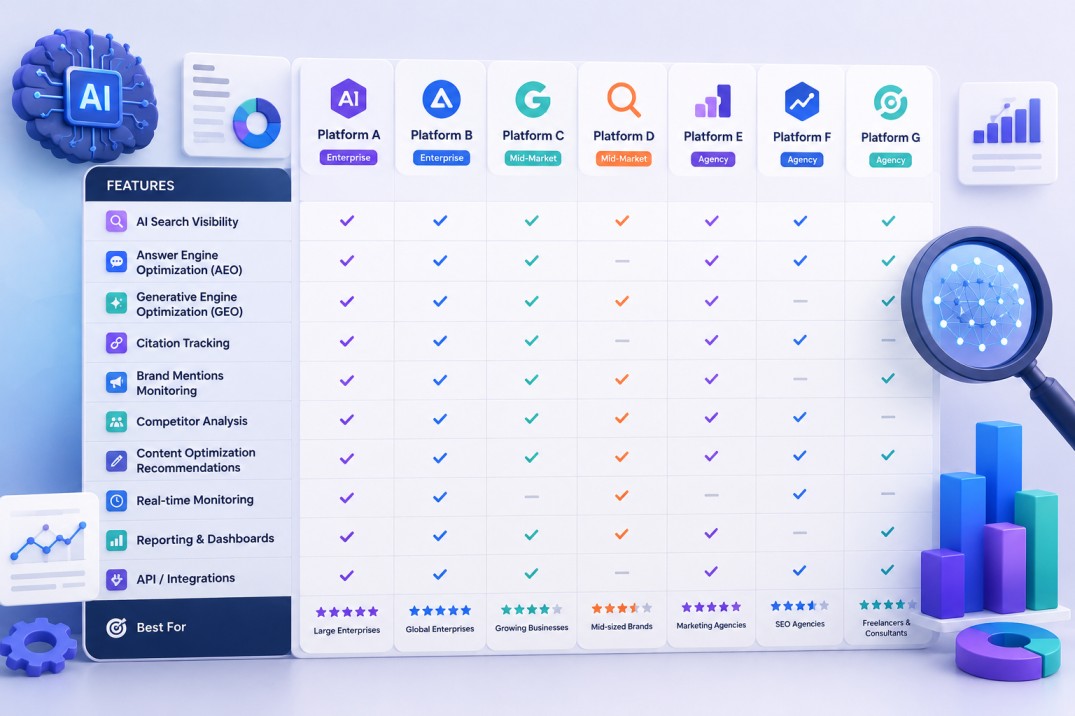
Feature comparison across the top AEO and GEO platforms in 2026
5. Peec AI - Real-Time AI Engine Monitoring
Peec AI is a focused monitoring tool that specializes in real-time tracking of brand mentions across AI engines. Where many platforms run batch queries on a scheduled basis, Peec AI emphasizes frequency and freshness of monitoring data, making it valuable for brands in fast-moving categories where AI engine responses can shift quickly.
The platform's alert system is a standout feature: teams receive notifications when citation rates change significantly, when a competitor gains or loses visibility, or when a new topic cluster becomes relevant to their brand. For PR and brand teams monitoring AI reputation in real time, Peec AI fills a clear need.
Peec AI is primarily a monitoring tool and does not provide deep optimization guidance. It works well as a real-time signal layer paired with a more comprehensive AEO platform like AI Rank Lab for strategy and content execution.
Best for: Brands needing real-time AI citation monitoring, particularly for reputation management and PR use cases.
6. Profound - B2B and Enterprise AI Visibility
Profound has built a strong reputation in the B2B enterprise segment, specifically for brands in technology, financial services, and professional services. Its positioning is around "AI share of voice" - measuring what percentage of AI-generated responses in your category mention your brand versus competitors.
The share-of-voice framing resonates with CMOs and brand teams who are accustomed to traditional share-of-voice metrics in paid media and PR. Profound's reporting translates AI citation data into the language of brand marketing rather than technical SEO, which can help internal advocacy for AEO investment.
Profound is strong on measurement and reporting but, like AthenaHQ, is primarily an intelligence platform. Optimization execution requires pairing it with content tools. Pricing reflects its enterprise positioning.
Best for: B2B enterprise brands, CMOs building internal business cases for AEO investment, technology and professional services sectors.
7. Semrush AI Toolkit - Broad SEO with AI Overlays
Semrush is not a dedicated AEO/GEO tool, but its AI toolkit additions in 2024-2025 make it worth including in an enterprise evaluation. For organizations that already rely on Semrush for traditional SEO - keyword research, backlink analysis, site audits - the AI-overlaid features add a layer of AEO-relevant insights without requiring a separate platform.
Semrush's AI features include content brief generation informed by AI search patterns, limited tracking of brand presence in AI Overviews, and integration with its existing keyword and content optimization workflows. The breadth of the platform is its strength: teams can move from traditional SEO analysis to AI content optimization within one environment.
The limitation is depth: Semrush's AEO features are supplementary to a traditional SEO platform, not a ground-up AEO solution. Teams serious about AI visibility optimization will find the dedicated AEO platforms provide significantly deeper capability.
Best for: Teams already heavily invested in Semrush wanting to add AI visibility features to an existing SEO workflow without adopting a new platform.
Enterprise vs Mid-Market vs Agency: Which Tool Fits?
Choosing the right AEO/GEO tool depends significantly on your organizational context:
Enterprise teams with dedicated analytics capacity and large content operations should evaluate Adobe GenStudio LLM Optimizer (if in the Adobe ecosystem), Profound (if B2B), Scrunch (if Asia-Pacific focused), or a combination of AthenaHQ for intelligence and AI Rank Lab for execution.
Mid-market companies need a platform that delivers the complete stack - monitoring, auditing, optimization, and content guidance - without requiring a large dedicated team to extract value. AI Rank Lab is the strongest fit here. It provides enterprise-grade insight with accessible onboarding and pricing that does not require a six-figure software budget.
Agencies managing multiple client accounts need multi-domain tracking, white-label reporting, and efficient workflow management. AI Rank Lab's multi-brand dashboard and white-label reports are built for this use case, with shared access, branded reports, and the ability to manage many domains from a single account.
The Four-Capability Stack Every Brand Needs
Regardless of which tool you choose, your AEO/GEO strategy requires coverage across four areas:
1. Monitoring: You cannot optimize what you cannot measure. Start by establishing a baseline of your current AI citation rate across the 15-20 prompts most relevant to your category. Track weekly.
2. Auditing: Understand why you are or are not being cited. Common issues include missing FAQ schema, insufficient topical authority on key questions, weak entity establishment (AI engines do not know clearly who you are), and thin or outdated content.
3. Optimization: Act on audit findings with specific content updates. The most impactful changes are typically: adding well-structured FAQ sections with schema markup, improving the clarity of your brand's entity description on key pages, and publishing direct-answer content that addresses the exact questions AI engines are asked about your category.
4. Content delivery: New content needs to reach AI engine indexes. Maintain fresh content publishing cadence, prioritize structured data on all new pages, and ensure your sitemap is current so AI engine crawlers find new content quickly.
Getting Started: A Practical Path
If you are new to AEO and GEO, the most practical starting point is a free audit. AI Rank Lab gives 100 free credits at signup (no credit card), enough to run your first AEO audit and one brand visibility prompt before committing to a paid plan.
The audit will surface the specific issues holding back your AI visibility. From there, you can prioritize a content update roadmap and begin tracking whether changes produce measurable citation improvement. Most brands see meaningful citation rate improvements within 60-90 days of implementing structured optimization recommendations.
The brands that start now will compound their AI visibility advantage over the next 12-24 months. The ones that wait will find the gap increasingly difficult to close as AI engines consolidate their understanding of which brands belong in which categories.
Conclusion
AEO and GEO tools are no longer optional for any brand that takes digital marketing seriously. With ChatGPT processing 1 billion+ queries per week and traditional search traffic declining, the marketing mix is shifting permanently toward AI-mediated discovery.
For most businesses, AI Rank Lab is the best starting point: it provides the complete monitoring, auditing, optimization, and content delivery stack at an accessible price. Enterprise teams with specialized needs can complement AI Rank Lab with dedicated intelligence platforms like Profound or AthenaHQ.
Start with your free audit at airanklab.com and get your baseline AI visibility score today. The data will show you exactly where the opportunity is and what to fix first.
Frequently Asked Questions
What is the difference between AEO and GEO?▾
Which AEO tool is best for small and mid-market businesses?▾
Do I need both an AEO tool and a traditional SEO tool?▾
How often should I track AI engine citations?▾
Is AI Rank Lab free to start?▾
Get a Free AI Ranking Consultation
Want to improve your brand's visibility in AI search engines like ChatGPT, Gemini, and Perplexity? Fill out the form and our experts will create a personalized strategy for you.

Written by
Devanshu
Chief Marketing Officer & AI Search Optimization Architect
Digital Marketing Strategist & Pioneer in SEO, Answer Engine Optimization (AEO), and Generative Engine Optimization (GEO).


