

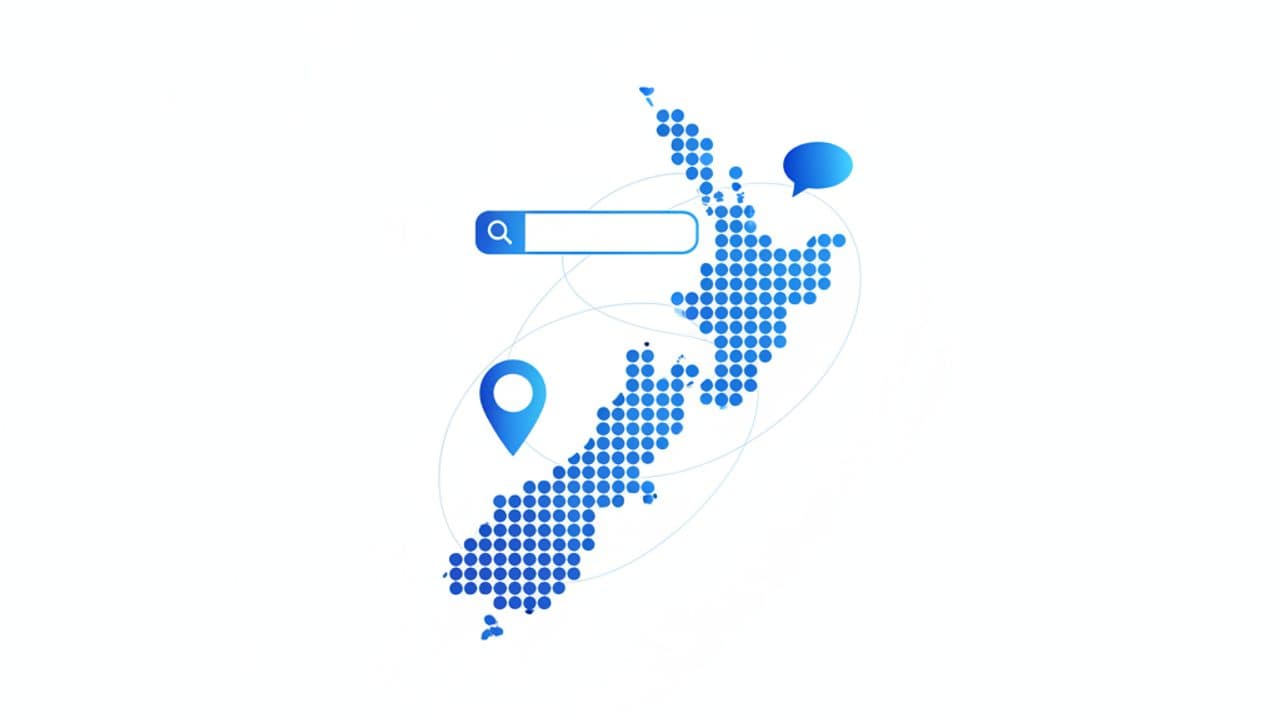
SEO in New Zealand works the same way it does anywhere: Google has to be able to crawl, understand and trust your pages. What is different is the market. It is small, Google handled 89% of New Zealand searches in October 2026, and Google's AI Overviews and AI Mode, plus ChatGPT, now answer many questions before anyone clicks. For most Kiwi businesses, SEO comes down to four jobs: a fast, indexable site on a domain that signals New Zealand, pages that answer the questions NZ customers actually ask, a complete Google Business Profile, and links and mentions from New Zealand sources.
This guide is the neutral version that the agency pages ranking for "SEO NZ" don't write. It covers the NZ search landscape with sourced numbers, the .co.nz vs .nz vs .com question using Google's own documentation, why keyword tools show near-zero volumes for NZ searches (with a snapshot of real NZ volumes), how AI answers change the work, a 90-day plan and when to hire help. Every figure and product detail was checked on 2 November 2026.
Key takeaways
- Google is the market. Google had 89.03% of NZ searches across all devices in October 2026 and Bing 7.66% (StatCounter). Optimise for Google first, then cover Bing cheaply.
- .co.nz and .nz are equal for SEO. Both sit under the .nz country code, which Google calls "a strong signal" that a site is meant for one country. Pick on brand, not rankings. Use .com only if you serve several countries.
- Keyword tools under-report New Zealand. Even "seo nz" shows only about 720 searches a month. Long-tail NZ searches often show 0-20. Plan by topic and check real queries in Search Console.
- AI answers use the same index. AI Mode launched in New Zealand on 22 August 2025, and Google says there are "no additional requirements" to appear in AI Overviews or AI Mode. Indexed, snippet-eligible, genuinely useful pages are the entry ticket.
- Measure AI visibility by country. Search Console's Generative AI performance report shows AI-feature impressions by page and country. It reached all sites by 31 August 2026.
What does the New Zealand search market look like in 2026?
New Zealand search is dominated by Google, has a higher desktop share than you might expect, and is increasingly answered by AI. The table pulls together the numbers that matter for planning. We cite the primary or closest-to-primary source for each one, because many NZ agency pages quote figures like "95% of searches" or "over 90%" without saying where they come from.
| Measure | Latest figure | Source | What it means for SEO |
|---|---|---|---|
| Google share of NZ searches (all devices) | 89.03% (October 2026) | StatCounter Global Stats | Google's rules and tools come first. |
| Bing, Yahoo, DuckDuckGo | 7.66%, 1.32%, 1.17% | StatCounter Global Stats | Small, but verifying your site in Bing Webmaster Tools takes minutes. |
| Web page views by device in NZ | 53.6% desktop, 43.5% mobile, 2.9% tablet (October 2026) | StatCounter platform share | Test on both. Google still indexes the mobile version of your pages, so mobile must be complete. |
| NZ businesses that report using AI | 82% (survey January-February 2026) | 2degrees and Deloitte Access Economics | Most use AI built into existing software. Your competitors can produce content faster, so quality and specifics are the differentiator. |
| Businesses in NZ, and share that are small | 612,417, of which 97% have fewer than 20 staff | business.govt.nz with Stats NZ | Most of your search competitors are small businesses too. Many categories are winnable without a big budget. |
| Google AI Mode in NZ | English, since 22 August 2025. Search Live (voice and camera) since 27 March 2026 | Google NZ, FutureFive | Longer, conversational questions. Google says early testers asked queries 2-3x the length of traditional searches. |
| ChatGPT use in NZ | Almost 10 million messages a day from NZ users | OpenAI research reported by IT Brief (September 2026) | ChatGPT is now a discovery channel, especially for local services and hospitality. |
| .nz domains registered | 767,053 (April 2026), of which 166,765 (about 22%) are direct .nz names | Domain Name Commission data via DomainCompare | .co.nz is still the familiar default. Direct .nz names are where the growth is. |
Two features of a small market shape everything below. First, competition is often light: outside Auckland and a few national categories, you are usually competing with a handful of local businesses. Second, data is thin. Keyword tools, rank trackers and industry benchmarks are built on samples that are much smaller for New Zealand than for the US or UK, so you have to rely more on your own Search Console data and customer conversations.
Is .co.nz or .nz better for SEO than .com?
For a business that serves only New Zealand, .co.nz and .nz are equally good, and both send a clearer country signal than .com. Google's documentation on managing multi-regional sites says country-code top-level domains "provide a strong signal to both users and search engines that your site is explicitly intended for a certain country." Both .co.nz and a direct .nz name sit under the .nz country code, so there is no ranking reason to prefer one over the other. Choose the one your customers will remember, register the other, and redirect it.
A .com is the better choice when you sell into more than one country, for example New Zealand and Australia. In that case, use country folders such as /nz/ and /au/ with hreflang annotations, which Google still supports. You cannot fall back on the old Search Console country setting: Google has deprecated the International Targeting report and says the ability to target results to specific countries "is no longer supported." If you are planning multiple markets or languages, our guide to multilingual and multi-country SEO for AI search covers the URL decisions in detail.
| Your situation | Domain choice | Why |
|---|---|---|
| NZ-only business, new site | .co.nz or .nz (own both, 301-redirect one) | Strongest country signal. Equal for Google, so decide on brand. |
| NZ-only business already on a .com that ranks | Usually keep the .com | A domain migration risks losing rankings for a modest gain. Add NZ signals instead: NZ address and phone, NZ$ prices, GST wording, NZ service areas. |
| Selling into NZ and Australia | .com with /nz/ and /au/ folders plus hreflang, or separate .co.nz and .com.au sites | Folders share one domain's authority. Separate ccTLDs are clearer to users but cost more to run. |
| Charity or community group | .org.nz | Same .nz country signal, and the suffix tells visitors what you are. |
| Thinking of a keyword domain (e.g. bestplumberauckland.co.nz) | Don't, for SEO reasons | Google's SEO Starter Guide says keywords in the domain "have hardly any effect beyond appearing in breadcrumbs." |
Two related myths: hosting in New Zealand and "geo" meta tags. Google lists server location as a signal but calls it "not a definitive signal", and says it ignores locational meta tags such as geo.position. Host where your site is fastest for NZ visitors. That usually means a nearby server or a CDN, for speed rather than as a geotargeting trick.
How do the four parts of SEO apply to a New Zealand business?
SEO has four working parts: technical health, content, local presence and links. The mechanics are global. The NZ specifics are in the details: which words people use, which directories matter and which sites are worth a link.
Technical SEO: can Google and AI crawlers reach your pages?
Nothing else matters until your important pages are indexed. Google's guidance on AI features and your website says a page must be "indexed and eligible to be shown in Google Search with a snippet" to appear as a supporting link in AI Overviews or AI Mode. That is the same bar as a normal blue link. Check these first:
- Indexing: In Search Console's Page indexing report, confirm every service and location page is indexed. Look for stray noindex tags, which are common on sites built from templates or staging copies.
- Crawler access: Make sure robots.txt does not block Googlebot or OAI-SearchBot. OpenAI's crawler documentation says OAI-SearchBot "is used to surface websites in search results in ChatGPT's search features", and that robots.txt changes take about 24 hours to apply.
- Speed and mobile: Check Core Web Vitals, including Interaction to Next Paint (INP), in Search Console. Check that the mobile version carries the same content as desktop.
- Duplicates: One URL per page. Watch for http/https, www/non-www and .nz/.co.nz duplicates that were never redirected.
An audit tool speeds this step up. AI Rank Lab's SEO, AEO and GEO audit crawls a site, scores technical SEO alongside answer-engine readiness and lists fixes in priority order. Google Search Console's free reports cover the essentials if you prefer to work manually.
Content: write for how Kiwis search and speak
The best NZ content answers the questions your customers ask, in their words, with New Zealand specifics. Generic content written for a global audience loses to a local page that says what things cost in NZ$, how long they take here and which rules apply. In practice:
- Use NZ vocabulary. Write "section", "bach" or "crib", "tradie", "council consent" and "GST-inclusive" where your customers would. Use NZ spelling consistently, and write place names the way locals search for them, including macrons where they are used (Taupō, Whangārei).
- Give concrete specifics. Price ranges in NZ$, timeframes, areas served, licences and memberships. These are the facts AI answers can quote. Vague pages give them nothing to cite.
- Answer full questions. AI Mode testers asked queries 2-3x longer than traditional searches, according to Google's NZ launch post. Put a plain, direct answer at the top of each service page, then the detail.
- Write location pages only for real locations. A page per suburb with the name swapped in is scaled content abuse under Google's spam policies. One genuine page per branch or service area, with local detail, beats twenty copies.
Local: Google Business Profile and NZ directories
For anyone serving customers in a town or region, Google Business Profile is the most important SEO asset after the website. Google says local results are based mainly on relevance, distance and prominence, and that "there's no way to request or pay for a better local ranking on Google." Complete every field, choose the right primary category, add real photos and reply to reviews.
New Zealand also has its own review and trade directories that rank in Google and appear in AI answers about local services. Builderscrack showed 16,100 verified tradies and 358,183 verified reviews on its homepage when we checked on 2 November 2026. NoCowboys, Finda and Yellow were also online that day. Their sites block automated checks, so confirm listing terms yourself. Keep your business name, address and phone number identical on every listing. We keep local to this one section on purpose. For how AI assistants pick local businesses, see how "near me" AI answers choose businesses. AI Rank Lab's local SEO checks can flag profile and consistency gaps.
Links and mentions: earn them from New Zealand sources
Links still matter because they are how search engines discover and weigh pages. Google's SEO Starter Guide notes that "the vast majority of the new pages Google finds every day are through links." In New Zealand, the realistic, durable sources are:
- Industry associations and registration bodies you already belong to (member directories often link out)
- Suppliers, manufacturers and partners who list stockists or installers
- Local news and community sites, earned with genuinely newsworthy work, data or events
- Local business associations, chambers of commerce and council business listings
- Sponsorships of local clubs and events that publish sponsor pages
Avoid paid link packages, which breach Google's spam policies. In a small market, a handful of relevant NZ links usually moves the needle more than hundreds of irrelevant ones.
Why do keyword tools show tiny or zero search volumes for New Zealand?
Keyword tools under-report NZ searches because most specific queries fall below the threshold the tools can measure. Google's own Keyword Planner help says keywords "with very low search volumes" are not "discoverable or forecastable", and third-party tools estimate volumes from samples that are thin for a small country. So a query that shows "0-10" can still bring you real customers every month.
Here is a real snapshot. We pulled Google search volumes for NZ SEO terms through AI Rank Lab's keyword research with the location set to New Zealand on 2 November 2026:
| Keyword (location: New Zealand) | Monthly searches | Difficulty (0-100) | CPC | Note |
|---|---|---|---|---|
| seo auckland nz | 1,000 | 30 | NZ$31.49 | Largest term in the set |
| seo nz | 720 | 25 | NZ$24.27 | An AI Overview was shown for this query |
| seo optimisation nz | 720 | 20 | - | NZ spelling |
| seo marketing nz | 720 | 20 | - | |
| seo services nz | 480 | 25 | - | |
| seo wellington | 170 | 0 | NZ$7.14 | Up 24% year on year |
| local seo nz | 40 | 0 | - | Up 33% year on year |
| seo prices nz / seo pricing nz / seo packages nz | 10-30 each | 0 | - | Buyers clearly ask this, yet the tool barely registers it |
| small business seo nz, ai seo nz | 0-20 | - | - | No measurable demand |
Two lessons. Even the head term for an entire industry is in the hundreds, not thousands. And the long-tail questions buyers obviously ask, such as what SEO costs, barely register. If you only write for terms with visible volume, you will skip most of what NZ customers search. Work around it like this:
- Use Search Console as your keyword tool. In the Performance report, filter Country to New Zealand and read the Queries tab. These are real searches that already show your site.
- Plan by topic, not by keyword. One strong page per service answers dozens of variants. Google's AI features expand a question into many related searches (query fan-out), so coverage beats exact matching.
- Borrow ratios, not numbers. Australian or UK volumes tell you which of two phrasings is more common. They don't tell you NZ demand.
- Compare phrasings in Google Trends with the region set to New Zealand, for example "optimisation" vs "optimization", or a te reo Māori vs English place name.
- Mine your inbox. Quote requests, phone calls and the People Also Ask box are the long tail that tools can't see.
- If you need exact numbers, run a small Google Ads test. Impression data from a live campaign is measured, not estimated.
AI Rank Lab's keyword planner shows volume, difficulty and whether an AI Overview appears, by country. That is how we built the table above.
How do AI Overviews, AI Mode and ChatGPT answer New Zealand searches?
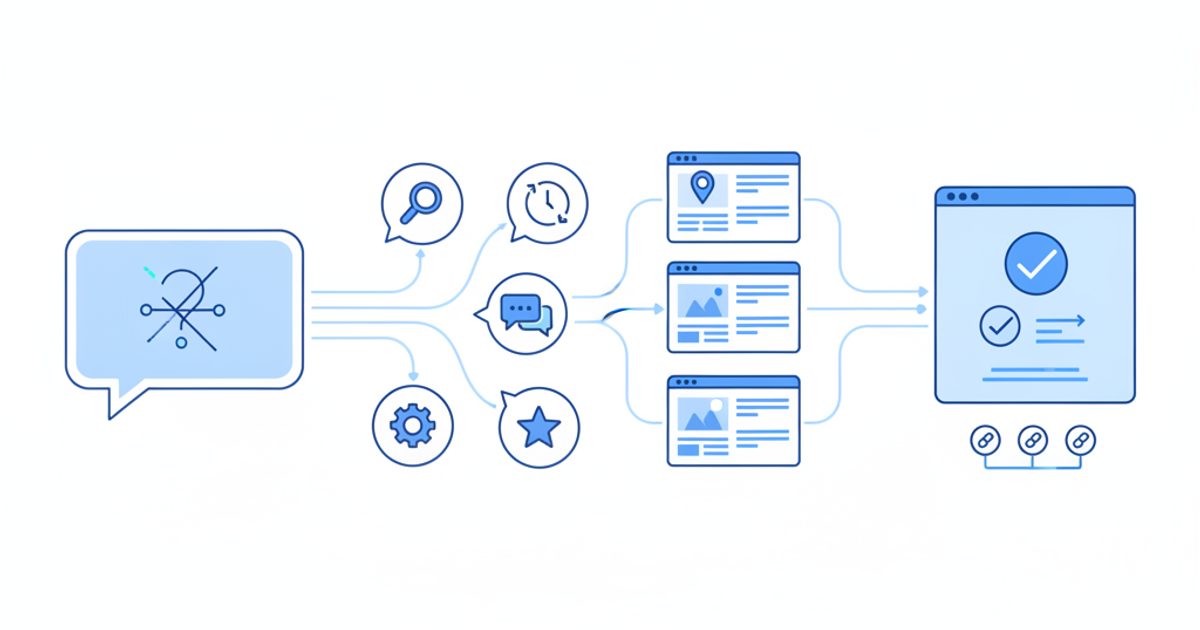
Google's AI features build answers from pages in the normal Google index. If your page ranks and can show a snippet in New Zealand, it can be cited. Google states plainly that "there are no additional requirements to appear in AI Overviews or AI Mode, nor other special optimizations necessary" (Google Search Central). ChatGPT is a separate system: it finds pages through its own search features, which rely on OpenAI's OAI-SearchBot crawler.
Google AI Overviews and AI Mode in New Zealand
AI Overviews appear above results for many NZ queries; "seo nz" itself showed one in our 2 November 2026 data. AI Mode launched in New Zealand in English on 22 August 2025 and is listed for New Zealand in Google's AI Mode help page. Google describes it as "breaking your question into subtopics and issuing a multitude of queries on your behalf." Since 27 March 2026, Kiwis can also use Search Live, which lets people talk to AI Mode by voice or point their phone camera at something and ask about it.
The practical consequence of fan-out is that a single question pulls in pages for several sub-questions. A page that answers the main question and the obvious follow-ups (cost, timeframe, who it suits, what can go wrong) gets more chances to be one of the cited links. For the differences between the two features, see Google AI Mode vs AI Overviews.
ChatGPT in New Zealand
ChatGPT is already part of how Kiwis find businesses. In OpenAI research reported by IT Brief in September 2026, based on a survey of 1,007 New Zealanders, 21% said they use ChatGPT weekly to find restaurants and cafés, and 35% had used it to compare tradie quotes and decide whether to hire. OpenAI also said NZ weekly active users grew by more than 20% over the year. For hospitality, trades and professional services, that is a discovery channel you cannot see in Google rankings.
What to do differently for AI answers
- Lead with the answer. Open each key page with a two- or three-sentence answer that makes sense on its own.
- Keep facts consistent everywhere. Prices, hours, service areas and licences should match across your site, Google Business Profile and directories. AI answers combine sources, and contradictions get repeated or the business gets left out.
- Publish specifics. NZ$ ranges, lead times and named areas are quotable. "Competitive pricing" is not.
- Let the crawlers in. Allow Googlebot and OAI-SearchBot. Blocking GPTBot only opts you out of model training, a separate setting according to OpenAI.
- Skip the gimmicks. Google's guide to optimising for generative AI features says Google Search doesn't use llms.txt files and needs no special schema for AI features.
How to measure AI visibility from New Zealand
Start with Google's own data. Search Console's Generative AI performance report shows how often your URLs appeared in AI features, with page, country, device and date dimensions, so you can look at New Zealand on its own. Google says it reached all websites by 31 August 2026. It reports impressions, not clicks for those features. Our walkthrough of the Search Console Generative AI report shows how to read it.
To see which pages are cited for a specific query, check the answer itself. AI Rank Lab's AI Overview tracker and AI Mode tracker take a country and language for each query, so you can check results with the location set to New Zealand and see the cited URLs. One limitation is worth knowing: its prompt runs on ChatGPT, Claude, Gemini and Perplexity do not emulate a location. Read those results as general answers, not NZ-specific ones.
A 90-day SEO plan for a Kiwi small business
Ninety days is enough to fix the foundations, rebuild your most important pages and set a baseline. It is usually not enough to see the full result. Google's SEO Starter Guide says some changes "might take effect in a few hours, others could take several months." Here is the order we would work in for a single-location or regional business:
| Weeks | Focus | Tasks | Done when |
|---|---|---|---|
| 1-2 | Foundations | Verify Search Console and Bing Webmaster Tools. Connect GA4. Submit a sitemap. Claim and verify Google Business Profile. Register the matching .nz or .co.nz and redirect it. | You can see NZ queries and indexing status for every key page. |
| 3-4 | Technical fixes | Run a site audit. Fix noindex errors, duplicate URLs, missing titles, slow templates and mobile layout issues. Check robots.txt allows Googlebot and OAI-SearchBot. | No important page is excluded or duplicated. |
| 5-6 | NZ research | Export NZ queries from Search Console. List the 20 questions customers ask most. Note the People Also Ask questions and AI Overview topics for your main services. | A one-page map of which page answers which question. |
| 7-9 | Core pages | Rewrite the 3-5 pages that earn the most revenue: direct answer first, NZ$ price ranges, areas served, proof (licences, reviews, examples), short FAQs. Add one page per genuine location. | Each core page answers its main question in the first two sentences. |
| 10-11 | Local and links | Complete Google Business Profile categories, services and photos. Start a review-request routine. Fix listings on 3-5 NZ directories. Pursue 2-3 link opportunities with associations, suppliers or local media. | Name, address and phone are identical everywhere. |
| 12-13 | Measure and plan | Compare NZ clicks and impressions with week 1. Check the Generative AI report. Check AI Overviews for 10 priority queries with the location set to New Zealand. Pick the next quarter's pages. | A baseline you can repeat every quarter. |
If you only have a few hours a week, do weeks 1-4 and 7-9 first. They carry most of the value.
Should a Kiwi business hire an SEO company or do it yourself?
Do SEO yourself if you run a single-location business with a small site and can set aside two to four hours a week. Hire help when the site is large or technically messy, when you are migrating domains or platforms, when you compete in a crowded Auckland or national category, or when nobody in the business has the time. The table is a quick test:
| Situation | DIY is fine | Get help |
|---|---|---|
| Site size | Under about 30 pages | Hundreds of pages, a store or many locations |
| Technical state | Modern site builder, no indexing errors | Indexing problems, a migration, custom code |
| Competition | Regional town, niche service | Auckland or national category with strong rivals |
| Time | A few hours every week, consistently | No regular time, or SEO keeps slipping |
| AI visibility | Checking a few queries by hand | Tracking many queries, competitors and cited sources |
If you hire, use Google's own advice on choosing an SEO: ask for examples of past work, ask which results to expect "in what timeframe", and walk away from guarantees, because "no one can guarantee a #1 ranking on Google." Published NZ pricing is scarce. Of the ten Auckland agencies ReVerb profiled, only one listed a price: from NZ$1,500 a month for small businesses. Our guide to hiring an AI SEO agency has the full question list, including how to check claims about AI search work.
Which SEO tools are worth it for a New Zealand business?
Disclosure: AI Rank Lab is our product. We list it first because this is our site, and we've kept the same criteria for every tool below.
- AI Rank Lab: Combines a site audit, keyword research by country, AI Overview and AI Mode checks with a New Zealand location, AI visibility tracking across ChatGPT, Claude, Gemini and Perplexity, and content and publishing tools in one place. Priced in USD from $69 a month, with 100 free credits at signup and no card required (pricing, checked 2 November 2026). Limitation: its LLM prompt runs don't emulate a location.
- Google Search Console: Free and essential. It is the only source of your real NZ queries and of Google's Generative AI performance report.
- Google Business Profile: Free. It is the core of local visibility in Search and Maps.
- Bing Webmaster Tools: Free. It covers the second search engine in NZ in a few minutes.
- Google Keyword Planner: Free with a Google Ads account. It is useful for relative demand, though it shows NZ long-tail volumes poorly, as covered above.
What doesn't move rankings in New Zealand?
Several things NZ businesses are still sold, or told, make no difference to Google:
- Geo meta tags. Google says it ignores locational meta tags and geotargeting HTML attributes.
- The Search Console country setting. It no longer exists.
- Keyword-stuffed domains and meta keywords. Google says domain keywords have "hardly any effect" and that it doesn't use the keywords meta tag.
- NZ hosting as a ranking trick. NZ hosting helps speed, but it is not a definitive geotargeting signal.
- llms.txt for Google. It does no harm, but Google Search doesn't use it.
- Suburb-swap pages and guaranteed rankings. The first is a spam-policy risk. The second is a red flag in itself.
How we researched this guide
We read 12 pages that rank for "seo nz" and related NZ terms, mostly agency service pages, agency rankings and agency blog posts, and noted what each covered and missed. None of them sourced their NZ market statistics, compared domain options against Google's documentation or covered how AI answers use NZ pages. Market figures come from StatCounter, 2degrees and Deloitte Access Economics, business.govt.nz, Google and OpenAI as linked. The keyword table is our own lookup on 2 November 2026. Limitations: StatCounter measures page views on sites running its tracker, not every search. The OpenAI survey was reported second-hand and did not name a full methodology. And keyword volumes are estimates by nature, which is the point of that section.
If you want to see where your site stands before starting the 90-day plan, run AI Rank Lab's SEO, AEO and GEO audit with your free signup credits. It shows the technical, content and AI-readiness fixes in one list.
Get a free AI ranking consultation
Want your brand to show up when ChatGPT, Gemini and Perplexity answer questions in your market? Tell us about your site and our team will send a personalized strategy.


