


AI search optimization in India means making your business easy for ChatGPT, Gemini, Perplexity and Google's AI Overviews and AI Mode to find, trust and cite when Indian users ask questions. The foundations are the same as anywhere: indexable pages, clear answers, a credible reputation on third-party sites. What changes in India is the audience: by OpenAI's own count it is ChatGPT's second-largest market, it asks in Hindi, Hinglish and regional languages, it leans on voice, and its local answers often come from directories and marketplaces rather than from business websites.
This guide pulls together the dated adoption numbers (each with its source), a timeline of every Google AI feature launch in Indian languages, what our own tracking data shows about which sites get cited for Indian local queries, practical rules for Hindi and Hinglish content, the UPI and agentic-commerce angle, and a checklist you can work through this month. All facts and prices were checked on October 18, 2026.
Key takeaways
- The audience is already large. Sam Altman said in February 2026 that India has 100 million weekly ChatGPT users, second only to the US. Free offers from OpenAI, Airtel (Perplexity) and Jio (Gemini) pushed adoption further in 2025.
- Google's AI features now speak most major Indian languages. AI Overviews launched in India in English and Hindi in August 2024. AI Mode added Hindi in September 2025, seven more Indian languages in October 2025, and its February 2026 list includes Gujarati, Odia and Punjabi.
- Local answers lean on aggregators. In our own tracking, justdial.com was cited in 148 of 1,612 prompt runs, the ninth most-cited third-party domain and the only general local business directory in the top 20. Your listings on such platforms are part of your AI visibility.
- Language is judged by visible text. Google says it ignores the HTML
langattribute when detecting a page's language. Write each page in one language, use hreflang for variants, and do not spin a page per script. - No special AI tricks are needed for Google. Google states there are no additional requirements to appear in AI Overviews or AI Mode. Indexing, helpful content, local SEO and a complete Google Business Profile still do the heavy lifting.
What is AI search optimization, and what is different in India?
AI search optimization (also called GEO, generative engine optimization, or AEO, answer engine optimization) is the work of getting your brand mentioned and your pages cited inside AI-generated answers. For Google, the mechanism is well documented: AI Overviews and AI Mode retrieve pages from the normal Search index and may use a "query fan-out" technique, issuing several related searches across subtopics before writing a response. Google's AI features documentation says plainly that "there are no additional requirements to appear in AI Overviews or AI Mode" beyond being indexed and eligible to show with a snippet. ChatGPT, Perplexity and Gemini work similarly when they search the web: they retrieve pages, then summarize and cite some of them.
So the playbook does not change at the border. What changes in India are the inputs those systems retrieve from and the way people ask:
- Language mix. Queries arrive in English, Devanagari Hindi, Romanized Hinglish and a dozen regional languages, often mixed in the same sentence.
- Voice and camera. Google calls Indian users "power users of multimodal search" and says India is its largest user base for both voice and visual search globally (Google India, October 2025).
- Aggregator-heavy local results. Directories such as Justdial and marketplaces such as IndiaMART, Zomato or Practo hold structured, reviewed data on millions of businesses, so they are natural retrieval targets for "best X in my city" questions.
- Commerce rails. UPI is how India pays, and it is the rail being tested for purchases inside AI assistants.
Most of the pages ranking for this topic today are agency service pages. In a live Google India SERP we pulled on October 18, 2026, all nine organic results for "ai search optimization india" came from agencies, agency directories or a company database, and Google showed an AI Overview above them. None published dated adoption data or a language timeline, which is why this guide focuses on both.
How many people in India use AI search?
The short answer: at least 100 million people use ChatGPT every week, tens of millions use Perplexity monthly, and a large share of India's 958 million internet users have touched an AI feature. No single source measures "AI search" across all tools, so the table below lists each figure with its publisher, date and what it actually measures.
| Metric | Figure | Source and date | What it measures |
|---|---|---|---|
| ChatGPT weekly active users in India | 100 million; second-largest market after the US | Sam Altman, via TechCrunch, Feb 15, 2026 | Company-stated weekly users, free and paid. Altman also said India has the most student users of ChatGPT globally. |
| Perplexity monthly active users in India | Peak of about 22 million (Oct 2025); nearly 14 million (Jul 2026) | Sensor Tower estimates, via TechCrunch, Aug 18, 2026 | Third-party app-intelligence estimate, mobile app only |
| Google AI Overviews engagement | Over 10% increase in Google usage for queries that show AI Overviews, in "our biggest markets like the US and India" | Google, May 20, 2025 | Usage lift on AI Overview queries, not a user count |
| Google AI Mode users | Over 1 billion monthly users worldwide (no India split published) | Google I/O 2026, May 19, 2026 | Global monthly users |
| Internet users using AI features | 958 million active internet users; 44% have used AI-enabled features such as voice search, image search or chatbots | IAMAI and Kantar, via tele.net, Jan 30, 2026 | Survey of 2025 internet use; "AI features" is broad |
| LLM search in purchase journeys | Reaches 22% of purchase journeys in India (social media: 29%); among people who use it, shapes final brand choice in 65% of journeys | BCG "Future of Influence", via MediaBrief, Sep 28, 2026 | Survey of almost 5,500 consumers in China, India, Japan and South Korea |
| LLMs as top discovery channel | Nearly 30% of consumers in India use LLMs as their number one discovery channel | Accenture Consumer Pulse 2026, via CXOToday, Jul 15, 2026 | Survey; India sample size not disclosed in coverage |
Read these as direction, not as one coherent market size. The ChatGPT number is company-stated, the Perplexity numbers are third-party estimates, and the BCG and Accenture figures come from different surveys asking different questions. What they agree on is that AI assistants are now a mainstream discovery channel in India, sitting just behind social media for shopping research.
Which AI search engines are most used in India?
ChatGPT is the clear leader by stated usage. Google's AI Overviews reach anyone using Google Search in India, which makes them the widest-reaching AI answer surface even though Google publishes no India-only user count. Perplexity grew fast on the back of a telecom bundle and has kept a sizeable base. Gemini's premium tier is bundled free for eligible Jio customers. A practical priority order for most Indian businesses is Google AI Overviews and AI Mode first, ChatGPT second, then Gemini and Perplexity.
Why did adoption jump in 2025?
Distribution deals, mostly. Four moves put premium AI tools in front of hundreds of millions of Indians:
- ChatGPT Go launched in India on August 18, 2025 at Rs 399 a month, payable through UPI (TechCrunch). OpenAI then made it free for 12 months for users in India who signed up from November 4, 2025 (MediaNama).
- Perplexity Pro via Airtel: a free 12-month subscription, worth Rs 17,000, for Airtel's 360 million customers, announced July 17, 2025 (Bharti Airtel). New redemptions closed on January 16, 2026, per TechCrunch.
- Google AI Pro via Jio: 18 months of Google AI Pro (Gemini) at no extra cost for eligible Jio Unlimited 5G customers, valued at about Rs 35,100, starting with 18 to 25 year olds (Engadget, Oct 31, 2025).
- Google AI Pro for students: offered free for a year to Indian students in September 2025, per the same TechCrunch report on ChatGPT's India numbers.
The business implication: a large share of Indian AI users are on generous free or bundled plans with web search switched on, so your pages are being retrieved for their questions today, whether or not you have planned for it.
When did Google launch AI Overviews and AI Mode in Indian languages?
India has consistently been one of Google's first markets for AI search outside the US. AI Overviews arrived in English and Hindi in August 2024, and AI Mode went from an English Labs test in June 2025 to covering most major Indian languages by February 2026. Here is the dated timeline, built from Google's own announcements.
| Date | Launch | Indian languages | Source |
|---|---|---|---|
| Aug 15, 2024 | AI Overviews roll out in India, with a language toggle and a "Listen" text-to-speech button | English, Hindi | Google India blog |
| Oct 3, 2024 | Google for India: AI Overviews to add four languages "in the coming weeks"; Gemini Live in Hindi plus 8 more | Telugu, Tamil, Bengali, Marathi (AI Overviews) | Google India blog |
| Oct 28, 2024 | AI Overviews expand to more than 100 countries | Hindi named among supported languages | Google blog |
| May 20, 2025 | AI Overviews reach 200+ countries and 40+ languages | Urdu named among new languages | Google blog |
| June 2025 | AI Mode opens in India as a Search Labs experiment | English | Referenced in Google's July 2025 post |
| Jul 8, 2025 | AI Mode rolls out to everyone in India, no Labs sign-up | English | Google India blog |
| Sep 8, 2025 | AI Mode in Hindi, for users worldwide | Hindi | Google India blog |
| Oct 8, 2025 | AI Mode adds seven Indian languages; Search Live (voice and camera) launches, India first outside the US | Bengali, Kannada, Malayalam, Marathi, Tamil, Telugu, Urdu (Search Live: English, Hindi) | Google India blog |
| Feb 18, 2026 | AI Mode ships in 53 new languages, 98 in total | List includes Gujarati, Odia, Punjabi and Sindhi alongside the earlier Indian languages | Nick Fox (Google) on X, via Search Engine Roundtable |
| May 19, 2026 | I/O 2026: Personal Intelligence in AI Mode expands to nearly 200 countries and 98 languages; new AI Search box rolls out wherever AI Mode is available | All AI Mode languages | Google blog |
Two caveats. Google announced the October 2024 AI Overviews languages as coming "in the coming weeks" and did not publish a per-language go-live date. And Assamese does not appear in the 98-language AI Mode list reported in February 2026, so if your audience searches in Assamese, check the live product before planning around it.
Which Indian languages does Google AI Mode support?
As of the February 2026 list: Hindi, Bengali, Gujarati, Kannada, Malayalam, Marathi, Odia, Punjabi, Sindhi, Tamil, Telugu and Urdu, plus English and Nepali. In practice, that means a user in Pune, Chennai or Kolkata can now ask AI Mode a long question in their own language and get an answer grounded in web pages. If those pages exist only in English, you are relying on the model to translate your content. If good pages exist in the user's language, they are the natural candidates to cite.
How do AI engines answer local queries in India?
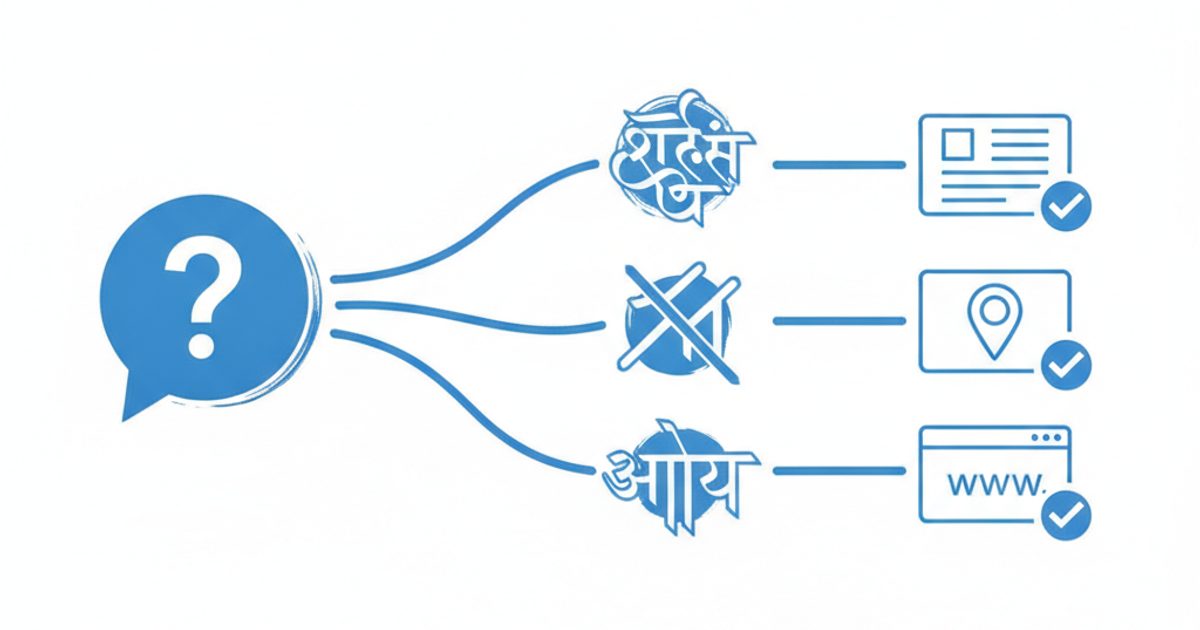
For local and comparison questions, AI engines tend to cite the pages that already compare businesses: directories, marketplaces, review sites and listicles. A single business website answers "what do you offer?"; a directory page answers "which of these is best near me?", which is the question being asked.
We see this in our own data. Across 1,612 successful prompt runs tracked in AI Rank Lab between February 13 and October 14, 2026, covering ChatGPT, Claude, Gemini, Perplexity, Google AI Overviews and AI Mode for 12 tracked domains, justdial.com was cited in 148 runs, making it the ninth most-cited third-party domain overall and the only general local business directory in the top 20. Most of the rest of the top 20 are marketing-software sites, which reflects the prompts our users track. Treat this as what we observed in our tracked prompts, not as a market-wide share: the sample is small and skewed toward the businesses that use our product. Even so, a general directory showing up that often, alongside specialist software sites, says something about how assistants source Indian local answers.
Google's own local ranking still sits underneath its AI features. Google says local results are based mainly on relevance, distance and prominence, and that "businesses with complete and accurate info are more likely to show up in local search results" (Google Business Profile Help). It also says there is no way to pay for a better local ranking.
Which Indian platforms should you check for your category?
The table below lists the platforms most likely to hold comparison-style pages for each kind of business. It is a checklist of where to look, not a ranking: apart from Justdial, we have not measured how often each one is cited, so run your own prompts and note which of these appear in the answers.
| Business type | Platforms to audit | What to fix there |
|---|---|---|
| Local services (repairs, salons, coaching, clinics) | Google Business Profile, Justdial, Sulekha | Same name, address and phone everywhere; correct category; hours; recent reviews with replies |
| Manufacturers and B2B suppliers | IndiaMART, TradeIndia, Google Business Profile | Product catalog with specifications, MOQ, GST-registered business details, response rate |
| Restaurants and cafes | Google Business Profile, Zomato, Swiggy | Current menu and prices, cuisine tags, photos, review replies |
| Doctors and clinics | Google Business Profile, Practo | Qualifications, consultation fees, timings, verified reviews |
| Real estate | 99acres, MagicBricks, Housing.com | RERA numbers, accurate project status, consistent builder name |
| Consumer brands and D2C | Amazon.in, Flipkart, Nykaa, your own product pages | Complete titles and specifications, INR prices, stock, return policy, review volume |
| Colleges and training institutes | Shiksha, Collegedunia, Google Business Profile | Fees, approvals, placement data with dates, course list |
| Software and SaaS | G2, Capterra, your own comparison and pricing pages | Current pricing (state INR if you bill in INR), feature lists, review volume |
Do local SEO and Google Business Profile still matter for AI answers?
Yes, more than before. AI Overviews and AI Mode draw on Google's index and its local data, and assistants that search the web often land on the same directory and map-derived pages. A complete, verified Google Business Profile with steady reviews remains the single highest-leverage local task. Our guide to appearing in "near me" AI answers covers the local workflow in detail. If you want to audit the basics quickly, AI Rank Lab's local SEO checks look at those listing and on-page signals.
Should you write in Hindi, Hinglish or English for AI search?
Write in the language your customers actually search in, one language per page, and make the Hindi or regional version a real page written or reviewed by a fluent person. English remains the default for B2B, SaaS and most urban professional audiences. Hindi in Devanagari makes sense for Hindi-first audiences, and AI Mode has supported Hindi since September 2025. Hinglish belongs inside pages as the words people type, not as a separate set of pages.
Does Google use the lang attribute or hreflang to pick a page's language?
No for lang, and only for variants with hreflang. Google's multi-regional and multilingual sites guide (last updated December 10, 2025) says: "Google uses the visible content of your page to determine its language. We don't use any code-level language information such as lang attributes, or the URL." It recommends one language per page, warns against side-by-side translations, and supports hreflang to point users to the right language version. Several India-focused guides we reviewed tell readers that setting lang="hi" helps Google understand the page. Set it anyway for accessibility, screen readers and other crawlers, but do not expect Google to use it for language detection.
How should you handle Hinglish and transliteration?
People type Hindi in Roman script all the time. Flipkart-affiliated researchers noted in a 2022 paper on search query translation that "many of the queries we receive are code-mix, specifically Hinglish", and built a model to handle it. AI systems understand synonyms and meaning, so you do not need a page for every spelling. What helps:
- Use the customer's own vocabulary inside the page. If buyers search "EMI", "kirana", "lakh" or a Romanized product name, use those words where they fit naturally, with the Devanagari or English equivalent nearby on first use.
- Keep the body in one script. A Hindi page should be Devanagari with common Roman terms (brand names, "UPI", "GST"), not alternating paragraphs of each script.
- Write numbers the Indian way where your audience does. Rs 1.5 lakh and 2 crore are how people speak and ask, especially by voice.
- Do not spin script variants. Separate Hinglish, Hindi and English pages carrying the same content are the kind of output Google's spam policies describe as scaled content abuse, which explicitly includes generating many pages "through automated transformations like synonymizing, translating" where little value is added.
What does voice-first searching change?
Questions get longer and more conversational. Google said in October 2024 that "over 40% of Gemini's Indian language users" already rely on voice interactions (Google for India 2024), and that Indian users listen to AI Overviews more often than users in other countries. Globally, AI Mode questions are nearly three times longer than traditional searches, per Google's October 2025 post. Pages that state a direct, speakable answer near the top of each section, with question-shaped headings, map more cleanly onto those questions.
| Your audience | Primary page language | What to add | What to avoid |
|---|---|---|---|
| Urban professionals, B2B buyers, SaaS | English | INR pricing, Indian examples, local proof (GST, city offices) | US-only examples and USD-only prices |
| Hindi-first consumers in North and Central India | Hindi (Devanagari) | Common Roman-script terms and brand names; hreflang to the English version | Raw machine translation, mixed-script paragraphs |
| Regional audiences (Tamil, Telugu, Bengali, Marathi and others) | The regional language | Native-speaker writing or review; local place names and units | Translating the whole English site without review |
| Young urban mobile users who type Hinglish | English or Hindi, depending on topic | Hinglish phrases where they occur naturally; FAQ answers phrased as spoken questions | Separate "Hinglish" duplicate pages |
How do UPI and agentic payments affect AI shopping in India?
They make India one of the first markets where an AI assistant can complete a purchase on a domestic payment rail, which raises the stakes on accurate product data. UPI processed 24.07 billion transactions worth Rs 29.37 lakh crore in September 2026, per NPCI data reported by Outlook Money. On October 9, 2025, Razorpay, NPCI and OpenAI announced a private beta of "Agentic Payments" on ChatGPT: users pre-authorize an AI agent to buy within spending limits they set, using UPI Circle and UPI Reserve Pay, with Axis Bank and Airtel Payments Bank as banking partners and bigbasket and Vodafone Idea as the first merchants. As of October 18, 2026, we found no announcement that it has moved beyond a pilot to general availability.
You do not need to be in the pilot to prepare. When an assistant compares products for an Indian shopper, it needs prices in rupees, stock status, delivery areas, return terms and specifications it can read. Merchants who keep those facts current on their own pages and in marketplace listings are the ones an agent can recommend with confidence. Our explainer on agentic commerce protocols for merchants covers the checkout standards in more depth.
Is AI search optimization different from SEO for Indian businesses?
It is an extension of SEO, not a replacement. Google says its AI features are rooted in core Search ranking, and its guide to optimizing for generative AI features says you don't need to create new machine-readable files, AI text files, markup or Markdown to appear in Google Search. If a page is not indexed and snippet-eligible, it cannot be cited in AI Overviews or AI Mode. Speed matters too: many Indian users are on mid-range phones and mobile data, so a slow site on cheap shared hosting is a real handicap. Our comparison of web hosting costs in India covers that side.
Where AI search optimization adds work on top of classic SEO:
- Off-site presence. Directories, marketplaces, reviews and press mentions shape the answer even when your site ranks well.
- Prompt-level tracking. You check what the assistants say about you for real questions, not just where a page ranks.
- Run-to-run variation. AI answers change between runs. Across 968 repeated runs of 42 prompt-engine pairs in AI Rank Lab (February to October 2026), 42.9% of pairs flipped between mentioning and not mentioning the tracked brand at least once. One check tells you little.
For a view of how the same shift is playing out in another English-speaking market, see our piece on AI SEO trends in Australia.
Checklist: AI search optimization for Indian businesses
Work through these in order. The first five cover most small businesses; the rest matter as you grow.
- Confirm indexing. In Google Search Console, check that your key pages are indexed and not blocked by
noindexornosnippet. Pages Google cannot show with a snippet cannot be cited in AI Overviews or AI Mode. - Complete and verify your Google Business Profile. Category, hours, service areas, photos and review replies. Then make your name, address and phone match exactly on Justdial, Sulekha, IndiaMART or whichever platforms your category uses.
- Write 15 to 30 real customer questions. Include English, Hindi and Hinglish versions of the questions your sales team actually hears, plus "best X in [city]" and "X vs Y" questions.
- Run them on each engine and record the sources. Ask ChatGPT, Gemini, Perplexity and Google (AI Overviews and AI Mode) and note which domains are cited. Those domains are your target list.
- Fix your own answer pages. For each question, make sure one page answers it directly near the top, with INR prices, Indian locations and dated facts where relevant.
- Add language versions where your customers need them. One language per page, written or reviewed by a fluent speaker, linked with hreflang.
- Strengthen the third-party sources that get cited. Update marketplace listings, ask happy customers for reviews, and correct outdated directory data.
- Keep commerce facts machine-readable. Product pages with clear specifications, rupee prices, stock and returns, consistent with your marketplace listings.
- Measure monthly. Track Search Console's generative AI impressions for India, AI referral visits in analytics, and your prompt results over several runs.
AI Rank Lab can automate steps 4 and 9: brand visibility tracking runs the prompts you choose on ChatGPT, Claude, Gemini and Perplexity, stores every run, and records mentions and cited URLs, and the AI Overview tracker and AI Mode tracker check Google's AI answers and their cited URLs for a chosen location, including India.
How can you measure AI search visibility in India?
Use three sources together, because none of them sees everything:
- Search Console's generative AI performance report. Google launched it on June 3, 2026 and, as of August 31, 2026, rolled it out to all websites worldwide. It shows impressions in AI Overviews, AI Mode and Discover's AI features, with a Countries breakdown, so you can isolate India (Google Search Central). Our walkthrough of the generative AI report in Search Console explains how to read it.
- Analytics for AI referrals. Visits from chatgpt.com, gemini.google.com, perplexity.ai and similar referrers show which assistants send people to you. Across 28 sites using the AI Rank Lab tracking tag (July 2025 to October 2026), ChatGPT accounted for 56.8% of 3,677 AI-referral page views, Gemini 17.1% and Perplexity 12.4%. That sample is not India-specific, but it matches the adoption order above. The GA4 setup is covered on our AI referral tracking page.
- Prompt tracking over time. Because answers vary run to run, measure the share of runs in which you are mentioned or cited over a few weeks, in each language you care about.
How much do AI visibility tools cost in rupees?
Most international AI visibility tools price and bill in US dollars or euros by card, so your final rupee cost depends on the exchange rate and your bank's foreign-currency charges. A few bill in INR. Prices below were checked on October 18, 2026.
Disclosure: AI Rank Lab is our product. We list it first because this is our site, and we've kept the same criteria for every tool below.
- AI Rank Lab (company based in New Delhi): subscriptions are processed in INR through Razorpay at a fixed rate of Rs 90 per US$1. Starter is $69 a month (charged as Rs 6,210), Professional $149 (Rs 13,410) and Enterprise $499 (Rs 44,910), with a 20% saving on annual billing. It covers ChatGPT, Claude, Gemini, Perplexity, AI Overviews and AI Mode, plus site audits, content and publishing. See the pricing page for current plan limits.
- Otterly.AI: lists prices in US dollars excluding tax, with its Lite plan (15 search prompts) shown at $25 to $29 a month, and says it accepts standard credit cards (Otterly pricing). Its low entry price is a real strength for a business that only needs to watch a handful of prompts.
- Agencies: Indian agencies typically quote monthly retainers in rupees. One Bangalore agency we reviewed publishes Rs 25,000 to 45,000 a month for local starter GEO packages. An agency makes sense if you need the content and outreach done for you rather than a tool to run yourself.
- Free: Search Console's generative AI report and manual prompt checks cost nothing and are enough to start.
If you want your Hindi and English prompts tracked across every major engine with INR billing, you can start tracking your AI visibility in AI Rank Lab.
常见问题
How many people in India use ChatGPT?▾
Which AI search engines are most used in India?▾
When did AI Overviews launch in India?▾
Is Google AI Mode available in Hindi and other Indian languages?▾
Does Justdial help my business appear in ChatGPT or Gemini answers?▾
Should I create separate Hinglish pages for AI search?▾
Do I need special markup or an llms.txt file to appear in AI Overviews in India?▾
How can I see my AI Overview and AI Mode visibility in India?▾
Can I pay for AI visibility tools in rupees?▾
Get a Free AI Ranking Consultation
Want to improve your brand's visibility in AI search engines like ChatGPT, Gemini, and Perplexity? Fill out the form and our experts will create a personalized strategy for you.

