



SEO for tradies is the work of making sure that when someone near you searches for your trade, on Google Search, Google Maps or an AI assistant, your business is the one they find, trust and call. For most Australian trade businesses that means a complete Google Business Profile set up as a service-area business, a steady flow of genuine reviews, one useful page per service and per area you really work in, and visible licence and insurance details that prove you are legit.
This guide puts those jobs in priority order, shows where suburb pages cross into what Google calls doorway abuse, compares hipages, Airtasker and ServiceSeeking with leads you own (using the platforms' own pages and filings, checked 2 November 2026), explains what AI answers draw on when someone asks for "the best electrician in Penrith", and finishes with a DIY cost and time table and a 30-minutes-a-week routine.
Key takeaways
- Do the work in this order: Google Business Profile, reviews, service and suburb pages, mobile speed, then directory listings. The first two carry most of the weight in the Maps results.
- Google ranks local results on relevance, distance and prominence, and says there is "no way to request or pay for a better local ranking".
- A suburb page is fine when it holds real local work (jobs, photos, prices, access notes). A copy-paste page with the suburb name swapped is the "substantially similar pages" pattern Google's spam policy calls doorway abuse.
- Oneflare closed on 30 June 2026 and now redirects to Airtasker. Older tradie SEO guides still recommend it.
- Lead platforms rent you customers. Your Google profile, reviews and website build an asset you keep. Most tradies are better off running both and measuring cost per won job, not cost per lead.
- AI answers are built on the same foundations: Google's AI features use the normal Search index and Business Profile data, and ChatGPT search relies on OpenAI's OAI-SearchBot crawler being allowed on your site.
What does SEO for tradies actually cover in 2026?
Tradie SEO now covers three places a job can start: the Google Maps "local pack", the normal Google results under it, and AI-written answers (Google AI Overviews, Google AI Mode, ChatGPT, Gemini and Perplexity). The underlying work is mostly the same for all three, which is good news if you only have a few hours a month.
The AI part is not hypothetical any more. Google began rolling out AI Mode to Australians from 8 October 2025. An ANU report produced with Google (July 2026, more than 3,500 adults) found 48.6% of Australians had used generative AI at least once. And in BrightLocal's Local Consumer Review Survey 2026, use of ChatGPT and other AI tools for local business recommendations jumped from 6% to 45% in a year. That survey is of 1,002 US adults, so treat it as a direction of travel for Australia, not a local number.
What has not changed is how Google decides who shows up in Maps. Its own help page lists three factors: relevance, distance and prominence. Relevance is how well your profile matches the search, distance is how far you are from the searcher, and prominence is how well known you are, which includes reviews and links. You cannot change distance, so the job is relevance and prominence.
The tradie SEO stack, in priority order
If you only do one thing, finish your Google Business Profile. If you do two, add a review habit. Everything else builds on those. The table below is the order we would work in for a one-truck or small-crew business, with our estimate of the setup time.
| Priority | Layer | What it does for you | Typical setup time (our estimate) | Cost |
|---|---|---|---|---|
| 1 | Google Business Profile (service-area setup) | Gets you into the Maps pack and gives Google and its AI features your services, areas, hours and photos | 2-3 hours, plus verification | Free |
| 2 | Reviews | The biggest prominence signal you control, and the first thing customers read | 1 hour to set up a request message and link, then minutes per job | Free |
| 3 | Service pages and genuine suburb pages | Lets you rank for "hot water repair Castle Hill"-style searches and gives AI answers something specific to quote | 2-4 hours per strong page | Your time, or a writer |
| 4 | Mobile speed and click-to-call | Most job searches happen on a phone, often in a hurry | 1-2 hours to test and fix the obvious problems | Free to test with PageSpeed Insights |
| 5 | Directory and platform listings (citations) | Consistent name, phone and area details across the web; extra places AI tools may read | 3-5 hours once, then occasional checks | Mostly free listings |
How should a tradie set up Google Business Profile?
Set it up as a service-area business: hide your street address and list the areas you travel to. Google's help page on service-area businesses says that if you don't serve customers at your address you should remove it, that you can list up to 20 service areas, and that the overall area "shouldn't be more than about 2 hours of driving time" from your base. Areas must be suburbs, postcodes or regions, not a radius.
Google's guidelines for representing your business also rule out the two shortcuts tradies most often try: stuffing keywords into the business name ("Joe's Plumbing - Emergency Plumber Sydney 24/7" is not your real name), and using a virtual office or PO box as an address. Both can get a profile suspended, which costs far more than it gains.
- Pick the most specific primary category (for example "Electrician", not "Contractor") and add secondary categories only for work you really do.
- List each service with a plain description, using the words customers use ("switchboard upgrade", "blocked drain").
- Add your 10-20 core suburbs or postcodes, staying inside a realistic travel time.
- Upload real job photos with the van, the crew and finished work. Stock photos add nothing.
- Set accurate hours, including whether you take after-hours call-outs.
- Link to your website's matching service page, not just the home page.
For the full Australian walkthrough, including verification and the settings that matter, see our Google Business Profile guide for Australian businesses.
How many Google reviews does a tradie need?
There is no magic number, but customers have one in their heads. In BrightLocal's 2026 survey (1,002 US adults), 47% said they would not use a business with fewer than 20 reviews, 74% only cared about reviews from the last three months, and 31% would only use a business rated 4.5 stars or higher. Google's own help page adds that "more reviews and positive ratings can help your business's local ranking". So aim for a steady trickle of recent reviews rather than a burst once a year.
Stay inside the rules. Google's fake engagement policy bans paying or offering "discounts, free goods and/or services" for reviews, and bans selectively asking only happy customers (review gating). Google's tips to get more reviews suggest sending customers a review link or QR code, which is the cleanest way to do it:
- Copy your review link from your Business Profile and save it as a text template on your phone.
- Send it to every customer the day the job is finished, while they are still pleased with the result.
- Ask them to mention the job and suburb in their own words ("replaced our hot water system in Ryde"). That detail helps both Google and AI tools match you to similar searches.
- Reply to every review, good or bad, within a few days. Keep replies short and specific.
Suburb pages vs doorway pages: where is the line?
A suburb page is legitimate when it would help someone in that suburb even if search engines did not exist. It becomes a doorway page when it is one of many near-identical pages made only to rank. Google's spam policies define doorway abuse as "when sites or pages are created to rank for specific, similar search queries" and list, among the examples, "having multiple domain names or pages targeted at specific regions or cities that funnel users to one page" and "creating substantially similar pages that are closer to search results than a clearly defined, browseable hierarchy".
That is exactly what a lot of cheap tradie websites ship: 80 "Plumber in [Suburb]" pages with the same 400 words and the suburb name swapped. They rarely rank for long, and they give an AI answer nothing worth quoting. The test below is the one we use when deciding whether a suburb deserves its own page.
| Question | Useful suburb page | Doorway page |
|---|---|---|
| Have you done real jobs there? | Yes, with photos and short job write-ups | No, or not that you can show |
| Does it say something only true of that area? | Housing stock, common faults, council or access quirks, travel time | Only the suburb name changes |
| Does it show local proof? | Reviews from customers in or near that suburb | Generic testimonials repeated on every page |
| Does it answer local questions? | Call-out availability, typical price ranges for your work there, parking or strata notes | Keyword-heavy filler |
| How many are there? | A handful for the areas that bring most of your work | One for every suburb in the state |
| Where does it lead? | Straight to a quote or call | Funnels to the same contact page as every other page |
A practical rule: build service pages first (one per job type), then add suburb pages only for the areas where you already have at least a few jobs, reviews and photos to show. Group small neighbouring suburbs onto one regional page ("Hills District") instead of making a page per postcode. BrightLocal's guide to service area pages makes the same point: "Quality trumps quantity every time."
Licence and insurance details: the trust signal most tradie sites hide
Put your licence number, licence class and insurer details where a customer can see them, and make them easy to check. A homeowner deciding who to let into their house wants proof you are licensed for the work, and a licence number they can look up on a government register is stronger proof than any badge. Of the Australian tradie SEO pages we reviewed for this guide, none told tradies to display their licence number.
What to show, on every service page footer and your About page:
- Your trade licence or contractor licence number and the licence class (for example, the categories of work it covers).
- Your ABN, which anyone can check on ABN Lookup.
- Your public liability insurer and cover amount, plus any home warranty or similar insurance your state requires for the work you do.
- Industry memberships you actually hold.
Licensing rules are set by each state and territory, and several regulators also have rules about how licence details appear in advertising. Check your regulator's advertising rules rather than assuming a website is exempt. Linking straight to the public register lets customers verify you in seconds:
| State | Where customers can check a licence | Covers |
|---|---|---|
| NSW | Verify a licence (NSW Government) | NSW licence and registration records, including trade licences |
| Queensland | QBCC licensee register | History of QBCC-licensed individuals and companies |
| Victoria (electrical) | Energy Safe Victoria public register | Licensed electricians and electrical contractors |
| Western Australia | Building and Energy licence and registration search | Builders, plumbers, electricians and gas fitters |
| Everywhere | ABN Lookup | Business name and ABN status |
Victorian builders and plumbers, and tradies in other states and territories, should link the register their own regulator publishes. Consistency matters here too: the business name on your licence, your ABN record, your Business Profile and your website should match.
hipages, Airtasker or your own leads: who owns the customer?
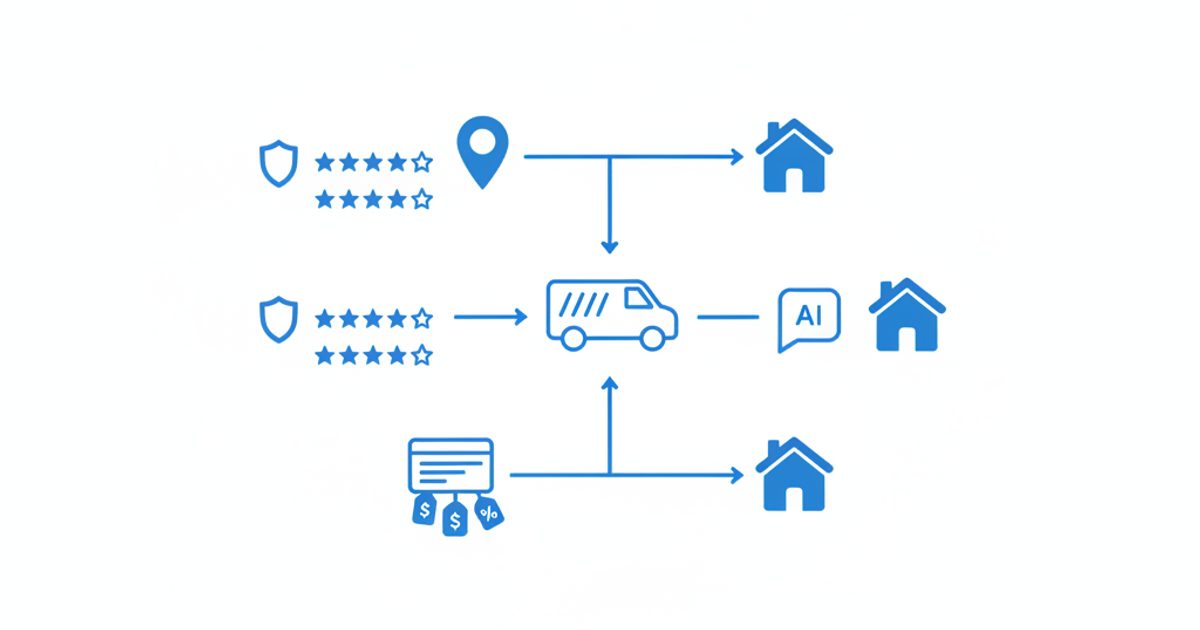
Lead platforms are rented demand: you pay per lead, per job or per month, and the customer relationship starts on someone else's platform. Google Business Profile, reviews and your website are owned demand: slower to build, but the phone rings for you and nobody else is quoted against you by default. Most established tradies use both and judge each on cost per won job.
The table uses only what each platform publishes about itself, checked on 2 November 2026. Where a platform does not publish its prices on a public page we could access, we say so rather than repeating third-party estimates.
| Channel | How it makes money from you (own source) | Who you compete with on each job | Do you own the customer? |
|---|---|---|---|
| hipages | Monthly subscription. Plan and per-lead prices were not on a public hipages page we could access; its FY26 results to the ASX (24 August 2026) report 36.4k subscription businesses and average annual revenue of A$2,475 per subscription business | Other subscribers matched to the same job; check your plan for the number | Partly: you get the contact, but the next job may go back through the platform |
| Airtasker | A service fee of 12.5% to 20% of the task price, set by your tier, plus tax, charged only when you are assigned the task | Unlimited offers on each task | Limited: customer contact details stay private until they choose you |
| Oneflare | Retired on 30 June 2026; the site and app now redirect to Airtasker (we confirmed the redirect on 2 November 2026) | - | - |
| ServiceSeeking | Prices are not shown on its public sign-up page, which says it "sent local businesses 180,710 job leads worth $25.9 Million in the last 12 months" | Other businesses quoting on the same job | Partly |
| Google Business Profile | Free. Google states you cannot pay for a better local ranking | Whoever else ranks for that search | Yes: the customer calls you directly |
| Your website | Hosting and your time (or an SEO provider) | Whoever else ranks for that search | Yes, fully |
Two notes. First, the hipages figure is its "subscription ARPU", which it defines as total operating revenue divided by average subscription businesses, so it is a rough guide to what a typical subscriber spends in a year (about A$206 a month), not a price list. Second, if you search for Google's pay-per-lead Local Services Ads, most guides you will find are written for the US or UK; we could not confirm on Google's help pages that they are offered to Australian trades as of November 2026.
Should I use hipages or invest in SEO?
Use a lead platform while your own channels are thin, and build the owned channels at the same time so you can lean on the platform less each season. The sum that decides it is simple:
- Add up what a channel cost you last quarter (subscription, credits, fees, or your SEO spend and hours).
- Count the jobs you actually won from it, not the leads.
- Divide cost by won jobs, then compare that with your average margin per job for that kind of work.
- Keep the channel if the cost per won job is comfortably below your margin; cut or renegotiate it if not.
Ask every new customer "how did you find us?" and write the answer on the job card. Without that, every channel looks better or worse than it is.
How do AI assistants decide which tradie to recommend?
AI answers about local trades are built from what the engine can retrieve: business profiles, reviews, your own pages, and directory or platform listings that mention you. They do not have a separate secret index. Google says its AI features are grounded in normal Search, use a "query fan-out" technique that issues "multiple related searches across subtopics and data sources", and that to appear as a supporting link a page "must be indexed and eligible to be shown in Google Search with a snippet". Its AI features guidance specifically recommends "checking that your Merchant Center and Business Profile information is up-to-date".
For ChatGPT, OpenAI's crawler documentation says OAI-SearchBot "is used to surface websites in search results in ChatGPT's search features" and recommends allowing it in robots.txt. If your web developer or security plugin blocks unfamiliar bots, check that it is not blocking this one.
In practice, a prompt like "best electrician in Penrith for a switchboard upgrade" fans out into sub-searches about the service, the suburb, prices and reviews. The businesses that get named tend to be the ones with:
- a Business Profile with the right category, the suburb in the service area, and recent reviews that mention the job type;
- a website page that plainly states the service, the area and the details a customer needs (price range, licence, availability);
- consistent listings on the directories and platforms the engine is likely to read, because those pages often rank for the same searches;
- no technical barrier: indexed pages, text rather than images of text, and crawlers allowed.
We did not run a live AI sample for this guide, so we are not quoting observed answers here. Instead, here is the 10-minute test we would run for any trade business, which takes no tools:
- Write five prompts a real customer would type, each naming your trade, a job and a suburb, for example "who's a good plumber in Ryde for a burst pipe".
- Run each one in Google (look at the AI Overview or AI Mode), ChatGPT and Gemini. Always include the suburb in the prompt so the results are comparable from anywhere.
- Record the results in a table like the one below.
- Repeat on the same day each month. Single runs vary, so look for patterns over several months.
| Prompt | Engine | Were you named? | Who was named instead | Which sources were linked |
|---|---|---|---|---|
| Good plumber in Ryde for a burst pipe | Google AI Mode | Yes / No | Business names | e.g. Maps profiles, a directory, a competitor's site |
| Same | ChatGPT | Yes / No | Business names | Linked pages, if any |
The "sources" column is the useful one: if the answers keep linking a particular directory or platform profile, make sure your listing there is complete and accurate. Our guide to near-me AI answers goes deeper on the local signals, and our 8-week local AEO playbook turns them into a week-by-week plan.
To automate this test, AI Rank Lab's AI Mode tracker runs Google AI Mode checks with the location set to Australia, and its local SEO checks ask ChatGPT, Claude, Gemini and Perplexity "best [service] in [suburb]" questions and record who is named and cited. Those chatbot runs do not emulate a location, so put the suburb in the prompt, exactly as in the manual test.
What does DIY tradie SEO cost in time and money?
Doing it yourself costs mostly time: roughly a long weekend to set up, then about half an hour a week. The hours below are our estimates for a small trade business with an existing basic website; the costs are what the tools charge, checked 2 November 2026.
| Task | One-off time (estimate) | Ongoing time (estimate) | Cost |
|---|---|---|---|
| Complete and verify Google Business Profile | 2-3 hours | 10 minutes a week (photos, posts, Q&A) | Free |
| Review request template and habit | 1 hour | 2 minutes per finished job | Free |
| Service pages (one per main job type) | 2-4 hours each | Update when prices or services change | Free if you write them |
| Genuine suburb pages for your top areas | 2-3 hours each | Add new jobs and photos monthly | Free if you write them |
| Licence, insurance and ABN details on the site | 30 minutes | Update at renewal | Free |
| Speed and mobile check | 1-2 hours | Quarterly re-test | Free (PageSpeed Insights) |
| Directory and platform listings | 3-5 hours | Quarterly spot-check | Mostly free |
| Google Search Console setup | 30 minutes | 5 minutes a week | Free |
| AI answer tracking (optional) | 1 hour to write prompts | 10 minutes a month manually | Free manually; paid tools cost extra |
Tools that help, if you want them:
- AI Rank Lab: Disclosure: AI Rank Lab is our product. We list it first because this is our site, and we've kept the same criteria for every tool below. Tracks whether ChatGPT, Claude, Gemini, Perplexity, Google AI Overviews and AI Mode name your business, runs local checks, and its Chrome extension checks a page's SEO basics as you browse. Priced in USD, from US$69 a month (Starter), with 100 free credits at sign-up and no ongoing free plan.
- Google Search Console: free, shows the searches that bring people to your site, and now includes a generative AI performance report for Google's AI features.
- PageSpeed Insights: free, shows what slows your site on a phone.
- BrightLocal: a long-standing local SEO suite with citation building and local rank tracking; its free research and guides are among the best on local search.
A 30-minutes-a-week routine
Once setup is done, half an hour a week keeps you ahead of most competitors in your area. Do it at the same time each week, for example Friday after knock-off.
- Reviews (5 minutes): check every finished job got a review request; reply to every new review.
- Photos (5 minutes): add two or three photos from this week's jobs to your Business Profile, named by job and suburb.
- Calls and enquiries (5 minutes): check your Business Profile performance (calls, website clicks, direction requests) and note where this week's jobs came from.
- One page improvement (10 minutes): add a short job write-up to the matching service or suburb page, or answer one question customers asked this week.
- Accuracy check (5 minutes): make sure hours, holiday closures and phone numbers are right on your profile and site.
Once a month, swap the page task for the AI answer test above and a quick look at Search Console.
When should a tradie pay for SEO help?
Pay for help when the setup is done, the routine is running, and you have more work in your area than you can capture yourself, or when you simply have no hours to spare and the maths of a lead platform has stopped working. Hiring someone before your Business Profile and reviews are in order usually means paying an agency to do the free basics.
Questions worth asking any SEO provider:
- How many tradie clients do you have in my area, and how do you avoid working for two competing businesses in the same suburbs?
- How will you report calls and won jobs, not just rankings?
- How do you build suburb pages, and can I see examples that are not copy-paste?
- What does the contract lock me into, and who owns the website and content if I leave?
Walk away from anyone promising a guaranteed number one position, offering to "manage" reviews in ways that break Google's rules, or planning hundreds of near-identical suburb pages. For what Australian providers charge and how pricing models compare, see how much SEO costs in Australia.
How do you know if tradie SEO is working?
Measure jobs, not rankings. The four numbers worth tracking monthly are: calls and website clicks from your Business Profile, enquiries from your website, the share of new customers who say they found you on Google or an AI assistant, and cost per won job for each paid channel. Google Search Console adds which searches bring visitors to your site; our guide to the Search Console generative AI report explains how to read the AI-feature data. Expect Business Profile changes to show up first and new pages to take longer; there is no honest fixed timeline.
How we put this guide together
We reviewed the pages ranking for "seo for tradies" and related searches in Australia (mostly agency sales pages and lead-platform comparisons), then checked every rule and number against primary sources: Google's own help and policy pages, the state licensing registers, hipages Group's ASX results, and Airtasker's and ServiceSeeking's own pages. Platform details were checked on 2 November 2026 and change often, so confirm current terms in your account before you commit. Time estimates are ours and will vary by trade and website.
If you want to see whether ChatGPT, Gemini and Google's AI Mode name your business for the jobs you want, you can run AI Rank Lab's local checks with the free sign-up credits.
Get a free AI ranking consultation
Want your brand to show up when ChatGPT, Gemini and Perplexity answer questions in your market? Tell us about your site and our team will send a personalized strategy.


