


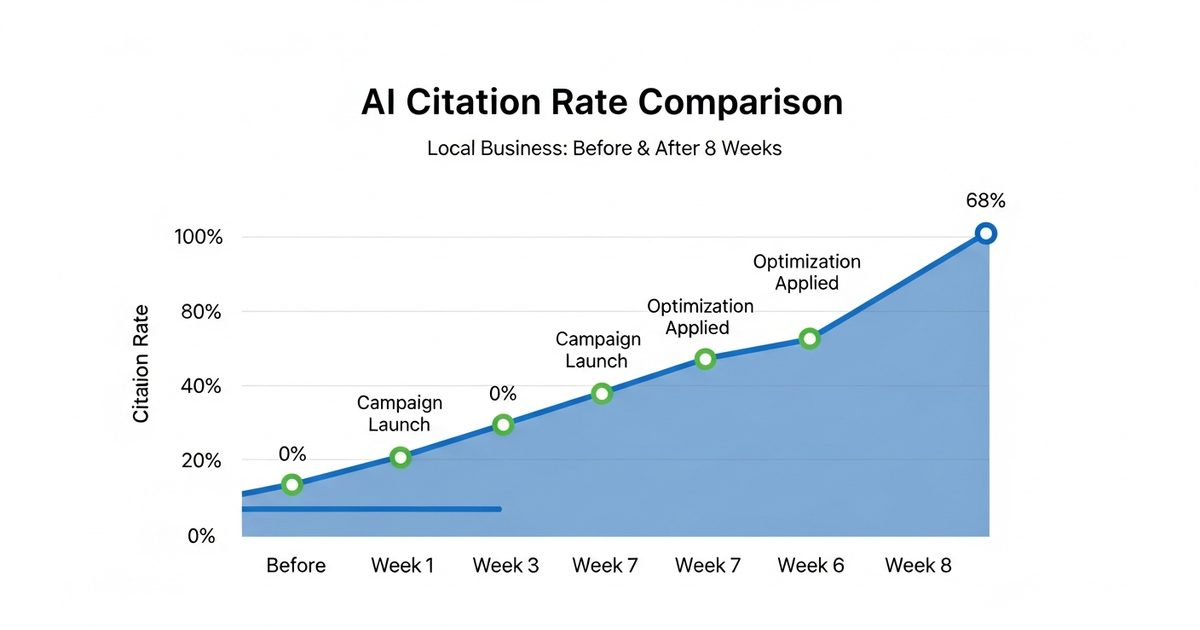
Most advice about getting a local business cited by ChatGPT is written as a success story. This is not one. There is no client name here, no before-and-after screenshot, and no citation-rate chart, because the honest version of this topic is that published evidence supports a clear sequence of actions while saying very little about guaranteed outcomes.
So that is what this is: an eight-week implementation order for a local service business, with every step tied to what the evidence actually shows and an explicit note where it shows nothing. Where a step rests on a published study, the study is linked. Where a step rests on reasoning, it says so.
What the evidence actually shows
Three findings should shape a local AI search program more than anything else.
Review platforms dominate local AI citations. Foundation, working with AirOps, analysed citations across ChatGPT, Gemini, Perplexity and Google AI Mode for more than 28 million small business queries during Q4 2025. Yelp drew 512,680 citations - roughly 3.4 times the next platform. Better Business Bureau followed at 149,700, Angi at 145,600, Thumbtack at 56,000, HomeAdvisor at 33,600 and Nextdoor at 10,300. Over half of Yelp's citations came from "near me" style queries. For a local business, presence on those platforms is not a nice-to-have sitting below your own website - it is frequently the surface the engine is reading.
Google says the fundamentals are the optimisation. In its guide to optimizing for generative AI features, published May 2026, Google states plainly that a page must simply be indexed and eligible for normal Search snippets, and that generative features are "rooted in our core Search ranking and quality systems". The same document explicitly says structured data "isn't required for generative AI search, and there's no special schema.org markup you need to add".
The traffic is small but converts unusually well. Ahrefs published first-party data in June 2025 showing AI search accounted for 0.5% of its visitors but 12.1% of signups - about 23 times the conversion rate of traditional organic. Two caveats matter and the author states both: this is one company's data, and users from AI search click through far less often, so the absolute volume stays small. Treat it as a reason to do the work, not as a forecast for your business.
Before week one: the eligibility floor
None of the following weeks matter if an engine cannot fetch the page. Check these first, because each is a hard gate rather than an improvement.
- Allow the retrieval crawlers. OpenAI runs separate bots for separate jobs. Per OpenAI's documentation,
OAI-SearchBotis the one that surfaces sites in ChatGPT search, and sites opted out of it "will not be shown in ChatGPT search answers".GPTBotis for model training and is a separate decision. BlockingGPTBotto protect your content from training does not block ChatGPT search - but blockingOAI-SearchBotdoes. Many sites confuse the two and remove themselves from ChatGPT by accident. - Confirm the pages are indexed and carry no
noindex,nosnippetor restrictivemax-snippetdirective. A page that cannot produce a snippet cannot be cited. - Serve content as text. Prices, service areas and answers locked inside images or injected late by JavaScript are content an engine may never read.
Weeks 1-2: claim the surfaces that actually get cited
This comes first because it is where the citation evidence is strongest, and because it does not depend on your website at all.
- Google Business Profile, accurate and verified. Google's representation guidelines require the name to match real-world signage, prohibit taglines and keyword padding in the name field, and allow only one profile per location. Service-area businesses keep one address-hidden profile with a defined area, which should not extend beyond roughly two hours of driving time. Getting suspended for a keyword-stuffed name costs more than the stuffing ever returns.
- Yelp first, then BBB and the category platforms. Given the citation distribution above, a claimed and complete Yelp profile is the single highest-evidence action on this list. Then Better Business Bureau and Angi, then the category platforms relevant to your trade.
- Make the details identical everywhere. Name, address, phone, hours and service area should match across every profile and your own site. Conflicting details give a retrieval system no clear answer to return.
What this will not do: produce an instant citation. These platforms have their own crawl and index cycles, and the studies measure aggregate citation share, not how fast one new profile gets picked up.
Weeks 3-4: the technical layer, in proportion
Be careful here, because this is where local AEO advice most often overpromises. Google's position is that structured data is not required for generative AI features. What LocalBusiness structured data does do is make a business eligible for knowledge panels and local rich results in classic Search - and Google is explicit that it "does not guarantee that features that consume structured data will show up in search results".
So implement it for the reason it exists, not for a promised AI outcome:
LocalBusinesswith the requirednameandaddress, plus the recommendedtelephone,url,geo,openingHoursSpecificationandpriceRange.sameAspointing at the profiles you claimed in weeks one and two, which ties the entity together across sources.- Accurate markup only. Schema describing something the page does not contain is a spam-policy problem, not a shortcut.
Spend the remaining time on page experience: load speed, mobile rendering, and removing duplicate thin pages. Google lists all three under its generative AI guidance for the same reason it lists them everywhere else.
Weeks 5-6: write for query fan-out
This is the step with the clearest mechanism behind it. Google's guide describes generative features using query fan-out: the model generates related queries and retrieves against all of them, rather than matching a single keyword. A prompt like "who should I call for an emergency AC repair in Austin on a Sunday" decomposes into questions about availability, after-hours pricing, response time, licensing and service area.
The practical consequence is that coverage beats repetition. A page that genuinely answers eight adjacent questions has eight chances to be the passage that gets retrieved. A page that repeats one phrase forty times has one.
- List the real questions customers ask before booking - your own call log and inbox are the best source, and they are first-hand data your competitors do not have.
- Give each question a heading and a direct answer in the first sentence or two beneath it, then expand. Retrieval works at passage level.
- Publish the answers competitors avoid, especially pricing, after-hours availability, call-out fees and what is excluded. Google's guidance singles out "commodity content" based on common knowledge as the thing that fails; specific local pricing is the opposite of commodity.
- Name the author and their credentials. Google's helpful-content guidance asks whether content is produced by someone with demonstrable expertise, and treats trust as the most important element of E-E-A-T.
Weeks 7-8: measure honestly
Google launched generative AI performance reports in Search Console in June 2026, which is where AI-feature performance data belongs. Google's guide also warns directly against third-party tools "that promise ranking success or claim to use 'internal' Google metrics" - no external tool has access to Google's systems.
Three things are worth tracking, in descending order of reliability:
- Search Console generative AI performance for Google surfaces. This is measured data, not inference.
- AI crawler hits in your server logs -
OAI-SearchBot,PerplexityBot,GPTBot,Google-Extended. This tells you what is being fetched and how often. AI Rank Lab records AI crawler visits automatically, currently covering GPTBot, PerplexityBot, Google-Extended, ClaudeBot and several other AI agents. - Referral traffic from AI assistants, which arrives with identifiable referrers from chatgpt.com, perplexity.ai and similar.
Citation-rate percentages across a query set, the metric most AEO case studies lead with, are the least stable of the four. Answers vary between sessions, personalise by location and change when the underlying model changes. Track the direction over months, and be sceptical of anyone reporting a precise citation percentage to the decimal.
What to skip
Google's guide includes an explicit mythbusting section, and several popular local AEO tactics appear in it:
- llms.txt and AI-specific markup files. "Google Search itself doesn't use them."
- Chunking content for AI parsing. Not required - Google's systems "are able to understand the nuance of multiple topics on a page".
- Rewriting copy to match exact prompt phrasing. "AI systems can understand synonyms and general meanings."
- Chasing brand mentions across low-quality sites. Ineffective, and adjacent to link schemes.
- A separate page per keyword variation - "plumber Austin", "plumber Austin TX", "best plumber Austin". This is scaled content abuse and a policy violation.
The honest summary
The eight-week frame is a planning device, not a promise. What the evidence supports is the order: fix eligibility, claim the platforms that get cited, implement structured data for what it genuinely does, then write coverage that survives query fan-out, then measure with the one tool that reports real data.
What the evidence does not support is a specific citation rate by a specific week. Any local AEO program that opens with that number, this article's own earlier version included, is describing a model rather than a measurement.
If you want your starting position rather than a projection, AI Rank Lab tracks which AI crawlers reach your pages and how your brand appears across AI engines, so week one begins with your baseline instead of someone else's.
Perguntas Frequentes
Can a local business actually get cited by ChatGPT?▾
Which review platforms do AI engines cite most for local businesses?▾
Does schema markup help a local business appear in AI search?▾
Does blocking GPTBot stop my business appearing in ChatGPT?▾
How long does local AEO take to show results?▾
How do I measure AI search visibility for a local business?▾
Is AI search traffic worth the effort if the volume is small?▾
Which local AEO tactics should I skip?▾
Get a Free AI Ranking Consultation
Want to improve your brand's visibility in AI search engines like ChatGPT, Gemini, and Perplexity? Fill out the form and our experts will create a personalized strategy for you.

Escrito por
Devanshu
Chief Marketing Officer & AI Search Optimization Architect
Digital Marketing Strategist & Pioneer in SEO, Answer Engine Optimization (AEO), and Generative Engine Optimization (GEO).


