


The way people find information online is going through a massive shift. Search engines no longer rely solely on ranked lists of blue links. Instead, they generate conversational answers powered by artificial intelligence, pulling facts, context, and supporting evidence from across the web. For website owners and digital marketers, this creates a pressing question: how do you know if your content is actually being used inside those AI-generated responses?
Microsoft just provided a concrete answer. On February 10, 2026, the company officially rolled out AI Performance in Bing Webmaster Tools as a public preview. This new dashboard gives publishers and site owners direct visibility into how often their content is cited in AI-generated answers across Microsoft Copilot, Bing’s AI summaries, and selected partner integrations. It marks the first time a major search platform has offered dedicated, structured reporting specifically for AI citation activity.
What Exactly Is AI Performance in Bing Webmaster Tools?
Bing Webmaster Tools has served as a go-to resource for website owners who want to understand how their content gets indexed, crawled, and surfaced in search results. The platform already provided data on impressions, clicks, keyword rankings, and crawl health. However, all of that reporting focused on traditional web search—the familiar ten blue links on a results page.
AI Performance changes the game by extending those insights into the world of generative AI. Rather than measuring how your site ranks for a given keyword, this new dashboard measures whether your content is being picked up, referenced, and displayed as a trusted source when AI systems craft their responses. Think of it as the difference between appearing on a library shelf and being quoted in someone’s research paper.
The dashboard is accessible at bing.com/webmasters/aiperformance for anyone with a verified Bing Webmaster Tools account. Microsoft has positioned it as an early step toward what the company calls Generative Engine Optimization (GEO) tooling—a concept that could shape how digital marketers approach content strategy in the years ahead.
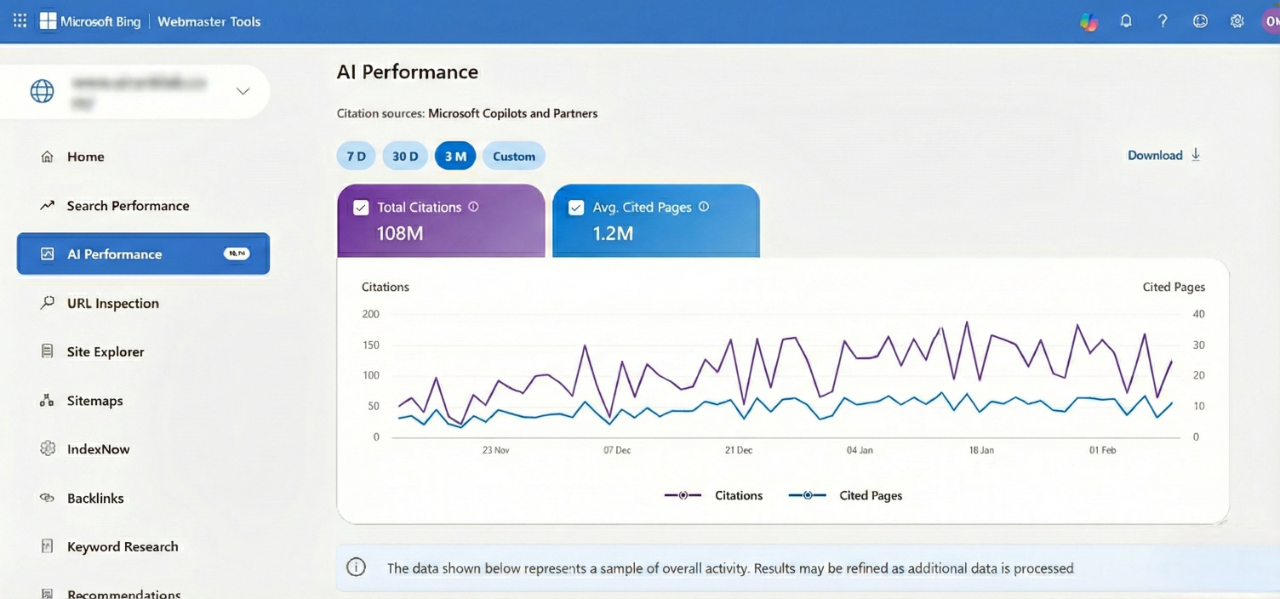
Key Metrics the Dashboard Tracks
The AI Performance dashboard introduces several metrics that are entirely new to the webmaster tooling landscape. Each one addresses a different aspect of how content interacts with AI systems.
Total Citations
This metric counts how many times your website appears as a source in AI-generated answers within a chosen date range. Every time an AI surface - whether it’s Copilot, Bing Chat, or a partner integration—references your content while composing a response, that counts as one citation. The number gives you a straightforward sense of how frequently AI systems rely on your pages.
Average Cited Pages
While total citations tell you how often your site is used overall, average cited pages reveals the daily average number of unique URLs from your domain that get referenced. A high number here means AI systems are pulling from a broad range of your content, not just one or two popular pages. That breadth can signal strong topical authority across multiple subjects.
Grounding Queries
This might be the most strategically valuable metric in the entire dashboard. Grounding queries show sample phrases that AI systems used when they retrieved and cited your content. In other words, you can see the actual questions or topics that led an AI model to choose your page as a source. For anyone working on content optimization, this data is like getting a peek behind the curtain at how AI interprets your content’s relevance.
Page-Level Citation Activity
Rather than grouping everything at the domain level, the dashboard breaks citation counts down by individual URL. You can quickly identify which specific pages on your website are doing the heavy lifting in AI responses. This makes it far easier to spot patterns—maybe your comparison guides get cited ten times more than your blog posts, or your FAQ section consistently outperforms longer articles.
Visibility Trends Over Time
The timeline view charts how your citation activity rises and falls across AI experiences over a selected period. Seasonal changes, content updates, competitor activity, and algorithm shifts can all influence these trends. Having a visual representation of that movement helps you correlate changes in citation activity with actions you’ve taken on your site.
"The data you see in AI Performance comes solely from Microsoft's own ecosystem — Copilot, Bing AI summaries, and selected partner surfaces. Citations from outside platforms are not included."
Why This Matters for Website Owners and SEO Professionals
Until now, understanding how your content performs inside AI-generated responses has been largely guesswork. You could see referral traffic from ChatGPT in your analytics logs. You might occasionally spot your site mentioned in a Perplexity answer. Google’s Search Console lumps AI Overviews data together with standard search performance, making it difficult to isolate.
Bing’s AI Performance dashboard is the first dedicated, structured tool from a major platform that breaks this data out into its own reporting space. That distinction matters because it acknowledges a fundamental reality: AI-driven discovery is not just a variation on traditional search. It’s a separate channel with its own dynamics, and it deserves its own measurement framework.
For SEO professionals, the implications run deep. Content strategies that worked well for ranking in organic search may not translate directly into AI citation success. The pages that earn top positions in standard results might not be the same pages that AI models prefer to cite. Understanding that gap—and having data to quantify it—opens up a new dimension of optimization.
How Does This Compare to Google’s Approach?
Google includes AI Overviews and AI Mode within Search Console’s existing performance reporting, but it hasn’t created a standalone dashboard specifically for AI citation data. In Google’s current setup, AI Overviews occupy a single position in reporting, and all links within an overview share that same position value. There’s no breakdown by individual cited URL, no grounding query data, and no dedicated trend visualization for AI-specific activity.
Bing’s approach goes further in several important ways. By providing page-level citation counts, grounding queries, and time-based trend charts, the AI Performance dashboard offers a more granular and actionable picture. Industry voices have taken notice. Several prominent SEO professionals praised the release on social media, with some pointing out that Bing Webmaster Tools has consistently pushed the envelope on transparency and feature depth compared to its Google counterpart.
This competitive pressure could eventually push Google to develop similar standalone reporting. When one platform provides data that marketers find valuable, others usually follow. For now, though, Bing holds a clear first-mover advantage in the AI analytics space.
Bing's dashboard is a solid first step, but it only covers Microsoft's ecosystem. Want to know how your content performs across Copilot, ChatGPT, Perplexity, and Google AI Overviews — all in one place? AI Rank Lab gives you the full picture. → www.airanklab.com
Limitations Worth Keeping in Mind
As promising as this release is, it comes with some notable gaps. The most significant one: click data is absent. The dashboard tells you how often your content is cited in AI-generated answers, but it does not reveal whether users who see those citations actually click through to your website. Without that information, you cannot calculate return on investment or determine whether AI visibility translates into meaningful traffic.
The metrics also don’t indicate ranking, prominence, or how a specific page contributed to a particular AI-generated answer. A citation could appear as the primary source at the top of a response, or it might be listed as a supplementary reference at the bottom. The dashboard treats both the same way.
Microsoft has acknowledged these limitations and hinted at further developments. Fabrice Canel from the Bing team noted that this is “just a preview” and promised that additional data and features would arrive throughout 2026.
Practical Steps You Can Take Right Now
Even with the current limitations, there are several concrete ways to put this data to work immediately.
Verify your site in Bing Webmaster Tools. If you haven’t already set up a Bing Webmaster Tools account, this is the time. Verification is straightforward and gives you access to the AI Performance dashboard along with all the traditional search reporting features.
Identify your most-cited pages. Look at the page-level citation data to understand which URLs are doing the heavy lifting. Ask yourself what those pages have in common. Are they structured with clear headings and concise answers? Do they cover topics with strong factual grounding? The patterns you spot can inform how you structure future content.
Study your grounding queries. These phrases reveal what AI systems think your content is about. If the queries match your intended topics, great—your content signals are working. If they surprise you, it could mean your content is being interpreted in unexpected ways, which is worth investigating.
Optimize content structure for AI retrieval. Microsoft’s own guidance suggests focusing on clear headings, evidence-backed claims, current and accurate information, and consistent entity representation. These are familiar SEO best practices, but they take on new importance when AI models are scanning your content for source material.
Keep your business listings current. For local businesses, Microsoft specifically recommends registering with Bing Places for Business. When AI systems answer location-based questions—like finding nearby restaurants with specific features—they pull from verified business data. Outdated or incorrect listings mean missed opportunities in AI responses.
The Bigger Picture: Generative Engine Optimization Is Here
Microsoft’s framing of this tool as a step toward Generative Engine Optimization is significant. The term itself captures a shift in how digital marketers will need to think about discoverability. Traditional SEO focused on getting your page to rank higher in a list. GEO is about getting your content selected as a trusted source by an AI system that’s assembling a direct answer for a user.
The skills overlap—quality content, clear structure, authoritative sourcing—but the measurement and optimization feedback loops are different. With traditional SEO, you optimize for position. With GEO, you optimize for inclusion and citation. The AI Performance dashboard is the first tool that lets you actually measure whether those GEO efforts are working.
As AI-powered search experiences continue to grow across platforms like Copilot, ChatGPT, Perplexity, and Google’s own AI features, the ability to track and optimize for AI citations will become just as important as tracking organic rankings. Publishers who get ahead of this shift now will be better positioned as the tools mature and the data gets richer.
What to Expect Next
Microsoft has signaled that this public preview is just the beginning. The company plans to refine the existing metrics, add new data points, and continue working with publishers and the webmaster community to expand the tool’s capabilities. The addition of click-through data would be the single most impactful improvement, giving publishers the ability to connect AI visibility with actual site traffic.
Beyond Bing, the broader industry is watching closely. If Microsoft demonstrates that transparency around AI citations creates a better ecosystem for publishers and AI platforms alike, other search engines and AI providers will face pressure to offer similar tools. The competitive dynamics between Microsoft, Google, and emerging AI search players could accelerate the development of more sophisticated GEO measurement frameworks across the board.
Final Thoughts
The launch of AI Performance in Bing Webmaster Tools represents a meaningful milestone in how we understand content visibility in the age of generative AI. It is not a complete solution—missing click data and citation prominence details limit its current usefulness. But it is a genuine first step that no other major platform has taken yet.
For website owners, the message is clear: the rules of discoverability are expanding. Ranking well in organic search results still matters, but it is no longer the whole picture. Understanding how AI systems select, cite, and present your content is becoming equally critical. And for the first time, there’s a real tool to help you measure that.
If you run a website and care about where your content shows up—whether in a search results page or inside an AI-generated answer—now is a good time to log into Bing Webmaster Tools, explore the AI Performance dashboard, and start building your understanding of this new frontier.
Frequently Asked Questions
What is AI Performance in Bing Webmaster Tools?▾
How do I access the AI Performance dashboard?▾
Does the AI Performance report show click-through data?▾
What are grounding queries in Bing Webmaster Tools?▾
How is this different from Google Search Console?▾
Get a Free AI Ranking Consultation
Want to improve your brand's visibility in AI search engines like ChatGPT, Gemini, and Perplexity? Fill out the form and our experts will create a personalized strategy for you.

Written by
Devanshu
Chief Marketing Officer & AI Search Optimization Architect
Digital Marketing Strategist & Pioneer in SEO, Answer Engine Optimization (AEO), and Generative Engine Optimization (GEO).


