


Every day, millions of people search on AI-driven tools such as Google AI Overviews, Perplexity, and Bing, Copilot to find answers. These platforms don't display a list of links. Instead, they analyze your content, pull out the most relevant information, and present it directly to the user. If your content isn't optimized for this, you may lose all visibility, regardless of how well it performs in traditional search results.
This is where an AEO audit becomes vital. An AEO audit (Answer Engine Optimization audit) is a systematic review of your content to assess whether it is prepared to be referenced and presented by AI-powered answer engines. According to Search Engine Land, more than 65% of all Google searches result in zero clicks, making AEO one of the most important for 2026.
This guide provides you with a free, practical AEO readiness audit that you can complete today, a clear AEO score to measure your progress, and a step-by-step plan to quickly address any gaps in your content.
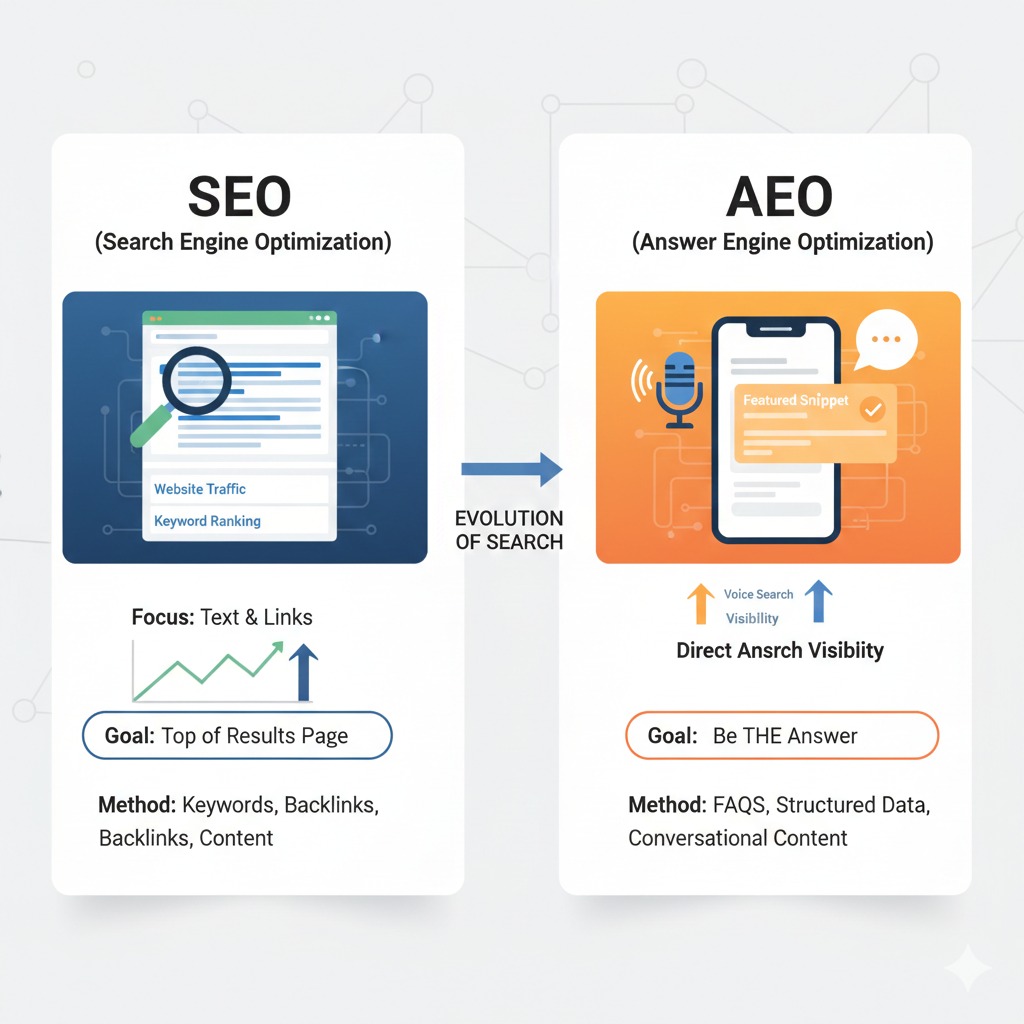
Difference between AEO and SEO:
How Does Answer Engine Optimization Work?
Answer Engine Optimization (AEO) involves sorting content in such a way that it allows AI systems to pull out as a direct and reliable answer to a user's question. While traditional SEO aims to improve a website's position in a list of search results, an AEO checker assesses if your content is properly formatted, structured, and trustworthy enough to be chosen as the actual answer.
When Should You Use AEO Over Traditional SEO?
You don't have to choose one over the other. AEO and SEO are interdependent. Traditional SEO lays the essential groundwork, while AEO enhances the content built of that foundation. However, when it comes to informational searches, how-to questions, and how to compare, AEO has become the primary factor in increasing visibility. If your content provides answers to questions people ask through AI Chabot’s, voice assistants, or conversational search engines, then you should consider getting an AEO audit.
Factor | Traditional SEO | Answer Engine Optimization |
Primary Goal | Rank in SERPs | Be selected as the direct answer |
Content Format | Keyword-rich articles | Question-answer structured content |
Schema Markup | Helpful but optional | Essential for AEO success |
Key Metric | Click-through rate | AI citation and extraction rate |
Credibility Signal | Backlinks | E-E-A-T + author authority |
Use AI Rank Lab’s free audit tool at www.airanklab.com to see your multi-layer SEO + AEO + GEO score, and receive prescriptive, prioritized fixes.
The Free 7-Checkpoint AEO Audit: Test Your Content Now
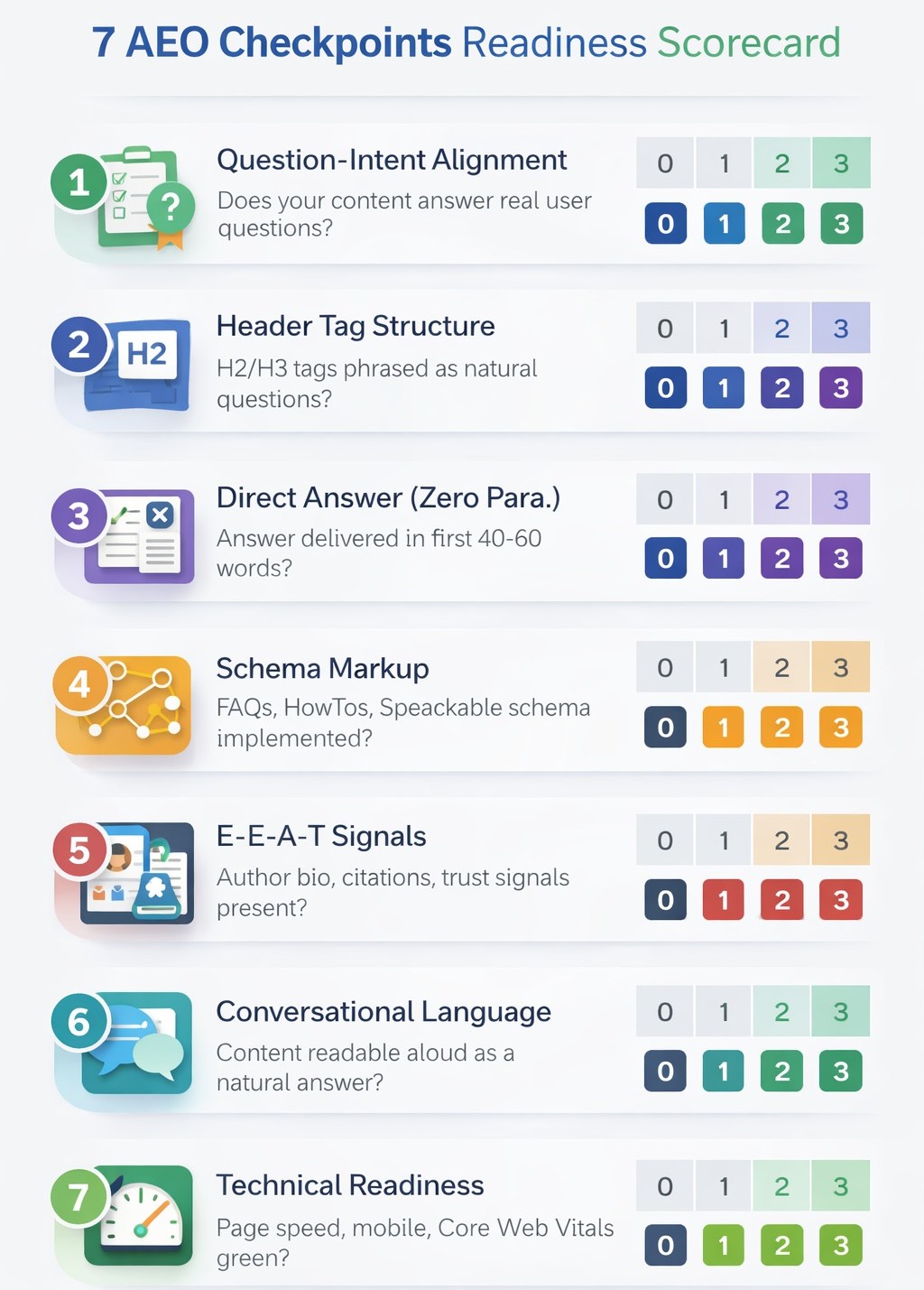
Run this AEO audit on any page of your website. Checkpoints in testing tools are explicitly designed to pass or fail a specific step. Your total AEO score out of seven tells you exactly where you stand and what to fix first.
CHECKPOINT 1: Question-Intent Alignment
Does Your Content Directly Address a Specific Question?
Each piece of content you create should be tied to one clear question that your audience is currently asking. An answer engine optimization tool will always check this first. Answer prefers accurate, question-specific responses.
How to Identify Question-Based Queries for Your Content
- Use Google's "People Also Ask" boxes to discover genuine user questions related to your topic
- Use AnswerToPublic.com to visually map conversational queries
- Filter keyword research tools by question formats such as who, what, when, where, why, and how.
Audit Action: Does your H1 or first H2 demonstrate the exact question your content answers? If not, rewrite your headline as a direct question before anything else.
CHECKPOINT 2: Header Tag Structure
Are Your H2 and H3 Tags Formulated as Natural Questions?
Answer engines analyze your heading structure to create a framework of your content before even reading the text. Using H2 and H3 tags that are phrased as questions significantly improves the likelihood of being extracted. For example, compare 'Schema Markup' (a topic label) with 'What Is Schema Markup and Why Does It Matter for AEO?' (a question that indicates an answer is coming).
Examples:
Non-Optimized Header | AEO-Optimized Header |
Schema Markup | What Is Schema Markup and How Does It Support AEO? |
Voice Search | How Does Voice Search Relate to Answer Engine Optimization? |
Content Strategy | What Is the Best Content Strategy for AEO in 2025? |
Audit Action: Count your H2 and H3 tags. If less than 50% are phrased as questions, this checkpoint is unmet. Rewrite your top three headings first.
CHECKPOINT 3: Direct Answer Placement
Does Each Section Open With a Clear, Self-Contained Answer?
The 'zero paragraph' is the 40-to-60-word answer placed immediately after a question-format heading. This is the single highest-impact structural change you can make to improve your AEO score. Answer engines are designed to extract exactly this format. Write the answer first, add context second.
Audit Action: Open your most important page. Find the first H2 section. Does the first paragraph deliver a complete within 60 words? If it begins with 'In this section...' rewrite it to lead with the answer directly.
CHECKPOINT 4: Schema Markup & Structured Data
Is Your Page Sending Structured Data Signals to Answer Engines?
Schema markup is structured code added to your HTML that explicitly tells answer engines the type, meaning, and context of your content. Without it, AI systems must infer context. With FAQ schema, HowTo schema, and Speakable schema, you declare it directly, which makes extraction far more reliable and precise.
Schema types that matter most for AEO audit success
• FAQ Schema - Marks up Q&A pairs for PAA box and AI extraction
• HowTo Schema - Marks up step-by-step instructional content
• Speakable Schema - Flags content suited for voice assistant responses
• Article Schema - Establishes authorship, dates, and content type for E-E-A-T
Audit Action: Run your top 5 pages through Google's Rich Results Test. Pages with zero schema detected fail this checkpoint. Add FAQ schema to any page with a Q&A section first.
CHECKPOINT 5: E-E-A-T Signals
Does Your Content Demonstrate Experience, Expertise, Authority, and Trust?
E-E-A-T (Experience, Expertise, Authoritativeness, Trustworthiness) is the credibility framework Google uses to determine whether content can be trusted as a reliable source. An answer engine optimization tool always considers E-E-A-T because answer engines do not reference anonymous or low-authority pages, no matter how well they are organized.
E-E-A-T elements to include on every content page:
- A named author with a professional background and relevant qualifications
- Clearly displayed publication date and last-updated date
- At least two external references (such as peer-reviewed research, official statistics, or industry reports)
- Firsthand observations, original data, or real-life examples
- Organizational information: About page, contact information, and privacy policy.
Audit Action: Check your top content page against all five E-E-A-T signals above. Missing three or more means this checkpoint is unmet. Start with adding or upgrading the author biography.
CHECKPOINT 6: Conversational Language
Does Your Content Sound Like a Natural, Spoken Answer?
Answer engines handle conversational questions and provide content that sounds like a natural spoken reply. Dense technical terms, the use of passive voice, and lengthy continuous paragraphs create structural challenges for NLP extraction. Content that successfully passes the voice readability test typically performs well as a candidate for an answer engine.
Readability targets for AEO-optimized content
• Flesch Reading Ease score: 60-70 (Grade 8 level, readable by any adult)
• Average sentence length: under 20 words
• Active voice: at least 80% of sentences
• Avoid keyword stuffing: write 'the best way to optimize for AEO' not 'AEO optimization AEO best AEO strategy'
Audit Action: Copy your content into the SEO Review Tools Readability Checker. If your Flesch score is below 50, rewrite the five most complex sentences using shorter, simpler constructions and active voice.
CHECKPOINT 7: Technical Readiness
Is Your Website Infrastructure Ready for Answer Engine Crawlers?
Page speed, mobile optimization, and Core Web Vitals are technical prerequisites for AEO success. Answer engine crawlers does not assess slow, unresponsive pages, and Google's mobile-first indexing means the mobile version of your page is the version being evaluated. Your AEO score cannot reach its ceiling without a technically sound foundation.
Free technical audit tools
• Google PageSpeed Insights - Core Web Vitals, LCP, CLS, INP benchmarks
• Google Search Console - Crawl errors, indexing, mobile usability
• Google Mobile-Friendly Test - Pass/fail mobile rendering check.
Use AI Rank Lab’s free audit tool at www.airanklab.com to check your Technical Readiness.
How to Calculate and Interpret Your AEO Score
What Does Each AEO Score Level Mean?
After completing all seven checkpoints, add up your passes. Your AEO score out of seven tells you your current AEO level and your highest-priority action. Use the table below as your benchmark.
Score | AEO Level | What It Means | Priority Action |
0-2 | AEO Beginner | Major structural issues across all areas | Rewrite headings + add direct answer paragraphs |
3-4 | AEO Developing | Good base, key structural gaps remain | Add FAQ schema + strengthen E-E-A-T signals |
5-6 | AEO Intermediate | Strong content with refinement needed | Polish readability + fix technical performance |
7 | AEO Ready | Fully optimized for answer engine extraction | Monitor AI appearances + scale across all pages |
AEO Best Practices: How to Build Answer-Engine-Ready Content
How to Write Content That Answer Engines Want to Cite
The most effective AEO audit is not a one-time exercise. It is a publishing standard you apply to every new piece of content from day one. Before writing, identify the primary question your content will answer, map the two to three related sub-questions, and draft your zero paragraphs before anything else. Structure determines selectability.
Five AEO best practices to implement across your content library
• Always start with the answer. Write your zero paragraphs before your introduction. First answer and then explain.
• Create every heading a question. Rewrite every H2 and H3 as a question that your audience would ask.
• Add a FAQ section to every article. Use five to seven questions drawn from PAA boxes and wrap them in FAQ schema.
• Cite credible external sources. Link to industry reports, official documentation, or studies to strengthen E-E-A-T.
• Audit existing content quarterly. Run your top 10 pages through the seven-checkpoint AEO audit every three months and update accordingly.
Final Verdict: Start Your Free AEO Audit Today
The shift to AI-powered answer engines is the present reality. Over 65% of Google searches end without a click, and that number is growing. Your AEO score is the single clearest indicator of whether your content is participating in that new reality or being left behind.
You now have the AEO audit framework, the scoring system, and the action plan. The next step is simple: run the seven checkpoints on your most important page today. Fix the lowest-scoring checkpoint first. Build the habit of applying this answer engine optimization checker to every new piece of content before it goes live.
Answer engines reward content that is clear, structured, credible, and built to answer. Every fix you make brings your content one step closer to being the answer.
الأسئلة المتكررة
What is the difference between an AEO audit and an SEO audit?▾
How do I calculate my AEO score using this audit?▾
Can I use a free answer engine optimization checker?▾
How often should I run an AEO readiness audit?▾
Does AEO replace traditional SEO?▾
Get a Free AI Ranking Consultation
Want to improve your brand's visibility in AI search engines like ChatGPT, Gemini, and Perplexity? Fill out the form and our experts will create a personalized strategy for you.

بقلم
Devanshu
Chief Marketing Officer & AI Search Optimization Architect
Digital Marketing Strategist & Pioneer in SEO, Answer Engine Optimization (AEO), and Generative Engine Optimization (GEO).

