


AI search citation is not mysterious. The brands that earn consistent citations in ChatGPT, Gemini, and Perplexity are not doing something fundamentally different from good SEO - they are doing specific things that most websites are not yet doing.
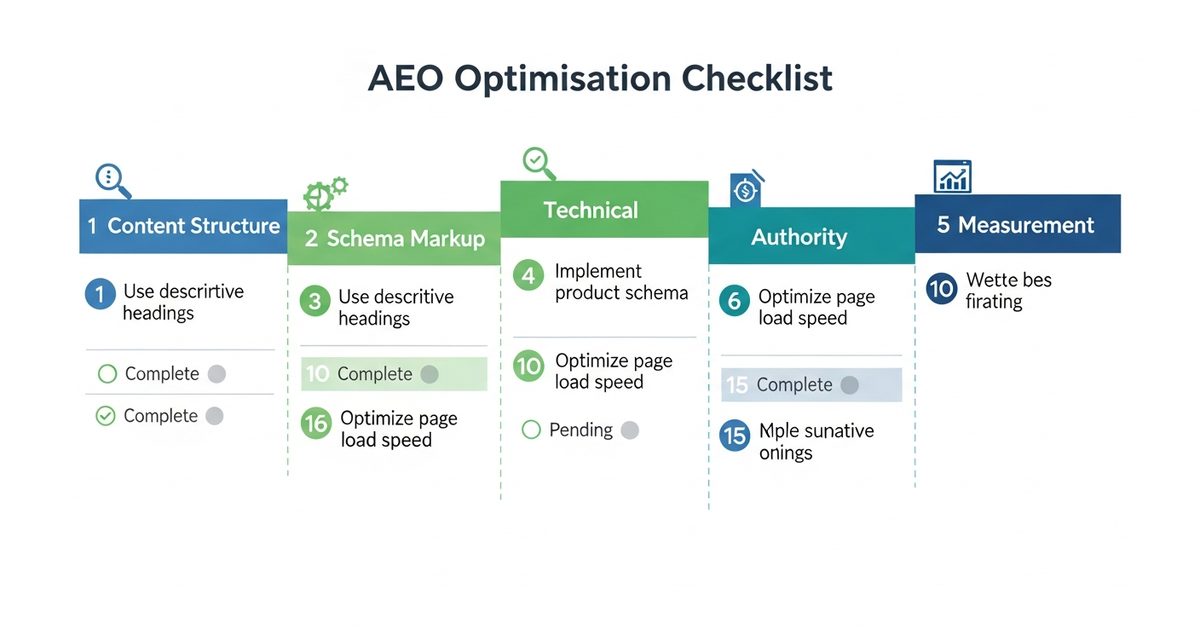
This checklist covers the 15 most impactful items for AEO optimisation. Work through it for any website and you will have a clear picture of where the citation gap is and what to fix first. Items are grouped by category and ordered within each category by ease of implementation relative to impact.
Section 1: Content Structure (5 items)
1. Direct answer in the first 100 words
Every page that targets a specific query must answer that query directly in the first 100 words - before context, before background, before the company story. AI engines retrieve content that resolves queries immediately. Content that builds to the answer over three paragraphs is consistently out-competed by content that states the answer first.
How to check: Read the first 100 words of your 10 highest-traffic pages. Does each one directly answer the primary query the page targets? If not, restructure the opening to lead with the answer.
2. Question-formatted section headers
H2 and H3 headers formatted as complete questions ("How does X work?" rather than "X Overview") match the conversational query format that AI engine users produce. This structural alignment significantly improves the probability that AI retrieval systems match your content to the right queries.
How to check: Review the H2/H3 structure of your key pages. Are section headers formatted as questions or statements? Convert statement headers to question format where the content section answers a specific question.
3. Complete topic coverage without gaps
AI engines cite content that fully covers a topic - not content that covers most of a topic and leaves users with open questions. For each key page, identify the 8-10 questions a user would have after reading the brief version of the topic, and ensure the page addresses all of them.
How to check: Use the "People Also Ask" section in Google for your primary keyword, and Perplexity's "Related Questions" panel, to identify questions commonly associated with your topic. Verify your page addresses each one.
4. Structured formatting throughout (bullets, tables, numbered lists)
AI engines extract information from structured content more reliably than from long prose paragraphs. Bullet points, numbered lists, comparison tables, and clearly delineated definitions all improve AI retrieval quality. Avoid walls of text for key factual content - structure it in a format designed for extraction.
How to check: Count the ratio of structured elements (bullets, tables, numbered lists) to paragraph-only sections on your key pages. Pages with no structured elements are likely underperforming in AI citation for structured data queries.
5. Content freshness - dated statistics and examples
Replace all outdated statistics with current figures. Add the publication year to any statistic that could be from any point in time ("60% of searches" versus "60% of searches in 2026, per BrightEdge research"). Update case study examples to reflect recent timeframes. Content freshness is one of the highest-signal quality indicators for AI engines selecting citation sources.
How to check: Scan your key pages for statistics without current year citations and examples that reference outdated periods. Set a reminder to refresh statistics quarterly.
Section 2: Schema Markup (4 items)
6. FAQPage schema on question-answer content
FAQPage schema is the single highest-impact schema type for AI citation. It explicitly marks up question-and-answer content as machine-readable Q&A pairs, making it trivially easy for AI engines to extract clean question-answer units. Add FAQPage schema to every page that covers multiple distinct questions.
How to check: Use Google's Rich Results Test on your key pages. Which pages have FAQPage schema implemented correctly? Which pages contain Q&A content but lack FAQPage schema?
7. Article/BlogPosting schema with author and dateModified
All content pages should have Article or BlogPosting schema with at minimum: headline, author (with URL to author page), datePublished, and dateModified. The dateModified field in particular signals freshness to AI crawlers - update it each time you refresh a page's content.
How to check: Run Google's Rich Results Test or use a schema validator on your content pages. Are all content pages returning valid Article/BlogPosting schema with author and date fields?
8. Organization schema on homepage and About page
Organization schema on your homepage and About page establishes your brand as a recognisable entity in AI knowledge systems. Include: name, URL, logo, description, sameAs links to your social profiles and Wikipedia page if available, and contactPoint. This establishes entity recognition that improves how AI engines describe your brand.
How to check: Validate your homepage and About page schema. Does the Organization schema include all key fields? Are sameAs links pointing to all major social and reference profiles?
9. HowTo or Product schema for instructional/commercial content
Instructional content should have HowTo schema with step-by-step structured data. Product and service pages should have Product schema with name, description, and where possible aggregateRating. These schema types enable clean extraction of structured content types that AI engines handle differently from generic text.
How to check: Identify your instructional and product pages. Which have appropriate schema? Which are missing it entirely?
Section 3: Technical Foundations (3 items)
10. All key pages indexable and crawler-accessible
AI engines cannot cite content they cannot retrieve. Verify that your highest-value pages are not accidentally blocked by robots.txt, excluded by noindex tags, or hidden behind JavaScript rendering that AI crawlers cannot process. This is the most basic technical requirement for AEO - a page that does not exist to AI crawlers cannot earn citations regardless of its content quality.
How to check: Use Google Search Console's URL Inspection tool on your 20 highest-value pages. Verify each is indexed. For pages relying heavily on JavaScript, test whether the core content renders in a crawler-accessible text view.
11. Core Web Vitals passing on key pages
Slow-loading pages are deprioritised by AI crawlers that prioritise fast, accessible content. Largest Contentful Paint (LCP) under 2.5 seconds and Cumulative Layout Shift (CLS) under 0.1 are the two most impactful Core Web Vitals thresholds for AI crawlability. Address failures on your key content pages first.
How to check: Google Search Console Core Web Vitals report, PageSpeed Insights, or AI Rank Lab's Core Web Vitals Automator to identify and fix failures.
12. HTTPS and clean canonical structure
HTTPS is table stakes - all AI crawlers require it. Beyond that, ensure your canonical tag structure does not accidentally consolidate content authority away from the pages you want cited. Verify that your most important content pages have self-referential canonicals or are designated as the canonical version of their content.
How to check: Confirm all pages serve over HTTPS. Audit canonical tags on key pages to verify they are not pointing to different pages or creating unintended consolidation patterns.
Section 4: Authority Signals (2 items)
13. Author credentials and E-E-A-T signals on content pages
Every content page should have a visible byline linking to an author bio page that establishes credentials. The author bio should include: relevant professional background, areas of expertise, other publications or appearances, and a professional headshot. AI engines increasingly distinguish expert-authored content from generic content - make the expertise signal explicit.
How to check: Review your content pages. How many have visible author bylines? How many link to author bios with substantive credential information? Add author attribution to all pages that lack it.
14. Third-party review and citation presence
AI citation rates improve significantly with third-party mention presence. Check whether your brand is listed and reviewed on the major platforms in your category: G2, Capterra, or Trustpilot for software/services; Trustpilot or Google Reviews for local businesses; Amazon and category-specific review sites for products. Being present and well-reviewed on these platforms improves your training data presence and citation frequency.
How to check: Search your brand name across major review platforms in your category. Where are you listed? Where are you absent? Where do reviews need to be actively solicited?
Section 5: Measurement (1 item)
15. AI visibility tracking configured
AEO optimisation without measurement is hypothesis, not strategy. Set up automated AI citation rate monitoring before implementing any changes - you need a baseline to measure improvement against, and you need ongoing tracking to detect when citation rates change after model updates, competitor content changes, or your own optimisation work.
How to implement: Set up AI Rank Lab's AI Visibility Tracker with your 10-20 highest-priority target queries. Configure competitor tracking for your top three competitors. Set the monitoring cadence to weekly. This is the final item on the checklist but should be the first thing you configure - it provides the data that makes every other checklist item measurable.
Using This Checklist in Practice
Work through the checklist systematically for any site you are optimising. Score each item: implemented correctly (2 points), partially implemented (1 point), not implemented (0 points). A perfect score is 30 points.
Scores above 20 indicate a strong AEO foundation with room for incremental improvement. Scores between 10-20 suggest significant citation gap opportunity from addressing the missing items. Scores below 10 indicate fundamental gaps across multiple categories that are likely producing very low AI citation rates.
For a full automated audit against these criteria, run the AI Rank Lab AEO/GEO Audit - it covers all 15 items in this checklist and 85+ additional factors, completing in under 60 seconds, with prioritised recommendations for each gap identified.
Häufig gestellte Fragen
What is AEO optimisation?▾
What are the most important AEO optimisation factors?▾
How do I check if my website is optimised for AEO?▾
Does good SEO automatically mean good AEO?▾
Get a Free AI Ranking Consultation
Want to improve your brand's visibility in AI search engines like ChatGPT, Gemini, and Perplexity? Fill out the form and our experts will create a personalized strategy for you.

Verfasst von
Devanshu
Chief Marketing Officer & AI Search Optimization Architect
Digital Marketing Strategist & Pioneer in SEO, Answer Engine Optimization (AEO), and Generative Engine Optimization (GEO).


