


If you have been researching AI search optimization in 2026, you have almost certainly encountered both terms: AEO (Answer Engine Optimization) and GEO (Generative Engine Optimization). Sometimes they appear to mean the same thing. Sometimes they are presented as distinct strategies. The inconsistency is real and it creates genuine confusion for teams trying to decide where to invest their optimization budget.
This guide clarifies the difference, explains what each type of report measures and delivers, and gives you a framework for deciding which one to prioritize first based on your specific business situation.
The Definitions (With the Important Nuances)
AEO: Answer Engine Optimization
AEO focuses on optimizing for answer-format search surfaces - situations where a search engine or AI generates a direct answer to a user's question rather than returning a list of links. The term has historical roots in optimizing for Google's featured snippets and answer boxes, and has evolved to include AI-generated answers from ChatGPT, Perplexity, Gemini, and Claude.
In its broadest 2026 usage, AEO covers:
Google AI Overviews (AI-generated summaries at the top of search results)
Featured snippets and People Also Ask boxes
ChatGPT response citations
Perplexity source citations
Gemini chat response citations
Claude response citations
Voice search responses
The emphasis in AEO is on being cited as a source in answer-format responses - regardless of whether that answer is generated by traditional search algorithms or large language models.
GEO: Generative Engine Optimization
GEO was coined specifically for the LLM-era of AI search. It focuses on optimizing content to be cited by generative AI models - specifically the large language models that power ChatGPT, Perplexity, Gemini, and Claude - when they generate answers.
GEO's narrower focus on generative AI means its techniques and metrics are specifically calibrated for how LLMs retrieve and cite content: topical authority signals, entity recognition, structured data that LLMs can parse, content formats that LLMs prefer to cite, and citation rate measurement across AI engines.
In practice, GEO is a subset of AEO - it covers the AI/LLM portion of the broader answer engine optimization landscape.
Why the Terms Are Used Interchangeably (and When It Matters)
Most tools, agencies, and practitioners use AEO and GEO interchangeably in 2026 because the optimization techniques are largely overlapping: structured data, authoritative content, clear entity definition, FAQ coverage, and technical crawlability are best practices for both. A piece of content optimized well for GEO (LLM citations) will also perform well in AEO (Google AI Overviews, featured snippets) because both favor the same content characteristics.
The distinction becomes meaningful in two specific situations:
Situation 1: Your audience is primarily on Google versus third-party AI engines. If your traffic is dominated by Google and your target audience primarily searches via Google Search (including Google AI Overviews), AEO optimization with a Google-heavy focus makes most sense. If your target audience uses ChatGPT, Perplexity, or Claude as their primary research tool, GEO's narrower LLM focus is more relevant.
Situation 2: You are buying a report or tool. A tool or report labeled "AEO" may include Google AI Overview tracking alongside ChatGPT and Perplexity. A tool labeled "GEO" is more likely to focus exclusively on non-Google AI engines. Ask specifically which engines are covered before purchasing either.
What an AEO Report Covers
A comprehensive AEO report (as offered by AI Rank Lab) covers:
Citation rates across AI engines: How often your brand is cited in ChatGPT, Gemini, Perplexity, and Claude responses for your target query set
Google AI Overview presence: Whether your pages appear in Google's AI-generated summaries for target keywords, via direct Google AI Overview and AI Mode checks
Competitive benchmarking: Your citation rates compared to specific competitors across all tracked engines
Technical audit findings: Schema markup coverage, AI bot accessibility, content structure, entity clarity - the technical factors that determine citation eligibility
Content gap analysis: Queries in your category that competitors are being cited for but you are not
Bot visit tracking: Which AI crawlers are accessing your site and when
Trend data: Citation rate changes over time against your baseline
What a GEO Report Covers
A GEO-specific report focuses on the LLM layer:
Citation rates in ChatGPT, Perplexity, and Claude (sometimes Gemini chat, distinct from Google Search)
How your brand is described and positioned when cited
Competitor citation rates in the same LLM responses
Content structure recommendations specific to LLM citation patterns
Note: in practice, most platforms labeled "GEO tools" and "AEO tools" overlap significantly. The label matters less than the specific engine coverage and feature set. Always verify what is actually tracked.
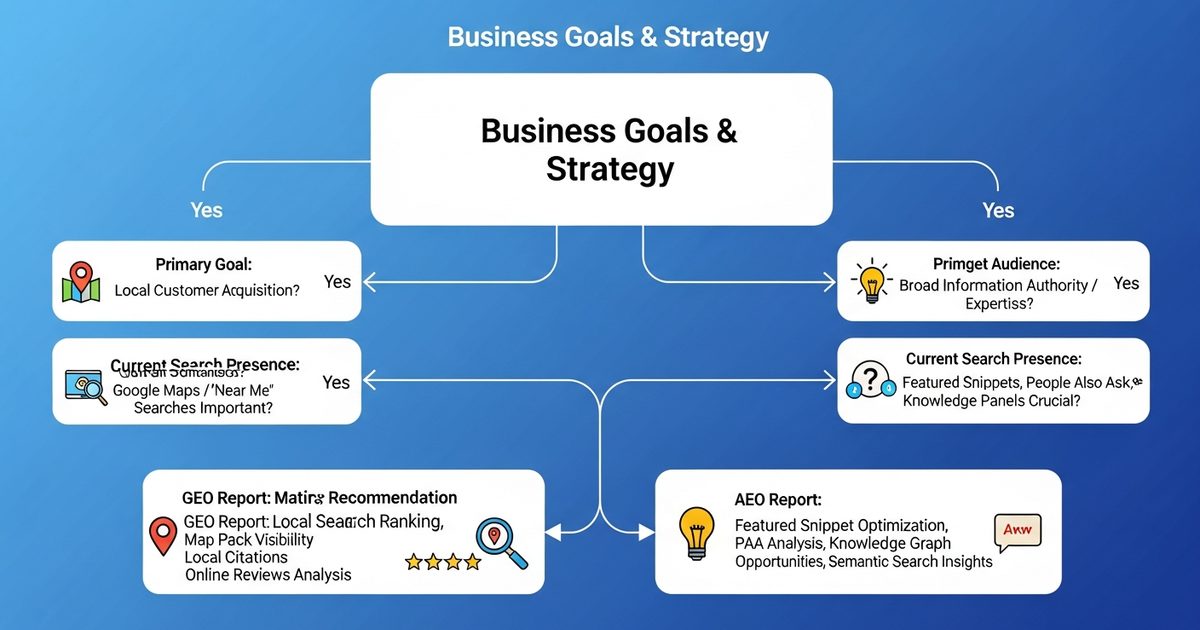
The Decision Framework: Which Report Should You Buy First?
For most businesses, the decision between AEO and GEO reports is not a meaningful binary choice - a good AEO platform covers both. The more useful framing is: which dimension of AI search visibility should you prioritize measuring and improving first?
Buy an AEO Report First If:
Google is your primary traffic source: If 70%+ of your traffic comes from Google Search, an AEO report that covers both Google AI Overviews and third-party AI engines gives you the broadest visibility into how the AI shift is affecting your most important channel.
You are building an initial visibility baseline: For a first-time AI visibility assessment, an AEO report's full coverage gives you the most complete picture before you decide where to focus optimization effort.
You need to justify AI optimization investment: AEO data that includes Google AI Overviews is often more compelling to stakeholders who already understand Google-based SEO metrics.
You are an agency presenting to clients: AEO reporting that covers multiple engines including Google provides broader context for client conversations about where AI search visibility matters for their business.
Buy a GEO-Focused Report First If:
Your audience heavily uses non-Google AI engines: B2B, tech, finance, healthcare, and research-oriented audiences over-index for Perplexity, ChatGPT, and Claude usage. If your buyer persona is a researcher or professional, GEO-specific data is most relevant.
You are in a category where Perplexity dominates AI query share: Certain research-heavy, comparison-oriented, and professional categories see more Perplexity and ChatGPT queries than Google AI Overview queries. Tracking where your audience actually searches is more important than tracking all engines equally.
You have identified a specific competitor dominating non-Google AI answers: If you know a competitor is being consistently cited by ChatGPT or Perplexity for your key category queries, a GEO report quantifies that gap and drives specific optimization actions.
The Practical Reality in 2026
In practice, the teams with the most effective AI search visibility programs in 2026 are not choosing between AEO and GEO reports - they are using platforms that cover both in a single view. The optimization techniques are so similar that separating them creates artificial complexity. The separate budget and tool for "GEO" versus "AEO" is a vendor-driven distinction more than an operational necessity.
AI Rank Lab's platform covers both AEO and GEO in a single dashboard: citation rate tracking across ChatGPT, Gemini, Perplexity, and Claude, alongside Google AI Overviews and Google AI Mode tracking. Teams get the full picture without choosing between reports.
Starting Point: The Unified Baseline Check
Rather than starting with a GEO-only or AEO-only view, the most efficient starting point in 2026 is a unified AI visibility baseline that answers all of these questions simultaneously:
What is my current citation rate in ChatGPT for my top 10 commercial queries?
What is my citation rate in Perplexity for the same queries?
What is my citation rate in Gemini and Claude?
How do those rates compare to my top 3 competitors?
What technical factors are most limiting my citation rates?
Once you have answers to these questions, the decision of where to focus optimization effort - Google AI Overviews versus ChatGPT versus Perplexity versus Claude - becomes data-driven rather than assumption-driven.
The teams that buy a single-engine report first ("just Perplexity" or "just ChatGPT") often find themselves needing to expand coverage within 60-90 days as their program matures and they realize which engines matter most for their specific audience. Starting with full coverage from day one is the more efficient path.
Making the Investment Decision
If your budget allows for one tool investment in AI search visibility, choose a platform that covers both AEO and GEO scope - citation tracking across all four major AI engines, Google AI Overview integration, competitive benchmarking, and technical audit diagnostics. AI Rank Lab from $69/month (Starter) provides all of this in a single platform.
If budget is the limiting factor and you need to start with minimum viable coverage, start with Perplexity and ChatGPT tracking (the two engines with the clearest citation-to-traffic correlation) and expand from there. AI Rank Lab's $69/month Starter plan covers this minimum viable scope as a starting point, and you can move to a larger plan as your program grows.
The AEO vs GEO terminology debate is interesting but ultimately not where your time should go. Start measuring your AI search visibility with whatever coverage your budget supports today, and expand as your program matures. The data will tell you where to focus.
Frequently Asked Questions
What is the difference between AEO and GEO?▾
Should I buy an AEO report or a GEO report first?▾
Do AEO and GEO use the same optimization techniques?▾
What does an AEO report include?▾
Is GEO more important than traditional SEO in 2026?▾
Get a Free AI Ranking Consultation
Want to improve your brand's visibility in AI search engines like ChatGPT, Gemini, and Perplexity? Fill out the form and our experts will create a personalized strategy for you.

Written by
Devanshu
Chief Marketing Officer & AI Search Optimization Architect
Digital Marketing Strategist & Pioneer in SEO, Answer Engine Optimization (AEO), and Generative Engine Optimization (GEO).


