


E-commerce used to compete on page-one Google rankings. Then it competed on Amazon listings. In 2026, a third channel has emerged that most online retailers are not yet optimising for: AI search engines that recommend specific products and brands in response to shopping queries.
When someone asks ChatGPT "What is the best running shoe for overpronation under $150?", or asks Perplexity "Which noise-cancelling headphones have the best battery life?", one or two brands get cited in the response. The brands that earn those citations get a buyer who arrives already convinced. The brands that do not are invisible to that shopper - regardless of how good their products are or how well their website ranks on Google.
This guide covers why AI product citations work differently from Google shopping rankings, what e-commerce teams need to do to earn them, and how to build an ongoing optimisation program that keeps your products visible as AI search continues to grow.
Why AI Product Citations Are Different from Google Rankings
Understanding the difference helps set the right optimisation priorities. On Google, product visibility comes from: ranking for transactional keywords, appearing in Shopping results, and building domain authority for category pages. On AI engines, product visibility comes from: being present in the training data and retrievable web sources that AI engines draw on when they form product recommendations.
The key differences:
AI engines cite brands, not URLs. A ChatGPT response about running shoes mentions brand names and model names, not a ranked list of product page URLs. Your product page needs to clearly associate your brand with the right product category and use case.
Review signals matter enormously. AI engines rely heavily on aggregated review data - G2, Trustpilot, Amazon reviews, Reddit discussions, and editorial product reviews - to determine which products are most trusted. A well-reviewed product on third-party platforms has a significant citation advantage over an equally good product with minimal review presence.
Content depth drives citation over conversion optimisation. Product pages optimised purely for conversion - minimal text, large images, buy buttons - give AI engines very little to work with. Pages that explain what the product does, who it is for, how it compares to alternatives, and what problems it solves are significantly more likely to earn citations.
The Query Types That Drive AI Product Citations
Not all product queries produce AI citations. Understanding which query types lead to AI product recommendations helps you prioritise where to invest your AEO effort:
Best-for queries (highest citation frequency)
"Best [product category] for [specific use case or customer type]" queries are the most citation-rich in e-commerce. These include: "best laptop for graphic designers", "best protein powder for muscle gain", "best noise-cancelling headphones for travel". AI engines respond to these with specific product recommendations and brands - making them the highest-priority targets for e-commerce AEO.
Comparison queries
"[Product A] vs [Product B]", "compare [product category] options", and "which [product] should I buy" queries generate AI responses that directly compare specific brands and models. If your product appears in comparison queries, you earn significant consideration even in responses where you are not the top recommendation.
Problem-solution queries
"What should I use for [problem]?", "How do I fix [issue] at home?", "What product helps with [condition]?" These are particularly high-intent - the user has a specific problem and is asking AI to recommend a solution product category and brand. Content that frames your product as a solution to specific, named problems performs well for this query type.
Specification queries
"Which [product] has [specific spec - longest battery, fastest processor, most storage]?" queries work well for products with quantifiable, comparable specifications. Ensuring your product specifications are clearly stated in structured, machine-readable format on your product pages helps AI engines accurately represent your product in specification-based comparisons.
How to Optimise E-Commerce Pages for AI Citation
1. Rewrite product descriptions for completeness, not just conversion
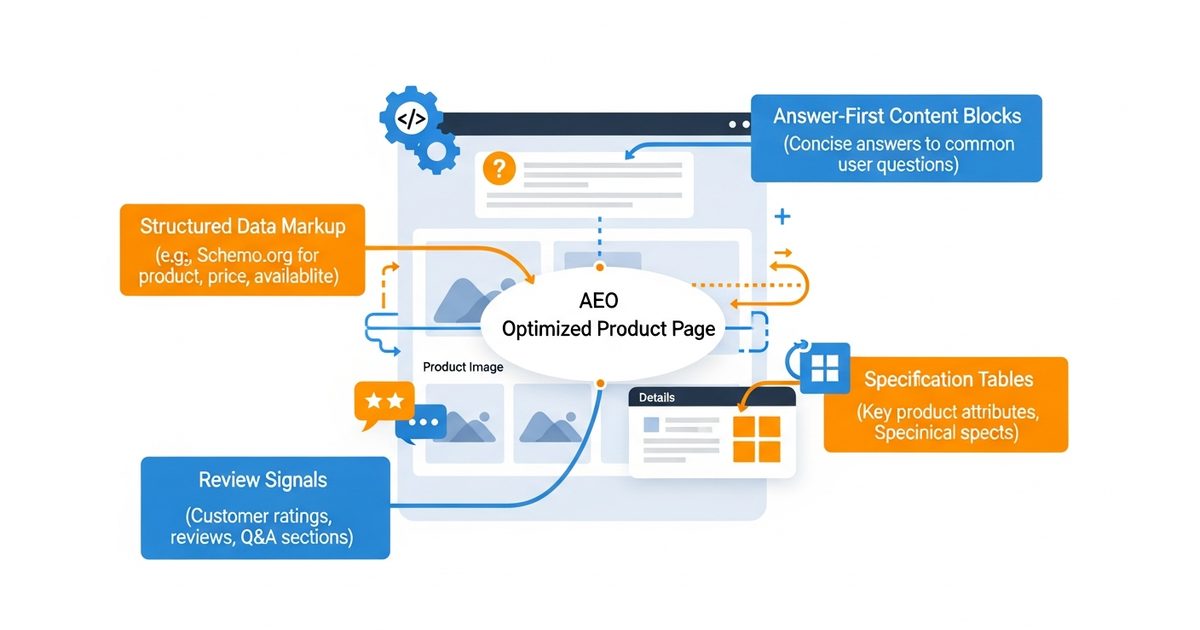
Traditional conversion-optimised product descriptions are brief, benefit-focused, and designed to move users to the buy button quickly. AEO-optimised product descriptions are comprehensive - they answer every question a potential buyer might ask ChatGPT about the product before purchasing. Include: who the product is designed for (specific user profiles), what problems it solves, how it compares to the category average, key specifications in a structured table, and common objections addressed directly.
This does not require removing your conversion-focused content. Add the comprehensive content after the core buy section - AI engines retrieve information from the full page, not just the above-the-fold content.
2. Add Product schema markup to every page
Product schema markup tells AI engines and search engines the machine-readable details of what your product is: name, brand, description, price range, aggregate rating, and review count. This is the most direct technical action available for improving how your products are represented in AI-generated responses. At minimum, every product page should have Product schema with brand, description, aggregateRating (if you have reviews), and offers fields populated.
For category pages and buying guides, add ItemList schema to mark up the products being compared or featured. This helps AI engines retrieve structured product comparison data from your content rather than relying on third-party sources.
3. Build use-case-specific category and guide content
The "best [product] for [use case]" queries that drive the most AI product citations are typically answered from editorial buying guide content, not from individual product pages. If you sell running shoes, a comprehensive guide to "best running shoes for overpronation" that covers the specific biomechanical need, what to look for, and features your recommended products with clear explanation of why they fit the use case will earn more AI citations than individual product pages.
Build guides for your top five to ten use-case combinations. Structure each guide with: the problem or use case explained, the key specifications that matter for this use case, a comparison of your product options for this use case, and a clear recommendation with reasoning. This is the content format AI engines draw from most heavily when formulating product recommendation responses.
4. Earn and aggregate third-party review signals
AI engines weight third-party review signals heavily when formulating product recommendations because they represent aggregated user experience data that is independent of the brand's own claims. The most impactful review channels for e-commerce AI visibility are: Amazon product reviews (particularly for consumer goods), category-specific review platforms (G2 for software, Wirecutter or RTINGS for electronics, Trustpilot for general e-commerce), and editorial reviews in industry publications.
Actively requesting reviews from satisfied customers, responding to negative reviews to demonstrate quality service, and ensuring your product is listed on the major review platforms in your category are all meaningful investments for AI citation authority.
5. Build brand presence across product discovery content
AI engines do not only cite from product pages and brand websites - they also cite from the product journalism, comparison articles, and editorial recommendations that dominate their training data. Getting your product reviewed and included in "best of" roundup articles on relevant editorial sites increases your probability of AI citation for the same queries those articles target.
Identify the top ten editorial sites in your product category that publish "best [product type]" roundups. Reach out to those publications for product review opportunities. Earning a single mention in a well-cited editorial roundup can produce more AI citation lift than months of on-page optimisation.
Monitoring Your E-Commerce AI Citation Rate
Optimisation without measurement does not produce consistent results. For e-commerce AI visibility, the metrics to track are:
Citation rate by query type - what percentage of your best-for, comparison, and problem-solution queries produce AI citations of your brand
Citation position - when your brand is cited, is it the first recommendation or the third? Being cited first produces a significantly higher consideration rate.
Competitor citation rate - which competitors are being cited for your target queries, and how frequently? This shows where you are losing AI-assisted product discovery to competitors.
AI Rank Lab's AI Visibility Tracker monitors your brand's citation rate across ChatGPT, Gemini, Claude, and Perplexity for your target query set on a weekly basis. For e-commerce teams managing product visibility across multiple categories and use-case combinations, this automated tracking is significantly more practical than manual testing.
The E-Commerce AI Citation Stack
The most effective e-commerce teams in 2026 are running two parallel visibility programs:
Traditional e-commerce SEO - Google Shopping optimisation, product page keyword targeting, category page authority building. This remains critical for the majority of purchase-intent traffic that still flows through Google's traditional results.
AEO for product discovery - use-case guide content, Product and ItemList schema, third-party review aggregation, and AI visibility tracking. This captures the growing share of early-stage purchase research that happens through ChatGPT and Perplexity before users ever reach Google or Amazon.
The brands that build both programs now will be harder to displace as AI search handles an increasing share of the product discovery journey. The brands that wait until AI citation loss becomes visible in traffic and revenue will be starting from a position of competitive disadvantage.
Run a free AEO audit for your e-commerce domain on AI Rank Lab and see exactly where your product pages stand against the factors that determine AI citation - and which changes will have the most impact on your AI search visibility.
Frequently Asked Questions
How do I get my products cited by ChatGPT?▾
Why does my product not appear in ChatGPT recommendations?▾
Do product schema markup and structured data help with AI citations?▾
How important are reviews for e-commerce AI visibility?▾
Is AI product visibility different from Amazon SEO?▾
Get a Free AI Ranking Consultation
Want to improve your brand's visibility in AI search engines like ChatGPT, Gemini, and Perplexity? Fill out the form and our experts will create a personalized strategy for you.

Written by
Devanshu
Chief Marketing Officer & AI Search Optimization Architect
Digital Marketing Strategist & Pioneer in SEO, Answer Engine Optimization (AEO), and Generative Engine Optimization (GEO).


