


Introduction
The digital discovery landscape is undergoing a seismic shift. Users don’t just want links anymore - they want answers. With the rise of AI-powered tools like ChatGPT, Google AI Overviews, Perplexity, and Microsoft Copilot, brands now compete not just for search rankings, but for being cited as the answer itself. This is the essence of Answer Engine Optimisation (AEO) - the practice of structuring your content so that AI and advanced search platforms can directly extract and present it as the definitive response to user queries.
For marketers, startup founders, and marketing managers, understanding AEO isn’t optional — it’s essential. The way people search is becoming conversational and intent-driven, and traditional SEO alone is no longer enough. In this article, you’ll learn what AEO is, why it matters, how it differs from SEO, key strategies to implement, and how to measure success in this new era of answer-first discovery. We’ll also explore examples, long-tail keyword opportunities, visual concepts to support understanding, and practical frameworks you can use in your content strategy.
Table of Contents
What is Answer Engine Optimisation (AEO)?
Why AEO Matters in Modern Search
AEO vs SEO: Key Differences
How Answer Engines Work
Core AEO Principles & Best Practices
Content Structure for AEO Success
Conversation-First Content & Queries
Technical Signals: Schema & Structured Data
Authority, EEAT & Trust Signals
Platforms Where AEO Matters (ChatGPT, SGE, Copilot…)
Measuring AEO Performance
Case Studies & Examples
Common AEO Mistakes to Avoid
Tools & Resources to Support AEO
Quick Takeaways
Conclusion
1. What is Answer Engine Optimisation (AEO)?
Answer Engine Optimisation (AEO) is the practice of optimizing your content so that AI-powered answer engines can find, interpret, and surface your information as direct answers to user questions - without users needing to click through a search results page.
Unlike traditional SEO, where the goal is to rank for keywords and attract traffic to a page, AEO focuses on being the answer itself in environments where AI and search engines synthesize information. These environments include:
AI chat tools like ChatGPT
Google’s AI Overviews and AI Mode
Bing and Microsoft Copilot
AI-powered assistant results (voice and chat)
Third-party engines like Perplexity AI
The shift from simple keyword ranking to answer extraction represents a broader change in how search engines and generative models deliver information. Rather than sending users a list of links to sift through, answer engines aim to provide concise, authoritative responses directly in the interface itself. This means the content that gets surfaced must be structured, factual, conversational, and directly aligned with user intent.
AEO builds on SEO fundamentals (crawlability, relevance, authority) but adds a new priority: readability and interpretability by language models. Instead of just ranking for a keyword like “Answer Engine Optimization,” AEO means your content is likely to be cited or quoted in the AI’s response to a natural language question such as “What is Answer Engine Optimisation and how does it impact marketing?”
In short, AEO flips the search paradigm: not “How do I make Google list my site?” but “How do I make AI list my answers?”.
2. Why AEO Matters in Modern Search
Search behavior is rapidly evolving. Research shows a growing number of users rely on AI-generated answers and conversational search experiences instead of traditional search engine results pages (SERPs). AEO is the strategy that helps brands stay visible within this new paradigm.
Zero-Click Searches Are Increasing
Traditional SEO drove traffic based on rankings in SERPs. But AI overviews and chat answers often resolve queries before a click occurs. This is sometimes called the “zero-click world”, where being quoted or cited in an AI’s response is often more valuable than traditional link-based rankings.
For marketers and founders, this shift means:
Traditional SEO alone cannot guarantee visibility in advancement-driven search surfaces.
Users expect direct, conversational answers — often phrased as questions.
Brand credibility and authority are increasingly tied to how AI sees your content, not just how search engines index it.
Higher Intent & Business Impact
AI referral traffic can convert at higher rates because users who ask conversational queries often have stronger intent. Some studies indicate AI driven search traffic can drive higher conversion rates than traditional organic search.
Competitive Advantage
Many businesses have yet to adopt AEO strategies. Early adopters gain advantages in visibility across AI tools and platforms. If your brand provides definitive, structured answers that AI pulls into responses, you essentially win this emerging space ahead of competitors.
AEO is not about abandoning SEO — it’s about expanding your visibility into the future of search.
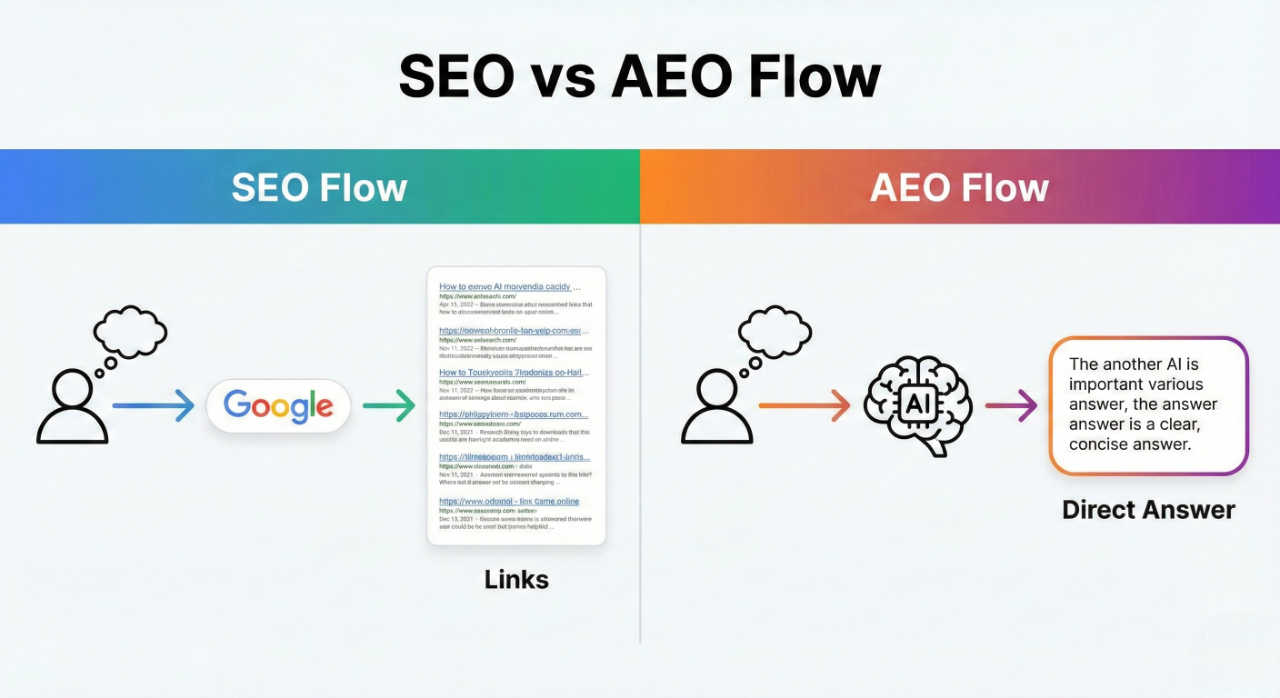
3. AEO vs SEO: Key Differences
Although AEO and SEO share a root goal — improving online visibility — their approaches, signals, and outcomes differ significantly.
Traditional SEO
Primary focus:
Ranking on SERPs
Driving traffic
Keyword intent
Backlinks and technical site health
Success is measured by metrics such as:
Search rankings
Organic impressions
Click-through rates (CTR)
Keyword visibility
Content optimized for SEO tends to be long-form, keyword-rich, and designed to satisfy multiple search queries.
Answer Engine Optimisation (AEO)
Primary focus:
Being cited as the answer by AI and large language models
Structuring content so machines understand context
Answering conversational questions directly
Success is measured by:
AI citations
Mentions within AI responses
Voice assistant visibility
Placement in featured summaries/answer boxes
While traditional SEO often targets keyword phrases, AEO targets natural language questions and intents, especially long-tail, conversational queries.
Key Differences
Feature | SEO | AEO |
|---|---|---|
Goal | Rank pages | Be the direct answer |
Focus | Keywords | Conversational intent |
Output | Listing & links | AI-generated answers |
Signals | Backlinks, ranking | Structured data, clarity, entity understanding |
Metrics | SERP rankings | AI mentions & citations |
Unlike SEO, which primarily drives users to your content, AEO drives your content into the answer itself. This increases brand visibility even when users don’t click through - a shift marketers must embrace.
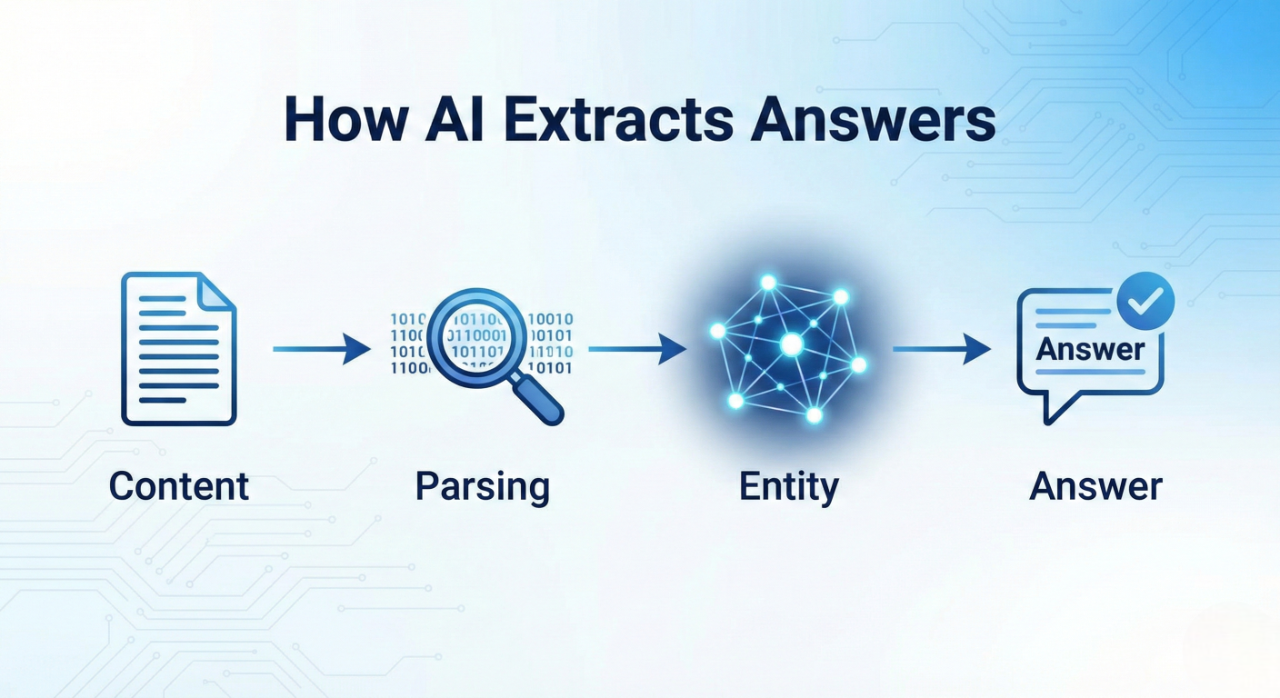
4. How Answer Engines Work
Answer engines are powered by advanced large language models (LLMs) and AI search systems that:
Interpret the user’s intent
Retrieve relevant information
Synthesize a concise answer
Present it as a direct response
This differs from classic search, which returns a list of links that users must explore. AI-powered engines gather signals from indexed content and use semantic understanding to produce “answer-first” outputs.
Query Interpretation
AI systems parse natural language - understanding context, synonyms, and implied meanings - in ways that go well beyond keyword matching. For instance, “How do I optimize my content for AI answers?” requires interpretation of intent, context, and purpose, not just keyword matching.
Information Retrieval
AI tools use datasets indexed by search engines, combined with training on large corpora of content across the web. Some models generate answers from training data (e.g., ChatGPT), while others use real-time retrieval (e.g., Perplexity).
Synthesis and Response
Rather than returning a ranked list, AI synthesizes input into a coherent, conversational answer — drawing on multiple sources if exposed.
For example:
“AEO means structuring content so that AI search tools extract your answers directly — not just your links.”
This sort of synthesis rewards content that is clear, factual, and structured.
Why Structure Matters
AI needs easily interpretable signals:
Headings and subheadings
Concise paragraphs
Defined terms and Q&A formats
Structured data (schema)
This ensures answers are correctly attributed and accurately represented - increasing the chance of citation.
5. Core AEO Principles & Best Practices
To win in Answer Engine Optimisation, you must stop thinking like a keyword optimizer and start thinking like an answer architect.
1. Answer First, Elaborate Second
AI systems favor content that:
Directly answers the question in the first 1–2 sentences
Then provides supporting explanation
For example:
What is Answer Engine Optimisation?
Answer Engine Optimisation (AEO) is the process of structuring content so AI search engines can extract and present it as a direct answer to user queries.
This pattern mirrors how featured snippets and AI answers are generated.
2. Use Clear, Explicit Language
Avoid:
Vague marketing language
Fluff and filler
Overly poetic explanations
Prefer:
Definitions
Step-by-step logic
Lists and structured formats
AI models extract facts, not vibes.
3. Map Content to Questions, Not Just Keywords
Instead of:
“Answer Engine Optimisation strategy”
Think:
“What is Answer Engine Optimisation?”
“How do you optimize for AI search?”
“Is AEO replacing SEO?”
This aligns your content with conversational search behavior and voice search optimization.
4. Build Entity Authority
AI systems increasingly rely on entity understanding:
Brands
People
Concepts
Categories
The more consistently your brand is associated with a topic, the more likely you’ll be cited.
5. Be the Best Answer, Not the Longest
In AEO:
Clarity beats length
Structure beats storytelling
Precision beats persuasion
Unique insight: In a world of AI answers, marketing is shifting from persuasion to precision. The brand that explains best wins.
6. Content Structure for AEO Success
Your structure is as important as your content.
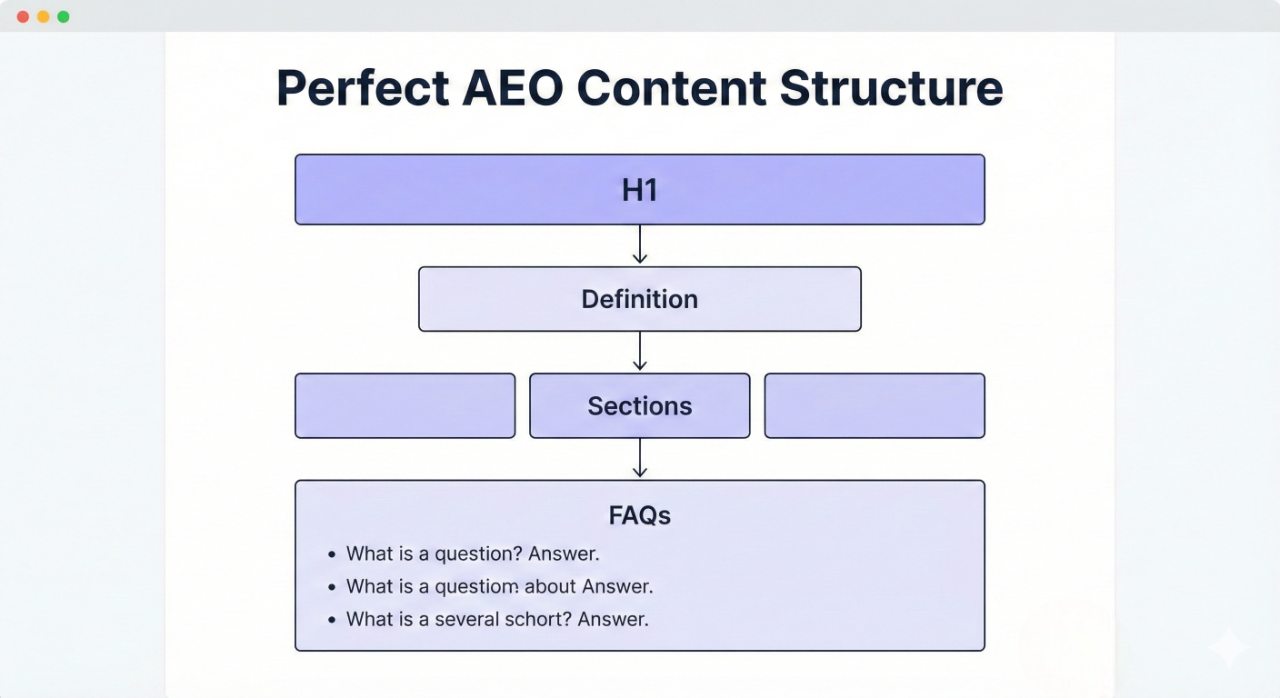
Ideal AEO Page Structure
H1: The main question/topic
Intro: Direct definition
H2: Subtopics framed as questions
H3/H4: Supporting explanations
Lists, tables, steps, FAQs
Why This Works
AI systems:
Parse headings as topic boundaries
Use lists and steps as extractable blocks
Prefer modular information
Winning Formats
Definition blocks
How-to steps
Comparison tables
FAQs
Glossaries
Checklists
Paragraph Length Rule
2–4 lines max per paragraph
Each paragraph = one idea
Schema Matters (But Isn’t Magic)
Schema helps machines understand your content faster, but it doesn’t fix bad content.
Unique insight: Think of your content like an API for AI. If it’s not clean, structured, and predictable — it won’t be used.
7. Conversation-First Content & Queries
AEO is powered by how people talk, not how they type.
Shift from Keywords to Questions
Old:
“AEO marketing strategy”
New:
“How do I optimize my content for AI answers?”
Where to Find These Questions
Google “People Also Ask”
Reddit
Quora
Sales calls
Support tickets
Chat logs
Write Like You’re Explaining to a Smart Human
Natural language
Direct tone
No jargon unless defined
Long-Tail & LSI Examples
“What is answer engine optimization in SEO”
“How to rank in AI search results”
“Optimize content for ChatGPT and Google AI”
“AEO vs SEO differences”
Unique insight: The future of search is dialogue, not discovery.
8. Technical Signals: Schema & Structured Data
While content is king, structure is the crown.
Most Useful Schema Types for AEO
FAQPage
HowTo
Article
Organization
Product
Review
What Schema Actually Does
Helps machines classify content
Improves extraction accuracy
Increases chance of rich results & answer usage
But Don’t Over-Optimize
Schema:
Supports clarity
It does not replace clarity
Bad content + schema = still bad content.
Other Technical Factors
Fast page speed
Clean HTML
Proper heading hierarchy
No content hidden behind JS when possible
Unique insight: AEO is not a technical trick. It’s a communication discipline.
9. Authority, EEAT & Trust Signals
AI systems increasingly rely on EEAT:
Experience
Expertise
Authoritativeness
Trustworthiness
How to Strengthen EEAT
Show authorship
Cite sources
Use original examples
Show real-world experience
Maintain topical consistency
Why This Matters for AEO
AI models:
Prefer credible sources
Avoid hallucination risk by leaning on trusted domains
Reuse sources that consistently explain things well
Unique insight: In AI search, reputation compounds faster than rankings.
10. Platforms Where AEO Matters
Google AI Overviews
ChatGPT
Perplexity
Bing Copilot
Voice assistants (Siri, Alexa)
Each pulls from structured, authoritative, well-explained content.
If your content explains things clearly, every AI becomes your distribution channel.
11. Measuring AEO Performance
Traditional metrics don’t fully apply.
New Metrics to Watch
Brand mentions in AI answers
Referral traffic from AI tools
Featured snippet ownership
Impression growth on question queries
Conversion quality
Tools
Google Search Console
Ahrefs / Semrush
Manual testing in AI tools
Perplexity source tracking
Unique insight: Visibility without clicks is still brand equity.
12. Case Studies & Examples
HubSpot dominates definitions
Investopedia dominates financial explanations
Wikipedia dominates entity clarification
Why?
Clear structure
Neutral tone
Direct definitions
Consistent formatting
They’re not “SEO clever”.
They’re explanation excellent.
13. Common AEO Mistakes to Avoid
Writing for keywords, not questions
Burying the answer
Overusing fluff
No structure
No entity focus
No credibility signals
14. Tools & Resources for AEO
AI Rank Lab
Semrush / Ahrefs (question research)
AlsoAsked
AnswerThePublic
Perplexity
Google PAA
Schema validators
Quick Takeaways
AEO is about being the answer, not just ranking
Structure matters as much as content
Write for questions and conversations
Authority and clarity win
AI is your new distribution layer
SEO isn’t dead — it’s evolving
Explanation is the new optimization
Conclusion
Answer Engine Optimisation isn’t a trend - it’s a structural shift in how information is discovered, consumed, and trusted. As AI systems increasingly mediate between users and the web, the brands that win will not be the loudest, but the clearest.
For marketers, startup founders, and marketing managers, this changes the game. Visibility is no longer just about ranking pages - it’s about owning explanations. It’s about being the source AI relies on when it needs to explain your category, your product, or your idea.
The good news? AEO rewards good thinking, good structure, and good teaching. If you can explain your domain better than anyone else, AI will eventually find you, trust you, and use you.
Start by:
Turning keywords into questions
Turning pages into answers
Turning content into a knowledge system
The future of search is not browsing.
It’s asking.
And the future of marketing belongs to those who answer best.
Frequently Asked Questions
What is Answer Engine Optimisation in simple terms?▾
Is AEO replacing SEO?▾
How do I optimize content for ChatGPT and AI search?▾
What is the difference between AEO and featured snippets?▾
Does schema guarantee AI citations?▾
Get a Free AI Ranking Consultation
Want to improve your brand's visibility in AI search engines like ChatGPT, Gemini, and Perplexity? Fill out the form and our experts will create a personalized strategy for you.

Written by
Devanshu
Chief Marketing Officer & AI Search Optimization Architect
Digital Marketing Strategist & Pioneer in SEO, Answer Engine Optimization (AEO), and Generative Engine Optimization (GEO).


