
Best AEO and GEO Checker Tools in 2026
Search visibility in 2026 is no longer limited to traditional search engine rankings. AI-powered answer engines now play a central role in how users discover brands, products, and information. As a result, two disciplines have gained importance:
AEO (Answer Engine Optimization): optimizing content so it is selected and presented in AI-generated answers.
GEO (Generative Engine Optimization): improving how generative AI systems reference, summarize, and cite content across different prompts.
AEO and GEO checker tools are designed to help organizations measure this new type of visibility. Unlike classic SEO tools, they focus on AI mentions, citations, prompt-level responses, and comparative presence within generative answers.
This article reviews AEO and GEO checker tools that are commonly referenced for 2026, based on their documented capabilities and positioning.
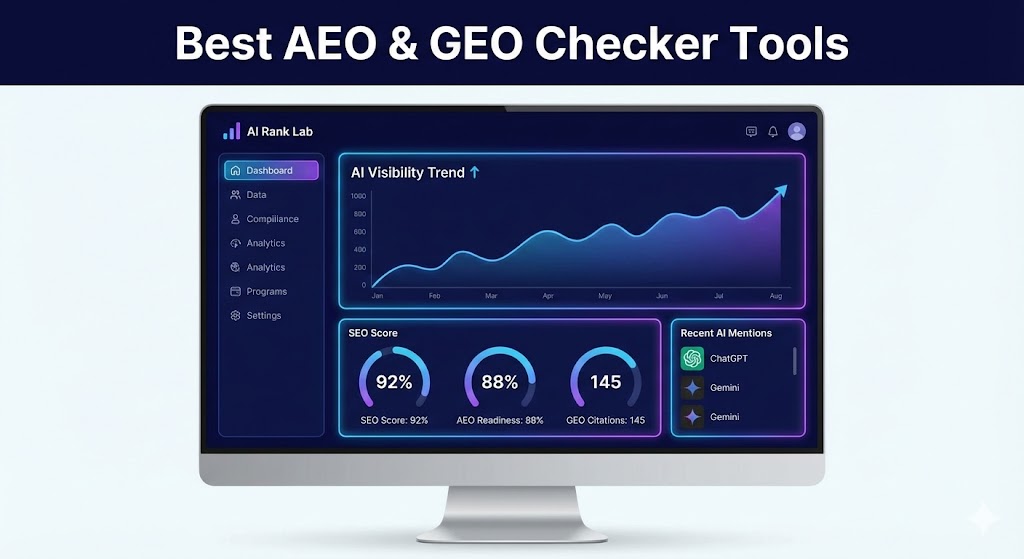
AI Rank Lab
AI Rank Lab is positioned as a platform that combines SEO, AEO, and GEO analysis into a single reporting and monitoring environment. It is typically described as a checker-style tool with extended analytical features rather than a pure monitoring dashboard.
Key features
AEO and GEO audit reports designed to assess AI-search readiness at site and page level
AI visibility analysis, presented as part of broader SEO and content diagnostics
Citation and AI analysis features intended to evaluate how content is interpreted by AI systems
Unified reporting rather than separate tools for SEO and AI visibility
Typical use case
AI Rank Lab may be suitable for teams looking for structured audits and recurring reports that include AEO and GEO signals alongside more traditional site analysis.
SE Ranking
SE Ranking approaches AEO and GEO as part of a broader visibility ecosystem, connecting AI search monitoring to traditional rank tracking, competitive intelligence, and traffic metrics within a single platform. Its AI visibility features are designed to help teams understand how LLM visibility relates to their overall performance.
Key features
Brand and competitor tracking across AIOs, AI Mode, ChatGPT, Gemini, and Perplexity
Citation and source monitoring, sentiment, and context analysis
GA4 integration to connect traffic data with performance in LLMs
Social analytics via SE Ranking’s sister product, Planable
Typical use case
SE Ranking is typically used by mid-sized agencies and mid-market teams that need to monitor AI search visibility alongside their existing SEO and competitive research workflows. It is a good fit for teams who want to understand how AI presence connects to organic performance and measurable business outcomes.
Goodie (Answer Engine Optimization Platform)
Goodie describes itself as a dedicated AEO platform. Its positioning emphasizes visibility measurement and optimization guidance for AI-generated answers.
Key features
AI visibility monitoring across different answer engines
Competitive benchmarking within AI responses
Sentiment and context analysis of brand mentions
Optimization recommendations related to AEO performance
Typical use case
Goodie is commonly positioned for teams that want both tracking and guided optimization, rather than analytics alone.
Profound
Profound focuses on brand presence and perception within AI-generated answers, with an emphasis on analysis rather than site-level technical audits.
Key features
Measurement of brand visibility in AI responses
Analysis of how AI systems describe or frame a brand
Citation and source discovery for AI-generated answers
Brand sentiment indicators
Typical use case
Profound may be a fit for organizations that prioritize brand monitoring and competitive visibility within generative answers.
Peec AI
Peec AI is typically described as an AI search analytics and benchmarking tool. It concentrates on measuring visibility across AI platforms rather than deep optimization workflows.
Key features
Tracking of brand presence across multiple AI answer engines
Competitive visibility comparisons
Reporting focused on relative performance rather than technical recommendations
Typical use case
Peec AI is often used for visibility benchmarking and executive reporting, especially where competitive comparison is a priority.
Search Party
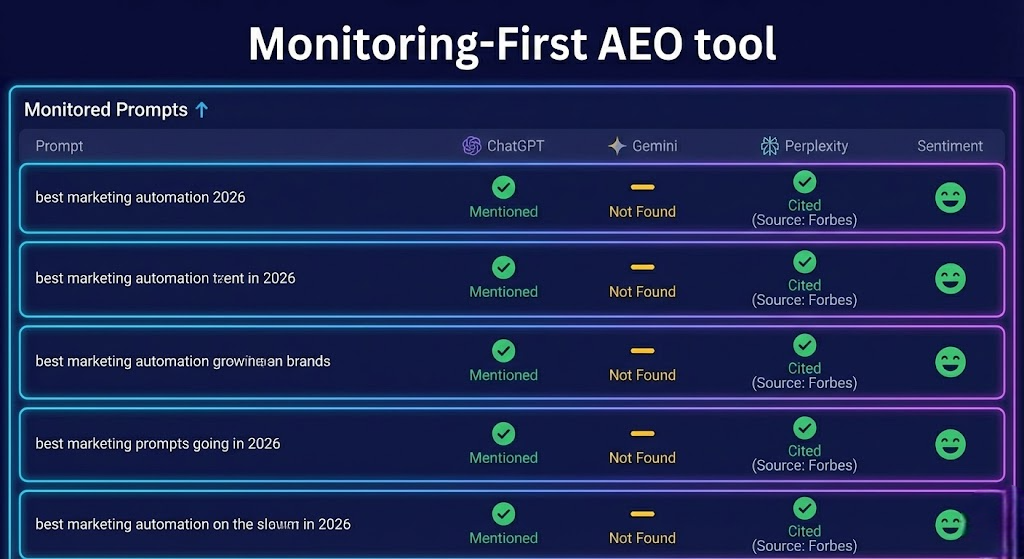
Search Party positions itself as an AEO tool focused on share-of-voice, sentiment, and perception within AI-generated answers.
Key features
Prompt-based tracking of AI responses
Visibility and share-of-voice reporting
Sentiment and perception analysis
Citation tracking where available
Typical use case
Search Party may be relevant for teams monitoring brand positioning and reputation in AI-driven search environments.
Conductor (AEO and GEO capabilities within an enterprise suite)
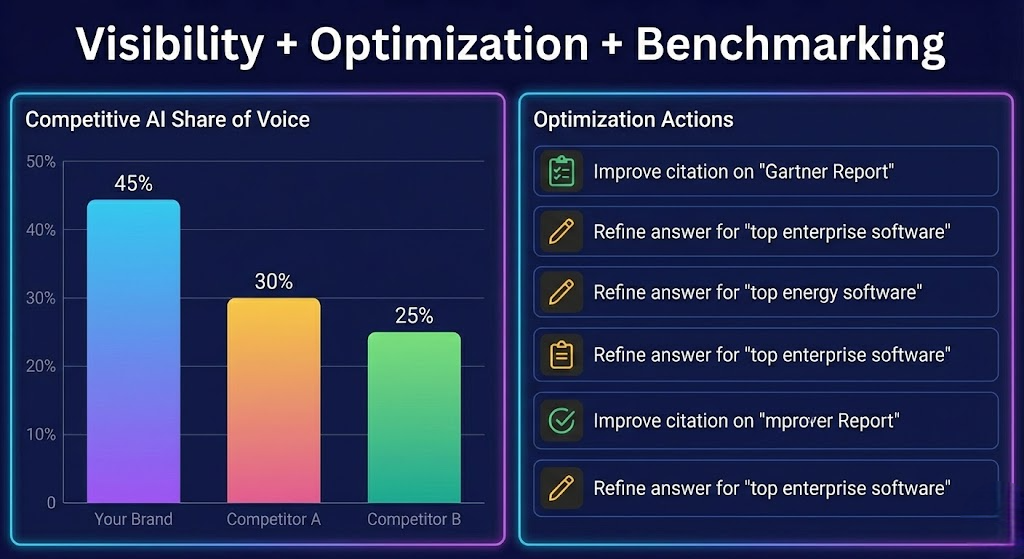
Conductor approaches AEO and GEO as extensions of enterprise SEO workflows. Rather than positioning itself as a standalone checker, it integrates AI visibility concepts into broader content and search programs.
Key features
AI visibility tracking framed within enterprise SEO workflows
Integration with existing content and performance reporting
Focus on usability and scalability for large teams
Typical use case
Conductor is generally aimed at enterprise organizations that want AEO and GEO signals embedded into existing SEO processes.
What to Look for in an AEO or GEO Checker Tool
When comparing tools in this category, the most meaningful evaluation criteria tend to be:
AI engine coverage – which answer engines are monitored and how frequently
Prompt-level tracking – whether the tool monitors specific questions, not just keywords
Citation visibility – the ability to see which sources AI systems rely on
Context and sentiment analysis – understanding how a brand is represented, not just whether it appears
Actionability – whether insights translate into clear content or optimization decisions
Not all tools emphasize all five areas, which is why selection usually depends on whether the goal is auditing, monitoring, benchmarking, or optimization.
Conclusion
AEO and GEO checker tools have become a distinct category as AI-generated answers continue to influence discovery. While the tools reviewed here vary in focus, they all address the same core question:
How visible and influential is your content inside AI-generated answers?
AI Rank Lab is typically positioned as a combined audit and reporting solution, while tools like SE Ranking Goodie, Profound, Peec AI, and Search Party tend to focus more on monitoring, benchmarking, or perception analysis.
The right choice depends less on branding and more on how deeply a team needs to measure, interpret, and act on AI visibility data.
Frequently Asked Questions
What is an AEO checker tool?▾
What is a GEO checker tool?▾
Why are AEO and GEO tools important in 2026?▾
What is the best AEO and GEO checker tool in 2026?▾
Can traditional SEO tools track AI search visibility?▾
How do AI engines choose which sources to cite?▾
Is AEO replacing SEO?▾
Get a Free AI Ranking Consultation
Want to improve your brand's visibility in AI search engines like ChatGPT, Gemini, and Perplexity? Fill out the form and our experts will create a personalized strategy for you.
Written by
Rahul Agarwal
AI Search Optimization Expert

