


Marketing teams understand intuitively why AI search visibility matters. CFOs need a different conversation. They need to understand the financial exposure created by poor AI visibility, the revenue opportunity from improving it, and why the investment delivers a better return than competing budget priorities.
This guide provides the framework and template language for building that case. The structure is designed to work in a CFO or executive budget conversation - grounded in numbers, competitive risk, and business impact rather than marketing channels and impressions.
Why Traditional Marketing ROI Arguments Do Not Work for AI Search
The standard digital marketing ROI argument runs: spend X, get Y traffic, convert at Z%, generate W revenue. This framework fails for AI search investment for a specific reason: AI citations do not always produce trackable clicks. A brand cited in a ChatGPT response influences the user's consideration, but they may not click through immediately - they may search Google for the brand name later, or call directly, or simply include the brand in their consideration set.
For CFOs, this means the attribution case needs to be built differently: not "here is the direct revenue from AI-referred clicks" but "here is the commercial exposure from being absent from AI-generated recommendations in our market."
The Three-Part CFO Business Case Framework
Part 1: Quantify the Current Exposure
Start by establishing what AI search invisibility is already costing the business. This requires three data points:
AI search volume in your category: How many queries related to your product category are being asked through ChatGPT, Perplexity, and Gemini monthly? Use AI Rank Lab's Keyword Planner to surface query volume estimates for your priority keywords across AI engines. For most established product categories, the combined AI search volume is already in the tens of thousands of monthly queries - and growing at 200-400% year-over-year.
Your current citation rate: What percentage of those queries produce AI responses that cite your brand? This is your baseline, established through AI Rank Lab's AI Visibility Tracker. Most brands discover their citation rate is below 20% - meaning 80%+ of AI search conversations in their market are happening without their brand mentioned.
Competitor citation rate: Which competitors are being cited instead? What is their citation rate relative to yours? A competitor being cited in 60% of relevant AI queries while you are cited in 15% is a commercially meaningful difference in brand consideration that compounds over time.
Combine these to build the exposure statement: "ChatGPT and Perplexity together handle approximately [X] monthly queries about [our product category]. Our brand appears in [Y]% of those responses. Our primary competitor appears in [Z]%. This means [X times (Z-Y)%] monthly query responses are directing potential customers to our competitor instead of us."
Part 2: Model the Revenue Impact of Improvement
Convert the citation gap into a revenue opportunity using this calculation framework:
Variable | How to calculate | Example value |
|---|---|---|
Monthly AI search queries in category | AI Rank Lab Keyword Planner + industry estimates | 40,000/month |
Current citation rate | AI Rank Lab AI Visibility Tracker baseline | 18% |
Target citation rate (12 months) | Benchmarked against leading competitor | 40% |
Additional cited queries per month | (40% - 18%) x 40,000 | 8,800/month |
Consideration rate from AI citation | Industry research (typically 15-25%) | 20% |
Additional considerations per month | 8,800 x 20% | 1,760/month |
Close rate from consideration | Your CRM conversion rate | 8% |
Additional revenue per month | 1,760 x 8% x average deal value | Depends on ACV |
For a SaaS company with a $200/month average contract value and a 20% annual churn rate, even a conservative model using these numbers produces a compelling ROI case. Adjust the variables with your own conversion metrics to build the version that reflects your specific business economics.
Part 3: Frame the Competitive Risk
Revenue opportunity models are useful but often treated with scepticism by finance teams who have seen too many optimistic marketing projections. The competitive risk framing is often more persuasive because it is harder to dismiss:
"Every month we do not invest in AI search visibility, our competitor [name] earns approximately [X] additional AI citations in queries our potential customers are asking. These citations build brand familiarity that influences consideration, preference, and ultimately purchase decisions. AI engine citation patterns, once established through training data and content authority, are self-reinforcing - the brands being cited today are more likely to be cited next year. The cost of this investment is [monthly budget]. The cost of not making it is [competitive disadvantage that compounds quarterly]."
This framing shifts the conversation from "is this worth spending on" to "can we afford not to" - a much stronger position for budget approval.
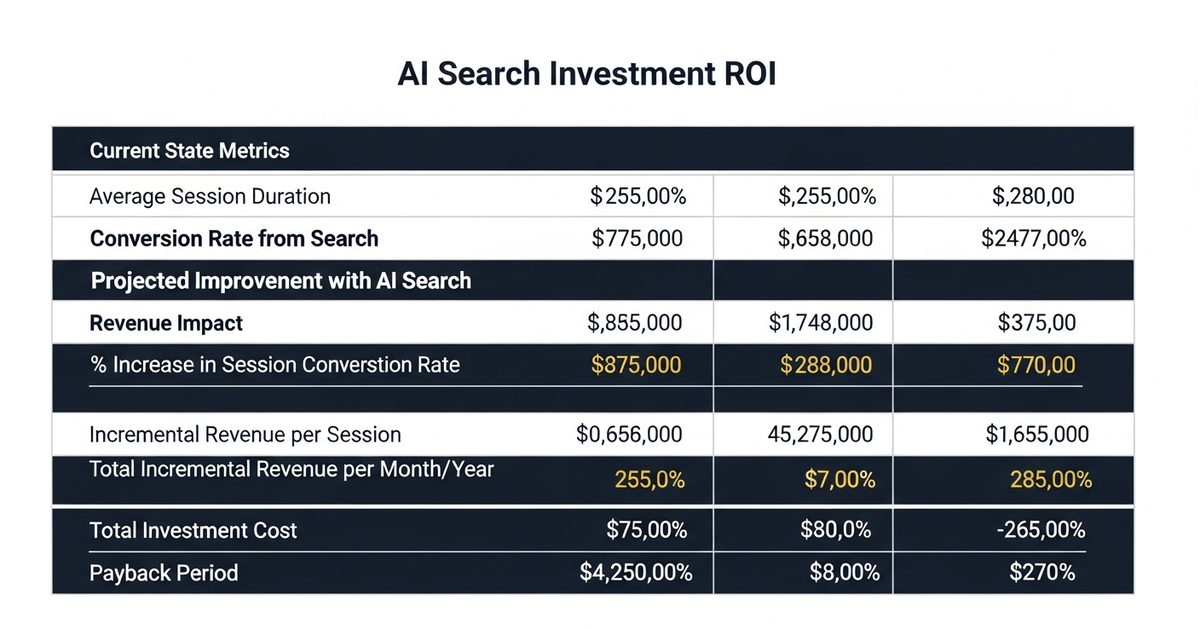
The CFO-Ready One-Page Summary Template
Use this structure for the executive summary:
Situation: AI search engines (ChatGPT: 2.8 billion users, Perplexity: 780M monthly queries, Google AI Overviews: 25%+ of all Google searches) now handle a meaningful and rapidly growing share of the queries our potential customers use to research [product category]. Our brand currently appears in [X]% of relevant AI responses; our primary competitor appears in [Y]%.
Implication: This citation gap means [Y-X]% of AI search conversations about our category are directing potential customers to our competitor's brand rather than ours. At estimated category AI query volume of [N] monthly queries, this represents approximately [N x (Y-X)%] monthly conversations where we are absent.
Investment required: [Monthly budget] for AI search visibility tools and implementation (AI Rank Lab platform + content and technical implementation). 12-month program with measurable citation rate milestones at 90 days, 180 days, and 12 months.
Expected return: Citation rate improvement from [X]% to [target]% within 12 months, producing estimated [revenue impact] in incremental consideration based on [conversion assumptions]. Payback period: [calculation].
Risk of inaction: Competitor citation advantage compounds quarterly as AI engine training data is updated and their content authority grows relative to ours. Early investment creates a citation lead that is significantly harder and more expensive to overcome from a trailing position.
Anticipating CFO Objections
"How do we measure this?"
AI Rank Lab's AI Visibility Tracker provides weekly citation rate measurement across ChatGPT, Gemini, Claude, and Perplexity with a clear before/after baseline. GA4 can be configured to track AI-referred traffic separately. Monthly reporting against citation rate targets provides the measurement cadence that finance teams require for budget accountability.
"This seems speculative - AI search might not last."
Every major technology company (Google, Microsoft, OpenAI, Meta, Anthropic) is investing billions in AI search infrastructure. Google AI Overviews appeared on 6.5% of queries in January 2025 and over 25% by mid-2025. The trajectory is not speculative - the question is the rate of growth, not the direction. Brands that wait for certainty will start from a trailing position when certainty arrives.
"Why can't we do this with our existing SEO team/tools?"
Traditional SEO tools (SEMrush, Ahrefs, Moz) do not measure or improve ChatGPT, Perplexity, or Claude citation rates. Your existing SEO team has the content and technical skills applicable to AEO/GEO, but needs AI-specific tooling and methodology. The incremental investment is in tooling (AI Rank Lab) and methodology upskilling - not in building a separate team from scratch.
Start building your business case with a baseline citation rate measurement from AI Rank Lab's free tier. The baseline data for Part 1 of the business case framework above takes less than a week to gather - and it is the most persuasive data point in any CFO conversation about AI search investment.
Frequently Asked Questions
How do you calculate ROI for AI search visibility investment?▾
What metrics should be included in an AI search business case?▾
How long does it take to see measurable ROI from AI search investment?▾
Get a Free AI Ranking Consultation
Want to improve your brand's visibility in AI search engines like ChatGPT, Gemini, and Perplexity? Fill out the form and our experts will create a personalized strategy for you.

Written by
Devanshu
Chief Marketing Officer & AI Search Optimization Architect
Digital Marketing Strategist & Pioneer in SEO, Answer Engine Optimization (AEO), and Generative Engine Optimization (GEO).


