


Why E-E-A-T Matters More for AI Citations Than for Google Rankings
Google introduced E-E-A-T (Experience, Expertise, Authoritativeness, Trustworthiness) as a content quality framework for its Search Quality Evaluator Guidelines. Most SEO practitioners treat it as a soft signal - important for Google but hard to measure directly. For AI search citations, E-E-A-T is not soft at all. It is one of the clearest patterns separating consistently cited sources from consistently ignored ones.
AI engines are making consequential decisions when they answer questions. When a user asks Claude about medication interactions or ChatGPT about investment options, the AI engine is not just pattern-matching to the most popular page - it is making a judgment about which source is most likely to be correct and trustworthy. E-E-A-T signals are how content communicates trustworthiness to systems that must make those judgments at scale.
The practical implication: sites with weak E-E-A-T signals may have high-quality, accurate content that never gets cited because AI engines cannot verify its trustworthiness from structural signals. Sites with strong E-E-A-T get cited more consistently, even on topics where their content is not uniquely differentiated.
How Each E-E-A-T Signal Translates to AI Citation
Experience
"Experience" in E-E-A-T means first-hand, real-world experience with the topic - as distinct from expertise derived purely from research. For AI citations, this translates to: content that describes actual observed outcomes, not just theoretical frameworks; case studies and specific examples rather than generic guidance; and data derived from real usage rather than cited from secondary sources.
AI engines can increasingly distinguish between content written by someone who has done the thing and content summarizing what others have done. The patterns that signal first-hand experience: specific numbers and observations ("in our analysis of 5,000 domains, we found..."), process descriptions that include implementation challenges ("the most common mistake we see is..."), and outcomes reported at a level of specificity that could only come from direct observation.
For AI Rank Lab, the research data in articles like our E-E-A-T deep dive comes from actual citation analysis across our customer base - that is an experience signal. Generic content summarizing published research on E-E-A-T has the same information but a weaker experience signal.
Expertise
Expertise is demonstrated knowledge depth on a specific topic. AI engines evaluate expertise through: technical depth of content (does it cover subtleties and edge cases?), accuracy and precision (are claims correctly stated?), and author credential signals in Article schema.
For AEO purposes, expertise signals should be made explicit rather than assumed. If a medical article is written by a physician, the author's credentials (MD, specialty, institution) should appear in the Article schema's author sub-object and on the author bio page. If a legal article is written by a practicing attorney, bar admission and practice area should be stated. AI engines use these explicit credential signals rather than inferring expertise from content quality alone.
Authoritativeness
Authoritativeness is about your site's reputation within a topic domain - are you recognized as an authority by other authoritative sources? In practical terms, this is about backlinks from credible sources, citations in other authoritative content, and presence in recognized industry directories and publications.
For AI citation specifically, authoritativeness is amplified by mentions in the content AI engines are trained on. A brand mentioned positively in academic papers, major publications, and authoritative industry resources has authoritativeness that extends into AI training data. Building editorial presence in your industry - through original research, expert commentary in publications, and conference presence - builds AI authoritativeness over time.
Trustworthiness
Trustworthiness is the foundation that makes the other three signals credible. AI engines evaluate trustworthiness through: site security (HTTPS, no security warnings), privacy and legal pages (privacy policy, terms of service), transparency about methodology and sources, contact information presence, and accuracy track record.
For content accuracy specifically, AI engines increasingly use cross-reference checking - if a claim appears on your site that contradicts what authoritative sources say about the same topic, trustworthiness is reduced. Maintaining content accuracy, citing sources for claims, and updating outdated information are all trustworthiness maintenance activities.
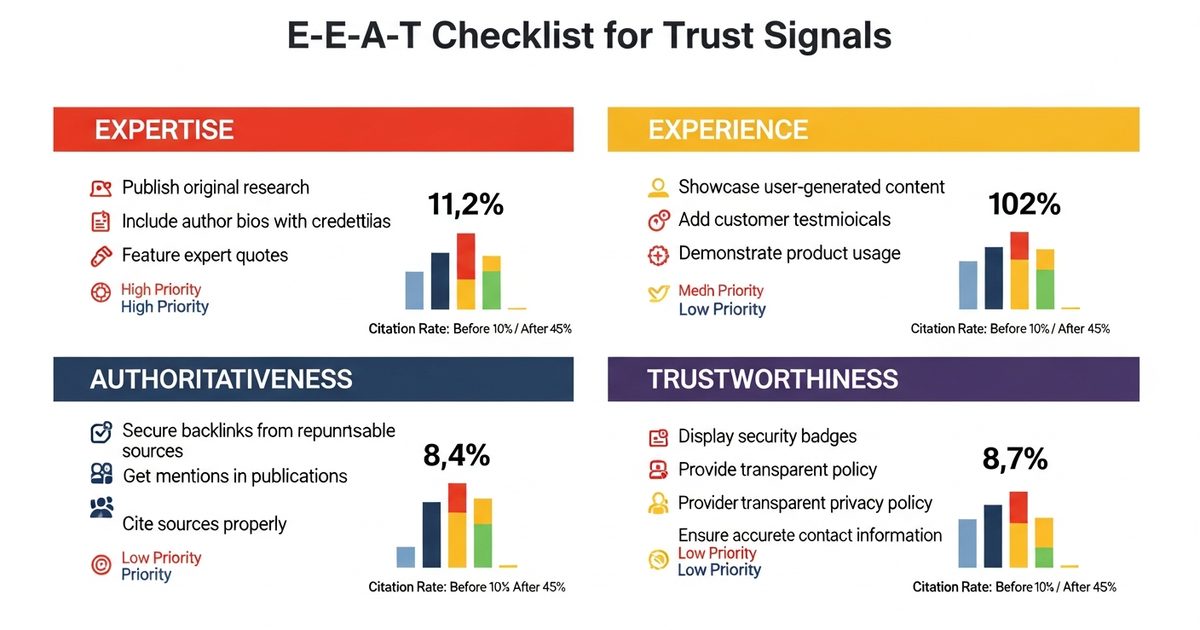
E-E-A-T Implementation Checklist for AI Search
Experience Signals
- Original data: Include research or analysis based on your own data (customer data, platform data, research studies) rather than just citing external sources
- Specific observations: Replace generic statements with specific observed examples ("We analyzed 500 domains and found...", "One client who implemented this saw...")
- Implementation detail: When describing processes, include the specific challenges, decisions, and trade-offs encountered in practice
- Outcome specificity: Report outcomes with specific numbers and timeframes rather than vague directional claims
Expertise Signals
- Author credentials in Article schema: Include author name, URL to bio, and jobTitle at minimum; add professional credentials, institutional affiliations for sensitive topic areas
- Author bio pages: Every content author should have a bio page with their professional background, relevant credentials, and links to professional profiles (LinkedIn, industry publications)
- Technical depth: Ensure content covers subtleties, edge cases, and common mistakes - not just the high-level overview that anyone could write
- Source citations: Link out to the primary sources you cite - this signals that your content is research-backed rather than opinion-based
Authoritativeness Signals
- Backlink building: Editorial backlinks from authoritative sources in your industry improve domain authority, which is the second-highest citation predictor after FAQPage schema
- Original research: Publish data studies and research reports that other sites cite - this creates authoritativeness through third-party citation
- Expert guest contributions: Content by recognized industry experts with their credentials visible improves authoritativeness for specific topic areas
- Industry directory presence: Ensure your domain is listed in authoritative industry directories and databases in your category
- Mentions in publications: Actively pursue editorial mentions, expert quotes, and references in industry publications that AI engines are trained on
Trustworthiness Signals
- HTTPS everywhere: All pages should serve over HTTPS with a valid certificate. Mixed content (HTTP resources on HTTPS pages) reduces trust signals.
- Privacy policy and terms: Present and accessible from every page footer
- About page with organizational detail: Who runs the site, what is the editorial process, what expertise does the team have
- Contact information: Visible contact details (not just a contact form) signal a real, accountable organization
- Methodology transparency: For data-driven content, explain how data was collected and analyzed
- Content accuracy maintenance: Regularly audit high-traffic pages for outdated claims and update them. Update
dateModifiedin Article schema when corrections are made.
E-E-A-T by Content Type and AI Engine
Informational content
E-E-A-T is a moderate citation signal for purely informational content (definitions, factual explanations) where the facts are verifiable and not dependent on source trustworthiness. The more consequential the information (health, finance, legal), the more E-E-A-T signals matter.
Advisory content
For evaluative, advisory, and recommendation content ("should I use X", "what is the best Y for Z"), E-E-A-T is the dominant citation signal. AI engines are most cautious about citing advisory content from sources with unclear credentials or methodology. Claude specifically shows the strongest E-E-A-T preference in our citation research - consistently favoring sources with explicit author credentials over equivalent content without them.
Time-sensitive content
For content where accuracy depends on recency (regulatory changes, product updates, market data), trustworthiness requires visible publication and update dates, with dateModified signaling current accuracy. AI engines are increasingly conservative about citing time-sensitive content without clear freshness signals.
Medical, legal, financial content
These YMYL (Your Money, Your Life) categories have the highest E-E-A-T requirements for AI citation. AI engines apply conservative citation standards to content in these areas without clear professional credentials. Physician-authored medical content, attorney-authored legal content, and CFA-authored investment content get cited significantly more reliably than equivalent content with unclear author credentials.
Common E-E-A-T Mistakes That Reduce AI Citations
Missing or generic author attribution
The most common and most impactful mistake. Content attributed to "Staff" or "Editorial Team" with no individual credentials loses the expertise signal entirely. Every piece of content should be attributed to a specific person with credentials for the topic.
Outdated content with no freshness signal
Content that was accurate in 2022 but has not been updated provides a trustworthiness risk for AI engines on topics where accuracy changes. Update key pages, update dateModified, and add a visible "Last updated: [date]" notice for content where recency is important.
Unsupported claims
Claims that cite no supporting evidence reduce trustworthiness for AI engines. "Studies show that X" without a source is less trustworthy than "According to [specific study from specific institution], X." Link to primary sources for data-backed claims.
No About page or organizational transparency
Sites that do not clearly identify who operates them and what expertise the organization has are less trusted by AI engines. A minimal About page that explains your organizational background, editorial process, and team expertise is a low-effort high-impact trustworthiness signal.
How to Audit Your E-E-A-T Signals
Use AI Rank Lab's full audit tool to check E-E-A-T signals automatically - it verifies Article schema author data, checks for author bio pages, reviews organizational schema, and flags missing trustworthiness elements like privacy policies and HTTPS issues.
For a manual audit, run through the four signal categories above and score your site on each. The goal is not perfection on every signal - it is eliminating the signals that are actively reducing citation confidence. Missing author credentials on high-traffic content pages, outdated YMYL content without freshness signals, and absent organizational transparency are the highest-priority fixes.
Conclusion
E-E-A-T for AI search is not a vague soft factor - it is a set of specific, implementable signals that determine whether AI engines trust your content enough to cite it. The most impactful changes are concrete: add author credentials to Article schema, create author bio pages with relevant expertise, publish original data-backed research, maintain content accuracy with current dateModified signals, and be transparent about your organizational methodology.
For teams in high-stakes content categories (healthcare, finance, legal, security), E-E-A-T is not optional - it is the primary determinant of whether your content gets cited at all. For teams in lower-stakes categories, it compounds the impact of schema and technical AEO work. Run the AI Rank Lab audit to see your current E-E-A-T signal status alongside the full AEO picture.
Frequently Asked Questions
How does E-E-A-T affect AI search citations?▾
What is the most important E-E-A-T signal for AI citations?▾
Does E-E-A-T matter for all types of content?▾
How do I improve my site's E-E-A-T signals quickly?▾
Is E-E-A-T more important for AI search than for Google SEO?▾
Get a Free AI Ranking Consultation
Want to improve your brand's visibility in AI search engines like ChatGPT, Gemini, and Perplexity? Fill out the form and our experts will create a personalized strategy for you.

Written by
Devanshu
Chief Marketing Officer & AI Search Optimization Architect
Digital Marketing Strategist & Pioneer in SEO, Answer Engine Optimization (AEO), and Generative Engine Optimization (GEO).


