
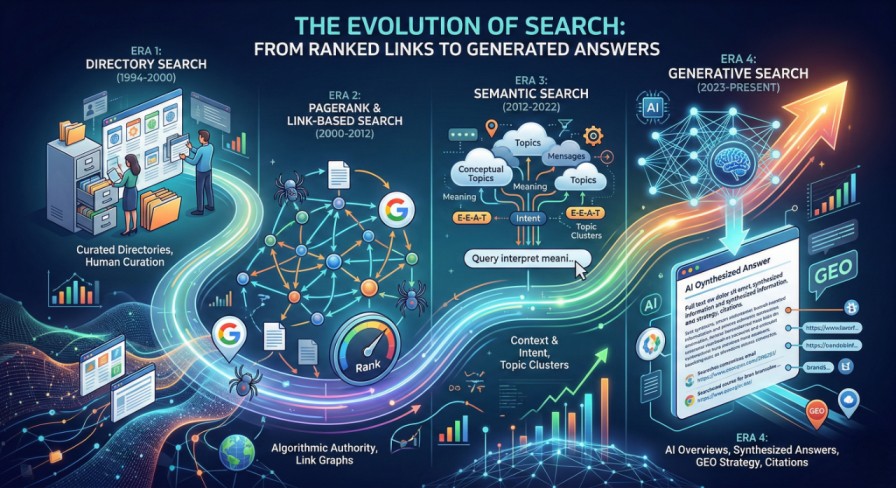
Search has never been a static technology. Every decade, the dominant paradigm for information retrieval has shifted - and with it, the strategies that win. We are living through the third great search paradigm shift: from ranked links to generated answers. Understanding the arc of this evolution helps you anticipate where to invest next.
Era 1: Directory Search (1994–2000)
The first search engines were essentially curated directories. Yahoo, DMOZ, and early AltaVista required humans to manually categorize and index websites. The "optimization" of this era was simple: submit your site to the right categories. There was no algorithm to game - just human editors making subjective quality judgments.
This era ended when the web scaled beyond human curation capacity. The directory model couldn't index millions of new pages per day.
Era 2: PageRank and Link-Based Search (2000–2012)
Google's PageRank algorithm solved the scale problem by using links as votes. A page linked to by many authoritative pages was considered more trustworthy. This triggered the first arms race of search marketing: link building. Black-hat tactics - link farms, paid links, reciprocal link exchanges - flourished until Google's Penguin algorithm (2012) began penalizing manipulative linking.
The lesson of this era: when rankings depend on external signals (links), marketers will manufacture those signals. Google's counter was to make signals harder to fake.
Era 3: Semantic Search and Intent Understanding (2012–2022)
Hummingbird (2013), RankBrain (2015), BERT (2019), and MUM (2021) progressively taught Google to understand the meaning behind queries rather than just matching keywords. This rewarded content that served genuine user intent over content that simply contained the right words.
The strategies of this era: topic clusters, E-E-A-T, Core Web Vitals, featured snippets. Marketers invested in comprehensive content that fully satisfied search intent. Content quality became the moat that protected rankings.
Era 4: Generative Search (2023–Present)
The release of ChatGPT in November 2022 catalyzed the current era. Within 18 months, every major search engine integrated generative AI into the search experience. Google AI Overviews. ChatGPT Search. Perplexity's full AI-native search. The search result is no longer a list of URLs - it is a synthesized answer that may or may not contain links.
The shift from ranking to citation is as significant as the shift from directories to algorithms. It changes the fundamental unit of search success from a URL position to a brand mention inside an AI answer.
What GEO Takes from Each Prior Era
Era | Key Contribution to GEO |
|---|---|
Directory era | Content must be organized and categorized clearly - AI systems behave like intelligent curators |
PageRank era | External authority signals (brand mentions, citations) still matter for AI trust |
Semantic era | Intent matching and E-E-A-T are more important than ever in AI evaluation |
Generative era | New: answer-first format, structured extraction, direct citation as the success metric |
What Comes Next: Predictions for 2027–2030
Based on current AI development trajectories, the next evolution in search will likely include:
Multi-modal AI search: Answers generated from text, image, video, and audio sources together - Google Lens integration is already a precursor
Personalized AI answers: AI engines that tailor answers based on individual user history and preferences - making brand authority more important than ever
Agentic search: AI that doesn't just answer but takes actions (booking, purchasing) on behalf of users - the next frontier where brand reputation in AI is monetized directly
Real-time citation markets: Possible emergence of paid placement inside AI answers (analogous to Google Ads)
AI-native content formats: Content designed natively for AI consumption rather than human reading - structured data, knowledge graphs, and semantic triples
Search Era Comparison: What Each Era Demanded of Marketers
Search Era | Years Active | Key Skill Required | Primary Metric |
|---|---|---|---|
Directory era | 1994–2000 | Directory submission & categorization | Directory listings |
PageRank era | 2000–2012 | Link acquisition & anchor text optimization | PageRank / backlinks |
Semantic era | 2012–2022 | Intent matching, E-E-A-T, topic clusters | Rankings, organic traffic |
GEO era | 2023–present | Answer formatting, structured data, authority | Citation rate, AI share of voice |
Key Milestones in the GEO Era (2022–2026)
November 2022: ChatGPT launches; search-as-conversation becomes mainstream
February 2023: Google Bard launches (later renamed Gemini); Microsoft integrates AI into Bing
May 2023: Google SGE (Search Generative Experience) enters testing
November 2023: Perplexity AI reaches 10 million users; citation-first search model validated
May 2024: Google AI Overviews rolls out globally; mainstream adoption begins
October 2024: ChatGPT Search launches; OpenAI becomes direct Google competitor
January 2025: AI Overviews appear on 6.49% of queries; GEO becomes essential practice
Mid-2025: AI Overviews reach 25%+ of queries; AI referral traffic surges 357% YoY
2026: AI chatbot users exceed 987 million globally; GEO is now standard marketing discipline
Common Mistakes When Navigating the SEO→GEO Transition
Thinking GEO is just "SEO for AI": GEO requires fundamentally different content architecture, measurement systems, and authority signals - not just tweaking meta tags
Waiting until AI search "matures": Brands that waited to adopt Google SEO in 2004–2006 spent years catching up; the same dynamic is playing out with GEO today
Ignoring the training data opportunity: Content published well before a model's training cutoff becomes part of its foundational knowledge - publish high-quality content consistently to maximize training data inclusion
Key Takeaways
Search has evolved through four distinct paradigm shifts; each one rendered the previous era's tactics insufficient
The GEO era began in 2022–2023 and reached mainstream adoption by 2024–2025; early optimizers have a significant head start
Gartner predicts 50% organic traffic decline by 2028 from AI search - the GEO transition is not optional
Agentic search is the next frontier - brands with strong GEO foundations will be best positioned to appear in AI-driven purchasing decisions
Investing in content authority and E-E-A-T today creates durable assets that compound through every future AI evolution
The brands investing in content authority, structured data, and E-E-A-T today are building an asset that will compound through every future iteration of AI search. Start tracking your position in this evolution with AI Rank Lab - the platform built specifically for the GEO era.
Frequently Asked Questions
When did the shift from SEO to GEO begin?▾
What is the most important lesson from SEO history for GEO?▾
Will GEO eventually be replaced by another paradigm?▾
How did E-E-A-T evolve for the GEO era?▾
What killed keyword-based SEO?▾
Is link building still worth investing in for GEO?▾
Get a Free AI Ranking Consultation
Want to improve your brand's visibility in AI search engines like ChatGPT, Gemini, and Perplexity? Fill out the form and our experts will create a personalized strategy for you.
Written by
Devanshu
AI Search Optimization Expert


