


For two decades, search engine optimisation meant one thing: ranking in Google. The rules were relatively stable - publish quality content, earn backlinks, optimise page speed, and your blue-link position would follow. In 2026, those rules still apply to Google's traditional results. But they are increasingly insufficient for the fastest-growing search channels: the AI-powered engines where a single generated answer, not ten ranked links, determines which brands users find.
This is the divide that Generative Engine Optimisation - GEO - was created to address.
What Is SEO? A Brief Anchor
Search engine optimisation is the practice of improving a website's visibility in search engine results pages (SERPs) - primarily Google, which holds approximately 90% of the global search market. Traditional SEO focuses on three pillars: technical performance (page speed, crawlability, indexability), content relevance (matching user intent, keyword coverage, topical depth), and authority (backlinks, domain reputation, E-E-A-T signals).
A successful SEO strategy earns a URL a high ranking position for target queries, which drives click-through traffic. The model assumes users will scan a list of results and choose which to visit. This assumption held throughout the Google era. It is breaking down as AI search becomes mainstream.
What Is Generative Engine Optimisation (GEO)?
Generative Engine Optimisation is the practice of structuring, formatting, and positioning your web content so that AI-powered generative search engines select it as a source when generating responses to user queries.
Where SEO earns a URL a position in a ranked list, GEO earns your brand a citation inside an AI-generated answer. The target engines for GEO include:
Google AI Overviews - AI-generated summaries appearing at the top of Google results pages, now present on more than 25% of all queries
ChatGPT with Browse - OpenAI's AI assistant, now handling 2.8 billion monthly active users with web retrieval capability
Perplexity AI - AI search engine with source citations, processing 780 million+ monthly queries
Google Gemini - Google's standalone AI assistant, with 2 billion monthly visits
Microsoft Copilot - AI search layer integrated into Bing and Microsoft's productivity suite
Claude (Anthropic) - AI assistant with growing enterprise and consumer adoption
GEO and AEO (Answer Engine Optimisation) are closely related terms. AEO typically refers specifically to AI answer engines (ChatGPT, Perplexity, Claude). GEO covers the broader category of all generative AI output surfaces - including Google AI Overviews and other AI-generated content layers within traditional search. In practice, the optimisation strategies overlap almost entirely, and the terms are often used interchangeably.
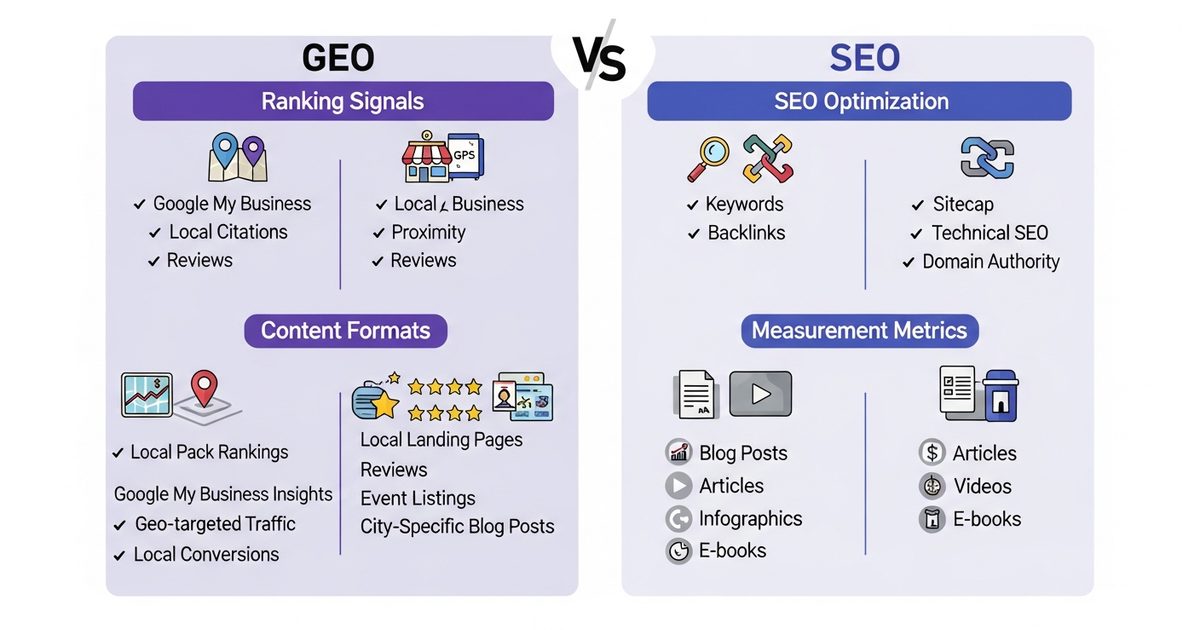
GEO vs SEO: Side-by-Side Comparison
Factor | Traditional SEO | GEO |
|---|---|---|
Primary goal | Rank URL in a list of results | Get cited inside an AI-generated answer |
Engine type | Algorithmic (Google, Bing) | Generative AI (ChatGPT, Gemini, Perplexity, Claude) |
Result format | 10 URLs on a results page | 1 AI answer citing 1-3 sources |
Primary ranking signal | Backlinks and keyword relevance | Content structure and answer completeness |
Schema markup | Helpful for rich snippets | Critical for AI source selection |
Content freshness | Important for time-sensitive queries | Critical - AI engines heavily favour recent content |
User action | Click through to your website | Brand cited; user may or may not click |
Key measurement metric | Rankings, organic traffic | Citation rate, AI visibility score |
Competition model | Compete for top 10 positions | Compete for 1-3 citation slots |
Content format priority | Long-form, keyword-rich articles | Structured, direct-answer content with schema |
The most important difference is the competition model. SEO allows ten brands to appear on page one for any given query. GEO allows two to three brands to appear in a single AI-generated response. The stakes per query are significantly higher - and the window for correction when you are not cited is much narrower.
Why GEO Matters More in 2026 Than at Any Point Before
Three converging trends make GEO urgent in 2026:
AI search is scaling faster than any previous search platform
ChatGPT went from zero to 2.8 billion monthly active users faster than any technology platform in history. Google AI Overviews expanded from 6.5% of queries to 25%+ in a single year. Perplexity grew 370% year-over-year. These growth rates are not slowing. Every month, more of the queries that used to drive traffic through Google's blue-link results are being answered directly by AI engines - with citations for two or three sources and no clicks for everyone else.
Zero-click search has reached a tipping point
More than 60% of Google searches now end without a click. Users get their answer from AI Overviews, featured snippets, or knowledge panels without visiting any website. For brands that rely on content marketing for lead generation, this means the traditional model - rank for a query, earn a click, convert the visitor - is increasingly interrupted at the first step. GEO addresses this by making your brand the source that gets cited in the AI answer, creating brand awareness even in a zero-click environment.
AI-cited brands earn disproportionate trust
When an AI engine cites your brand, users receive a form of third-party endorsement more implicit than a paid ad and more prominent than a position-5 organic result. Research consistently shows that AI-recommended brands receive higher consideration rates than brands users discover through ranked link clicks. Being cited by ChatGPT or Gemini is increasingly the highest-value brand visibility placement available in digital marketing.
How Generative Engines Select Their Sources
Understanding GEO requires understanding how AI engines decide which sources to cite. The dominant architecture is Retrieval-Augmented Generation (RAG):
Retrieval - the AI engine queries an index (its training data or a live web index) to find documents relevant to the user's query. Documents that are well-structured, properly indexed, and topically relevant pass through this gate.
Augmentation - relevant documents are used as context to inform the AI's response. The AI does not simply copy text; it synthesises information from retrieved sources into a generated answer.
Generation - the AI generates a response and decides which sources to cite based on how clearly each source addresses the specific question being answered.
GEO optimisation works on all three stages: ensuring your content is indexed and retrievable (technical foundation), ensuring it is structured clearly enough to be used in augmentation (content structure), and ensuring it provides such complete answers that it is the obvious citation choice (answer completeness).
The 5 Pillars of GEO Implementation
Pillar 1: Structured Content Architecture
AI engines extract information from content that has clear structure. This means: question-formatted headers (H2s and H3s that mirror conversational queries), short direct-answer paragraphs that lead each section, bullet points and numbered lists for multi-part answers, and tables for comparisons and data. Content that buries its key insight in paragraph four of a long introduction consistently underperforms in AI citation compared to content that states its answer immediately and then supports it.
Pillar 2: Comprehensive Schema Markup
Schema markup is the most direct technical signal available to GEO. Pages with FAQPage, HowTo, Article, and Organization schema provide AI engines with machine-readable metadata about what the content contains, who wrote it, and when it was published. BrightEdge research shows pages with comprehensive schema markup earn a 36% advantage in AI-generated citations versus identical content without schema. At minimum, add Article schema with author and dateModified to every page, and FAQPage schema to any page that addresses multiple questions.
Pillar 3: Topical Authority Clusters
AI engines treat the depth and breadth of a site's content on a topic as an authority signal. A single well-written article on a subject earns fewer citations than a site with 20 articles covering every dimension of that subject. Build content clusters: a pillar article covering the core topic comprehensively, supported by in-depth articles on each subtopic. Internal links between cluster articles reinforce topical authority signals. This approach improves GEO performance across all articles in the cluster, not just the pillar piece.
Pillar 4: Content Freshness
AI engines apply a strong recency bias when selecting sources. Content updated within the last 30 days receives 3.2 times more citations than equivalent content last updated over a year ago, according to BrightEdge research. Build a content refresh schedule: review your highest-value pages quarterly, update statistics with current figures, add new examples and case studies, and update the dateModified field in your schema. Freshness signals help even when the core information has not substantially changed.
Pillar 5: E-E-A-T and Authority Signals
Experience, Expertise, Authoritativeness, and Trustworthiness - Google's E-E-A-T framework - directly informs AI citation selection. AI engines prioritise sources that demonstrate real expertise: author credentials and bylines, first-hand experience described in the content, citations of original research and data, and consistent authoritative coverage of a specific domain. Generic content that could have been written by anyone about anything is consistently deprioritised in favour of content with clear expert authorship and demonstrated subject-matter depth.
GEO Metrics vs SEO Metrics
Measuring GEO performance requires different tools and metrics than traditional SEO. You cannot see your ChatGPT citation rate in Google Search Console or Ahrefs. The metrics that matter for GEO are:
Metric | What It Measures | Tool |
|---|---|---|
AI Citation Rate | % of target queries where your brand is cited in AI responses | AI Rank Lab |
AI Visibility Score | Composite of citation frequency, position, and query breadth | AI Rank Lab |
Share of AI Voice | Your citation rate vs. competitor citation rate for the same queries | AI Rank Lab |
AI Overview appearances | How often your pages appear in Google AI Overview summaries | Google Search Console |
AI-referred traffic | Visits to your site attributed to AI engine referrals | GA4 |
Traditional SEO metrics - rankings, organic traffic, domain authority - remain relevant for measuring Google performance. But they tell you nothing about GEO performance. Brands that rely solely on traditional metrics can see their Google traffic holding steady while their AI visibility erodes, only discovering the problem when a new competitor emerges that is being recommended by ChatGPT in every industry query.
Will GEO Replace SEO?
No - at least not in the near term. Google's traditional ranking algorithm still drives the majority of search clicks for most websites, and the organic channel remains critical for content marketing, e-commerce, and local business visibility. The brands that treat GEO and SEO as competing priorities get both wrong; the brands that treat them as complementary disciplines performed with different tools are positioned to win both channels.
The practical reality of 2026 is that the two disciplines share significant overlap. Strong topical authority, high-quality structured content, comprehensive schema markup, and excellent technical performance all improve both SEO rankings and GEO citation rates. The incremental investment to optimise for GEO on top of a solid SEO foundation is relatively small - and the return, in terms of brand visibility across the fastest-growing search channels, is increasingly large.
The brands that will lead in search visibility through 2027 are optimising for both channels now. Run a free GEO/AEO audit on AI Rank Lab to see exactly where your site stands against all 100+ factors that determine AI engine citation - and which gaps to close first.
To learn more about the tools available for GEO implementation, read the complete guide to the best AI SEO tools for 2026.
Frequently Asked Questions
What is GEO (Generative Engine Optimisation)?▾
What is the difference between GEO and SEO?▾
What is the difference between GEO and AEO?▾
How do generative engines like ChatGPT choose which sources to cite?▾
Does GEO replace the need for traditional SEO?▾
Get a Free AI Ranking Consultation
Want to improve your brand's visibility in AI search engines like ChatGPT, Gemini, and Perplexity? Fill out the form and our experts will create a personalized strategy for you.

Written by
Devanshu
Chief Marketing Officer & AI Search Optimization Architect
Digital Marketing Strategist & Pioneer in SEO, Answer Engine Optimization (AEO), and Generative Engine Optimization (GEO).


