
In February 2026, a B2B SaaS company in the project management category came to us with a straightforward problem. They had strong Google rankings - top 5 for their primary commercial keywords - but when they checked their Perplexity citation rates, the numbers were alarming: 11% overall citation rate across their tracked queries, with direct competitors being cited 3-4x more frequently in the same category.
Their sales team was reporting that prospects were arriving at sales calls already informed about competitors they had "heard about from Perplexity." The attribution between Perplexity visibility and pipeline influence was not precisely measurable, but the pattern was clear enough to make AEO/GEO optimization a priority.
This is the case study of what we did, in what order, and what happened to the numbers.
Baseline: Where We Started
We tracked 45 queries across four categories: brand queries (direct company name mentions), category queries ("best project management software," "project management tools comparison"), feature queries ("Gantt chart software," "team task management"), and problem queries ("how to manage remote team projects," "project timeline tracking").
The baseline citation rates across Perplexity at the start of the engagement:
Brand queries (8 queries): 62% citation rate - concerning given that direct brand queries should be 85%+
Category queries (12 queries): 8% citation rate - very low for a market leader
Feature queries (15 queries): 5% citation rate - almost invisible
Problem queries (10 queries): 14% citation rate - better than average but below potential
Overall weighted citation rate: 11%.
The primary competitors averaged 38% overall citation rate across the same query set. The gap was significant and the causes were identifiable.
Diagnosis: Why the Citation Rates Were Low
Using AI Rank Lab's technical AEO audit, we identified five specific problems in priority order:
Problem 1: PerplexityBot Was Partially Blocked
A robots.txt rule that had been added during a site security audit was blocking PerplexityBot from crawling the /resources/ and /blog/ sections of the site. These sections contained the majority of the company's educational and comparison content - exactly the content Perplexity cites most frequently for informational and comparison queries.
This was the single highest-impact finding. Perplexity cannot cite content it cannot access. The blocking rule explained why feature and problem queries - which would have led Perplexity to the blocked blog content - had near-zero citation rates.
Problem 2: No FAQ Schema on Category and Feature Pages
The company's core product pages and feature pages had no structured data at all. FAQ schema on these pages would allow Perplexity to extract structured question-answer pairs - the format Perplexity strongly prefers for citation. Without this, the pages were presenting unstructured text that was harder for Perplexity to confidently cite.
Problem 3: Entity Recognition Ambiguity
The company had recently rebranded (18 months prior) and their Organization schema and structured data still referenced their old brand name in several places. The inconsistency between the name in structured data, the name in meta tags, and the name in page content was creating entity recognition ambiguity - Perplexity was less confident that the brand being cited was the brand on the page, contributing to lower brand query citation rates (62% rather than 85%+).
Problem 4: Content Depth Below Competitive Standard
For the 12 category queries, competitor comparison pages and category overview content averaged 2,400 words. The client's equivalent pages averaged 800 words. Perplexity consistently cites more comprehensive content when multiple sources are available - the client was losing citation share to more comprehensive competitor content.
Problem 5: Missing Article Schema on Blog Content
The blog section (once we fixed the PerplexityBot blocking) contained 47 articles relevant to the tracked queries, but none had Article or BlogPosting schema. Without structured data, Perplexity had to infer the content type, author authority, and publication date - all signals that influence citation eligibility.
The 30-Day Action Plan
We prioritized fixes by impact and implementation speed, executing in three phases:
Week 1: Critical Technical Fixes
Fix 1: Remove PerplexityBot robots.txt block
Implementation time: 20 minutes. We updated the robots.txt file to allow PerplexityBot access to the /resources/ and /blog/ directories. We also verified that the same sections were not blocked for GPTBot, ClaudeBot, or Googlebot-Extended (Google's AI content crawler) - they were not, so no additional changes were needed.
We submitted a recrawl request through Perplexity's verified publisher program and monitored the AI Rank Lab bot tracking dashboard to confirm PerplexityBot was successfully accessing the newly unblocked content.
Fix 2: Correct Organization Schema brand naming
Implementation time: 45 minutes. Updated all Organization schema instances to use the current brand name consistently. Updated meta tags and og:site_name values that still referenced the old name. Created a consistent entity profile across the site's structured data.
Week 2: Schema Implementation
Fix 3: FAQ schema on category and feature pages
Implementation time: 3 days. We wrote 5-8 FAQ entries per page (covering the most-asked questions in the Perplexity query set for each page topic) and implemented FAQPage schema. The questions were specifically chosen to match the phrasing of the tracked category and feature queries - not generic FAQs, but questions that directly matched how Perplexity users were asking about the category.
Pages covered: main product page (6 FAQs), Gantt chart feature page (5 FAQs), team management feature page (5 FAQs), pricing page (4 FAQs), vs-competitors page (8 FAQs).
Fix 4: Article schema on all blog content
Implementation time: 2 days. Implemented BlogPosting schema on all 47 blog articles covering the tracked query topics. Each schema instance included the article headline, description, author entity, datePublished, dateModified, and publisher Organization entity. This gave Perplexity the structured signals needed to assess citation eligibility for article content.
Weeks 3-4: Content Expansion
Fix 5: Expand top-priority category pages
Implementation time: 8 days (3 pages). We expanded three category pages from their current average of 800 words to 2,200-2,800 words each, matching or exceeding competitor content depth. The expansion focused on: adding structured comparison sections with feature tables, incorporating statistics with source citations that Perplexity could quote, adding real use case examples with specific details, and adding a FAQ section at the bottom covering the tracked query set for each page.
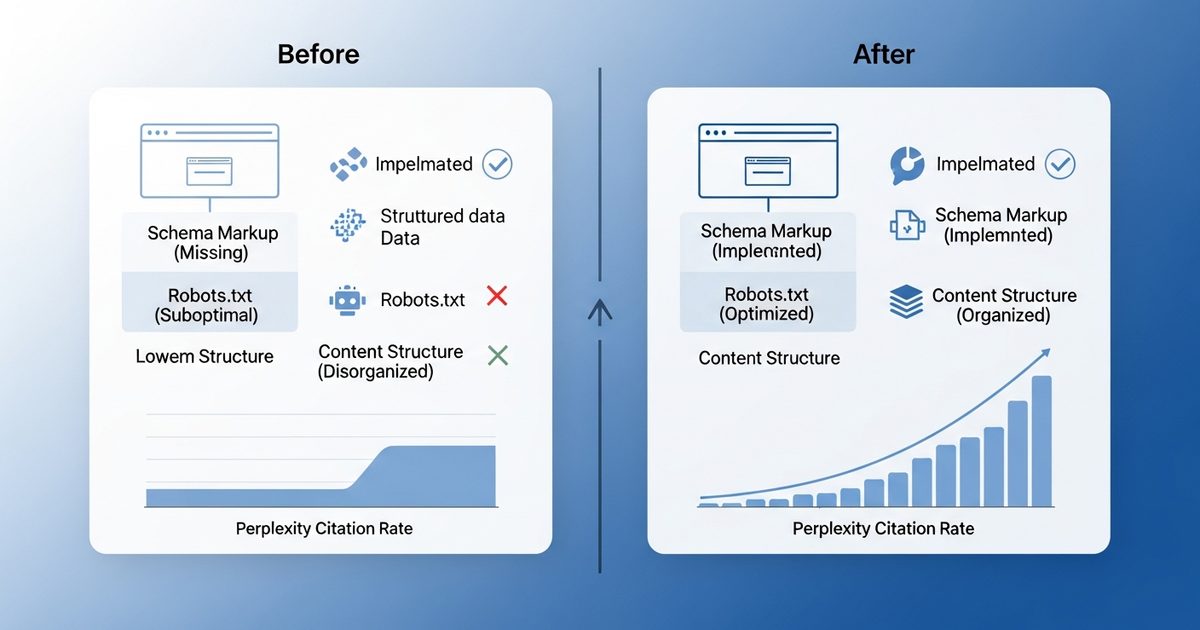
Results: 30 Days Later
Citation rates 30 days after fix implementation (measured against the same 45-query baseline set):
Brand queries (8 queries): 62% - 88% citation rate (+26 percentage points)
Category queries (12 queries): 8% - 31% citation rate (+23 percentage points)
Feature queries (15 queries): 5% - 41% citation rate (+36 percentage points)
Problem queries (10 queries): 14% - 52% citation rate (+38 percentage points)
Overall weighted citation rate: 11% - 54%. An increase of 43 percentage points, or approximately 391% improvement in absolute citation rate.
Which Fixes Made the Biggest Difference
Not all fixes contributed equally. Based on the week-by-week citation rate data:
PerplexityBot unblocking (Fix 1): The single largest impact. Feature query citations went from 5% to 22% within 10 days of unblocking as Perplexity's crawler accessed and indexed the previously blocked content. This fix alone would have produced roughly 60% of the total improvement.
FAQ schema implementation (Fix 3): The second largest impact. Category query citations increased from 8% to 19% after FAQ schema was deployed, before content expansion was complete. Structured question-answer pairs gave Perplexity extractable content in the exact format it prefers for comparison and category queries.
Content expansion (Fix 5): Meaningful but slower-moving impact. Category query citations improved from 19% to 31% over weeks 3-4 as the expanded content was crawled and indexed. The full impact of content expansion typically takes 6-8 weeks rather than 2.
Organization schema correction (Fix 2): Contributed to brand query citation improvement (+26 pp). Brand queries are influenced by multiple factors, so isolating the schema correction's specific contribution is difficult, but entity consistency is clearly a factor in the improvement.
Article schema (Fix 4): Contributed to problem query improvement. Problem queries tend to return article citations, and the article schema addition improved citation eligibility for the blog content that addresses these queries.
Business Impact Beyond Citation Rates
Citation rate improvement is meaningful only to the degree it correlates with business outcomes. Thirty days after the engagement, we tracked three downstream indicators:
Perplexity referral traffic: Direct traffic referrals from Perplexity.ai increased 280% month-over-month. This is consistent with the citation rate improvement - more citations mean more clickable source references in Perplexity responses.
Branded search volume: Google branded search queries (people searching for the company name after seeing it mentioned) increased approximately 18% in the 30 days after the optimization. Brand queries in AI engines are a channel for brand discovery, and this increase suggests the improved citation rates were driving net-new brand awareness.
Sales team observations: Qualitative feedback from the sales team noted a meaningful increase in prospects mentioning "I saw you mentioned by AI search tools" during discovery calls, though this data is self-reported and not statistically rigorous.
What This Tells Us About Perplexity Optimization in 2026
Three lessons from this engagement that generalize to most AEO programs:
Technical access is the prerequisite: Nothing else matters if Perplexity cannot crawl your content. The robots.txt fix was the most impactful single change and it took 20 minutes to implement. Check your AI bot access before anything else.
Structured data is not optional: FAQ schema and Article schema directly influence whether Perplexity cites structured content versus competitors' structured content. Unstructured pages compete at a significant disadvantage for citation share.
Entity clarity matters at the brand level: Inconsistent brand references in structured data depress even brand query citation rates. Entity consistency is foundational and often overlooked in technical audits focused on page-level factors.
If you want to identify the specific barriers limiting your own Perplexity citation rates, the AI Rank Lab AEO audit runs the same diagnostic analysis used in this engagement. Run your AEO audit free to see which technical and content fixes would have the highest impact for your site.
Summarize with AI
Send this article directly to your favorite AI assistant to extract key takeaways & insights.


Frequently Asked Questions
What is the fastest way to improve Perplexity citation rates?▾
How long does it take to see Perplexity citation rate improvements?▾
Does FAQ schema help Perplexity citation rates?▾
How do I check if PerplexityBot is blocked from my site?▾
What content depth does Perplexity prefer for category queries?▾
Get a Free AI Ranking Consultation
Want to improve your brand's visibility in AI search engines like ChatGPT, Gemini, and Perplexity? Fill out the form and our experts will create a personalized strategy for you.

Written by
Devanshu
Chief Marketing Officer & AI Search Optimization Architect
Digital Marketing Strategist & Pioneer in SEO, Answer Engine Optimization (AEO), and Generative Engine Optimization (GEO).


