


How to Use This Checklist
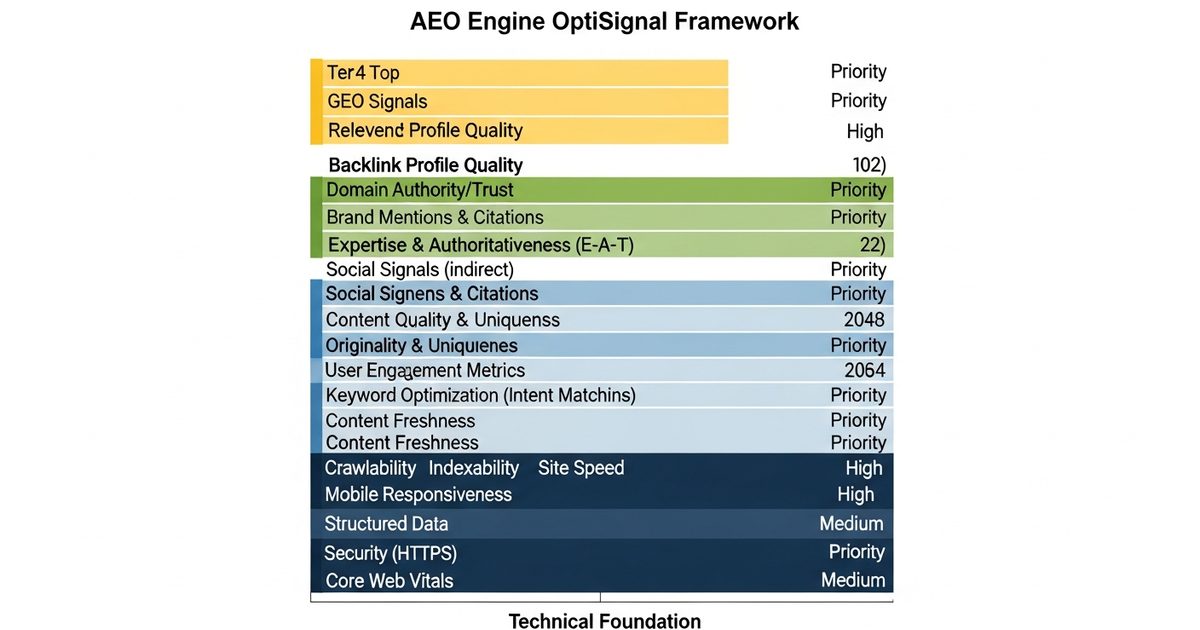
This checklist covers 40 AEO (Answer Engine Optimization) signals organized across four priority tiers. Tier 1 signals are critical - they block AI search visibility until fixed. Tier 2 signals have direct, measurable impact on citation rates. Tier 3 signals provide compounding benefits over time. Tier 4 signals are advanced GEO optimizations for teams that have completed the first three tiers.
The fastest path to improved AI citation rates is to complete all Tier 1 signals first, then work through Tier 2 in priority order. Do not start Tier 3 work while Tier 1 items remain incomplete - they are blocking conditions. Use AI Rank Lab's audit tool to automatically check your status on the technical signals in Tiers 1 and 2.
See the complete AEO guide for strategic context behind these signals.
Tier 1: Technical Access Signals (Critical - Fix First)
These signals are binary: pass or fail. Failing any of them blocks AI citation regardless of content quality or other optimizations. Check and fix all Tier 1 items before proceeding.
1. GPTBot allowed in robots.txt
Check: User-agent: GPTBot is present in your robots.txt with no Disallow: / applying to it. If the wildcard User-agent: * rule has a broad Disallow and GPTBot is not explicitly allowed, GPTBot is blocked.
Fix: Add User-agent: GPTBot / Allow: / to your robots.txt
2. ClaudeBot / anthropic-ai allowed in robots.txt
Check: Both User-agent: ClaudeBot and User-agent: anthropic-ai are explicitly allowed. Anthropic uses both user agents; blocking either one restricts Claude's access.
3. PerplexityBot allowed in robots.txt
Check: User-agent: PerplexityBot is explicitly allowed. Perplexity drives the majority of AI search referral traffic - blocking this bot has the most immediate traffic impact.
4. Google-Extended allowed in robots.txt
Check: User-agent: Google-Extended is explicitly allowed. This is separate from Googlebot and controls whether Google's AI features (AI Overviews, Gemini) can use your content.
5. Sitemap is present and accessible
Check: yourdomain.com/sitemap.xml returns a valid XML sitemap. AI crawlers use sitemaps to discover pages - without one, they may miss important content.
6. Canonical URLs are correct
Check: Each page has a self-referencing canonical tag. Incorrect or missing canonicals can cause AI engines to index the wrong version of a page.
7. No noindex on important content pages
Check: Your key AEO pages (informational content, product/service pages) do not have noindex meta robots tags. Noindexed pages cannot be cited.
8. Site loads over HTTPS
Check: All pages are served over HTTPS with a valid SSL certificate. HTTP sites receive reduced trust signals from AI engines.
Tier 2: High-Impact AEO Signals (Direct Citation Impact)
These signals directly determine citation rates. Work through them in order after completing all Tier 1 items.
9. FAQPage schema on informational pages
Priority: Highest. FAQPage schema is the single strongest predictor of AI citation rate. Every informational page that answers specific user questions should have it.
Check: Run Google's Rich Results Test on your top informational pages. Verify FAQPage schema is present and valid.
10. FAQ answers are direct and declarative
Schema validity alone is not enough. Answers must be direct ("The answer is X"), specific, and not redirect to contact forms. Vague or hedged answers do not drive citations.
11. HowTo schema on procedural content
All tutorial and step-by-step content should have HowTo schema with discrete, actionable steps. Each step should be independently meaningful, not split for schema's sake.
12. Article schema with author credentials
All blog posts and articles should have Article schema including author name, author URL (linking to bio), datePublished, and dateModified. Missing author data is a missed E-E-A-T opportunity.
13. dateModified kept current
When you update content, update the dateModified field in Article schema. Freshness signals matter significantly for AI citation of time-sensitive topics.
14. llms.txt file present
Check: yourdomain.com/llms.txt returns a valid file. If absent, create one using AI Rank Lab's free generator.
15. llms.txt summary is specific and differentiated
The summary blockquote in llms.txt should include: specific audience, key differentiation, topic coverage, and authority signals. Generic summaries provide minimal benefit.
16. llms.txt includes key page listings with descriptions
Particularly important for under-linked pages (tool pages, documentation, niche guides) that AI crawlers may otherwise deprioritize.
17. Organization schema on homepage
Organization schema declares your entity to AI engines. Include: name, URL, description, logo, contactPoint. This is the anchor for brand representation in AI responses.
18. BreadcrumbList schema on all pages
BreadcrumbList communicates topical hierarchy to AI engines, improving site structure understanding and topic authority signals.
19. Content answers questions directly above the fold
Key informational content should provide the direct answer early in the page, not after 500 words of preamble. AI engines prefer pages where the answer to the query is clearly visible near the top.
20. No thin content on indexed pages
Pages under 300 words that do not serve a clear purpose should either be expanded, canonicalized to a better page, or noindexed. Thin content dilutes domain authority and reduces citation confidence.
Tier 3: Content Authority Signals (Compounding Benefits)
These signals build over time and compound with the Tier 1 and 2 foundation.
21. Author bio pages with credentials
Every content author should have a bio page with professional credentials, relevant experience, and external profile links (LinkedIn, industry publications). These bio pages should be linked from Article schema's author.url field.
22. Content covers the complete topic depth
AI engines assess topical completeness. A page on "email marketing" that does not cover segmentation, automation, or deliverability is less citation-worthy than one that covers the topic comprehensively. Use competitor citations to identify which subtopics they cover that you do not.
23. Direct answer density is high
Measure: ratio of declarative statements to hedged language. "The best approach is X because Y" scores higher than "one possible approach might be to consider X." Rewrite passages with excessive hedging.
24. Content is recently updated on key topics
AI engines favor fresh content for time-sensitive topics. Schedule quarterly reviews of your top AEO pages to verify accuracy and update as needed.
25. Internal links connect related topical content
Pages that are well-linked within a topical cluster signal depth of coverage. Build a clear internal link structure connecting pillar content to supporting pages.
26. Pillar content exists for each primary topic
For each major topic you want AI citation on, there should be one authoritative "pillar" page that comprehensively covers the topic and is well-linked from supporting content.
27. External links to authoritative sources
Citing credible external sources (academic papers, government data, industry research) in your content improves E-E-A-T and citation confidence for the claims you make.
28. No duplicate content issues
Multiple pages targeting the same query dilute topical authority. Identify and resolve duplicate content through canonicalization or content consolidation.
29. Backlinks from authoritative domains
Domain authority (driven by backlink quality) is the second-highest citation predictor after FAQPage schema. Build editorial backlinks through original research, data studies, and expert content that other sites cite.
30. Product/service schema on commercial pages
Product, Service, or SoftwareApplication schema on commercial pages enables AI engines to accurately describe and recommend your offerings in shopping and recommendation queries.
Tier 4: GEO and Advanced Signals
These signals require Tiers 1-3 to be complete before they add meaningful value. They refine and extend AI search visibility.
31. LLM citation rate tracked across all 4 major platforms
Ongoing measurement is required to know which signals are working. Track citation rates for your target query cluster in ChatGPT, Claude, Perplexity, and Gemini monthly.
32. Competitive citation analysis conducted
For your top 10 queries, identify which domains are cited instead of yours and what AEO signals they have that you lack. Use this to prioritize remaining optimization work.
33. AI referral traffic tracked in analytics
Filter Google Analytics 4 for sessions from perplexity.ai, chat.openai.com, claude.ai, gemini.google.com. Track this as a growth metric alongside traditional organic traffic.
34. Brand description accuracy monitored in LLM responses
Periodically test how AI engines describe your brand, product, or service. Flag inaccuracies (wrong pricing, deprecated features, incorrect use cases) and address them through content updates and llms.txt refinement.
35. Review presence on key third-party platforms
AI engines weight third-party reviews and mentions. Ensure you have reviews on the relevant platforms for your industry (G2, Capterra, Trustpilot, Yelp, TripAdvisor) with content that describes your key use cases and differentiators.
36. Conversational content structure used throughout
AI engines prefer content written in conversational question-answer format over dense academic prose. Review key pages for readability and conversational tone without sacrificing accuracy.
37. AI Bot monitoring active
Track which AI crawlers are visiting your site, what pages they prioritize, and how often they return. Unusual patterns (bots blocked, low crawl frequency, specific pages not visited) can indicate AEO signal issues. AI Rank Lab's bot tracking feature provides this visibility.
38. Page speed meets Core Web Vitals thresholds
Poor Core Web Vitals reduce AI citation confidence for real-time retrieval systems. Ensure LCP < 2.5s, FID < 100ms, CLS < 0.1 across key pages.
39. Mobile-friendly on all key pages
A growing share of AI queries come from mobile contexts. Pages that are not mobile-friendly receive lower trust signals from AI crawlers that test mobile rendering.
40. Schema errors resolved across full site
Run a complete schema validation audit periodically using Google's Rich Results Test or AI Rank Lab's audit - check for syntax errors, deprecated fields, and content-schema mismatches across the full domain.
Using This Checklist With AI Rank Lab
AI Rank Lab's audit tool automatically checks most of the Tier 1 and Tier 2 signals in this checklist - bot access status for all major AI crawlers, schema coverage and validity, llms.txt presence and format, content signals, and E-E-A-T markers. Running the audit gives you an instant status report on the most important signals without manually checking each one.
The audit output is organized by priority - it shows you which Tier 1 blockers need immediate attention before which Tier 2 optimizations to pursue. Use it as the starting point, then use this checklist to guide the detailed implementation work that follows.
Conclusion
AEO optimization is not a one-time project - it is a systematic practice of auditing signals, fixing gaps, and tracking improvement over time. This 40-signal checklist covers the complete landscape from technical blocking conditions to advanced GEO signals. Work through the tiers in order, and use the audit to establish your starting point.
Teams that complete all Tier 1 and 2 signals typically see measurable citation rate improvements within 2-4 weeks. Teams that also complete Tier 3 see compounding improvements over the following months. The investment is concentrated but the payoff - appearing in AI engine responses for your target queries - is increasingly valuable as AI search traffic grows.
Frequently Asked Questions
What is AEO and what signals does it optimize?▾
What are the most important AEO signals to fix first?▾
How do I audit my website's AEO signals?▾
What is the difference between AEO and SEO?▾
How often should I run an AEO audit?▾
Get a Free AI Ranking Consultation
Want to improve your brand's visibility in AI search engines like ChatGPT, Gemini, and Perplexity? Fill out the form and our experts will create a personalized strategy for you.

Written by
Devanshu
Chief Marketing Officer & AI Search Optimization Architect
Digital Marketing Strategist & Pioneer in SEO, Answer Engine Optimization (AEO), and Generative Engine Optimization (GEO).


