


In 2020, the answer to "where does my business need to show up online?" was simple: Google. Get to page one, optimise for the algorithm, earn the traffic. Six years later, that answer is still true - but it is no longer complete.
ChatGPT has 2.8 billion monthly active users. Perplexity processes 780 million monthly queries. Google AI Overviews now appear on more than 25% of all Google searches. Users are making purchase decisions, booking services, choosing software, and selecting professionals based in part on what AI engines recommend to them - recommendations your Google rankings have no influence over.
The 2026 question is not "ChatGPT vs Google" as if you must choose. It is: how do these two channels work differently, which parts of your customer journey do they each serve, and what does showing up on both actually require?
How ChatGPT and Google Work Differently as Search Channels
Factor | Google Search | ChatGPT |
|---|---|---|
How it works | Algorithmic ranking of indexed URLs | AI-generated responses from training data and retrieval |
Results format | 10+ links on a results page | 1 AI-generated answer citing 1-3 sources |
Query format | Short keywords ("best HVAC Austin") | Full questions ("What is the best HVAC company in Austin for an old house?") |
User intent served | All intents: informational, navigational, commercial, transactional | Primarily informational and commercial research |
Position in buyer journey | All stages, particularly high-intent transactional | Primarily top and mid-funnel research and evaluation |
Click behaviour | Users click through to websites (though 60%+ do not) | Many users get their answer without clicking |
Primary ranking signal | Backlinks, keyword relevance, technical quality | Content structure, answer completeness, schema, authority |
Measurement tool | Google Search Console, Ahrefs, SEMrush | AI Rank Lab AI Visibility Tracker |
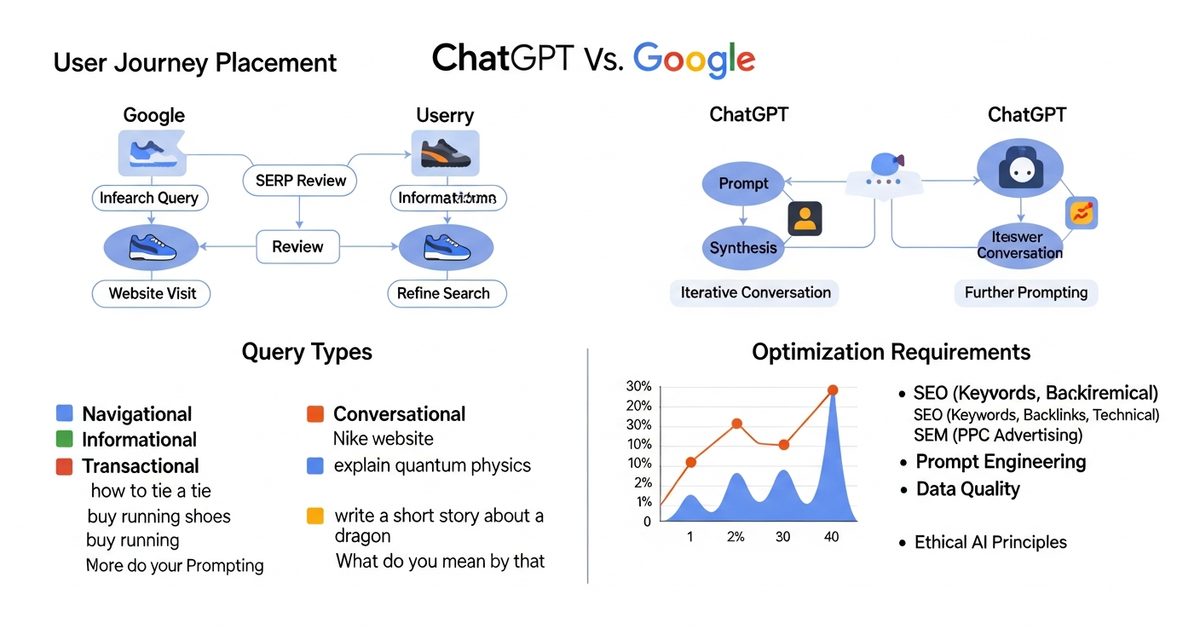
The most important difference from a business strategy perspective is the position in the buyer journey. Google serves users across all stages - from early research through to high-intent transactional searches for a specific product or local service. ChatGPT serves primarily the research and evaluation stages, where users are forming their consideration set and deciding which brands deserve further investigation.
This means that being visible on ChatGPT but not Google loses you at the bottom of the funnel. Being visible on Google but not ChatGPT loses you at the top of the funnel, before users ever reach the transactional search stage where your Google rankings matter.
The Scale Comparison in Context
Numbers matter for understanding the relative opportunity:
Google: 8.5 billion searches per day, approximately 90% global search market share, decades of SEO investment and infrastructure
ChatGPT: 2.8 billion monthly active users, growing at extraordinary rate, primarily research and recommendation queries
Perplexity: 780 million monthly queries, 370% YoY growth, strong among professional and research-oriented users
Google AI Overviews: Present on 25%+ of all Google searches as of mid-2025 (up from 6.5% in January 2025)
Google's total volume remains larger. But the relevant comparison for most businesses is not total volume - it is the volume of queries in their specific category, at the specific funnel stage where AI search influence is strongest. For informational and consideration-stage queries, AI engines often handle a larger share than their aggregate numbers suggest.
Where Google Still Leads
High-intent transactional searches
When a user has already made their decision and is ready to act - "buy [specific product]", "book [specific service] near me", "[brand name] pricing" - they still predominantly use Google. These queries have direct commercial intent that AI engines are less well-positioned to serve than a results page with product listings, local pack results, and direct booking links.
Navigation queries
Searching for a specific website, brand, or URL still primarily happens through Google. Users who already know what they want navigate directly through Google searches rather than asking ChatGPT.
Real-time and local queries
"Open now", "near me", "today's hours" - real-time local queries with transactional intent still flow overwhelmingly through Google and Google Maps. ChatGPT's training data does not include real-time business availability, and Perplexity's real-time retrieval is catching up but not yet matching Google's local data quality.
Shopping and product comparison
Google Shopping and product listing ads serve a commerce infrastructure role that AI engines do not yet replicate for high-intent, comparison-shopping queries where users are ready to purchase.
Where ChatGPT Is Winning
Category-level research queries
"What is the best CRM for a small B2B sales team?" This type of high-intent category research query is increasingly being answered by ChatGPT and Perplexity rather than Google. The AI-generated response provides a synthesised recommendation that a Google results page of 10 competing articles does not match for speed and clarity of answer.
For businesses in competitive categories where decision-making involves comparing multiple options, ChatGPT is increasingly the first touchpoint in the purchase journey - before Google, before review sites, before sales outreach.
Complex information queries
Multi-part questions, queries requiring synthesis of information from multiple sources, and questions where the user wants an explanation rather than a list of links are better served by ChatGPT's conversational response format. Users who have previously received a good ChatGPT answer for a complex question are more likely to return to ChatGPT for similar queries in the future.
Professional and research contexts
Across enterprise and professional user segments, ChatGPT and Claude are increasingly used as primary research tools for vendor evaluation, technology assessment, and strategic decision support. For B2B businesses, this makes AI search visibility in professional-facing AI tools particularly high-value.
The Specific Risk of Being on Google but Not ChatGPT
Consider a buyer journey for a mid-market SaaS purchase decision in 2026:
User asks ChatGPT: "What is the best project management software for a 50-person engineering team?" - ChatGPT names three brands. Yours is not among them.
User evaluates the three ChatGPT-recommended brands and shortlists two.
User Googles the shortlisted brands for pricing, reviews, and alternatives.
User never encounters your brand, because they are Googling your competitors.
Your Google rankings are irrelevant in this scenario. You were eliminated in step one, before the user ever reached the stage where your Google presence would have been visible. This is the commercial consequence of ChatGPT invisibility for high-consideration purchase categories.
The Specific Risk of Being on ChatGPT but Not Google
The reverse is also true. A user who encounters your brand in a ChatGPT response and decides to investigate further will almost always Google your brand name next. If your Google presence is weak - poor brand search visibility, few positive review results, competitor comparison articles outranking your own pages - the ChatGPT citation generates a consideration that your Google presence fails to close.
Both channels are necessary. Neither is sufficient alone.
What Showing Up on Both Channels Requires
For Google visibility
Keyword-targeted content for commercial and transactional queries
Technical SEO: indexability, Core Web Vitals, crawlability
Backlinks and domain authority for competitive rankings
Google Business Profile for local visibility
Google Shopping for product-based businesses
For ChatGPT visibility
Direct-answer content structure for conversational queries
Comprehensive schema markup (FAQPage, Article, Organization)
Topical authority depth across your subject area
Third-party review and mention presence on platforms AI engines draw from
Content freshness - regular updates with current information
AEO-specific keyword targeting for full-question query formats
Where the two overlap
Content quality, page speed, technical accessibility, and topical authority improve both channels. A page that is well-structured, expert-authored, technically sound, and comprehensively covers its topic performs better in both Google rankings and AI engine citations than a page that does only one of these things. The investment in content quality is the most leveraged investment across both channels.
How to Measure Performance on Both Channels
You need different tools for each channel:
Google: Google Search Console (rankings, clicks, impressions, AI Overview appearances), Ahrefs or SEMrush (keyword rankings, traffic estimates, competitive analysis)
ChatGPT, Gemini, Perplexity, Claude: AI Rank Lab's AI Visibility Tracker (weekly citation rate monitoring across all four engines, competitive benchmarking)
Teams that measure only Google performance can have their Google traffic holding steady while their AI visibility erodes - discovering the problem only when a new competitor emerges that is being recommended by ChatGPT for every relevant query in the market. Build both measurement systems before you need them.
The 2026 Answer to "Where Do I Need to Show Up?"
Both. The framing of ChatGPT vs. Google misses the point - they are not competing channels any more than television and radio were competing channels. They serve different user behaviours, different parts of the customer journey, and different decision-making contexts.
The businesses that will lead in search visibility through 2027 are the ones building presence on both channels now - while the majority of their competitors are still treating AI search as something to evaluate later.
Start measuring your current position on both channels. Google Search Console shows your Google visibility. AI Rank Lab's free tier shows your ChatGPT, Gemini, Perplexity, and Claude citation rate. Together, they give you the complete picture of where your business shows up - and where it does not.
Preguntas Frecuentes
Is ChatGPT replacing Google search?▾
Does ranking on Google help you appear in ChatGPT?▾
What is more valuable: Google traffic or ChatGPT citations?▾
How do I measure my visibility on both Google and ChatGPT?▾
Should I invest in Google SEO or ChatGPT SEO first?▾
Get a Free AI Ranking Consultation
Want to improve your brand's visibility in AI search engines like ChatGPT, Gemini, and Perplexity? Fill out the form and our experts will create a personalized strategy for you.

Escrito por
Devanshu
Chief Marketing Officer & AI Search Optimization Architect
Digital Marketing Strategist & Pioneer in SEO, Answer Engine Optimization (AEO), and Generative Engine Optimization (GEO).


